Beatles childhood homes guide — Mendips and 20 Forthlin Road
Liverpool: Beatles-Themed Private Taxi Tour with Transfers (Mad Day Out)
Can you visit John Lennon and Paul McCartney's actual childhood homes in Liverpool?
Yes. Mendips (John Lennon's childhood home) and 20 Forthlin Road (Paul McCartney's) are both owned and preserved by the National Trust and open exclusively via timed, guided minibus tours booked in advance — there's no independent walk-up access, since both remain quiet residential streets with neighbours living nearby.
Mendips and 20 Forthlin Road, John Lennon’s and Paul McCartney’s childhood homes, are the most intimate stop on Liverpool’s Beatles trail — quiet suburban houses preserved by the National Trust and open only via a small, timed guided tour. Here’s how the tour works, what you’ll actually see, and how to fit it into a Chester-based Liverpool trip.
| Where | Mendips (251 Menlove Avenue) and 20 Forthlin Road, Liverpool suburbs |
| Cost | National Trust guided minibus tour, booked in advance |
| Time needed | Around 2 hours |
| Getting there | Train to Liverpool Lime Street (~45 min) + short walk to pickup |
| Best time | Weekdays outside school holidays for the easiest booking |
The most intimate stop on the Beatles trail
Of all the Beatles-related sites in Liverpool, the National Trust’s tours of Mendips and 20 Forthlin Road offer something the larger museums and bus tours can’t: an unmediated look inside the actual, largely unaltered rooms where John Lennon and Paul McCartney grew up, wrote some of their earliest songs, and first played guitar together as teenagers.
Mendips, at 251 Menlove Avenue, was Lennon’s home from early childhood until he left Liverpool, raised there by his aunt Mimi Smith after his mother Julia’s more complicated and ultimately tragic personal circumstances meant Mimi took on his upbringing. 20 Forthlin Road, a modest council house a few miles away, was the McCartney family home, and its front room is where Lennon and McCartney are understood to have written or worked out early versions of several songs that would later appear on the Beatles’ catalogue, sometimes skipping school to do so.
Why these are the only two homes open to the public
George Harrison’s and Ringo Starr’s childhood homes remain private residences without any public access arrangement, which is part of why the National Trust tour focuses specifically on Mendips and Forthlin Road — both properties came into Trust ownership through donations tied to preserving the houses in something close to their original condition, an arrangement that hasn’t been replicated for the other two members’ childhood homes. Both houses are presented largely as they would have appeared during the relevant Beatles-era years, based on research, family recollection and in some cases surviving original fittings, rather than as generic period-furnished show homes unconnected to specific research about how the families actually lived.
How the tour works
Access is exclusively via a small, guided minibus tour departing from a central Liverpool pickup point, typically covering both properties across a couple of hours with a guide providing context and managing the group’s movement through the houses — you cannot simply walk up to either address and ask to look inside, since both remain part of quiet, occupied residential streets, and the National Trust manages visitor numbers carefully out of respect for the neighbours living around both properties.
Group sizes are kept deliberately small, which is part of why advance booking is essential rather than optional; tours run on a fixed schedule with limited capacity per departure, and popular dates, particularly in summer, can sell out days or weeks ahead.
What you’ll actually see inside
Inside Mendips, visitors see the front room, kitchen, and Lennon’s boyhood bedroom, along with contextual details about his relationship with his aunt Mimi and the wider family circumstances that shaped his upbringing — a more textured, personal account than the broader Beatlemania narrative told at the Beatles Story museum.
At 20 Forthlin Road, the small front room where McCartney and Lennon are believed to have written or developed early songs is the clear highlight, alongside family photographs and period details reflecting the modest, working-class household the McCartneys maintained. Neither house is large or grand — that’s rather the point, since seeing how ordinary and unremarkable the physical surroundings were makes the scale of what emerged from them more striking by contrast.
Getting to the tour from Chester
The tour departs from a central Liverpool pickup point, reachable from Chester by train to Liverpool Lime Street (around 45 minutes, usually with one change at Runcorn or Hooton), followed by a short walk to the meeting point. Because the tour runs on fixed departure times rather than flexible scheduling, it’s worth checking the timetable and booking your slot before finalising the rest of your day’s itinerary, since the tour’s timing may not align conveniently with a tight single-day trip from Chester if you’re also trying to fit in the Beatles Story, Cavern Club and Magical Mystery Tour bus on the same visit.
Fitting this into a wider Beatles day or trip
Because of its fixed scheduling and roughly two-hour duration, the childhood homes tour is often the one element of a full Beatles day that doesn’t comfortably fit alongside the other major sites in a single visit from Chester. Visitors prioritising this tour specifically might reasonably dedicate a full day to it alongside just one other site — the Beatles Story in the morning, the childhood homes tour in the afternoon, for instance — rather than attempting all four major sites in one day.
Our Beatles Liverpool guide compares how all the major sites fit together, and the Chester-Liverpool weekend itinerary spreads Beatles sites across two unhurried days specifically to accommodate this tour’s fixed timing without rushing the rest of the trip.
An alternative: private taxi tours covering both homes
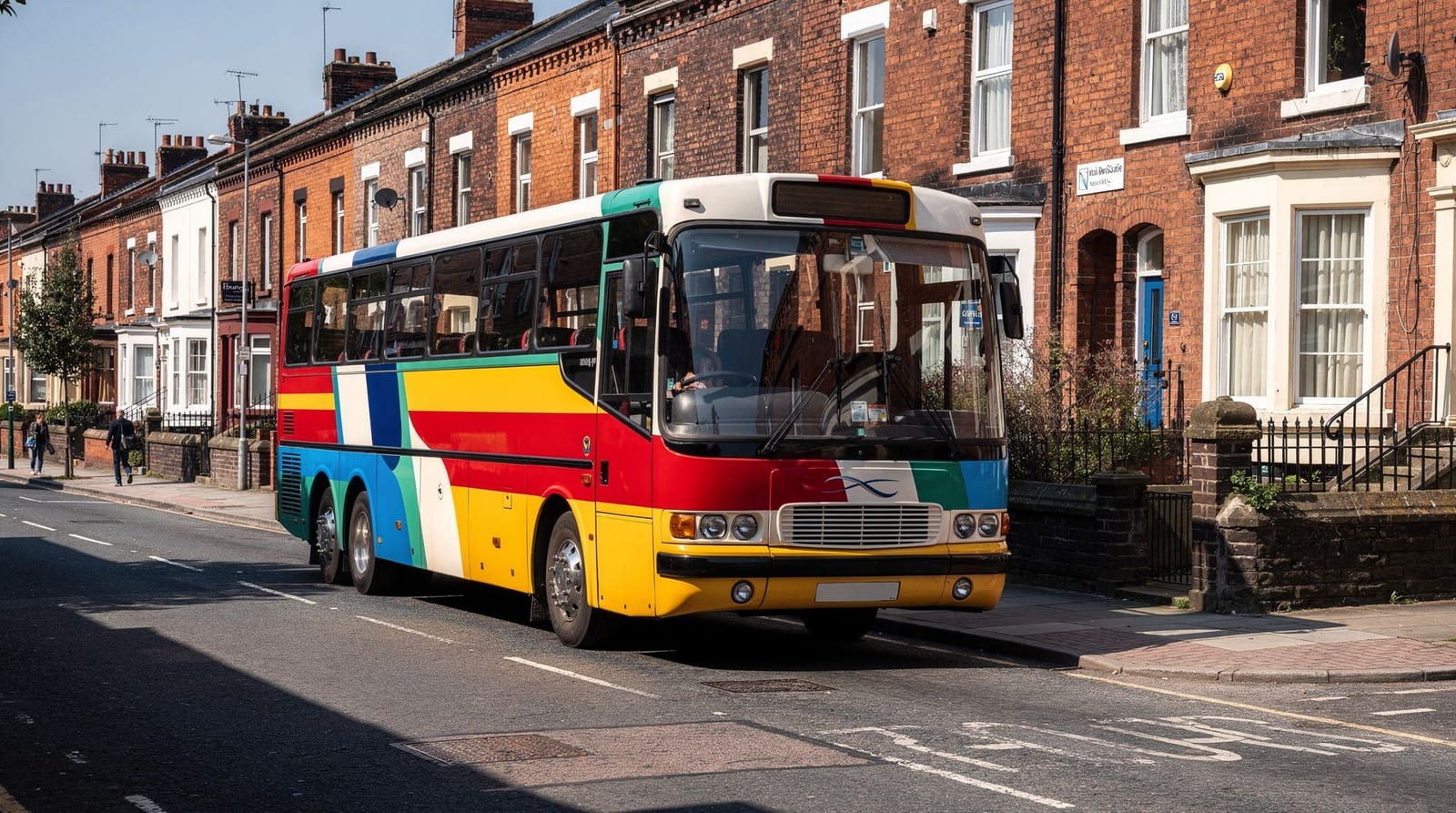
For visitors who can’t align their schedule with the National Trust’s fixed departure times, or who want a more flexible, personalised pace, the Mad Day Out private Beatles taxi tour and similar driver-guide options cover many of the same childhood-era locations from outside, with a driver providing commentary at each stop, though without the interior access to Mendips and Forthlin Road that only the National Trust tour provides.
The Beatles walking tour with radio tower and Beatles Story visit is another way to combine broader Beatles context with a museum visit if the National Trust tour’s timing doesn’t work for your trip.
Mendips and Forthlin Road are National Trust properties in ordinary suburbs, and the streets around them hold nothing else worth a stop: a private Beatles city taxi tour covers the outer addresses that the Trust shuttle leaves out.
Why the interior access matters
It’s worth being clear about the distinction: taxi and walking tours can drive or walk past both childhood homes and describe their significance from the street, which is a reasonable option if the National Trust tour is fully booked or doesn’t fit your schedule, but only the official National Trust tour provides access inside the actual rooms.
For visitors whose main interest in Liverpool is specifically the Beatles’ formative years rather than their global fame, that interior access is the difference between a genuinely memorable, intimate experience and a more distant, exterior-only view — worth planning around if it’s a priority for your trip, even if it means restructuring the rest of your Liverpool day to fit the tour’s fixed schedule.
Respecting the residential setting
Both Mendips and 20 Forthlin Road sit on ordinary residential streets with neighbours who live there year-round, and the National Trust is notably careful about managing visitor behaviour accordingly — no loud groups lingering outside either property outside of the scheduled tour, no photography of neighbouring homes, and guides actively manage the group’s presence to minimise disruption to residents. This isn’t unique to the Beatles homes; it’s standard practice for National Trust properties embedded in residential areas, but it’s worth visitors being aware of and respecting, both out of basic courtesy and because the ongoing goodwill of local residents is part of what keeps this level of access available to the public at all.
Booking tips and best time to visit
Book several weeks ahead if your visit falls in summer or school holidays, when demand is highest and tours sell out fastest; outside peak season, booking a week or two ahead is usually sufficient. The tour runs regardless of weather since most of the visit is indoors, making it a reasonably good wet-weather option for a Liverpool day, though the minibus transfer between the two properties and pickup point involves some brief outdoor waiting. Comfortable, unhurried expectations help — this is a slower, more reflective tour than the faster-paced Magical Mystery Tour bus or a typical city walking tour, and rewards visitors willing to listen to the guide’s context rather than rushing through.
The story of how the National Trust acquired the properties
Mendips came into National Trust care in 2002, following a donation by Yoko Ono, John Lennon’s widow, who purchased the house specifically to ensure its preservation rather than risk it passing into private hands with no guarantee of protection or public access. 20 Forthlin Road had already been acquired by the Trust some years earlier, in 1995, after Paul McCartney’s own involvement in securing the property’s future, making it the first of the two houses to enter public stewardship.
Both acquisitions reflect a broader recognition, shared by surviving band members and their families, that these unremarkable-looking suburban houses held genuine cultural significance worth formally protecting rather than leaving to the ordinary risks of the private property market — a decision that, decades later, gives visitors access most other musicians’ childhood homes never offer.
What surprises most visitors
Most first-time visitors come away struck by how genuinely modest both houses are — neither is large, architecturally distinctive, or obviously connected to global fame from the outside, and it’s precisely that ordinariness that guides lean into throughout the tour. Mendips, despite being a semi-detached suburban house rather than a mansion, was actually considered a reasonably comfortable, middle-class home for its era compared with 20 Forthlin Road’s more modest council housing, a class distinction between Lennon’s and McCartney’s upbringings that guides sometimes touch on as relevant context for the two songwriters’ later creative partnership and occasional friction.
Visitors expecting a grand, museum-like presentation are often pleasantly surprised by how lived-in and human-scale both properties feel by comparison, reinforcing the guide’s central point: extraordinary creative output emerged from thoroughly ordinary domestic surroundings, not from any obvious external sign of future greatness.
How this tour compares to the alternatives
If the National Trust’s fixed schedule genuinely doesn’t work for your trip, it’s worth knowing exactly what you gain and lose by choosing an alternative instead.
| Option | Interior access | Flexibility | Best for |
|---|---|---|---|
| National Trust guided tour | Yes, inside both houses | Fixed departure times, book ahead | Genuine fans prioritising the full experience |
| Mad Day Out taxi tour | No, exterior only | Flexible, private | Visitors short on time or with a tight schedule |
| Walking tour with Beatles Story | No, exterior only | Fixed but broader context | Combining a museum visit with street-level history |
None of the alternatives are a downgrade exactly — they simply trade interior access for flexibility, which suits visitors whose main interest is broader Beatles history rather than the specific experience of standing inside Lennon’s boyhood bedroom or McCartney’s front room.
Weather, seasons and photography
Because most of the visit takes place indoors, the tour runs reliably regardless of weather, making it one of the more dependable wet-weather options for a Liverpool day. Photography inside both houses is generally restricted or limited to specific areas, in keeping with the National Trust’s approach to preserving the properties’ original condition and respecting them as historic interiors rather than photo backdrops — check the current policy when booking if photography matters to you, since guides do explain what’s permitted at the start of the tour. Exterior photography of the houses themselves is more freely permitted, though guides ask visitors to be mindful of neighbouring properties and residents when doing so.
Combining with a longer Beatles day
Visitors who do want to fit the childhood homes tour alongside other Beatles sites in a single day from Chester should plan around the tour’s fixed timing first, then build the rest of the day around it rather than the other way round — the Beatles Story museum, being self-paced with no fixed entry slot, is the easiest site to shift earlier or later depending on when the childhood homes tour departs. See our Beatles Liverpool guide for how all four major sites fit together across a single day or a more relaxed two-day stay.
Frequently asked questions about Beatles childhood homes guide
Can you walk up to Mendips or 20 Forthlin Road without a tour?
No. Both remain quiet, occupied residential streets, and the National Trust only permits access via its timed, guided minibus tour booked in advance. There's no independent walk-up viewing of the interiors, and lingering outside either property outside a scheduled tour isn't appropriate given the neighbours living nearby.How far ahead should I book the childhood homes tour?
Several weeks ahead for a summer or school-holiday visit, since group sizes are kept deliberately small and popular dates sell out. Outside peak season, a week or two ahead is usually enough, but booking as soon as your Liverpool dates are fixed removes the risk entirely.
Top experiences
Bookable activities with verified prices and instant confirmation on GetYourGuide.