Chester: Roman walls, the Rows and a walkable city break
Chester travel guide: the 2-mile Roman wall walk, the Rows, Chester Zoo and honest advice on where to eat, stay and take day trips by train.
Chester: The Heart of Chester Walking Tour
Duration: 1.5 hours
Quick facts
- County
- Cheshire, North West England
- Nearest airport
- Liverpool John Lennon (35 min drive) or Manchester (45 min)
- Train hub
- Chester station — direct lines to Liverpool, Manchester, Llandudno, Cardiff
- Population
- ~80,000 (city proper)
- Currency
- GBP (£) — most prices below shown with a rough € equivalent
- Best base for
- Day trips into North Wales, Liverpool and the Lake District without a car
Quick answer: Chester is a walled Roman-founded city in Cheshire, England, built around a complete 2-mile circuit of city walls and the Rows — covered, two-level medieval shopping galleries unique to the city. Most visitors need 1-2 days for Chester itself (walls, cathedral, the Rows, a Dee cruise) plus Chester Zoo, and it works well as a 2-3 night base for train day trips to Liverpool (about 45 minutes), Manchester (about an hour) and the North Wales coast (Llandudno in roughly 1h07).
| Where | Cheshire, North West England, on the River Dee |
| Cost | Free walls and Rows; Chester Zoo around £33 adult |
| Time needed | 1-2 days for the city; 2-3 nights as a day-trip base |
| Getting there | Direct trains from Liverpool (~45min), Manchester (~1hr), Llandudno (~1h07) |
| Best time | May-September; avoid driving in on Chester Races days |
A Roman fortress that never stopped being a city
Chester was founded around AD 79 as Deva Victrix, a legionary fortress for the Roman XX Valeria Victrix legion, and it’s one of the only English cities where you can walk an essentially unbroken circuit of the defensive walls — about 2 miles, mixing Roman masonry at the base with medieval and Georgian additions on top. Unlike York, where the walls are the main event, Chester layers Roman, Norman, Tudor and Georgian history on the same footprint, which is what makes an afternoon here feel denser than the city’s modest size suggests.
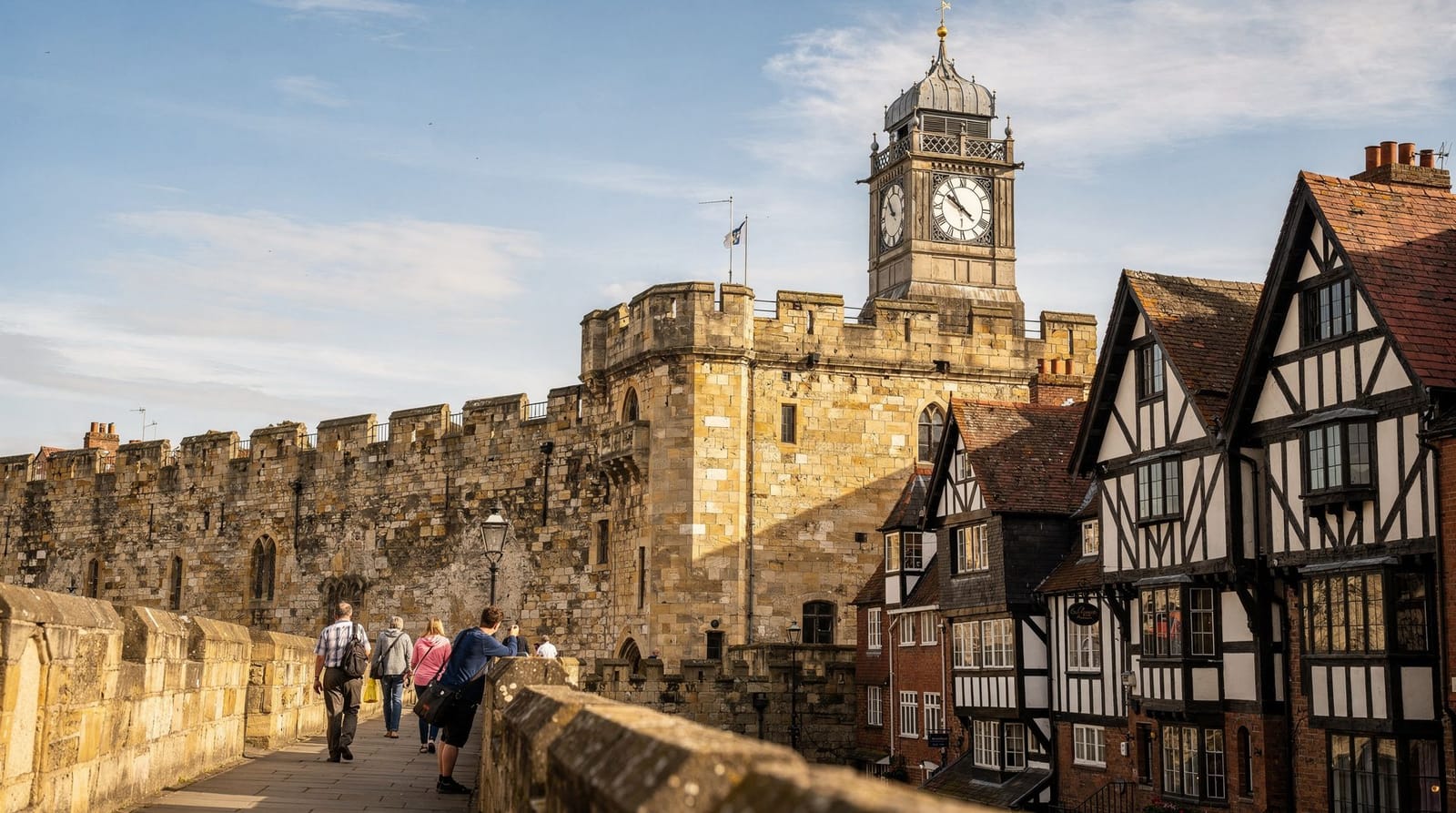
The best free orientation in the city is simply to walk the full wall loop, which takes 1.5-2 hours at a browsing pace and passes the Eastgate Clock (added in 1899 for Queen Victoria’s diamond jubilee, and — per the city’s own claim — the second-most photographed clock in England after Big Ben), the Roman Garden near Newgate, and views down onto the River Dee at the Groves.
For a deeper Roman layer, the Roman Amphitheatre (free, English Heritage) near the cathedral is the largest known amphitheatre in Britain, though only about 40% has been excavated — the rest sits under a school and convent garden, which is a good example of the honest caveats worth knowing before you go (see Chester Roman Amphitheatre for the full picture).
If you’d rather have a guide connect the Roman fort to the medieval city in one go, a walking tour does that legwork for you:
The Heart of Chester walking tour is a 1.5-hour guided loop covering the walls, cathedral quarter and the Rows, useful on a first visit when you want context rather than just photos.
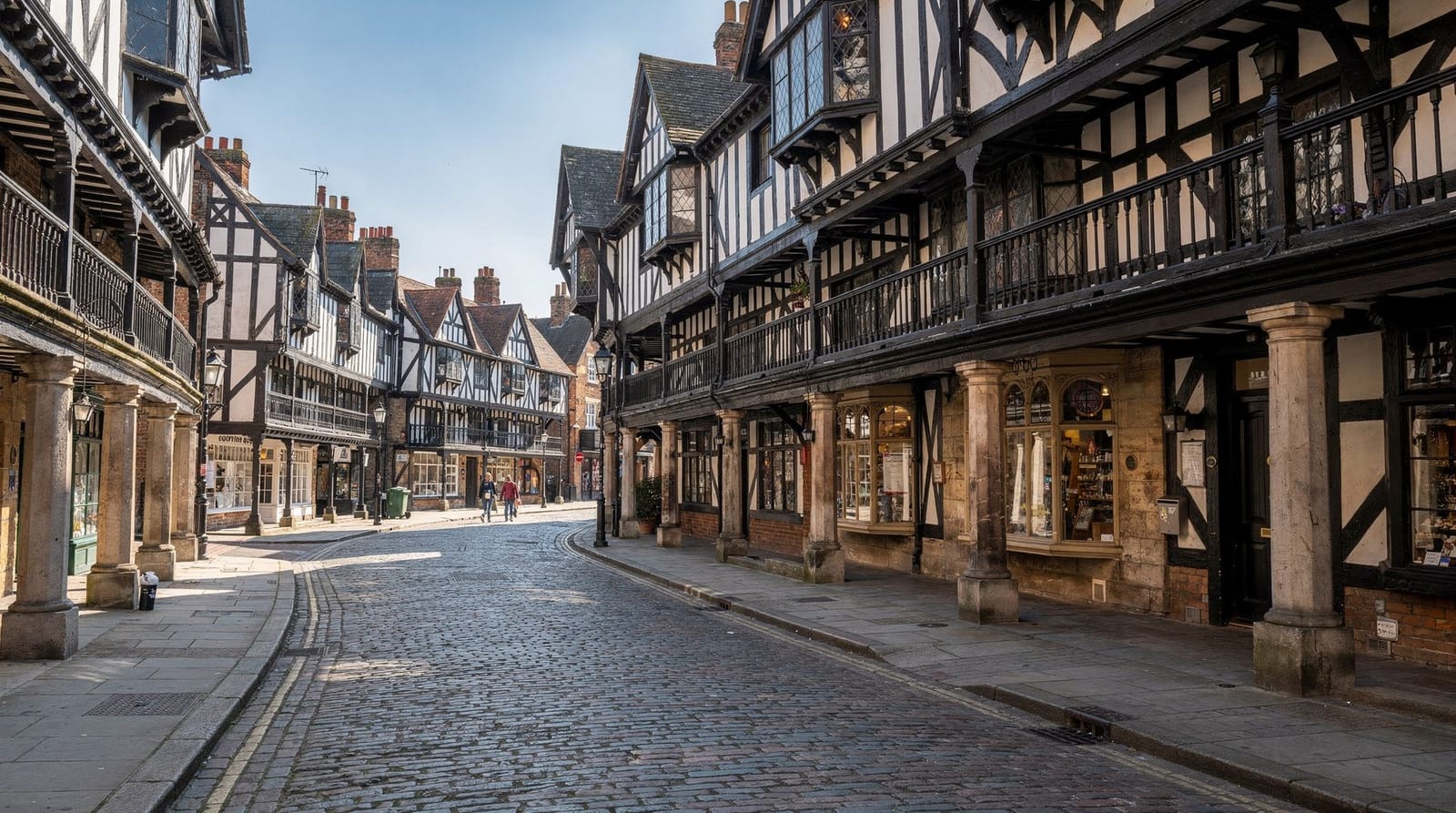
The Rows: Britain’s only double-decker medieval shopping streets
Chester’s signature architectural quirk is the Rows — covered walkways one level above street level, running along Eastgate, Bridge Street, Watergate and Northgate, dating from around the 13th century though heavily restored (some would say over-restored) in the Victorian “black-and-white revival” style. Walking the Rows is free and takes 30-45 minutes if you actually browse; the ground-floor shops and first-floor gallery shops are genuinely different retailers, so it’s worth going up as well as along.
See The Rows Chester for a street-by-street breakdown of which sections are original medieval fabric versus 19th-century pastiche — an honest planner’s note: several of the most photogenic black-and-white facades on Eastgate Row are Victorian, not medieval, despite what some walking tour scripts imply.
Chester Cathedral, a former Benedictine abbey that became a cathedral at the Reformation in 1541, charges around £9 (~€10.50) for adults and is worth the fee mainly for the medieval choir stalls’ carved misericords and the cloister garden — skip it if you’re only doing a half-day and short on time, and spend that time on the free wall walk instead.
A city that outlasted the legion: a short history
Chester’s Roman origins are the headline, but the layers on top of Deva Victrix are what make the city feel lived-in rather than preserved-in-amber. The Normans built a castle here after 1070 (Chester Castle’s Agricola Tower survives; most of the rest was rebuilt in the 18th and 19th centuries as courts and a barracks). The city held out for royalist forces in a lengthy siege during the English Civil War in 1645-46, which is why several buildings still bear cannonball damage — a plaque on the walls near Phoenix Tower marks the spot where Charles I reportedly watched his forces defeated at the Battle of Rowton Heath.
The Georgian era brought the elegant terraces around Abbey Square and the racecourse’s formalisation, and the Victorians, rather than tearing the medieval fabric down, doubled down on a self-consciously “olde English” black-and-white aesthetic that still defines the city’s postcard image — genuine medieval timber-framing exists, but plenty of what looks Tudor on Eastgate and Bridge Street was built or heavily re-fronted between 1850 and 1910. None of this makes Chester less worth visiting; it just means “medieval” and “Victorian pastiche of medieval” are both on display, often on the same street, and it’s worth knowing which is which rather than assuming every black-and-white gable is 500 years old.
Chester Races and the Roodee
The Roodee, Chester’s racecourse on the banks of the Dee just outside the walls, is recognised as the oldest racecourse still in use in England, with race meetings recorded since 1539 — it’s also unusually central for a British racecourse, sitting a five-minute walk from the cathedral rather than out in the suburbs. The May Meeting (built around the Chester Cup and Chester Vase, a recognised Epsom Derby trial) is the highlight of the calendar, with further meetings in July and September.
Race days bring a genuinely different atmosphere to the city — a lot of visible dressing-up, packed pubs from early afternoon, and noticeably worse traffic and parking, which is the honest reason this guide repeatedly flags race days as a scheduling consideration rather than a bonus event to build a visit around, unless racing itself is the point of your trip.
Chester Zoo: the UK’s most-visited zoo, and worth the trip
Chester Zoo sits about 2 miles north of the city centre (bus or a 10-minute taxi) and is consistently the UK’s most-visited zoo by paying visitor numbers, spread across 125 acres with a strong conservation focus — it funds field projects on orangutans, black rhinos and UK native species. Admission runs around £33 (~€38) for adults if bought on the gate, cheaper booked ahead:
Chester Zoo entry ticket — book in advance rather than queueing at the gate, especially on school-holiday weekends when the car park fills by mid-morning.
Budget a full day if you want to see the whole site properly; half a day covers the main enclosures (elephants, Islands habitat, Monsoon Forest) but you’ll be rushing. Full guide at Chester Zoo Guide, with a shorter family-focused version at Chester with Kids.
A slower way to see the city: the River Dee
The River Dee curls around the south and east of the city walls, and the Groves — a Victorian promenade — is the departure point for short sightseeing cruises. A half-hour loop is a genuinely relaxing way to see the city from the water and get a different angle on the walls and Old Dee Bridge:
Half-hour River Dee city cruise runs frequently in summer (less so November-February — check ahead in winter). Full detail on cruise operators and seasonal timetables at River Dee Cruises.
Rowing boat and pedalo hire is available on the same stretch in summer if you’d rather do it yourself, and it’s one of the cheaper ways to spend an hour with kids.
Where to eat honestly
Chester’s dining is solid pub-and-bistro territory rather than a food-tourism destination in its own right. Independent options worth seeking out over the chain restaurants that dominate the Rows: the food scene skews toward good gastropubs on the edge of the centre rather than the tourist-facing spots directly on Eastgate and Bridge Street, which charge a premium for the location rather than the cooking.
The Bear & Billet on Lower Bridge Street is a genuinely old timber-framed pub (1664) rather than a themed reproduction, and Chester Market, redeveloped into a food hall in recent years, is a reasonable lower-cost option for a varied lunch without committing to one restaurant. A full, honestly-rated rundown — including which “historic” pubs are genuinely centuries old and which have just been dressed up to look that way — is at Chester Restaurants and Chester Pubs. Expect £15-25 (~€17-29) for a main course at a mid-range pub, more in the tourist core.
Where to stay
Staying inside or just outside the walls means everything in this guide is walkable; staying further out (near the racecourse or train station) trades a 10-15 minute walk for lower prices. Hoole, a suburb a short walk or bus ride north-east of the centre, has developed a genuinely good independent restaurant strip in recent years and tends to offer better value accommodation than the walled centre itself, at the cost of a 15-20 minute walk into town. Mid-range hotel rates run roughly £90-150 (~€105-175) a night depending on season — higher on Chester Races weekends in May, July and September, when rooms sell out well in advance. Full area-by-area breakdown at Where to Stay Chester.
Chester as a day-trip base — this is the real argument for staying longer
Chester’s train station is the reason many visitors extend their stay from one night to three: it sits on lines that reach Liverpool Lime Street in about 45 minutes (often with one change, sometimes direct), Manchester Piccadilly in about an hour, and Llandudno on the North Wales coast in roughly 1h07 direct for around £10 (~€11.50) each way. That last one matters because it opens up the whole of North Wales — castles, Snowdonia, Portmeirion — without renting a car.
Full-day guided North Wales tour from Chester is the easiest way to see Conwy Castle, Caernarfon and Snowdonia’s fringes in one day if you don’t want to plan your own train-and-bus route; see Chester to North Wales and North Wales for the DIY version.
For the football-and-film crowd, Wrexham is a genuinely quick 15-20 minute direct train from Chester — close enough that Wrexham AFC’s Racecourse Ground, the world’s oldest international football stadium still in use, makes a viable half-day add-on since the Ryan Reynolds and Rob McElhenney ownership era turned the club into a minor global story. See Wrexham and Wrexham Afc.
Other realistic day trips: Liverpool for the Beatles and two rival football clubs (Liverpool, Chester to Liverpool), Manchester for football and museums (Manchester, Chester to Manchester), and the Lake District for a longer, more ambitious day out that needs an early start (Lake District, Chester to Lake District).
A full comparison of which day trips suit which travel style is at Best Day Trips by Train, and train-specific planning at Chester Trains Day Trips.
Tourist traps and honest cautions
Parking in Chester’s centre is expensive and the multi-storeys fill quickly on weekends and race days — the Park & Ride sites on the ring road (Wrexham Road, Boughton Heath, Sealand Road) are cheaper and usually faster than circling for a space; see Park and Ride Chester and Parking in Chester.
Some of the ghost-walk operators along the Rows recycle the same three “haunted” stories with more theatrical delivery than actual local history — fine as evening entertainment, just don’t expect a history lesson (a genuinely researched option is covered at Chester Ghost Tours). And several souvenir shops directly under the Rows charge tourist-trap prices for items available cheaper a five-minute walk from the historic core.
Practical planning notes
Chester station sits about a 15-20 minute walk (or a short bus ride) from the city centre, on the opposite side to most hotels and the historic core, which catches some first-time visitors out when they picture a compact walled city with the station inside it. Most of the headline sights — walls, cathedral, the Rows, the amphitheatre — are genuinely accessible for visitors with mobility considerations at street level, though several wall sections involve narrow stone steps up onto the parapet, and some of the Rows’ upper galleries have uneven, centuries-old flooring rather than a flat modern surface.
For photography, the best free vantage points are the Eastgate Clock itself (from the wall either side, not just street level), the view of the cathedral from Abbey Green, and the Dee Bridge looking back at the Groves promenade in late afternoon light. Most attractions keep standard hours (roughly 9am/10am-5pm) with Chester Zoo often opening earlier and closing later in peak summer — always check specific opening times before a visit outside the core April-October season, since several sites reduce hours or close specific areas in winter.
A realistic first-day plan
For a single full day, a sensible order runs: start with the wall walk from the Eastgate Clock (an hour or so, either direction), drop down into the Rows for browsing and a coffee, cross to the cathedral if it’s included in your plans, then finish at the Groves for a Dee cruise or a riverside walk before dinner. Trying to fit Chester Zoo into the same day as the walls and Rows is the single most common overreach in first-day planning — the zoo alone is a half-day-to-full-day commitment, and squeezing it in after a morning of walking usually means rushing both.
Chester through the seasons
| Season | Conditions | What’s on |
|---|---|---|
| Spring (Mar-May) | Mild, gardens and river coming alive | Cruise season starts; fewer crowds than summer |
| Summer (Jun-Aug) | Warmest, busiest | Chester Races (May/Jul), longest zoo hours, book hotels early |
| Autumn (Sep-Nov) | Cooling, quieter | September Chester Races meeting; good balance of weather and crowds |
| Winter (Dec-Feb) | Cold, short days | December Christmas market; cruises largely paused Nov-Feb |
Chester versus a car-based North Wales trip
Visitors weighing whether to hire a car for their whole Chester stay or rely on the train network should know the honest trade-off: Chester’s rail links reach Liverpool, Manchester, Wrexham and the North Wales coast (Llandudno, Conwy) comfortably without a car, but interior Snowdonia — Betws-y-Coed, Beddgelert, the less-served trailheads — opens up considerably more with your own transport. A car-free week built around Chester’s train links covers a genuinely wide range of day trips; a car adds flexibility specifically for the rural North Wales and Cheshire countryside stops that public transport reaches poorly.
First-timer mistakes worth avoiding
The most common misstep is picturing Chester as small enough that the train station sits inside the walled core — it doesn’t, and the 15-20 minute walk (or short bus ride) from the station catches out visitors who’ve pictured a tighter city than Chester actually is.
The second is assuming every black-and-white timber building on Eastgate and Bridge Street is genuinely medieval; plenty is Victorian re-fronting, and treating the whole streetscape as 700 years old rather than a mix of eras is a small but real misreading of what you’re looking at. The third is driving into the centre on a Chester Races day without checking the calendar first — traffic and parking get noticeably worse, and the Park & Ride becomes the sensible option even for people who’d normally drive straight in.
Suggested itineraries
If you’re planning the trip properly rather than winging it, 1 Day Chester covers a tight single day, 2 Days Chester adds the zoo and a slower pace, and Chester 3 Day Weekend builds in one North Wales or Liverpool day trip. For a longer regional trip that treats Chester as the hub for the whole area, see North West England 5 Days.
Frequently asked questions about Chester
How many days do you need in Chester?
One full day covers the walls, the Rows and the cathedral at a comfortable pace. Two days lets you add Chester Zoo or a River Dee cruise without rushing. Three days or more makes sense if you’re using Chester as a base for day trips to Liverpool, Manchester or North Wales.
Is Chester worth visiting if I’ve already done York?
Chester and York overlap on “walled Roman-to-medieval English city,” but Chester’s Rows are architecturally unique in Britain and its rail links make it a stronger day-trip base for North Wales and Liverpool. See the direct comparison at Chester vs York.
Can you walk the full Chester city walls?
Yes — the roughly 2-mile circuit is walkable in full and free, taking 1.5-2 hours at a relaxed pace with stops. A short closure occasionally applies near Newgate for maintenance; check on arrival if you want the complete loop.
Is Chester Zoo worth the entry price?
For a full day with children, yes — it’s the UK’s most-visited zoo and one of the larger sites in Europe by area, so a rushed half-visit undersells it. If you only have 2-3 hours, the entry fee (£33 / ~€38) is harder to justify against other options.
How do you get from Chester to Liverpool without a car?
Direct or one-change train services run roughly hourly from Chester station to Liverpool Lime Street, taking about 45 minutes. See Chester to Liverpool and Chester Trains Day Trips for timetable patterns and off-peak fares.
Is Chester a good base for visiting North Wales?
Yes — Chester’s direct line to Llandudno (about 1h07, roughly £10 each way) and its position on the edge of the region make it one of the most practical English bases for reaching Conwy, Caernarfon, Snowdonia and Portmeirion without hiring a car for the whole trip, though a car does open up more of interior Snowdonia in a single day.
When is the worst time to drive into central Chester?
On Chester Races days at the Roodee racecourse (meetings in May, July and September) — traffic and parking in the centre get significantly worse, and the Park & Ride becomes the sensible option even for people who’d normally drive in.
Is Chester expensive compared to other UK city breaks?
It’s mid-range: hotel rates (£90-150/night) and pub meals (£15-25) sit above regional cities like Liverpool but below London. Chester Zoo and the North Wales day tours are the largest single costs most visitors budget for. See Chester Travel Budget for a fuller breakdown.
Is the Chester train station within walking distance of the walls?
Yes, but it’s a genuine 15-20 minute walk, not a five-minute stroll — a short bus ride is a reasonable alternative if you’re carrying luggage. First-time visitors picturing a tighter city than Chester actually is are the ones most often caught out by this.
Are the Chester Rows genuinely medieval?
Partly. The Rows’ basic structure — covered walkways one level above street level — dates from around the 13th century, but many of the black-and-white facades, especially on Eastgate Row, are Victorian re-fronting from the 19th-century “black-and-white revival” rather than original medieval fabric. See The Rows Chester for a street-by-street breakdown.
Top experiences
Bookable activities with verified prices and instant confirmation on GetYourGuide.