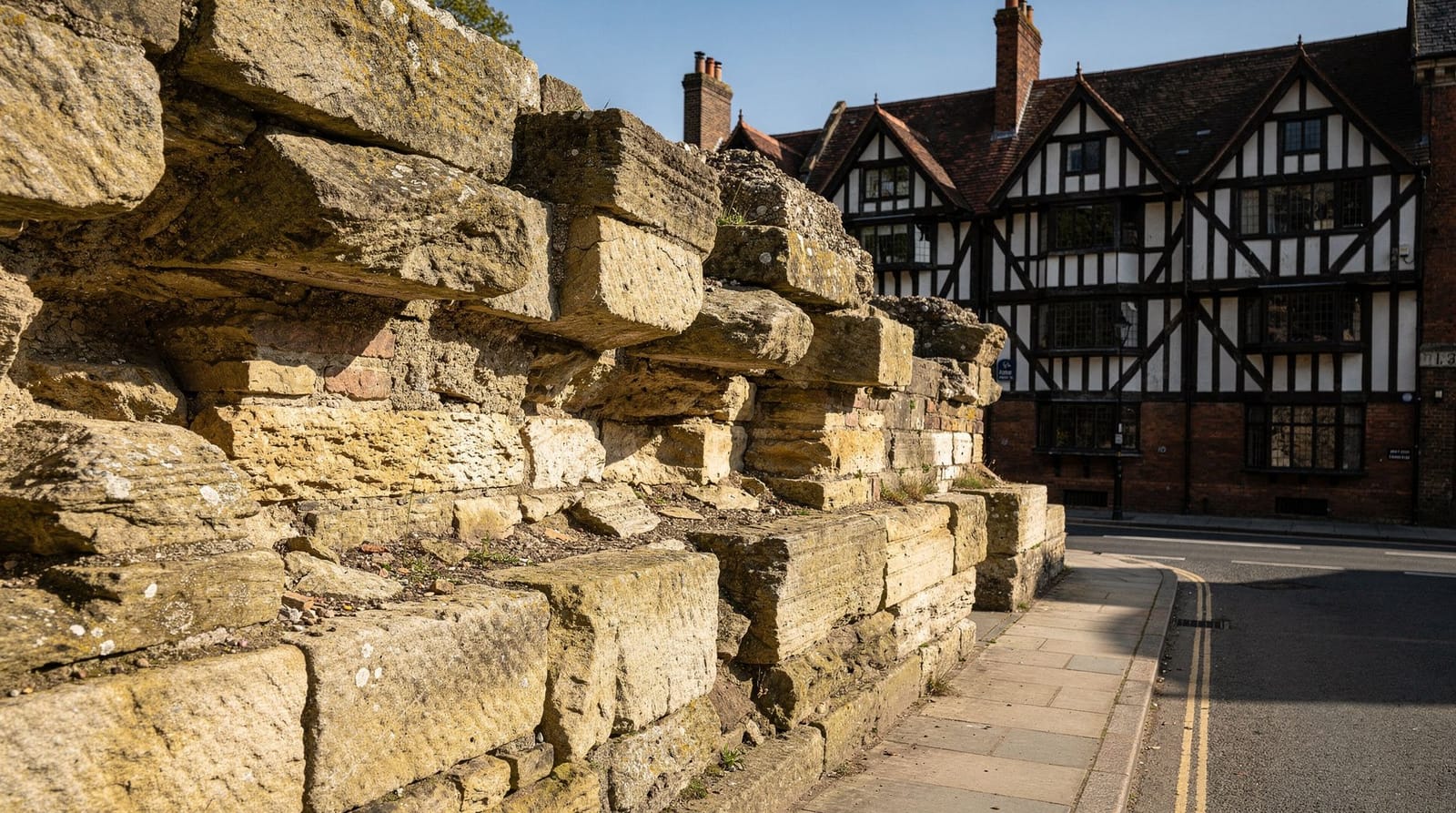
Chester Roman amphitheatre — Britain's largest, half-buried arena
Chester: Deva Roman Experience
Is the Chester Roman amphitheatre free to visit?
Yes. It's an English Heritage site with no admission charge and no set opening hours — the excavated northern half sits in the open air beside the city walls, a two-minute walk from Chester Cathedral, and can be viewed at any time.
The largest arena the Romans built in Britain
Chester’s amphitheatre is the biggest of its kind found anywhere in Roman Britain — bigger than the better-known examples at Caerleon in South Wales or Cirencester — and it sat right outside the southeast corner of the legionary fortress of Deva Victrix, a short walk from where Chester Cathedral now stands. At its full extent it could hold somewhere in the region of 8,000 to 10,000 spectators, roughly comparable to the entire population of the fortress and its surrounding settlement, which tells you how central it was to garrison life rather than an occasional-use luxury.
| Where | Vicars Lane, southeast corner of the city walls |
| Cost | Free, no ticket needed |
| Time needed | 15-20 minutes |
| Getting there | 5-minute walk from Eastgate |
| Facilities | None on-site — nearest toilets/café near the Cathedral |
It isn’t a ruin you’d mistake for the Colosseum. What’s visible today is a stone-lined oval depression, roughly at ground level, with the lower stone walls of the arena and the entrance passages traceable but no upper seating tiers surviving above ground. That’s a deliberate contrast worth setting expectations around before you visit: this is an archaeological site for understanding scale and layout, not a dramatic standing monument like Conwy Castle or the other North Wales castles covered elsewhere on this site.
Discovery and why only half is excavated
The amphitheatre was rediscovered in 1929 during building work and has been excavated in phases ever since, most substantially during major digs in the 1960s and again between 2000 and 2006 as part of the Chester Amphitheatre Project, a joint effort between English Heritage and Chester City Council. Those later excavations recovered the clearest evidence yet of the building’s construction phases — an earlier, smaller wooden-and-earth arena from the first Roman occupation phase (around AD 70s), rebuilt in stone in a larger form in the early 2nd century, likely under Emperor Hadrian’s reign, when the legionary garrison at Chester was at its most established.
Only the northern half of the amphitheatre has ever been excavated and is visible today. The southern half lies beneath Dee House, a Georgian-era grade II listed building and its associated grounds, immediately south of the exposed section. Successive plans to remove or excavate under Dee House have stalled for decades over cost, listed-building protections and land ownership, and there’s no confirmed date for further excavation as of this guide’s last review. In practice this means you’re seeing roughly half of what was one of the largest Roman structures in Britain — worth knowing so you don’t spend time looking for a “missing” section assuming poor signage rather than an actual, long-running excavation gap.
What you can see today
The visible remains show the amphitheatre’s oval footprint clearly from ground level — low stone walls marking the arena wall itself, the position of the main entrances (the vomitoria, at the north and south ends of the long axis), and a small shrine base near one of the entrances, thought to have been used by gladiators or venue staff for offerings before contests, a detail that survives at few Roman amphitheatre sites anywhere in the empire. Information panels around the perimeter explain the construction phases and what gladiatorial and other events (animal-baiting, executions and military drill displays were all plausible uses here, alongside combat) likely looked like on this site specifically.
There’s no visitor centre, ticket office or dedicated staff on-site — it functions as an open, unstaffed heritage site maintained by English Heritage, similar in that respect to Flint Castle further along the North Wales coast. That means access is unrestricted at any time of day, but also that there’s nowhere on-site to buy tickets to anything else, get information beyond the panels, or find shelter if the Cheshire weather turns, which it regularly does.
What actually happened here
It’s easy to assume “Roman amphitheatre” automatically means gladiatorial combat to the death, but the reality at a provincial military site like Chester was more varied and, in some ways, more mundane.
Alongside occasional gladiatorial contests — likely a smaller, less lavish version of what happened in Rome itself, given Chester’s frontier location and military rather than purely civilian population — the amphitheatre almost certainly hosted animal-baiting displays, public executions of criminals and deserters as a deterrent to the garrison, and formal military drill and weapons training for troops, since an oval arena of this scale was also simply useful training infrastructure for a legion that needed space to practise formation manoeuvres. Religious and civic ceremonies likely took place here too, given the small shrine base found near one entrance, suggesting the space carried ritual as well as entertainment functions.
This mixed-use picture is actually more historically accurate for most Roman amphitheatres outside the city of Rome itself, where the spectacle culture was less extreme and the buildings served military garrisons as much as urban populations. It’s a useful corrective to bring to the visit — the excavated remains you’re looking at supported a working military installation for around three centuries, not an occasional theatre of extreme violence.
Comparing Chester to Caerleon and the wider Roman world
Chester’s amphitheatre is often described as the largest known in Britain, edging out the amphitheatre at Caerleon in South Wales — itself well preserved and worth visiting if your trip extends that direction, attached to another of Roman Britain’s three permanent legionary fortresses (Isca). The two sites make an interesting comparison for anyone interested in Roman military architecture: Caerleon’s amphitheatre is more fully excavated and gives a clearer overall impression of scale despite being smaller, while Chester’s, though larger in its original footprint, is only half-visible, which paradoxically makes Caerleon’s the more visually satisfying visit for casual tourists even though Chester’s held more people.
Set against continental Roman amphitheatres — Nîmes or Arles in southern France, both far better preserved with standing seating tiers still intact — Chester’s remains are modest, and it’s worth calibrating expectations accordingly. What Chester offers that those better-preserved continental sites don’t is direct, walkable proximity to the fortress, walls and museum collection that give the fullest possible context for a single legionary garrison anywhere in the former empire — breadth of connected sites rather than a single spectacular standing ruin.
The stalled excavation, in more detail
The unexcavated southern half beneath Dee House has been a recurring point of local debate for decades. Dee House itself, a Georgian-era grade II listed building, has stood empty and increasingly dilapidated for years, and successive council and heritage body plans to demolish it, relocate its protected status, or fund a full excavation underneath have each stalled — sometimes over cost (a full excavation and conservation programme would run into many millions of pounds), sometimes over disagreements about whether removing a listed Georgian building to expose Roman remains is itself an acceptable heritage trade-off.
Local campaigners have periodically pushed for renewed government or National Lottery Heritage Fund investment to finally complete the excavation, but as of this guide’s last review there’s no confirmed timeline. If a full excavation ever proceeds, it would likely double the amphitheatre’s visible footprint and potentially reveal much more of the arena floor and lower seating structure — worth checking Chester City Council’s and English Heritage’s current announcements if this history particularly interests you, since it’s one of relatively few “live” archaeological questions in the city with a genuine possibility of new discoveries in coming years.
Visiting with children
The amphitheatre works well as a family stop precisely because it doesn’t require reading dense information panels to be interesting — children generally grasp the basic idea of “this was a Roman arena where thousands of people watched fights and shows” quickly, and the open, grassy, low-walled site is safe for children to walk around and even run in without the constraints of a fully enclosed museum setting.
Combining it with the Deva Roman Experience, with its costumed figures and hands-on elements, generally holds children’s attention better than the amphitheatre alone, and the two together make a solid half-day for families visiting Chester with kids — see our Chester with kids guide for how this fits alongside the city’s other family-friendly attractions.
Getting the most from a short visit
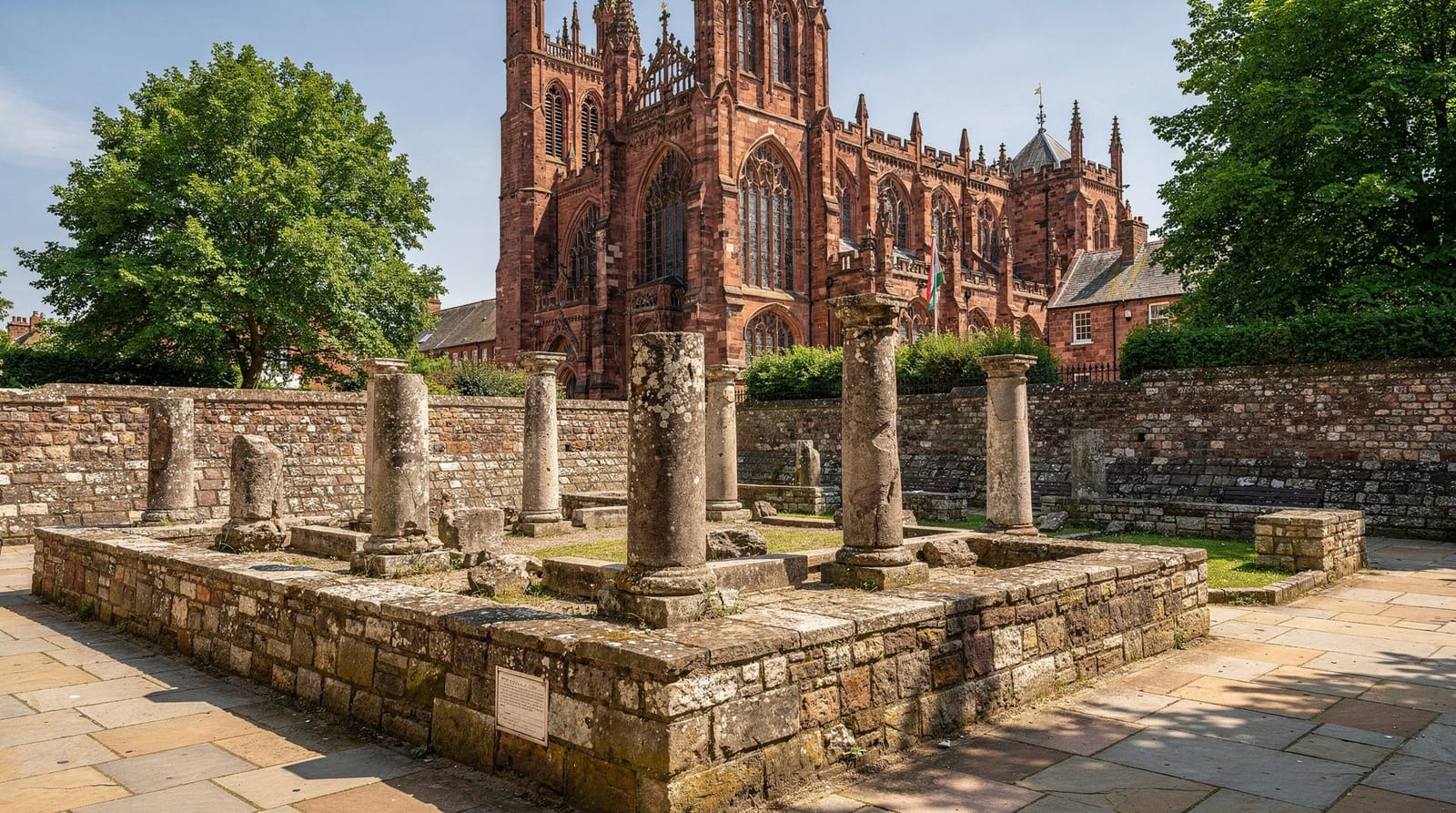
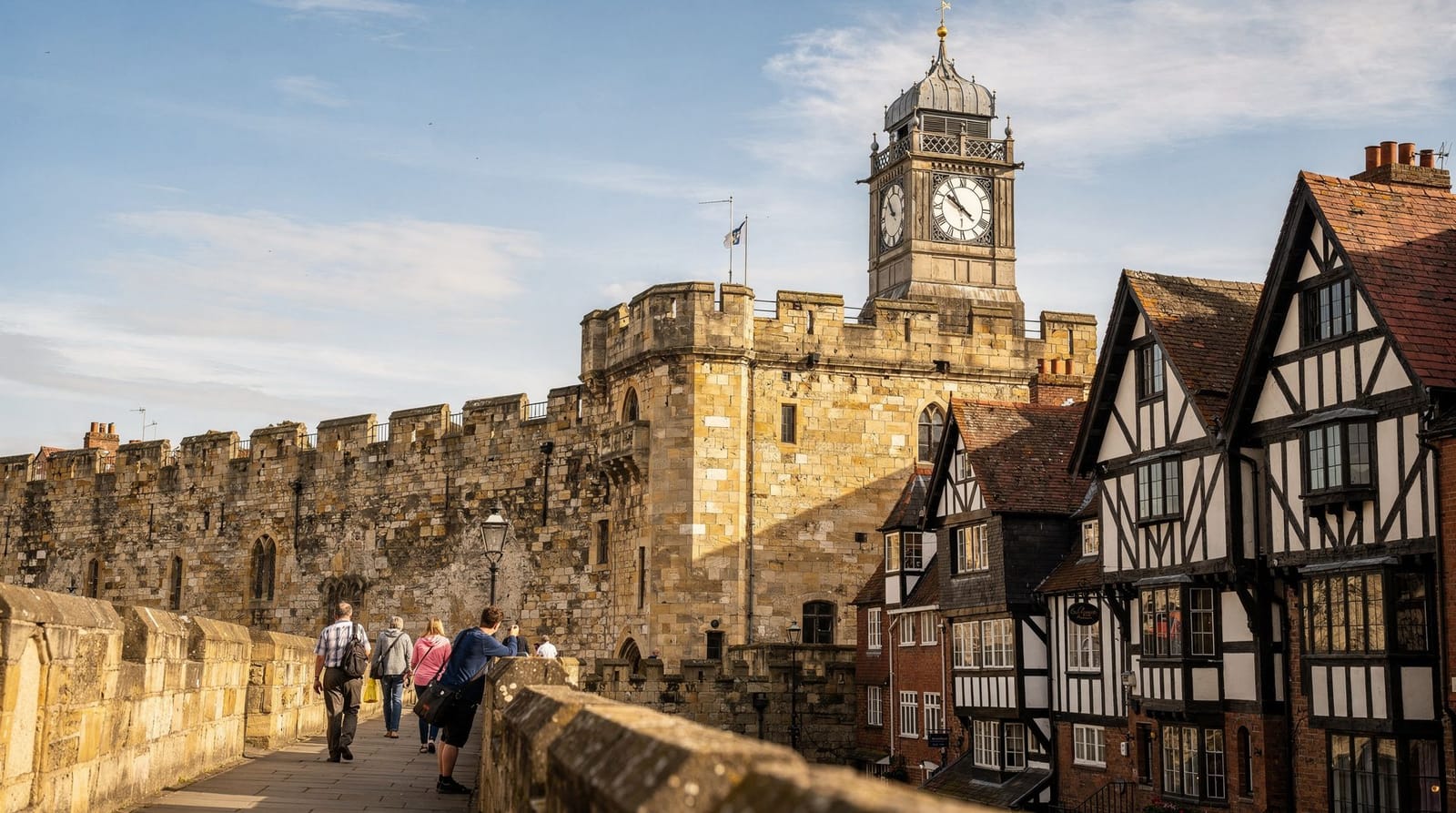
Fifteen to twenty minutes is enough to walk the perimeter, read the main panels and get a sense of the scale, making this an easy add-on to a longer walk around the Chester city walls, which run directly above and beside the site — the wall’s southeast stretch gives you an elevated view down into the amphitheatre that’s arguably more useful for grasping its size than walking around it at ground level. The Roman Gardens, a small landscaped area a couple of minutes further along the wall, display a scatter of genuine Roman architectural fragments — column bases, hypocaust tile stacks — recovered from elsewhere in the city and worth the extra five minutes.
To put real content into what’s otherwise a fairly abstract stone outline, visit before or after the Deva Roman Experience, an indoor exhibition a short walk away near the Rows that reconstructs Roman Chester with life-size dressed figures and a walk-through fortress street — it gives the amphitheatre’s bare foundations a much clearer sense of what actually happened on this ground for the roughly 300 years Deva Victrix was garrisoned.
Why the amphitheatre matters beyond Chester
Because it’s the largest known example of its type in Britain, Chester’s amphitheatre has a significance to the study of Roman military architecture that extends well beyond local interest — it’s regularly cited in academic and popular accounts of Roman Britain as evidence for how seriously Rome invested in permanent infrastructure at its most strategically important frontier bases, rather than treating British garrisons as a purely temporary or secondary commitment relative to more central parts of the empire.
Its scale, combined with the equally oversized fortress it served, supports the broader argument that Chester briefly held greater strategic and perhaps even administrative importance within Roman Britain than its later, more modest medieval and modern history might suggest on its own.
The amphitheatre in the story of Deva Victrix
The amphitheatre only makes full sense alongside the wider story of Deva Victrix, the fortress built for the 20th Legion (Legio XX Valeria Victrix) from around AD 74-79 and garrisoned, on and off, for roughly three centuries — one of only three permanent legionary fortresses in Roman Britain, alongside York (Eboracum) and Caerleon (Isca). A fortress of that size and permanence needed entertainment infrastructure to match, and the amphitheatre’s scale reflects Chester’s status as a major military and administrative centre rather than a minor frontier post.
The Grosvenor Museum, a ten-minute walk away, holds finds from the amphitheatre excavations alongside the wider collection of Roman tombstones and inscriptions recovered from across the city, including military diplomas and evidence of the specific units stationed here. Seeing the amphitheatre first, then the museum’s collection of objects actually excavated from it and the surrounding fortress, gives a more complete picture than either site does alone.
Best time of day and light for visiting
Because the amphitheatre is an open-air, at-ground-level site with no roof or shelter, the quality of a visit depends more on weather and light than at most of Chester’s other Roman sites. Overcast days actually work reasonably well for reading the low stone walls and information panels without harsh shadow, while a low morning or late-afternoon sun brings out the texture of the sandstone arena wall in a way flat midday light doesn’t. Given the site takes only 15-20 minutes, it’s easy to time a visit around a break in the weather rather than committing a whole afternoon and hoping the rain holds off — one of the more flexible stops on any Chester itinerary precisely because it demands so little time.
The Roman Gardens immediately alongside are worth the extra few minutes in decent weather, less so in poor weather since there’s no cover — a small landscaped strip along the wall displaying genuine Roman architectural fragments (column bases, part of a bathhouse hypocaust, altar stones) recovered from various sites around the city and arranged for public display since the mid-20th century. It’s a low-key, easily missed spot that rewards visitors specifically interested in Roman stonework beyond the amphitheatre and walls themselves.
Getting there and practical details
The amphitheatre sits just outside the city walls near the southeast corner, roughly a five-minute walk from Eastgate and immediately south of Chester Cathedral — look for Vicars Lane, which runs alongside it. There’s no dedicated car park; the nearest options are the pay-and-display and multi-storey car parks serving the city centre, covered in our Chester parking guide, though walking or using the Park & Ride service is the more sensible option given how central and walkable the old town is.
Because it’s an open, unstaffed site there’s no closing time to plan around, no ticket to book in advance, and no toilets or café on-site — the nearest facilities are back toward the city centre and cathedral precinct. Wheelchair and pushchair access to the viewing area is generally straightforward since it’s at street level with paved paths, though the excavated arena floor itself is roped off and viewed from above rather than entered.
Weather, seasons and what changes across the year
Because the site is entirely outdoors and unstaffed, there’s no seasonal opening or closing to plan around, but the experience does shift noticeably with the seasons. Summer brings the longest daylight hours and the driest underfoot conditions, useful given the arena floor viewing areas can turn muddy after sustained rain, particularly in the low-lying excavated section.
Winter visits are perfectly viable and often quieter, though shorter daylight means an afternoon visit can run close to dusk, and the exposed, unsheltered nature of the site makes it one of the less comfortable Chester attractions to visit in genuinely poor weather compared with the covered Rows or an indoor museum. If your Chester visit is weather-dependent and flexible, it’s worth treating the amphitheatre as an opportunistic stop for a dry spell rather than a fixed-time commitment.
Combining with the rest of Roman Chester
Because it’s free, unticketed and takes only 15-20 minutes, the amphitheatre works well slotted into almost any Chester day plan rather than needing its own dedicated visit. Our one-day Chester itinerary pairs it with the walls walk and the Rows for a single-day Roman-and-medieval overview, while the Chester history guide puts the amphitheatre into the fuller chronological sweep of the city’s history from Roman fortress through medieval market town to the present.
If you’re building a longer North West England trip, our 5-day North West England itinerary uses Chester’s Roman sites as a half-day anchor before moving on to Liverpool and Manchester.
For visitors whose real interest is Roman military history rather than the medieval overlay, this amphitheatre, Deva Victrix and the Grosvenor Museum’s tombstone collection form a compact half-day circuit that’s arguably underrated compared with Chester’s more famous Rows and cathedral — worth building in deliberately rather than treating as an afterthought on the way to somewhere else.
Accessibility in more detail
The amphitheatre’s viewing paths sit at street level and are paved and level, making the site straightforward for wheelchair users and pushchairs to reach and view the perimeter — a genuine advantage over some of Chester’s other historic sites, where uneven medieval stonework or the Rows’ stepped upper walkways can be genuinely difficult terrain. The arena floor itself is roped off and viewed from above rather than entered, so there’s no barrier of steps or uneven ground to negotiate to see the site’s main features. Benches are limited around the perimeter, so anyone needing to rest partway through should factor that into a longer combined walk with the city walls.
What visitors commonly misunderstand
The most common misconception is expecting a fully excavated, walk-into arena the way many visitors picture “Roman ruins” from television or continental sites like Nîmes. Chester’s is a half-excavated, viewed-from-above site with the arena floor roped off, not a walk-through attraction — worth knowing before you visit so you’re not disappointed by scale expectations set by more famous, better-preserved amphitheatres elsewhere. A second common misunderstanding is assuming the whole footprint is visible; as covered above, roughly half still lies unexcavated beneath Dee House, so what you’re seeing is genuinely a partial picture rather than a complete one obscured by poor presentation.
Photography and what makes a good shot
The elevated view from the city walls’ southeast stretch, looking down into the arena, is the single most useful vantage point for photographing the site’s oval shape and scale — ground-level shots struggle to convey the layout the way an overhead angle does. Low morning or late-afternoon light brings out the sandstone’s texture and colour more than flat midday sun, and an overcast day, while less dramatic, actually reads well for close-up shots of the information panels and stonework without harsh shadow.
Frequently asked questions about Chester
Do I need to book to visit the Chester Roman amphitheatre?
No. It’s a free, unstaffed English Heritage site with no ticket, booking or set opening hours — you can view it at any time of day.
Why is only half of the Chester amphitheatre excavated?
The southern half lies beneath Dee House, a Georgian grade II listed building. Plans to excavate underneath it have stalled for decades over cost and heritage protections, with no confirmed date for further excavation.
How does Chester’s amphitheatre compare to the one at Caerleon?
Chester’s is larger in its original footprint but only half-excavated and visible; Caerleon’s, in South Wales, is smaller but more fully excavated, which paradoxically makes it the more visually complete experience for a casual visitor even though Chester’s original arena held more people.
Top experiences
Bookable activities with verified prices and instant confirmation on GetYourGuide.