Deva Victrix — the Roman fortress that founded Chester
Chester: Deva Roman Experience
What was Deva Victrix?
Deva Victrix was the Roman legionary fortress built at Chester from around AD 74-79, garrisoned for roughly 300 years by the 20th Legion (Legio XX Valeria Victrix) and, initially, the 2nd Adiutrix Legion. It was one of only three permanent legionary bases in the whole Roman province of Britannia, alongside York (Eboracum) and Caerleon (Isca), which reflects Chester's exceptional strategic importance for controlling both Wales and the Irish Sea.
| Where | Chester’s walled city centre, Roman sites walkable from each other |
| Cost | Amphitheatre and walls free; Deva Roman Experience and museum have separate entry fees |
| Time needed | 2-3 hours for the core sites, half a day with the museum |
| Getting there | Everything sits inside or just outside the walls, no transport needed between sites |
| Best time | Weekday mornings, before day-trip and coach-tour crowds build up |
One of only three permanent legionary fortresses in Roman Britain
Chester exists in its current form because the Roman army decided, around AD 74-79, that this bend in the River Dee was worth garrisoning permanently with an entire legion — roughly 5,000-6,000 professional soldiers, plus the auxiliary troops, camp followers, traders and families who inevitably clustered around any long-term Roman base.
The fortress they built, Deva Victrix, is one of only three sites in the entire Roman province of Britannia that held a permanent legionary garrison for most of the Roman occupation, the other two being York (Eboracum, home to the 9th and later 6th Legions) and Caerleon in South Wales (Isca, home to the 2nd Augusta Legion). Everywhere else in Roman Britain, legions moved between temporary campaign bases; only these three locations were judged strategically important enough to warrant permanent, purpose-built fortress infrastructure.
Chester’s position explains why. It sits at the lowest crossing point of the River Dee, controlling access into North Wales — a region the Romans spent decades subduing, with periodic uprisings continuing long after initial conquest — while also giving direct access to the Irish Sea for naval operations and supply. A fortress here let Rome project military force into Wales, monitor the sea route toward Ireland, and support operations along the whole western frontier of Roman Britain, a strategic triple-purpose that neither York nor Caerleon quite matched on their own.
Building and garrisoning the fortress
Construction began under the 2nd Adiutrix Legion, newly raised and initially based in Chester before being redeployed elsewhere in the empire within a decade or two. From roughly the AD 90s onward, Deva Victrix became the permanent base of the 20th Legion (Legio XX Valeria Victrix — “Valiant and Victorious”), which remained here, with some interruptions, for the better part of two centuries. The name Deva comes from the Roman name for the River Dee, itself likely derived from an earlier Brittonic word associated with a river goddess — one of several places in Roman Britain where the fortress or town took its name directly from a pre-Roman sacred river name rather than inventing something new.
At its full extent the fortress covered around 60 acres, making it one of the largest legionary bases in the empire — genuinely larger than was strictly needed for a single legion’s barracks, storage and administrative buildings, which has led some historians to speculate Chester may briefly have been considered as a potential provincial capital or even a planning centre for a wider British campaign that never fully materialised. Whatever the exact reasoning, the unusually generous scale is one of the more interesting open questions in Romano-British archaeology.
Deva versus York and Caerleon, side by side
Because Chester is so often mentioned in the same breath as Britain’s other two permanent legionary fortresses, it helps to see the comparison laid out directly rather than piecing it together across separate sentences.
| Fortress | Legion | Modern visibility today |
|---|---|---|
| Deva (Chester) | 20th Legion (Valeria Victrix) | Largest visible amphitheatre in Britain; walls trace the original perimeter; little else above ground |
| Eboracum (York) | 9th, later 6th Legion | Multangular Tower and sections of wall survive; much lies beneath York Minster and the modern centre |
| Isca (Caerleon) | 2nd Augusta Legion | Best-preserved barracks and amphitheatre remains of the three, in a smaller modern town |
Chester’s advantage over the other two isn’t any single surviving structure — Caerleon’s barracks are arguably better preserved, and York’s Minster sits directly on Roman foundations — but the combination of a still-inhabited, walkable walled city built almost exactly on the fortress footprint, a genuinely dedicated museum collection, and a reconstructed visitor experience aimed at non-specialists. For a visitor with only one Roman-Britain stop on their itinerary, that combination is hard to match anywhere else in the country.
The 20th Legion — where it came from and what happened to it
Legio XX Valeria Victrix had a long history before it ever reached Chester, having taken part in the initial Roman invasion of Britain in AD 43 and served at various bases across the developing province, including a spell under the future emperor Vespasian’s command. Its title “Valeria Victrix” — roughly “valiant and victorious” — was reportedly earned for its role suppressing Boudica’s revolt in AD 60-61, one of the most serious uprisings the Roman occupation of Britain ever faced. By the time it settled permanently at Deva Victrix, probably in the AD 90s, it was among the most experienced units in the western empire.
The legion remained at Chester, with periods of detachment for campaigns elsewhere in Britain and occasionally the continent, for close to two centuries, likely being progressively run down in size and eventually withdrawn or absorbed into smaller frontier garrisons as the Roman military presence in Britain was restructured during the 3rd and 4th centuries — a broader pattern across the empire as static legionary fortresses gave way to smaller, more mobile frontier forces. The exact date the legion left Chester for good isn’t precisely documented, but by the time Roman administration in Britain formally ended in the early 5th century, the fortress had likely already been operating at reduced military strength for some decades.
Daily life inside the fortress
A permanent legionary fortress of this scale needed substantially more than barracks. Archaeological excavation over the past century has confirmed the presence of a large bath complex — one of the biggest found anywhere in Roman Britain — reflecting how central bathing culture was to Roman military and social life, alongside granaries built to store enough grain to supply thousands of soldiers through winter months when supply lines were less reliable, workshops for equipment repair and manufacture, and a principia (headquarters building) at the fortress’s administrative centre where the legion’s standards were kept and formal ceremonies conducted.
Soldiers serving a 25-year term (the standard length of legionary service) would have spent much of their adult working life within this fortress, and many, on discharge, settled locally rather than returning to their region of origin, marrying and raising families in the civilian settlement outside the walls — part of why Roman Chester’s population and culture became genuinely rooted rather than a purely transient garrison passing through.
The canabae — Chester’s first civilian town
Immediately outside the fortress walls, a civilian settlement known as the canabae developed to serve the garrison’s needs — traders, innkeepers, blacksmiths and other tradespeople supplying goods and services the legion itself didn’t produce internally, alongside the families of soldiers who, despite official restrictions on legionary marriage that persisted until the early 3rd century, commonly formed unofficial households nonetheless. This settlement grew substantially over the fortress’s centuries of occupation, and it’s this civilian population — rather than the military garrison itself — that provided the continuity when the legion was eventually withdrawn, evolving gradually into the Saxon and then medieval town that followed.
Archaeological evidence for the canabae is more fragmentary than for the fortress itself, since it lay outside the walls in areas that saw more disruptive redevelopment over the following centuries, but excavations across the city centre have periodically turned up domestic and commercial Roman-era remains confirming its extent, some of which are now held in the Grosvenor Museum’s collection.
Two centuries of excavation
Modern understanding of Deva Victrix has been built up gradually since Victorian-era antiquarians first began systematically recording Roman finds uncovered during Chester’s 19th-century building expansion — one of the direct reasons the Grosvenor Museum was founded in 1886. Major 20th-century excavations, including the discovery of the amphitheatre in 1929 and substantial work on the fortress baths and defences through the mid-to-late century, filled in much of the picture historians now rely on.
More recent excavation, including the early-2000s Chester Amphitheatre Project, has continued to refine understanding of the fortress’s construction phases and precise chronology, and further discoveries remain plausible any time significant building work takes place within the old walled city, since large parts of the fortress interior have still never been formally excavated.
What survives, and where to see it
Almost nothing of the original above-ground Roman stonework remains visible today — nearly two thousand years of continuous rebuilding, first medieval and then Georgian and Victorian, replaced or buried the fortress structures beneath the modern city centre. What does survive is mostly below street level or incorporated, unrecognised for centuries, into later structures.
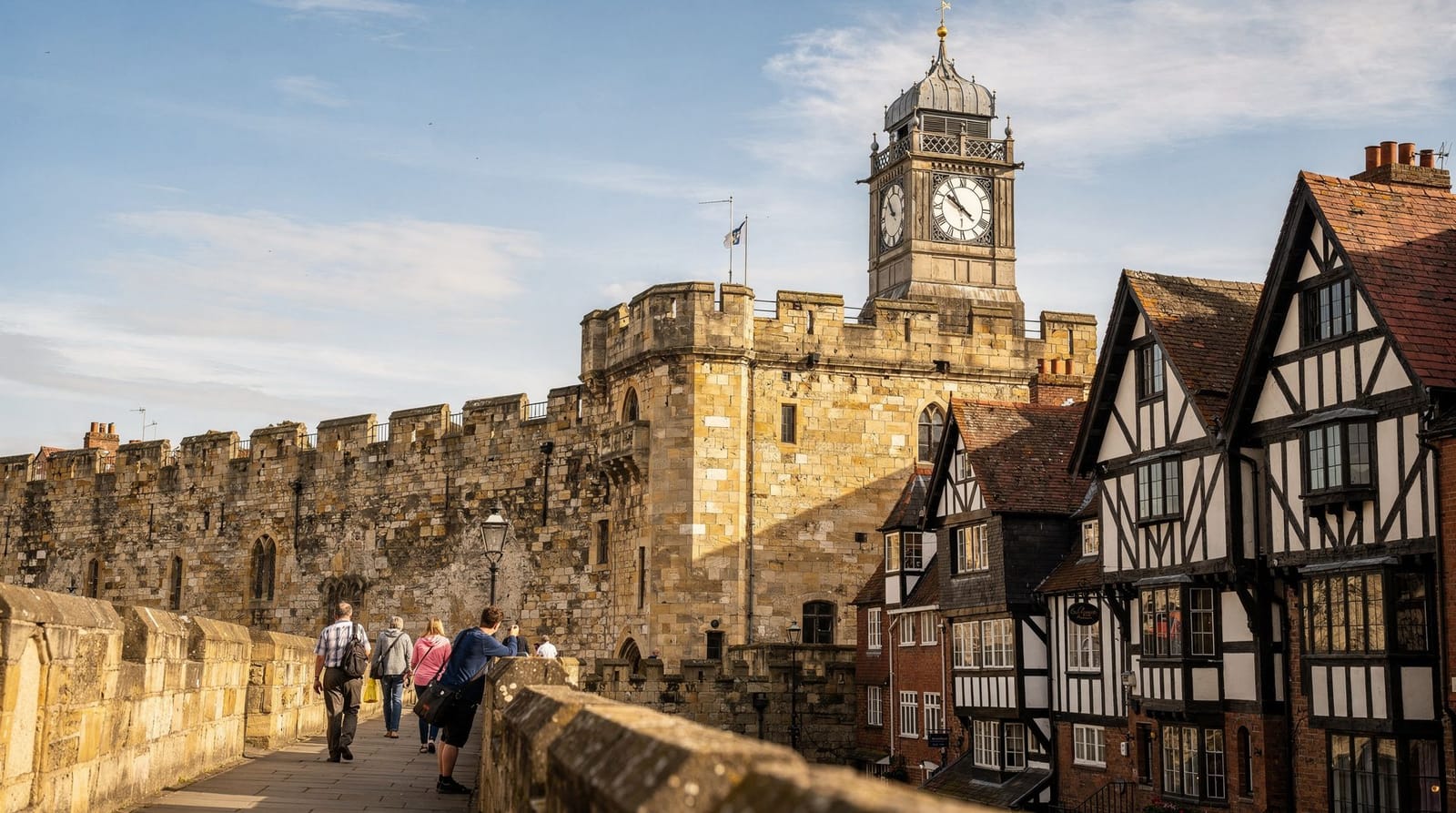
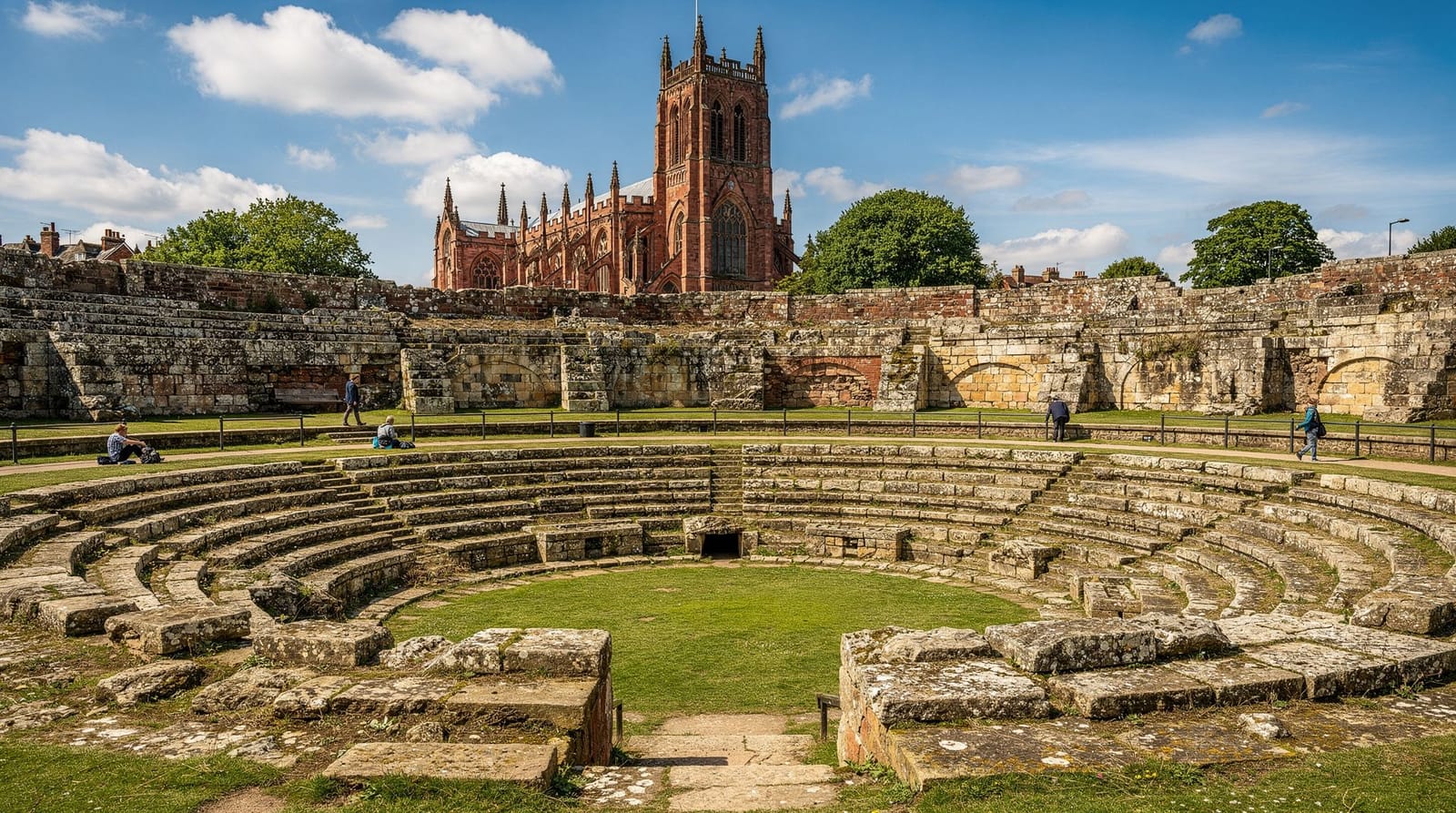
The city walls follow the exact alignment of the original Roman fortress defences on their northern and eastern sides, meaning the walk you take today traces the Roman perimeter even though the visible stonework is almost entirely medieval and later rebuilding. The Roman amphitheatre, just outside the fortress’s southeast corner, is the single largest visible Roman structure in Britain and the clearest standing evidence of the garrison’s scale — it needed to seat thousands, which tells you directly how large the associated military and civilian population was.
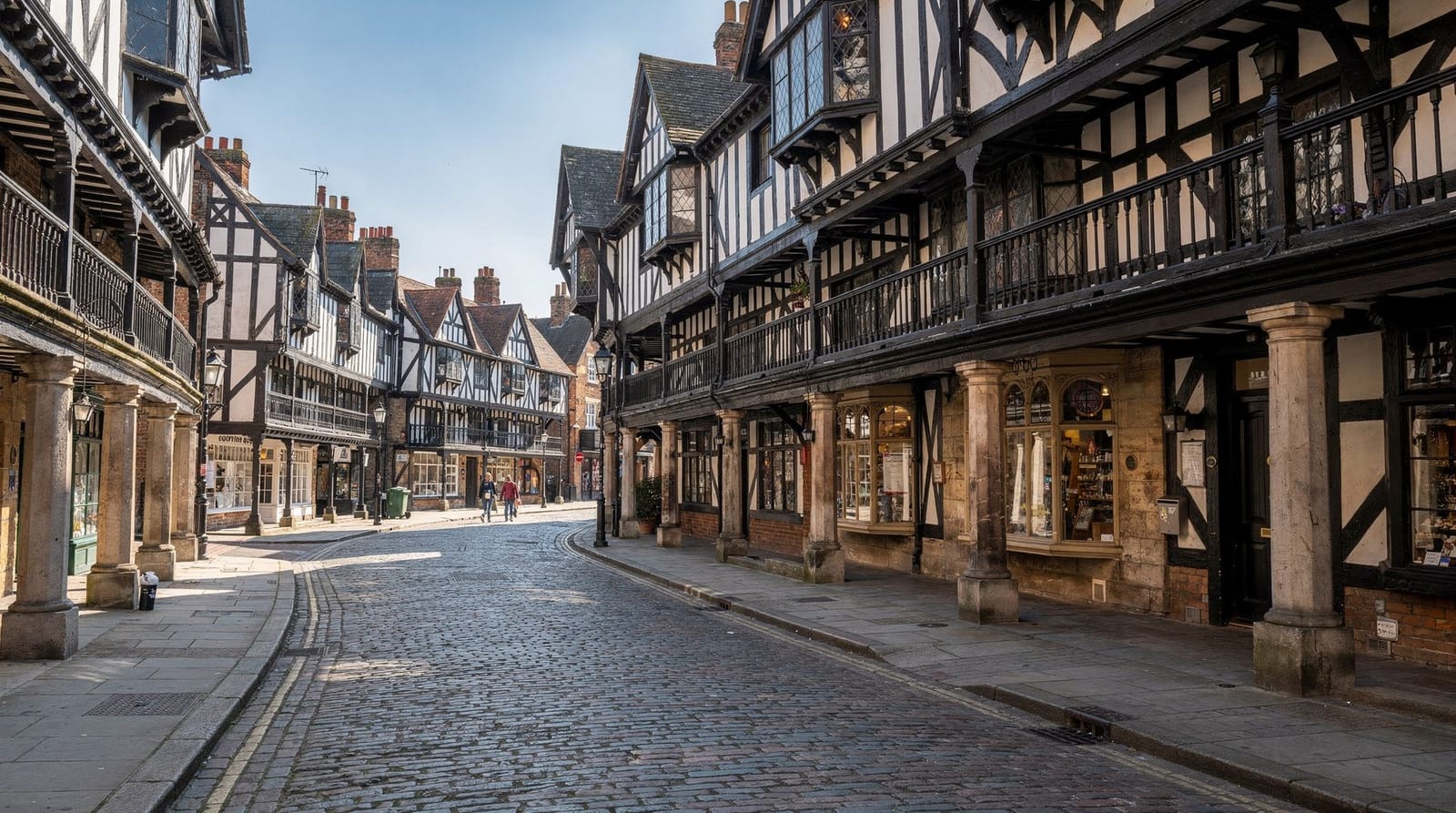
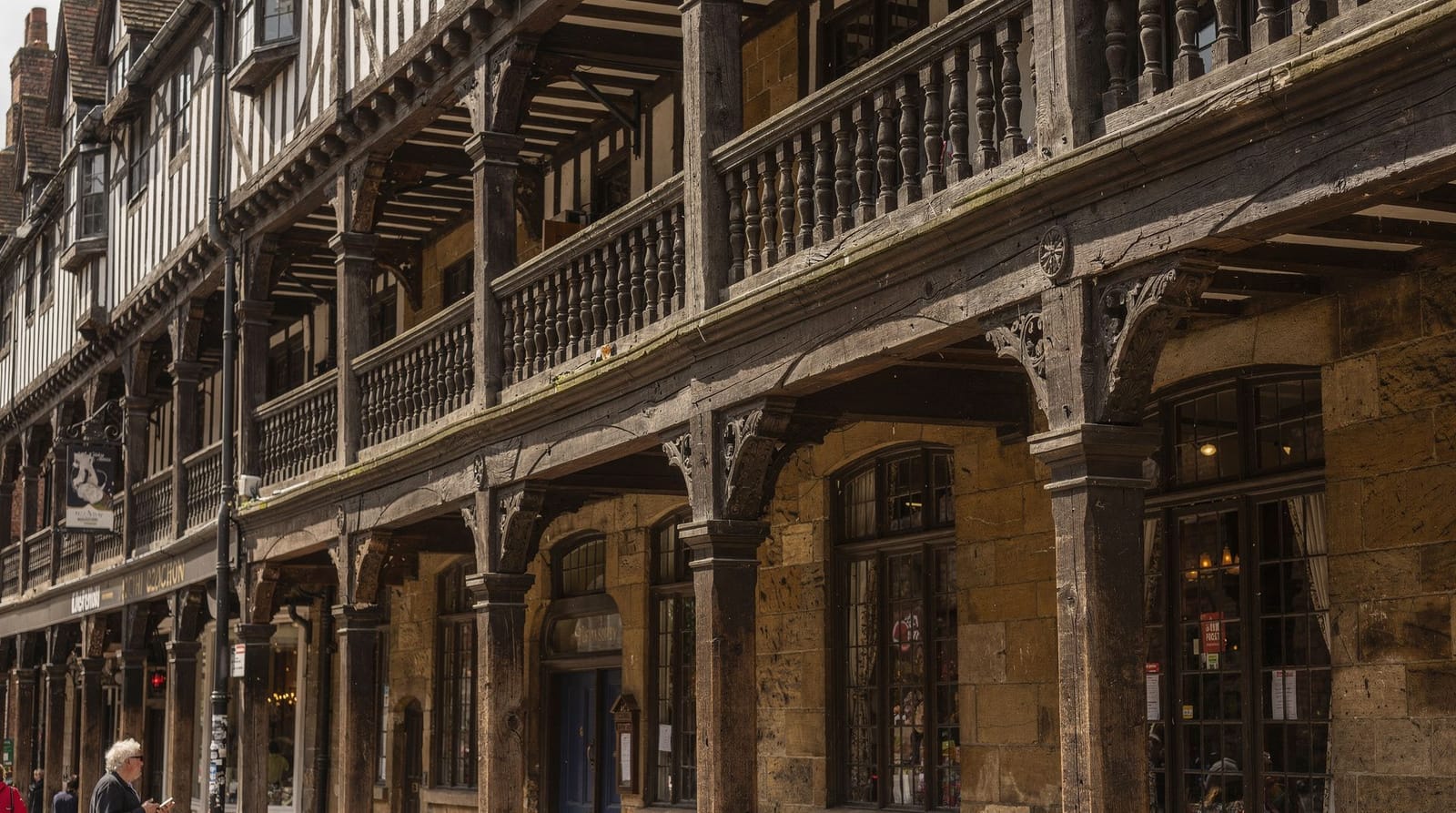
Beneath the Rows, several undercrofts incorporate genuine Roman masonry or foundations, since the Rows follow the same four streets that trace the fortress’s internal road grid almost exactly. The Grosvenor Museum holds the objects and inscriptions — tombstones, military diplomas, everyday equipment — that put names, dates and human detail onto what would otherwise be an abstract archaeological footprint.
The Deva Roman Experience — seeing it reconstructed
Because so little original fabric survives above ground, the most vivid way to actually picture Roman Chester is the Deva Roman Experience, an indoor attraction near the Rows that reconstructs a fortress street with life-size costumed figures, soundscapes and a walk-through format rather than static display cases. It’s aimed at giving visitors — particularly families and anyone without deep prior knowledge of Roman Britain — a physical sense of scale and daily life that the surviving ruins, being mostly fragmentary or below street level, can’t provide on their own.
It’s worth treating this attraction as a complement to the museum and outdoor sites rather than a replacement for either — the Experience gives atmosphere and orientation, while the Grosvenor Museum’s actual artefacts and the amphitheatre’s genuine scale provide the archaeological substance behind it.
Why Chester’s Roman identity still shapes local pride
Modern Chester leans heavily on its Roman identity in ways that go beyond tourism marketing — local sports teams, businesses and civic branding regularly reference the legionary and Deva Victrix connection, and the amphitheatre and walls remain sources of genuine local civic pride rather than purely commercial heritage assets. This isn’t unique to Chester among former Roman towns in Britain, but the sheer completeness of the surviving evidence here — walls, amphitheatre, tombstones and a continuously inhabited street plan — gives Chester’s Roman identity a tangibility that’s harder to sustain in places where the physical evidence is thinner or entirely buried beneath later development.
From fortress to town, and its long afterlife
Deva Victrix wasn’t only a military base — a civilian settlement (canabae) grew up immediately outside the fortress walls to serve the garrison, trading, providing services and eventually developing into a substantial town in its own right as the Roman occupation matured. When the legion was finally withdrawn in the early 5th century as Roman Britain’s administration collapsed, that civilian settlement — rather than vanishing — persisted and gradually evolved into the medieval and later city of Chester, inheriting the fortress’s walls, street grid and strategic river crossing more or less intact.
That continuity is genuinely unusual. Many Roman fortress and town sites in Britain were abandoned outright after the Roman withdrawal, their locations forgotten or reduced to isolated ruins; Chester’s is one of a smaller number where Roman-era urban planning directly shaped a settlement that’s remained continuously inhabited and economically active for nearly two thousand years since. Understanding Deva Victrix, in other words, is really understanding why Chester looks the way it does today — the four main streets, the wall circuit, even the general shape of the historic core all trace back to decisions made by Roman military engineers in the AD 70s.
Deva Victrix and the Anglo-Welsh frontier that followed
Chester’s Roman role as the military anchor for controlling North Wales set a pattern that persisted, in different forms, for the following thousand years and more. The Norman Earls of Chester who took over the city after 1070 inherited essentially the same strategic problem the Roman legion had solved — how to project military authority into Wales from a secure base on the English side of the border — and Chester Castle, along with the wider system of Marcher lordships along the Anglo-Welsh border, represents a medieval solution to the same geographic reality Deva Victrix had first addressed a thousand years earlier.
Edward I’s own campaign against Wales in the late 13th century, which produced the ring of castles covered in our Welsh castles guide and Edward I castles guide, used Chester as a key mustering point and supply base, directly continuing a role the city had first played for the Roman army.
This continuity is one of the more genuinely interesting through-lines in British history — a single geographic chokepoint, the lowest crossing of the Dee at the edge of Wales, repeatedly chosen as the base for controlling the same frontier by the Romans, the Anglo-Saxons, the Normans and Edward I’s medieval English state, each for broadly similar strategic reasons separated by well over a thousand years.
Further reading and depth beyond this guide
For visitors who want to go deeper than a single guide can cover, the Grosvenor Museum’s own published research and on-site scholarly panels remain the most authoritative and detailed local source on Deva Victrix specifically, drawing on more than a century of continuous excavation and academic study. English Heritage’s own published material on the amphitheatre covers the most recent excavation phases in more technical depth than a general visitor guide like this one can responsibly summarise, useful if the archaeological detail genuinely interests you beyond a single Chester visit.
Getting there and combining sites
All of Deva Victrix’s key surviving and reconstructed sites — the walls, amphitheatre, Rows, Grosvenor Museum and Deva Roman Experience — sit within Chester’s compact walled centre, walkable in any combination without needing transport between them. There’s no dedicated parking for any individual Roman site; use the city centre car parks or the Park & Ride service covered in our Chester parking guide, since the whole historic core is designed to be explored on foot.
The Heart of Chester walking tour ties several of these Roman-era sites together with a guide in a single circuit, a useful option if you’d rather have the history explained on the spot than piece it together from individual site panels.
Supplying a fortress of 5,000-6,000 people
Feeding and equipping a permanent garrison this size was a genuine logistical operation, not an afterthought. Grain was shipped in via the River Dee and stored in purpose-built granaries designed to keep several months’ supply dry and pest-free through the winter, when overland transport across Roman Britain’s road network became slower and less reliable.
Pottery, tools and military equipment were partly manufactured on-site in fortress workshops and partly imported from elsewhere in the empire — amphora fragments recovered locally show wine and olive oil arriving from as far away as the Mediterranean, evidence of a supply network that reached well beyond Britain’s shores to keep a legion stationed at the edge of the Roman world properly provisioned. It’s this scale of organised logistics, as much as the military architecture itself, that marks Deva Victrix out as genuine imperial infrastructure rather than a simple frontier camp.
Why “Deva Victrix” rather than just “Deva”
You’ll see the fortress referred to both as “Deva” and “Deva Victrix” in different sources, and the distinction is worth a brief note. “Deva” is simply the Roman name for the site, derived from the river; “Victrix” (“victorious”) was sometimes appended in connection with the resident legion’s own honorific title, Valeria Victrix, and appears in some historical and modern usage as an extension of the place name itself, though it wasn’t necessarily used as a formal, fixed place name by the Romans in the way modern signage and tourism branding sometimes implies. Both forms are in common use today, including in this guide, and either is understood locally and in academic literature to refer to the same site.
Planning a Roman Chester day
A half-day dedicated to Deva Victrix’s story works well structured as: the Deva Roman Experience or a read of this guide first for orientation, then the amphitheatre, a stretch of the city walls, and finally the Grosvenor Museum to finish with the actual artefacts. Our one-day Chester itinerary and two-day itinerary both build in time for this Roman circuit alongside the Rows and cathedral, and our Chester history guide extends the story forward from Deva Victrix through the medieval and modern city for anyone who wants the fuller chronological picture rather than the Roman period in isolation.
Roman Chester with children
Deva Victrix works surprisingly well as a family theme, since the amphitheatre and the reconstructed Deva Roman Experience both give children something physical and visual to engage with rather than text panels alone. Our Chester with kids guide covers how to pace a Roman-themed morning around nap times and attention spans, and Chester for first-timers places the Roman sites within a broader first visit if this is your only trip to the city.
If you’re weighing whether Chester as a whole justifies the trip, our is Chester worth visiting guide covers the case directly, and the Chester destination guide ties Roman, medieval and modern Chester together in one overview. Anyone who’d rather have the Roman story explained in person can compare it against the self-guided approach in our Chester walking tours guide.
Frequently asked questions about Deva Victrix
How much time should I set aside for Roman Chester?
A focused visit to the amphitheatre, a stretch of the walls and the Deva Roman Experience takes around 2-3 hours. Add the Grosvenor Museum's Roman gallery and you're looking at half a day if you want to see the artefacts as well as the sites themselves.Is any of Roman Chester free to see?
Yes. The Roman amphitheatre and the Roman-aligned stretches of the city walls are free to view at any time, and the Grosvenor Museum has free general admission. Only the reconstructed Deva Roman Experience charges an entry fee.
Top experiences
Bookable activities with verified prices and instant confirmation on GetYourGuide.