Edward I's castles — the "Iron Ring" that conquered North Wales
From Chester: North Wales and Caernarfon Castle Tour
Duration: 10 hours
What is Edward I's "Iron Ring" of castles?
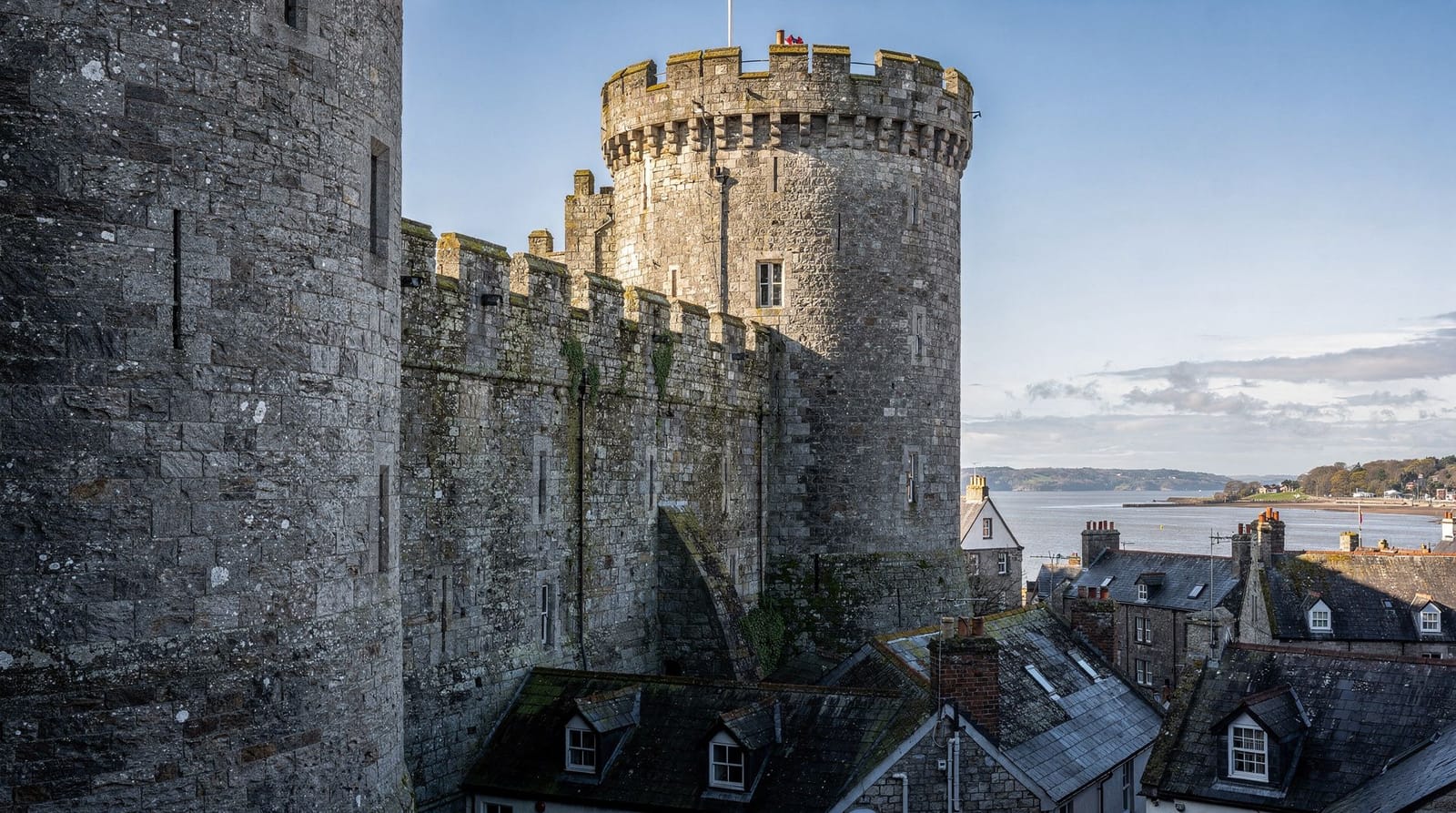
The "Iron Ring" is the modern name for the chain of fortresses Edward I built or rebuilt across North Wales between 1277 and around 1330 to permanently secure his conquest of the region — including Flint, Rhuddlan, Conwy, Caernarfon, Harlech and Beaumaris. Four of these (Conwy, Caernarfon, Harlech and Beaumaris) are jointly UNESCO-listed today; the others survive in more fragmentary form.
| Where | Coastal and inland North Wales, from Flint to Beaumaris on Anglesey |
| Cost | Free (Flint, Rhuddlan ruins) to around £11-16 per Cadw castle ticket |
| Time needed | A day per major castle, or a multi-day road trip for the full ring |
| Getting there | Train to Conwy or Flint direct; car or guided tour for the rest |
| Best time | Spring or autumn for fewer crowds at the UNESCO sites |
Reading the castles as a single connected system
The single most useful shift in perspective for visiting any of these castles is to stop thinking of them as isolated tourist attractions and start seeing them as parts of one deliberately engineered system, positioned along the coast and inland routes specifically so that each could be resupplied by sea, support neighbouring garrisons, and collectively make any part of North Wales reachable by English military force within days rather than weeks.
Chester’s own role as the ultimate logistical hub behind this whole network — covered in more depth in our Chester history guide — is what ties the city’s own layered Roman and medieval history directly into the story told at every one of these North Wales sites, rather than the two simply happening to sit within convenient day-trip range of each other.
A conquest secured in stone
Between 1277 and roughly 1330, Edward I of England oversaw the construction or substantial rebuilding of a chain of castles across North Wales, a systematic project historians and popular writers alike have nicknamed the “Iron Ring” — a deliberate encirclement of the region designed to make any future Welsh uprising against English rule militarily unwinnable. It’s one of the most concentrated and expensive castle-building programmes in medieval European history, and its surviving fortresses, several now UNESCO World Heritage Sites, remain the single most significant reason North Wales draws heritage visitors from across the world today, including the large share of Chester-based day-trippers this guide is written for.
Two campaigns, not one
Edward’s Welsh castle-building happened in two distinct phases, corresponding to two separate military campaigns, a detail that’s easy to miss if you only visit the more famous later castles. The first campaign, in 1277, forced Llywelyn ap Gruffudd — the last Welsh ruler to hold the title Prince of Wales with genuine independent authority — into a humiliating peace that stripped away much of his territory, and Edward used this first campaign to build an initial set of castles, including Flint and Rhuddlan, establishing an early foothold along the North Wales coast.
Llywelyn’s brother Dafydd ap Gruffudd led a renewed uprising in 1282 that drew Llywelyn back into open conflict, resulting in Llywelyn’s death in battle near Builth in December 1282 and Dafydd’s eventual capture and brutal execution in 1283 — the definitive end of native Welsh princely rule.
It was this second, more decisive campaign that triggered the far larger and more ambitious second wave of castle-building: Conwy and Caernarfon, begun immediately in 1283, followed by Harlech the same year, and finally Beaumaris in 1295, prompted by yet another uprising under Madog ap Llywelyn that made clear even the 1283 settlement needed further reinforcement.
Flint and Rhuddlan — the overlooked first phase
Flint Castle, begun in 1277, was the very first castle in Edward’s entire Welsh building programme, chosen for its position on the Dee estuary within easy supply reach of Chester — a detail that underlines just how central Chester itself was to the whole conquest, functioning as the logistical and military base from which Edward’s entire Welsh campaign was organised and supplied. Rhuddlan Castle, a short distance further along the coast and also begun in 1277, similarly benefited from an ambitious engineering project that diverted and canalised the River Clwyd to allow supply ships to reach the castle directly from the sea — an early demonstration of the kind of large-scale infrastructure investment that would recur, in a more sophisticated form, in Harlech’s later “way from the sea” and Beaumaris’s tidal dock.
These first-phase castles are considerably less visited and less architecturally refined than the later UNESCO sites, reflecting both their earlier construction (before James of St George’s design approach had fully matured) and their more fragmentary survival today. They’re nonetheless historically essential to understanding the full sweep of Edward’s conquest, and Flint in particular, sitting directly on the Chester-North Wales rail line, is an easy and free addition to a North Wales day trip for visitors interested in seeing the campaign’s actual starting point.
The wider Iron Ring — Denbigh, Hawarden and beyond
Beyond the sites covered in detail elsewhere on this site, Edward’s broader Welsh castle-building programme included several other fortresses that, while less visited by Chester-based day-trippers, are worth knowing about for the fuller picture. Denbigh Castle, further inland than the coastal sites, was granted to Edward’s ally Henry de Lacy to build following the 1282 campaign, and its substantial surviving gatehouse remains one of the more architecturally impressive of the “second tier” Welsh castles, incorporating similar polygonal tower design principles to Caernarfon.
Hawarden Castle, close to the Welsh-English border and much closer to Chester than most of the Iron Ring sites, has a more complex history — its medieval castle was largely destroyed after the Civil War, though the site later became the estate of British Prime Minister William Gladstone in the 19th century, an interesting layering of medieval military history and much later political history on the same ground. Ruthin and Holt castles round out the wider network, both now more fragmentary than the major sites but part of the same coordinated system of control across the region.
Collectively, this wider ring of castles, both the famous UNESCO sites and these lesser-known fortresses, demonstrates just how comprehensively Edward’s engineers thought through controlling North Wales — not a handful of showpiece fortresses, but a genuinely dense, mutually supporting network designed to make coordinated resistance across the whole region logistically impossible.
The Statute of Rhuddlan — conquest made administrative
Alongside the physical castles, Edward’s conquest was formalised through the Statute of Rhuddlan in 1284, issued from Rhuddlan Castle itself shortly after its completion, which restructured much of North Wales into English-style counties and imposed English common law and administrative structures over what had previously been governed under distinct Welsh legal traditions.
This administrative dimension of the conquest is easy to overlook when focusing purely on castle architecture, but it’s arguably just as significant historically — the physical fortresses secured Edward’s conquest militarily, while the Statute of Rhuddlan secured it legally and administratively, together representing a genuinely comprehensive assertion of English control that went well beyond simply building impressive stone walls.
James of St George — the architect of conquest
A single figure oversaw the design of most of this castle-building programme: James of St George, a master mason recruited from Savoy (in what’s now eastern France and Switzerland) after Edward encountered his work during his own travels through the region. James brought sophisticated continental European fortification theory, itself partly influenced by Crusader-era encounters with Byzantine and Islamic military architecture in the eastern Mediterranean, to a scale of building previously unmatched in Britain.
His design approach evolved visibly across the programme — from the more straightforward early designs at Flint and Rhuddlan, through the integrated castle-and-town-wall approach at Conwy, to Caernarfon’s deliberate symbolic architecture, and finally to Beaumaris’s fully realised, purely theoretical concentric perfection, unconstrained by difficult terrain for the first time in the whole programme.
James was eventually knighted and granted the constableship of Harlech Castle in recognition of his service, an extraordinary honour for a working mason, and he remains one of the very few individually documented architects from medieval Britain whose body of work across multiple still-standing major structures can be traced with real confidence.
The staggering cost of conquest
Surviving medieval financial records give an unusually detailed picture of what this building programme actually cost, and the numbers were, for their time, genuinely enormous — historians estimate Edward’s total expenditure on Welsh castles across the whole programme at somewhere in the region of £80,000-£100,000 in contemporary money, an amount that represented a very substantial share of total crown revenue across the relevant years and required extraordinary taxation and borrowing to fund.
This financial strain is part of why Beaumaris, the final castle in the programme, was never fully completed — by the mid-1290s, Edward’s attention and treasury had shifted decisively toward his expensive and prolonged wars in Scotland, and funding for the Welsh castles’ completion simply dried up.
The human cost was similarly substantial: each major castle required a workforce running into the thousands at peak construction, drawn from counties across England through a system of forced conscription of skilled labour, uprooted from their homes and transported to a recently conquered, still-unstable region for months or years at a time — a scale of labour mobilisation that had real social and economic consequences across England, not just in Wales.
The castles as instruments of control, not just defence
It’s worth being clear-eyed about what these castles were actually for. They weren’t built purely as passive defensive structures but as active instruments of ongoing political and demographic control — several, including Conwy, Caernarfon and Beaumaris, had entirely new fortified towns built alongside them, populated deliberately with English settlers and, for generations in some cases, formally barring Welsh residents from living within the walls at all.
This policy of displacement and demographic engineering is a less comfortable but essential part of understanding what the “Iron Ring” actually achieved beyond its undeniable architectural brilliance — a permanent, physically imposed assertion of English control over Welsh territory, land and, in the case of the new towns, everyday economic life.
Did the Iron Ring actually work?
The castle-building programme largely succeeded in its immediate goal of preventing another native Welsh prince from re-establishing independent rule, but it didn’t prevent all future rebellion.
Owain Glyndŵr’s uprising, beginning in 1400 and lasting over a decade, captured or besieged several of Edward’s own castles — most notably Harlech, taken in 1404 after the sea-supply route that had been specifically engineered to prevent exactly this kind of successful siege was itself successfully blockaded by Glyndŵr’s forces. Glyndŵr even held a parliament at Harlech during his rebellion, a genuinely remarkable turn of events given the castle’s original purpose as a symbol and instrument of English royal authority.
That the Iron Ring could be breached, even temporarily, by a determined and well-organised Welsh uprising over a century after its construction shows the limits of even the most sophisticated medieval fortification against genuine, sustained popular resistance — though it’s also true that English forces eventually recaptured every castle Glyndŵr’s rebellion took, and no subsequent Welsh uprising ever came as close to overturning Edward’s original settlement. In that sense, the Iron Ring achieved its core strategic purpose over the long run, even if its individual fortresses proved less than absolutely impregnable in the specific circumstances of the early 15th century.
Visiting the Iron Ring today from Chester
Chester’s historic role as the logistical base for Edward’s entire conquest makes it a genuinely appropriate starting point for exploring the surviving castles today, beyond simply being conveniently located. The guided day tour from Chester covering North Wales and Caernarfon Castle and the full-day guided North Wales sightseeing tour both offer practical single-day ways to see multiple sites from the Iron Ring without managing the transport logistics of reaching several separate, sometimes poorly connected locations independently.
For a fuller, multi-day exploration, our North Wales castles road trip itinerary sequences the major surviving sites — Conwy, Caernarfon, Beaumaris and, time permitting, Harlech — into a coherent route with a car, while our Welsh castles guide gives the practical comparison and decision-making detail for choosing which sites matter most for your specific interests and time available.
The Prince of Wales title and its lasting legacy
One of the more enduring legacies of Edward’s conquest is the English royal tradition of granting the title Prince of Wales to the heir to the throne — a practice Edward himself is popularly, if not entirely certainly by strict historical record, credited with initiating by presenting his infant son (the future Edward II, reportedly born at Caernarfon Castle in 1284) to the newly conquered Welsh as their prince.
Whatever the precise historical accuracy of the specific anecdote, the title has persisted in English and later British royal tradition for over seven centuries since, most visibly marked in the modern era by the two investiture ceremonies held at Caernarfon Castle in 1911 and 1969 — a direct, unbroken symbolic line connecting the modern British monarchy to Edward I’s original 13th-century conquest of Wales, and a reminder of just how long the consequences of this castle-building programme have continued to shape British constitutional and ceremonial life.
What happened to the castles after they stopped being needed
Once the immediate military threat of renewed Welsh rebellion faded over the 14th and 15th centuries, several Iron Ring castles saw reduced garrisons and gradual decline in active military use, a process common to castles across Britain as the nature of warfare and political control evolved. The English Civil War in the 1640s gave most of the surviving castles one final period of genuine military significance, as Royalist and Parliamentarian forces fought over control of these still-formidable fortifications, with several — including Conwy, Caernarfon, Harlech and Beeston — changing hands more than once during the conflict.
Parliament’s subsequent policy of slighting (deliberately damaging) many castles after the war, to prevent them being used as strongholds in any future conflict, explains why some sites survive in far more fragmentary condition than others: Beaumaris, notably, was largely spared this deliberate demolition, which is part of why its walls, despite never being fully completed in the first place, remain in comparatively good structural condition today.
By the 18th and 19th centuries, picturesque ruin had become fashionable among Romantic-era travellers and artists, and several Iron Ring castles began attracting early tourism on this basis, a trend that accelerated through the 19th and 20th centuries into the substantial heritage tourism industry that now sustains Cadw’s management of these sites and draws the volume of visitors — including the Chester-based day-trippers this guide is written for — that make North Wales one of Britain’s most visited historic regions today.
The Iron Ring at a glance
| Castle | Phase begun | Status today | Best reached from Chester |
|---|---|---|---|
| Flint | 1277 | Free, fragmentary ruin | Direct train, ~15-20 min |
| Rhuddlan | 1277 | Free, fragmentary ruin | Short drive from Flint or Conwy |
| Conwy | 1283 | UNESCO, largely intact walls | Direct train, ~55 min |
| Caernarfon | 1283 | UNESCO, well preserved | Guided tour or car via Conwy |
| Harlech | 1283 | UNESCO, dramatic clifftop site | Car; no direct train from Chester |
| Beaumaris | 1295 | UNESCO, most architecturally refined, never finished | Car via Anglesey |
Planning a multi-castle trip from Chester
Because the sites string out along a single stretch of coast and inland Anglesey, most Chester-based visitors sequence two or three rather than attempting all six in one trip. Conwy and Caernarfon pair naturally as a single guided day, while Harlech and Beaumaris generally need a dedicated day each given the extra driving distance. Our two-day Welsh castles itinerary sequences the major sites without unnecessary backtracking, and Chester trains and day trips covers which castles are realistically reachable by rail alone versus which need a car or tour.
What Cadw membership changes for repeat visitors
For visitors planning to see three or more of the Iron Ring’s ticketed castles — Conwy, Caernarfon, Harlech and Beaumaris all charge individual admission — a Cadw annual membership can work out cheaper than paying single entry at each site, particularly if the trip also takes in some of Cadw’s other properties across Wales beyond the Iron Ring itself. It’s worth doing the maths against your specific planned itinerary before committing, since the saving only materialises once you’re visiting enough sites to offset the membership cost, but for anyone spending several days touring North Wales’s castles specifically, it’s a genuine consideration rather than a marginal one.
How this fits a wider North Wales trip
For visitors weighing castles against North Wales’s other draws — Snowdonia’s mountains, the coastal towns, the heritage railways — our day trips from Chester overview and best castles near Chester both help place a castle-focused day within a broader itinerary rather than treating the Iron Ring as a standalone specialist trip.
Understanding the full picture before you visit
Visiting any single castle from this programme in isolation gives an incomplete picture of what the Iron Ring actually represented — a systematic, extraordinarily expensive, demographically transformative campaign of conquest, executed with genuine architectural brilliance by James of St George’s team, but built explicitly to permanently suppress Welsh independence rather than simply to look impressive on a hilltop.
Reading this wider context before visiting individual sites like Conwy, Caernarfon, Beaumaris or Harlech gives each individual visit considerably more depth and meaning than approaching them purely as picturesque medieval ruins.
For the earlier chapters of the same Anglo-Welsh frontier story, stretching back through Chester’s own Norman and Roman history, see our Chester history guide and Deva Victrix guide, both of which show how the same underlying strategic logic — controlling this specific frontier between England and Wales — recurred across nearly two thousand years of continuous fortification on and around the same stretch of border country.
Frequently asked questions about Edward I's castles
How many castles are in Edward I's "Iron Ring"?
The core Iron Ring is usually counted as six castles built or rebuilt between 1277 and 1295 — Flint, Rhuddlan, Conwy, Caernarfon, Harlech and Beaumaris. A wider reading of the same programme also includes Denbigh, Hawarden, Ruthin and Holt, though these are less commonly grouped under the "Iron Ring" name.Which Edward I castles are UNESCO World Heritage Sites?
Conwy, Caernarfon, Harlech and Beaumaris are jointly inscribed as a single UNESCO World Heritage Site, recognised for their exceptional preservation and their status as some of the finest surviving examples of medieval military architecture in Europe. Flint and Rhuddlan, from the earlier 1277 phase, are not included in the UNESCO listing.
Top experiences
Bookable activities with verified prices and instant confirmation on GetYourGuide.