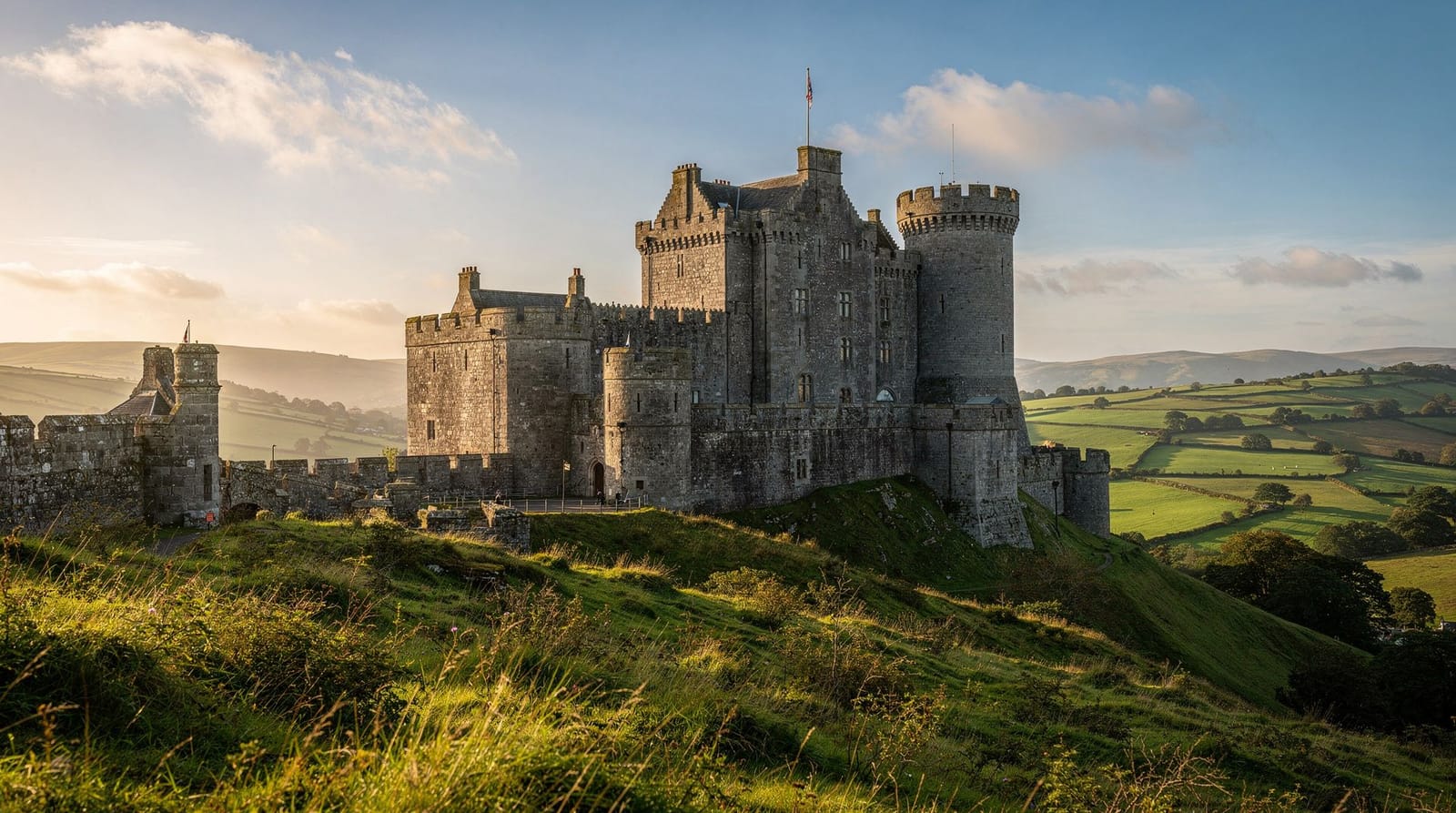
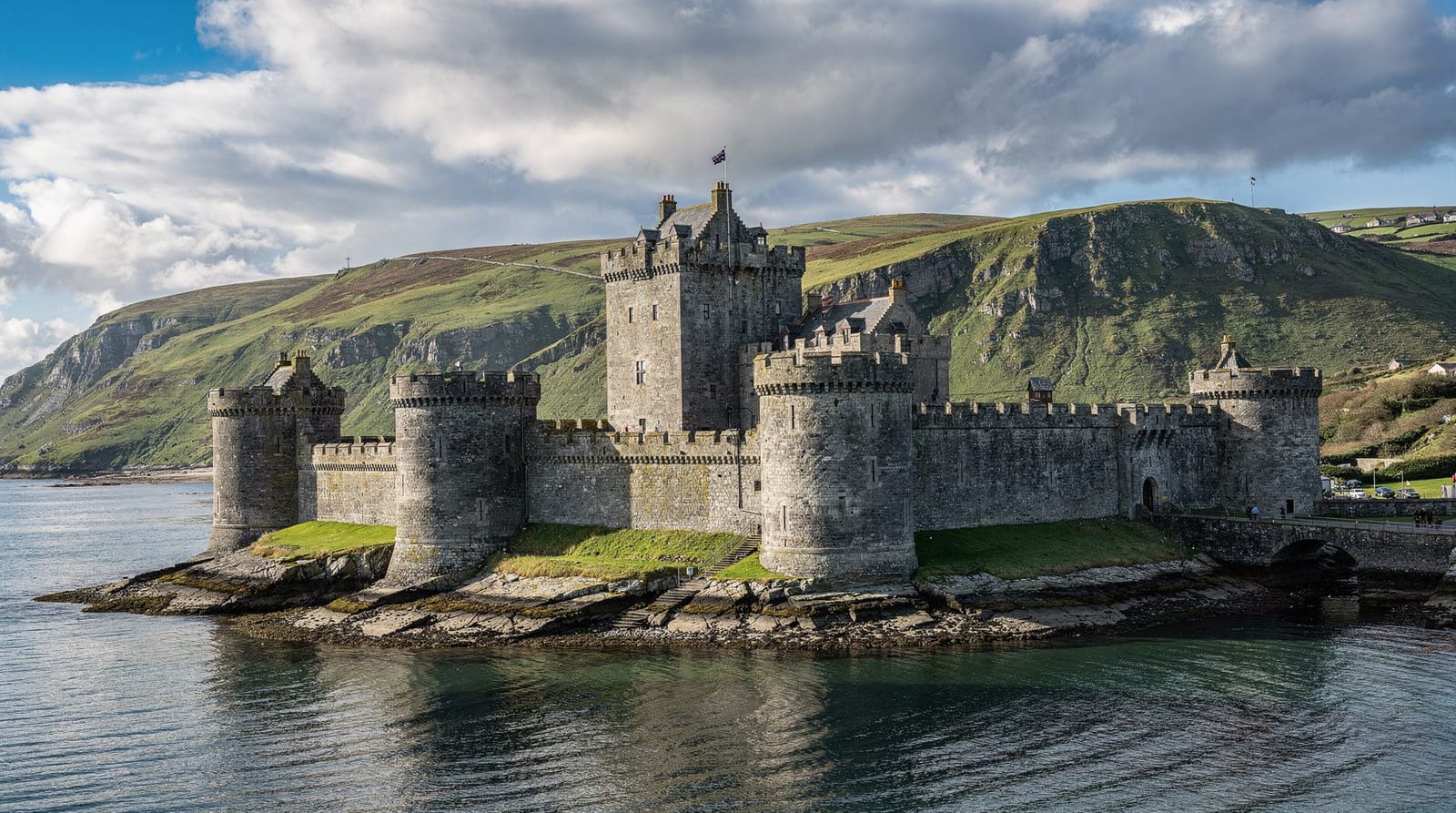
Harlech Castle — the clifftop fortress with a stairway to a vanished sea
Llandudno Gateway: Snowdonia, Castles & Portmeirion Day Tour
Why is Harlech Castle built on a cliff?
When Edward I's fortress was built between 1283 and 1289, the sea came right up to the base of the rock, and the cliff gave the castle a naturally defended side facing the water while a deep rock-cut ditch protected the landward approach. Centuries of coastal silting have since pushed the shoreline back over half a mile, leaving the castle standing dramatically above flat land rather than the sea it was originally designed to command.
A fortress built to be supplied from the sea
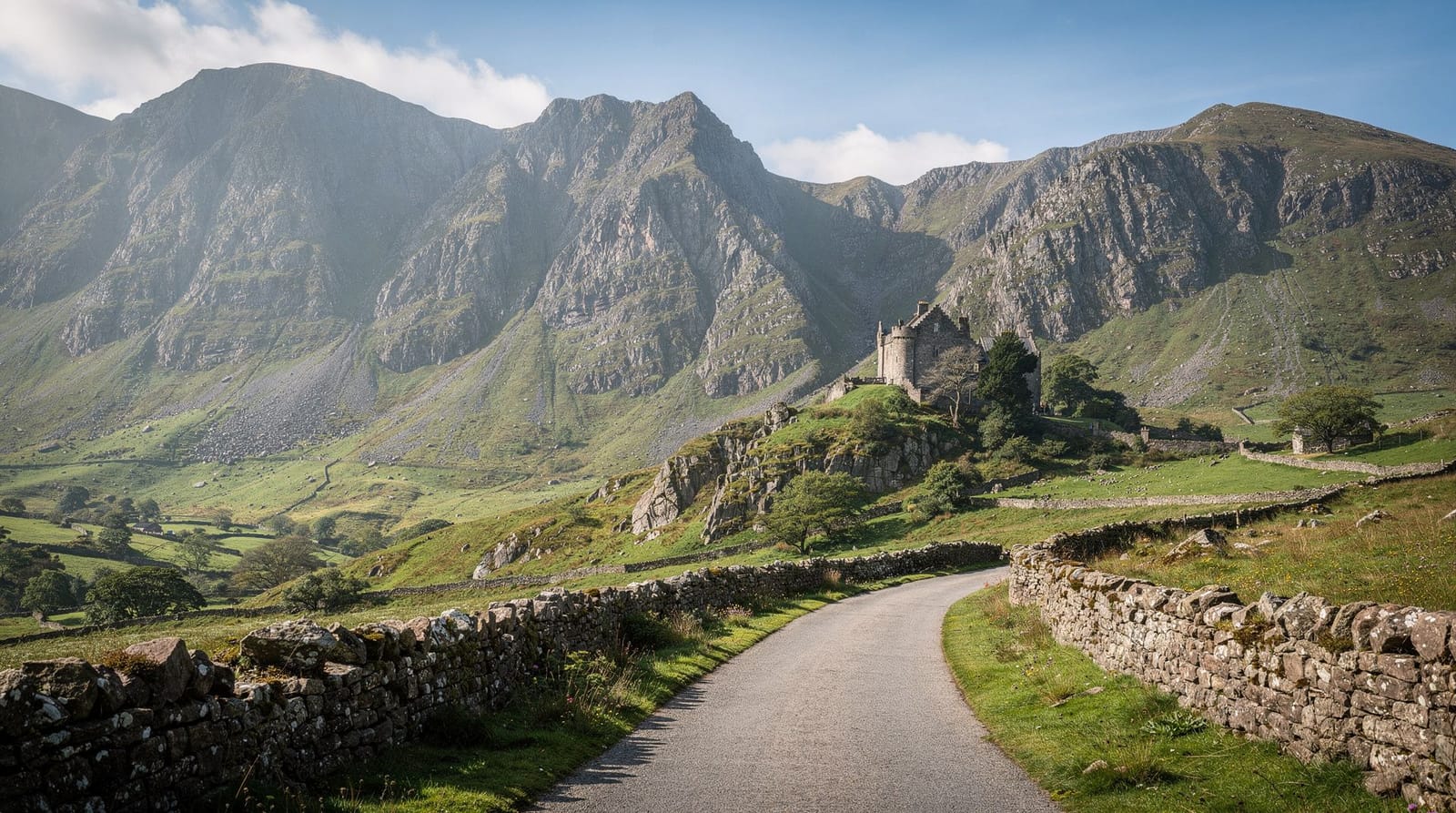
Harlech Castle sits on a rocky outcrop above the Cambrian coast of North Wales, and even in its current, land-locked setting, it remains one of the most visually striking of Edward I’s Welsh castles — a compact, powerfully built fortress that seems to grow directly out of the rock itself. Construction ran from 1283 to 1289, part of the same wave of castle-building that produced Conwy and Caernarfon, and like those sites it was designed by James of St George, Edward’s Savoyard master of works, though Harlech’s design responds to a very different natural setting than either of its sister castles.
| Where | Harlech, Gwynedd — Cambrian coast of North Wales |
| Cost | Typically £9-12 per adult (Cadw site), concessions available |
| Time needed | 45 min-1 hour |
| Getting there | Best by car, around 1hr45-2hrs from Chester; limited rail access |
| Best time | Early morning or late afternoon for photography and fewer crowds |
When it was built, the sea came directly up to the base of the cliff on the castle’s western side, and the “way from the sea” — a long, fortified stairway cut into the rock, descending from a small watergate within the castle down to what was then the shoreline — allowed supply ships to resupply the garrison directly, bypassing any besieging force controlling the landward approaches entirely. This single design feature proved decisively important during the castle’s most famous siege, and it’s one of the more remarkable pieces of medieval military engineering anywhere in Britain, even though the sea it was built to reach has long since retreated.
The vanished sea and a dramatically changed landscape
Over the roughly 700 years since Harlech was built, the coastline has shifted substantially, with sediment and sand building up across what was once open water until the sea now sits more than half a mile from the base of the castle rock. This is one of the most dramatic examples of coastal landscape change at any historic site in Britain, and it fundamentally alters how visitors experience the castle compared with how it would have looked and functioned in the medieval period — rather than a fortress rising directly from the waves, Harlech today stands above flat grazing land and the small town that’s grown up around it, with the sea only a distant line on the horizon.
Understanding this change matters for making sense of the castle’s design: the “way from the sea” staircase, which today ends partway down the rock face overlooking dry land, only makes full sense once you know it was originally built to reach a working tidal harbour, not the grassy plain visible today. Information panels at the site explain this coastal history in detail, and it’s worth reading before assuming the stairway’s current, seemingly pointless termination reflects poor design rather than dramatic environmental change over seven centuries.
Harlech’s design — a compact concentric fortress
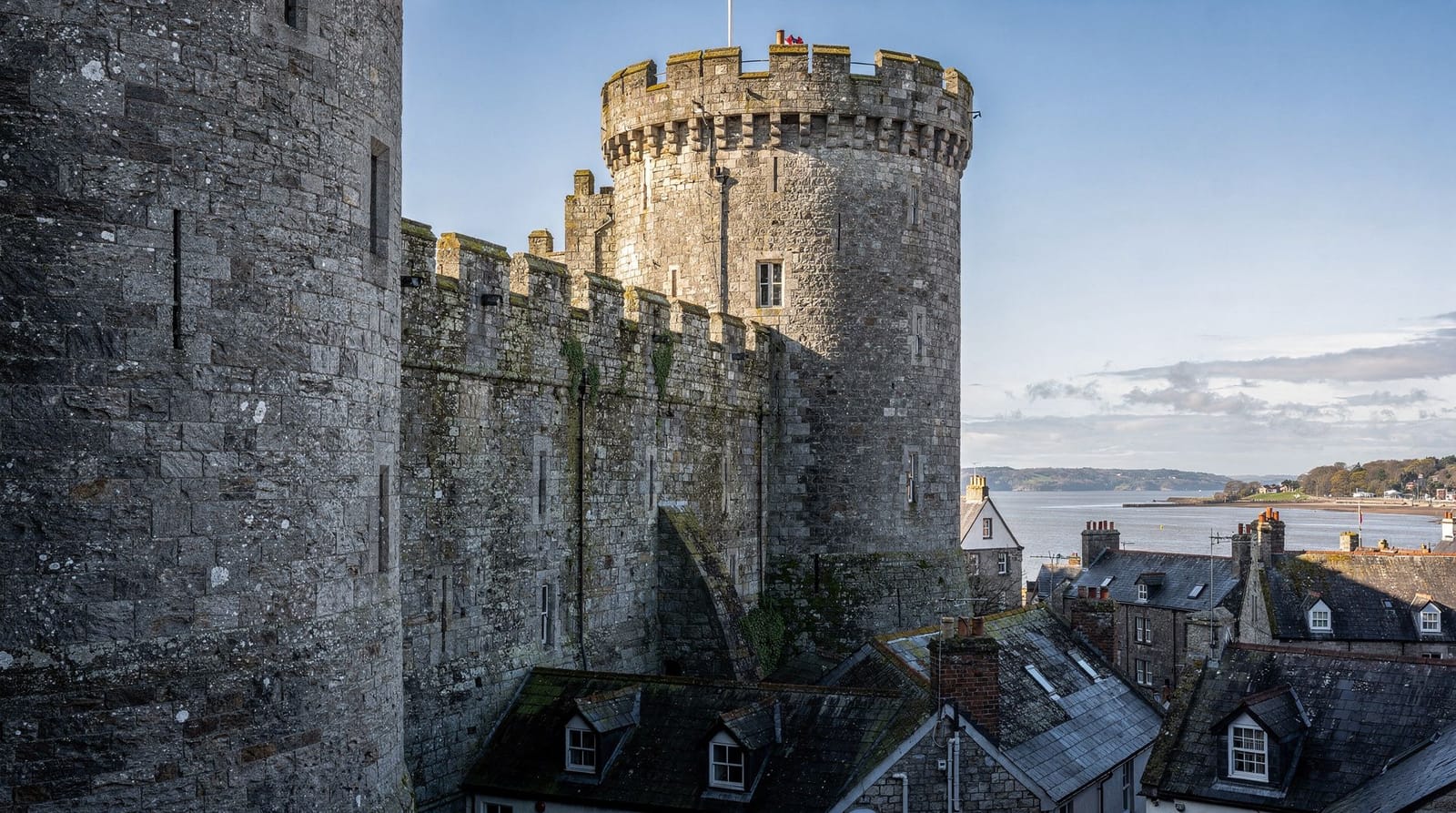
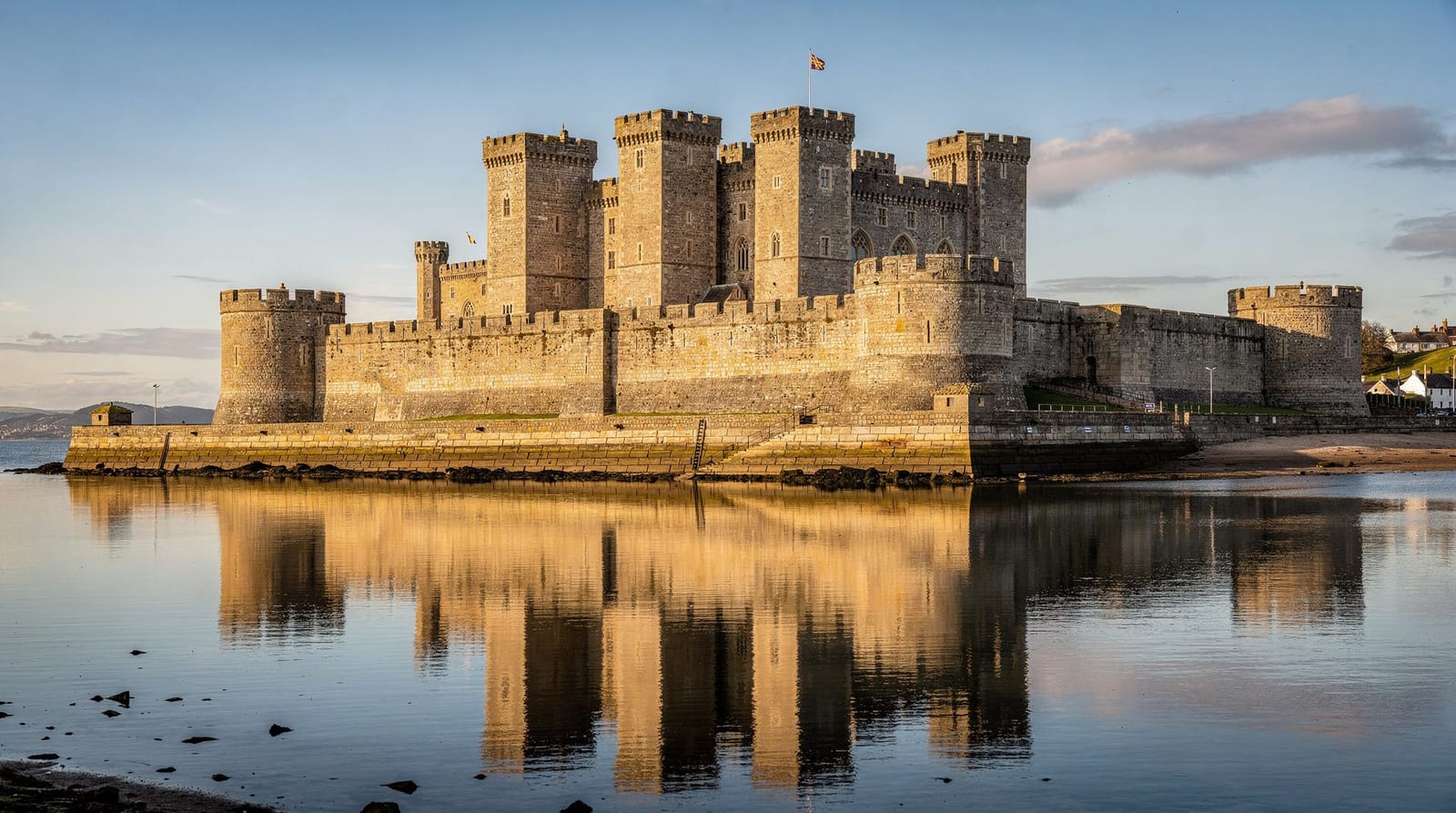
Though smaller in scale than Caernarfon or Beaumaris, Harlech incorporates a genuine concentric defensive principle within its compact footprint — an inner ward with four corner towers surrounded by a lower outer wall, creating a similar “walls within walls” defensive logic to Beaumaris, adapted to fit the rock’s much smaller and more irregular natural platform.
The main gatehouse, disproportionately massive relative to the rest of the castle, functioned as a self-contained strongpoint and likely also housed the constable’s residence, a common design solution at several of Edward’s Welsh castles where the gatehouse doubled as both the most vulnerable point requiring the heaviest defence and the most desirable, defensible living quarters available on site.
The castle’s seaward side relied primarily on the sheer drop of the rock itself for defence, requiring comparatively modest wall fortification compared with the landward side, where a deep rock-cut ditch — still visible today — provided the primary obstacle to any attacking force approaching from the more accessible eastern approach. This asymmetric design, responding directly to the specific advantages and vulnerabilities of the rock’s natural shape, is a good example of how Edward’s castle-building programme, while following broadly consistent design principles across all four UNESCO sites, adapted intelligently to each individual site’s particular terrain rather than applying a single rigid template everywhere.
The siege that made Harlech famous
Harlech’s most significant historical episode came during the Welsh uprising led by Owain Glyndŵr in the early 15th century, when Glyndŵr’s forces besieged and eventually captured the castle in 1404 after the sea-supply route, which had allowed earlier garrisons to hold out against landward sieges, was successfully blockaded — a rare case of an attacking Welsh force overcoming the specific engineering advantage the castle had been built to provide. Glyndŵr held Harlech as one of his key strongholds and is even said to have held a parliament here during his rebellion, a genuinely significant moment in Welsh political history, before English forces recaptured the castle in 1409 after another prolonged siege.
Harlech’s dramatic later history continued into the English Civil War, when it became the last Royalist stronghold in Wales to hold out against Parliamentarian forces, finally surrendering in March 1647 — the final castle in the entire conflict to fall, a distinction the site’s own interpretation materials make a point of noting. This “last castle to fall” status has given Harlech an enduring place in Welsh historical memory, reflected even in the well-known Welsh song “Men of Harlech,” widely (though not entirely certainly, historically) associated with the castle’s Civil War defence.
”Men of Harlech” and the castle’s cultural legacy
The rousing Welsh march “Men of Harlech” (“Rhyfelgyrch Gwŷr Harlech”) is one of the best-known pieces of Welsh music internationally, familiar to many visitors from its use in the 1964 film Zulu, where it’s sung by British soldiers awaiting a Zulu attack — a scene with no direct historical connection to Harlech Castle itself, but one that’s cemented the song’s association with heroic last-stand defence in popular culture well beyond Wales.
Historically, the song’s precise origins and its connection to any specific siege of the castle (whether the 1408-09 recapture from Glyndŵr’s forces or the 1647 Civil War siege) are debated by historians and folklorists — the tune and lyrics as known today were first published considerably later than either siege, and while local tradition strongly links it to Harlech’s defensive history, this connection isn’t as firmly documented as the castle’s own military history is.
It’s worth knowing this distinction between well-established historical fact and enduring, meaningful tradition, since the song is presented at the site and in Welsh cultural memory more broadly as directly tied to Harlech, whatever the precise historical uncertainty around its actual composition.
Photography and the best time to visit
Harlech’s dramatic clifftop silhouette is best photographed from the flat land to the north or west, where the full height of the rock and castle combine in a single striking frame, particularly effective in the low light of early morning or the last hour before sunset when the stone takes on a warm golden colour against the surrounding green farmland.
From the castle itself, the battlements offer some of the best long-distance mountain and coastal views of any historic site in Wales, though visibility is highly weather-dependent — a clear day gives views deep into Snowdonia, while low cloud or coastal haar can reduce visibility to just the immediate town and coastline. Because Harlech draws fewer visitors than Conwy or Caernarfon, even midsummer visits rarely feel crowded, making it one of the more relaxed and contemplative of the four UNESCO castles to actually spend time in rather than rushing through.
What to see today
Harlech’s compact scale compared with Caernarfon means a visit typically takes 45 minutes to an hour, though the dramatic views alone are worth lingering over — from the castle’s battlements, on a clear day, you can see across Tremadog Bay toward the Llŷn Peninsula and inland toward Snowdonia’s mountains, including views of Cadair Idris and the Rhinogydd range, making Harlech arguably the most scenically situated of all four UNESCO-listed Welsh castles.
The gatehouse, one of the most heavily fortified parts of the design, and the twin round towers flanking it are worth particular attention, along with the “way from the sea” stairway itself, accessible via a footbridge and walkway added in recent decades to give visitors safe access to view this distinctive feature without needing to descend the original, now precarious medieval stairs.
Harlech’s steepest street and the town beyond the castle
Harlech itself is a small town, and one of its streets — Ffordd Pen Llech — has at various points been recognised by Guinness World Records as the steepest street in the world, a genuinely startling gradient that’s worth seeing (or, for the more adventurous, walking) if you have time beyond the castle visit itself. The town’s compact centre has a handful of cafés and shops catering to castle visitors, generally reasonably priced given the smaller volume of tourism compared with busier North Wales coastal towns, and the approach to the castle itself, particularly from the modern visitor centre, gives a good initial sense of the scale and drama of the site before you’re inside the walls.
The visitor centre at the base of the castle houses ticketing, a shop and interpretation displays covering the site’s history and the coastal change that’s transformed its setting, a useful orientation stop before climbing up to the castle itself via a modern access bridge that replaced the original, much steeper medieval approach.
Accessibility and practical visiting notes
Harlech’s position on a rocky outcrop means full accessibility is inherently limited — the modern access bridge and pathways to the main gatehouse are more manageable than the original medieval approach would have been, and the lower courtyard areas are reasonably level, but the towers and battlements are reached via original stone spiral staircases with no lift alternative, ruling out full wheelchair access to the upper viewing points that give the castle’s best views. Cadw provides specific accessibility guidance for the site on request, useful to check in advance if mobility is a concern for your visit.
Weather is a genuine factor at Harlech given its completely exposed clifftop and coastal position — the battlements and outer approaches can be significantly windier and colder than inland sites even on a nominally mild day, and waterproof, windproof clothing is worth having on hand regardless of the season, since this stretch of the Cambrian coast sees frequent and sometimes sudden weather changes blowing in from the Irish Sea.
Comparing Harlech to other British clifftop castles
Harlech is often mentioned alongside other dramatically sited British castles — Bamburgh and Dunstanburgh in Northumberland, or Tintagel in Cornwall — as an example of medieval builders exploiting a naturally defensible coastal or clifftop position to maximum effect. What distinguishes Harlech within this group is the specific, documented engineering of its “way from the sea” supply route, a level of deliberate logistical planning around the site’s coastal position that goes beyond simply using a cliff for passive defence, as most of these comparable sites do.
Combined with its status as part of a UNESCO World Heritage listing alongside Conwy, Caernarfon and Beaumaris, Harlech arguably has a stronger claim to genuine international architectural significance than most of Britain’s other scenic coastal castles, even if it draws considerably fewer visitors than better-known sites like Bamburgh.
Getting to Harlech from Chester
Harlech is the most remote of the four UNESCO castles from Chester, and reaching it by public transport is a genuinely lengthy undertaking. Harlech does have its own small railway station, on the scenic Cambrian Coast line, but that line connects to the rest of the rail network via Machynlleth or Porthmadog rather than directly toward Chester, meaning a public transport journey typically involves multiple changes and can run to three hours or more depending on connections — considerably longer and less convenient than the direct or near-direct routes to Conwy or Caernarfon.
For most visitors coming from Chester, driving is the practical option, taking around 1hr45-2hrs via the A55 and A470/A496 through Snowdonia’s western fringes — a scenic route in its own right, passing through or near Betws-y-Coed and skirting the mountains, worth treating as part of the day’s experience rather than simply transit time. Because of the distance and journey time involved, Harlech is best combined with an overnight stay in the area or built into a multi-day North Wales itinerary rather than attempted as a rushed single-day round trip from Chester.
Combining Harlech with the wider region
Harlech’s position on the Cambrian coast puts it within reach of Snowdonia’s southern and western areas, including Portmeirion, the eccentric Italianate village a short drive north, and the beaches and dunes along this stretch of coastline, generally quieter and less developed than the more touristed North Wales coast around Llandudno and Conwy. Our Snowdonia destination guide covers the wider region, and our Welsh castles guide places Harlech in context alongside Conwy, Caernarfon and Beaumaris for anyone planning to see all four UNESCO sites across a longer trip.
Given the distance from Chester, Harlech works best as part of a longer North Wales stay — a multi-day trip based in or near Snowdonia, rather than Chester itself, makes visiting Harlech considerably more practical than treating it as a day trip alongside the more accessible coastal castles.
For visitors without a car, a guided day tour covering North Wales castles and Portmeirion together removes the logistics headache of the long, multi-change public transport route entirely. The Conwy, Snowdonia castles and Portmeirion day tour from North Wales is worth checking against the current itinerary if a Harlech-area day is what you’re after — confirm exactly which castles and stops are included before booking, since itineraries on multi-castle tours vary by operator and season.
What sets Harlech apart from Wales’s other UNESCO castles
Anyone building a trip around all four UNESCO-listed castles — Conwy, Caernarfon, Beaumaris and Harlech — quickly notices each has a distinct personality rather than being a repeat of the same design. Conwy impresses through the sheer completeness of its town walls; Caernarfon through scale and its symbolic, imperial-Roman-inspired design; Beaumaris through textbook concentric geometry on flat, undramatic ground.
Harlech’s distinction is its site: no other castle in the group, or arguably in Wales, tells such a clear physical story of engineering built around a coastline that has since dramatically retreated. Seeing all four in sequence, ideally over several days rather than rushed into one, gives a far richer sense of Edward I’s Welsh castle-building programme than any single site can on its own — see our Welsh castles guide and Edward I’s castles guide for the fuller comparison.
Budgeting a Harlech visit
Admission runs a modest £9-12 per adult, with family and concession tickets typically available and Cadw membership covering entry free if you’re visiting several Cadw sites across a longer Wales trip. The visitor centre shop stocks guidebooks and gifts tied to the castle’s history, generally reasonably priced, and the town’s handful of cafés charge typical small-town North Wales prices for lunch, in the £8-15 range.
Factor fuel or car hire into the overall cost given the distance from Chester — for a family of four driving from Chester, a realistic day including admission, lunch and fuel runs somewhere in the £80-120 range, before accommodation if you’re staying overnight in the wider Snowdonia area rather than attempting a single very long day.
Visiting with children
Harlech’s compact scale and dramatic setting tend to appeal to children readily, particularly the “way from the sea” stairway and the story of ships once sailing directly up to the castle walls — a vivid, easy-to-grasp piece of history that doesn’t require reading dense inscription panels to understand.
The site’s smaller size compared with Caernarfon means a family visit rarely overstays its welcome, and the surrounding town’s manageable scale makes combining the castle with an ice cream or lunch stop straightforward. Given the distance from Chester, families are generally better served treating Harlech as part of a longer Snowdonia or North Wales stay with a car, rather than attempting the long round trip in a single day with young children.
Tourist traps and practical notes
Harlech’s smaller visitor numbers compared with Conwy and Caernarfon mean less pricing pressure around the site itself, though parking in the small town can be limited on busy summer days — the main visitor car park near the castle entrance is the most reliable option. As with the other Cadw sites covered in this guide, confirm current opening hours and admission prices before travelling, since these are set and reviewed annually and can vary seasonally.
What to bring and how to time your visit
Beyond the weatherproof clothing already mentioned, sturdy footwear matters more at Harlech than at some of the region’s flatter attractions — the original stone stairs to the towers are uneven and can be slippery after rain. Arriving close to opening time or in the last hour or two before closing generally gives the calmest experience and the best light for photography, since Harlech’s modest visitor numbers mean it rarely feels genuinely crowded even at midday, but the golden-hour light against the stone is worth timing for if photography is a priority. A refillable water bottle is worth carrying, since the on-site options are limited to the visitor centre and town cafés rather than anything inside the castle itself.
Planning your visit
Harlech rewards visitors willing to make the longer journey with what’s arguably the most dramatically situated castle in Wales, a genuinely moving piece of siege history tied to Owain Glyndŵr’s rebellion and the Civil War, and views that few other British historic sites can match.
Given the travel time involved from Chester, it’s best planned as part of a longer North Wales or Snowdonia stay rather than a single rushed day trip — see our Chester and North Wales 3-day itinerary or Snowdonia adventure itinerary for how Harlech can fit into a longer regional trip alongside the more accessible castles and Snowdonia’s outdoor attractions.
Frequently asked questions about Harlech Castle
How much does it cost to visit Harlech Castle?
Harlech Castle is run by Cadw, and admission is a modest per-adult fee typically in the £9-12 range, with concessions for children, families and Cadw members. Prices are set and reviewed annually, so check the current rate before travelling.Is Harlech Castle worth visiting if I've already seen Conwy and Caernarfon?
Yes — Harlech is smaller and quicker to see, but its "way from the sea" staircase and dramatically changed coastal setting give it a genuinely different character from its sister castles, and its Owain Glyndŵr and Civil War history is among the most significant of the four UNESCO sites.