Caernarfon Castle — Edward I's imperial statement in stone
From Chester: North Wales and Caernarfon Castle Tour
Duration: 10 hours
How much does it cost to visit Caernarfon Castle and how do you get there from Chester?
Adult admission runs around £11-12 (Cadw sets prices annually, so confirm current rates before visiting). There's no direct train to Caernarfon — the nearest station is Bangor, reached from Chester in around 1hr20-1hr40, followed by a roughly 20-30 minute bus or taxi, or you can join a guided day tour direct from Chester that handles the whole journey.
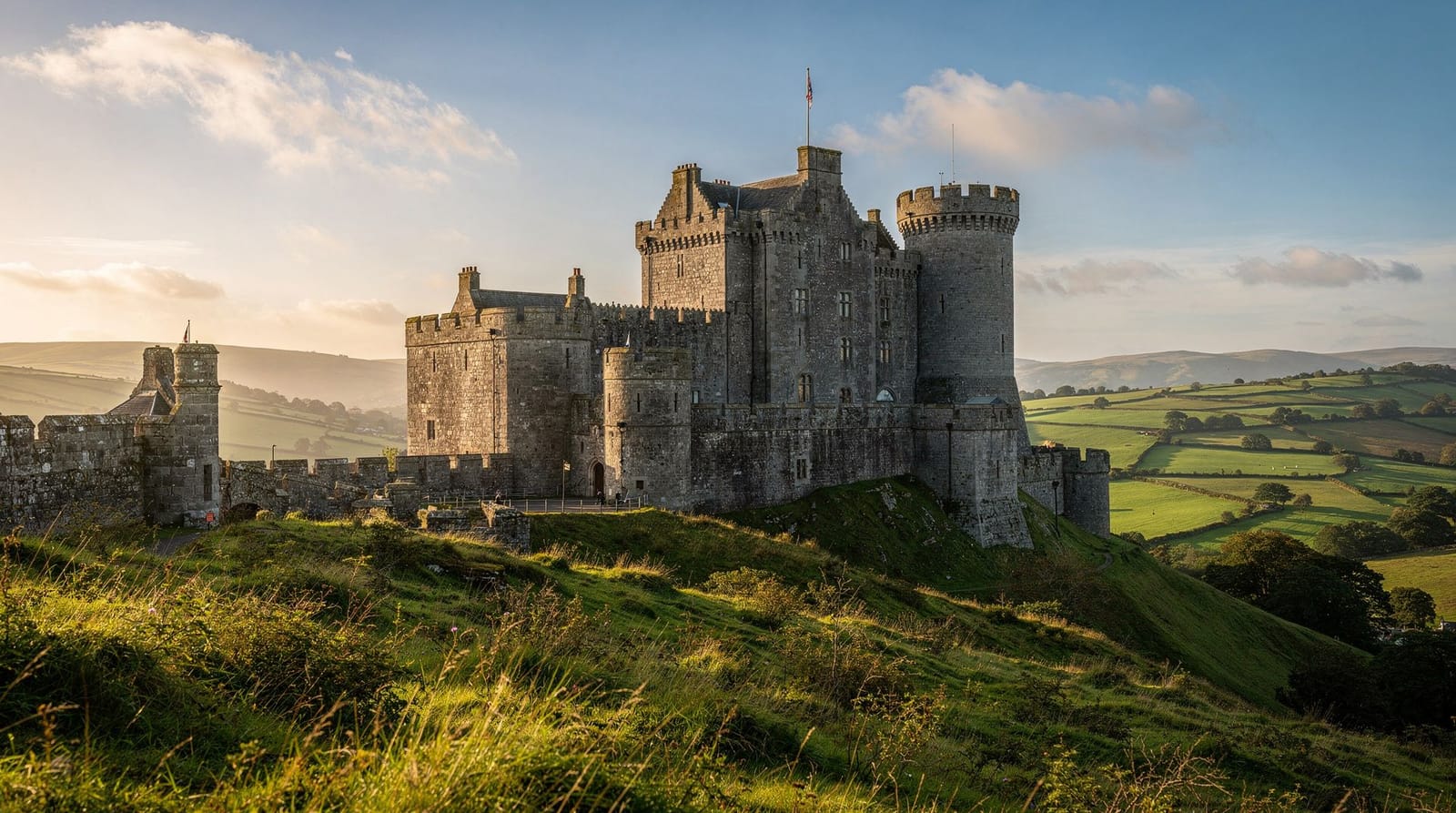
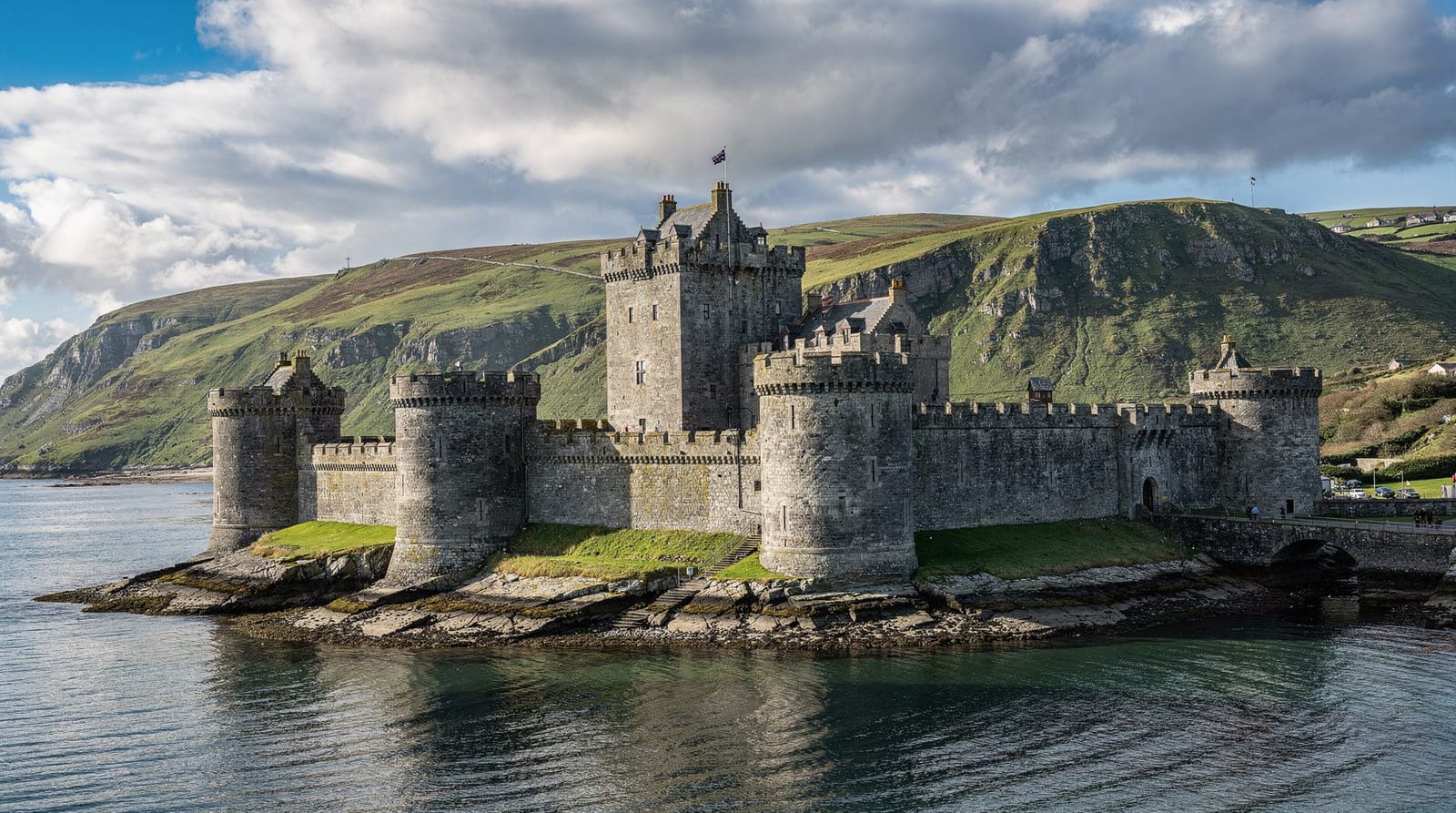
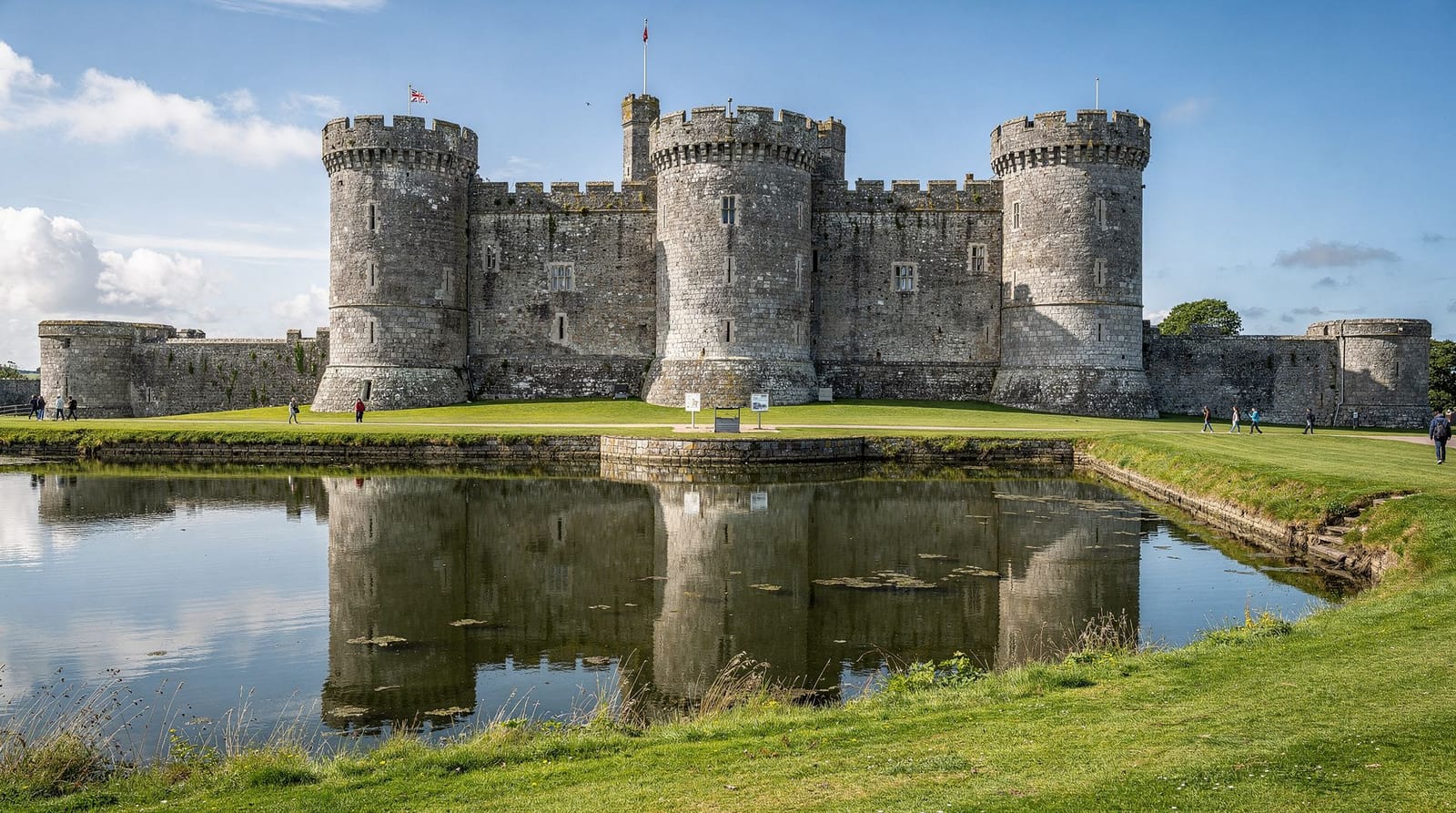
Caernarfon Castle is the largest and most symbolically loaded of Edward I’s Welsh fortresses — built not as a garrison but as a statement of imperial authority, and the site of two royal investitures centuries later. This guide covers the history, what to see, and how to get there from Chester.
| Where | Caernarfon, Gwynedd, North Wales |
| Cost | Around £11-12 adult admission (Cadw) |
| Time needed | At least 1.5-2 hours |
| Getting there | Train to Bangor (~1hr20-1hr40) + bus/taxi, or a guided day tour from Chester |
| Best time | Early morning in summer to beat coach-tour crowds |
Edward I’s grandest and most political castle
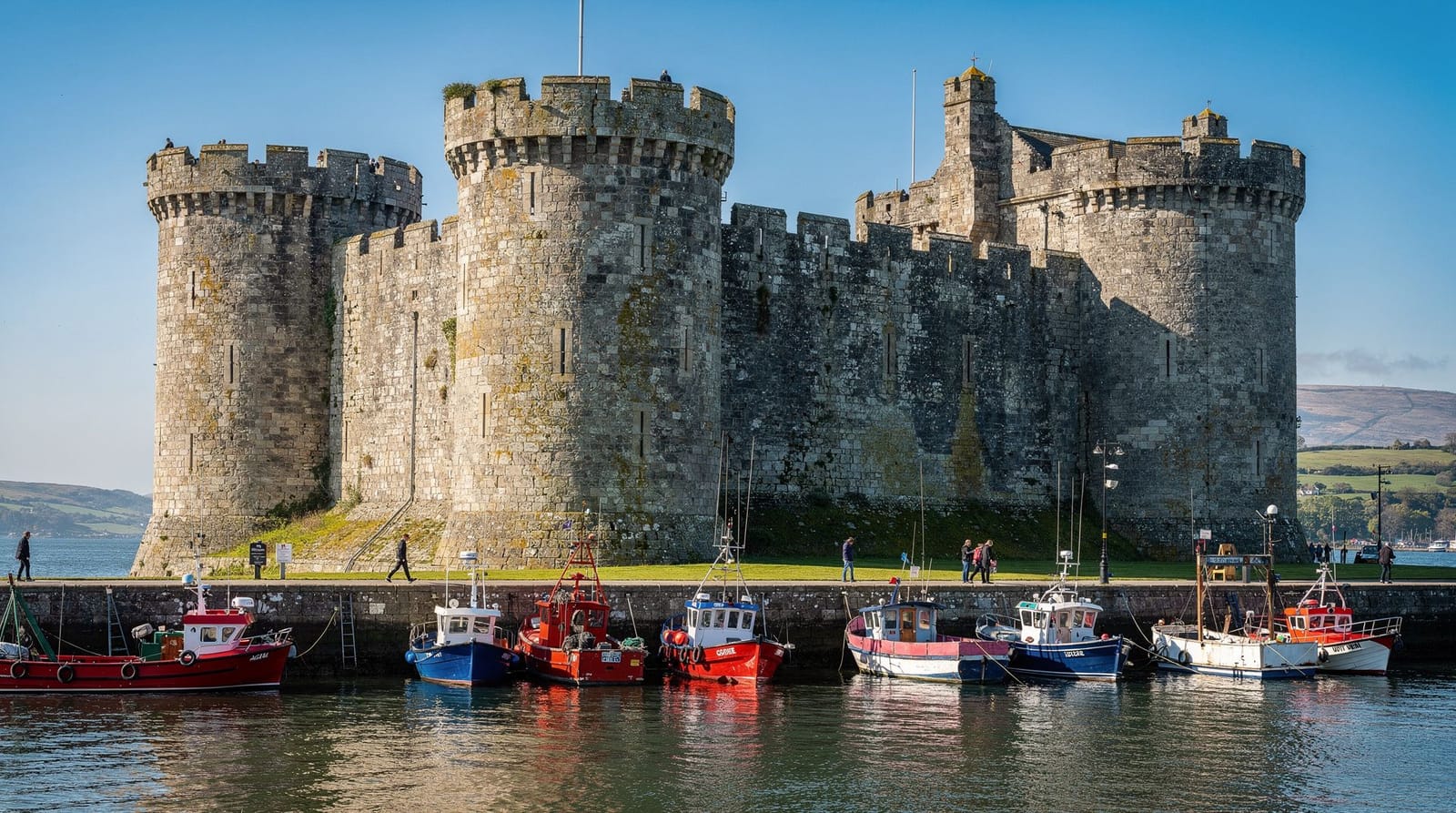
Caernarfon Castle is the largest and most architecturally ambitious of the fortresses Edward I built during his conquest of North Wales in the late 13th century, and unlike its sister castles at Conwy, Beaumaris and Harlech, it was never intended purely as a military garrison. Caernarfon was designed and built to function as the administrative seat of English royal authority over the whole of North Wales — a capital in stone, and its architecture makes that ambition unmistakable even seven centuries later.
Construction began in 1283, immediately after the death of Llywelyn ap Gruffudd, the last native Prince of Wales, and continued in phases for several decades, with the castle never fully completed according to its original, even more ambitious design — a fate shared with Beaumaris, the last and largest of Edward’s Welsh castles, which was also left unfinished. What was completed at Caernarfon, though, remains one of the most imposing and best-preserved medieval fortresses in Britain, and its symbolic weight in both English and Welsh history extends well beyond its physical scale.
Why Caernarfon looks different from Edward’s other castles
The most distinctive feature of Caernarfon’s design is its polygonal, many-sided towers, in contrast to the plain round towers used at Conwy, Harlech and Beaumaris, combined with bands of different coloured stone running through the curtain walls. This design wasn’t accidental or purely decorative — it deliberately echoes the Theodosian land walls of Constantinople, the Byzantine capital, connecting Edward’s new fortress to the legend of Magnus Maximus, a 4th-century Roman general and briefly a Western Roman emperor who held deep significance in Welsh political mythology as a legendary founding figure of Welsh royal lineages, appearing in medieval Welsh literature including the Mabinogion.
By building a castle that visually referenced Constantinople and, through it, the legend of a Roman emperor claimed as an ancestor by Welsh princely dynasties, Edward was making an unusually sophisticated propaganda statement — asserting that English royal authority in Wales was not simply a conquest but a legitimate inheritance of a deeper imperial Roman tradition that Welsh tradition itself had already claimed. It’s one of the more intellectually elaborate pieces of medieval political architecture anywhere in Britain, and worth knowing before you visit, since the polygonal towers and coloured stone banding can otherwise just look like an unexplained stylistic choice rather than a deliberate act of political messaging.
Two royal investitures
Caernarfon’s association with English royal authority over Wales made it the deliberately chosen site for the investiture of the Prince of Wales in the modern era — first in 1911, when Prince Edward (later briefly Edward VIII before his abdication) was invested at the castle in a ceremony revived and elaborately staged partly for its symbolic value, and again in 1969, when Prince Charles, now King Charles III, was invested at Caernarfon in a ceremony broadcast internationally and watched by an estimated worldwide television audience in the hundreds of millions.
Both ceremonies were held specifically because of Caernarfon’s historic weight as the seat of Edward I’s original assertion of English authority over Wales, a decision that remains politically contested in parts of Wales given the castle’s origin as a monument to conquest rather than a neutral ceremonial site.
Physical traces of the 1969 investiture remain visible within the castle, including the dais and setting used for the ceremony, and information displays cover both investitures in more detail — a genuinely unusual case of a medieval fortress remaining directly relevant to 20th-century constitutional ceremony rather than existing purely as a historical relic.
Inside the castle
Caernarfon’s scale allows for a more complex internal layout than the other Welsh castles, with several towers open to visitors offering different vantage points over the town, the River Seiont and the Menai Strait toward Anglesey. The Eagle Tower, the largest and most elaborately decorated of the castle’s towers, was likely intended as the residence of the castle’s constable and carries carved eagle sculptures on its turrets — a rare survival of the sort of decorative flourish more castles would originally have had before centuries of weathering and deliberate later demolition stripped most such details away elsewhere.
The castle also houses the Royal Welch Fusiliers Museum, covering the history of the regiment within one of the towers — a detour into more recent military history that some visitors skip in favour of the medieval architecture, but worth at least a brief look if regimental and Welsh military history interests you. Information panels throughout explain the castle’s construction phases, the 1294 Welsh uprising under Madog ap Llywelyn that briefly captured and damaged the still-unfinished castle before Edward’s forces retook it, and the long slide into disuse and disrepair after the Civil War period, when — as with most of Edward’s Welsh castles — the fortress’s active military role effectively ended.
The scale of the building effort, in numbers
As with Conwy, surviving medieval financial records give an unusually detailed picture of what building Caernarfon actually involved, and the numbers are worth pausing on. Construction drew on a workforce that, at its peak, likely exceeded 1,500 people in a single building season — masons, quarrymen, carpenters, smiths, lime-burners and general labourers, many conscripted from counties across England and transported to North Wales specifically for the project, at a cost that historians estimate placed one of the most significant strains on royal finances of Edward’s entire reign.
Stone came partly from local quarries and partly shipped in from further afield, and the logistics of feeding, housing and paying such a large workforce in a recently conquered, still-unstable region required a level of administrative organisation that was, for its time, genuinely remarkable.
That the castle was never fully completed according to its original plan — several intended additional towers and defensive elements were never built, largely due to the financial strain of Edward’s ongoing wars elsewhere, including in Scotland — is itself informative. Caernarfon as it survives today represents an ambitious project that outgrew even a powerful medieval king’s ability to fully fund it, a detail easy to miss when looking at what remains an imposing, seemingly complete fortress from the outside.
Contested symbolism and the 1969 investiture
Caernarfon’s role as the site of Prince Charles’s 1969 investiture remains a genuinely contested piece of modern history within Wales, worth understanding rather than glossing over as straightforward royal pageantry. The ceremony was accompanied by significant protest and controversy at the time, including a bombing campaign by Welsh nationalist paramilitary groups targeting infrastructure in the run-up to the event, and continuing debate in the decades since over whether staging the investiture at a castle built explicitly to subjugate Welsh political independence was an appropriate — or deliberately provocative — symbolic choice.
This tension between Caernarfon’s role as a UNESCO heritage site celebrating medieval architecture and its origin as a monument to conquest is worth holding in mind as you walk through, rather than experiencing the castle purely as an impressive stone spectacle divorced from what it was actually built to achieve.
Cadw’s own interpretation materials at the site have, in recent years, engaged more directly with this complexity than older, more purely celebratory heritage presentations once did — a reflection of a broader shift in how UK heritage bodies present sites tied to conquest and colonial-style political control.
Photography and best viewpoints
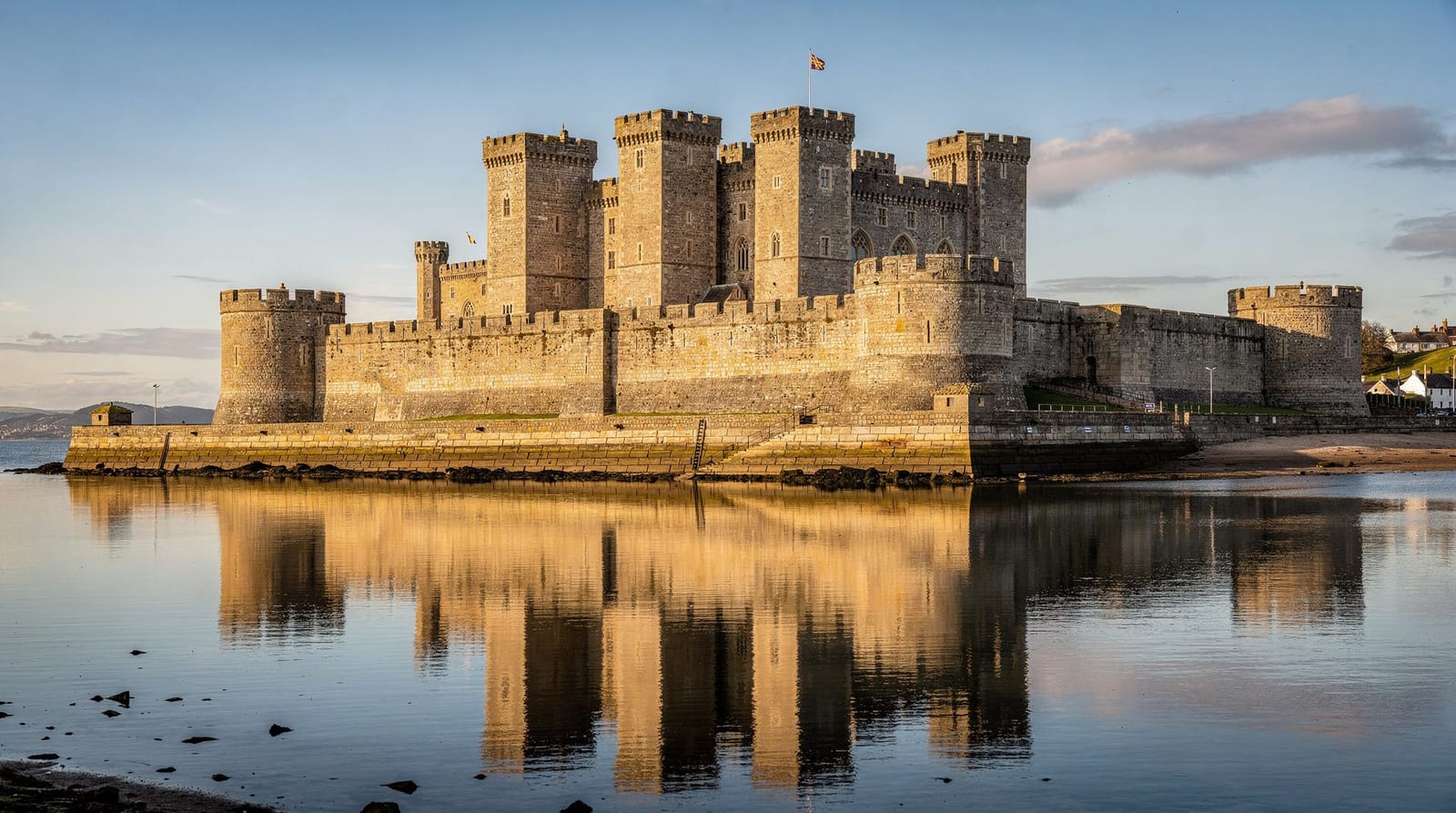
The classic exterior view of Caernarfon Castle, with its full length of curtain wall and polygonal towers reflected in the River Seiont, is best captured from the Aber Swing Bridge or the riverside path on the opposite bank, ideally in the low light of early morning before the town’s day-trip crowds arrive.
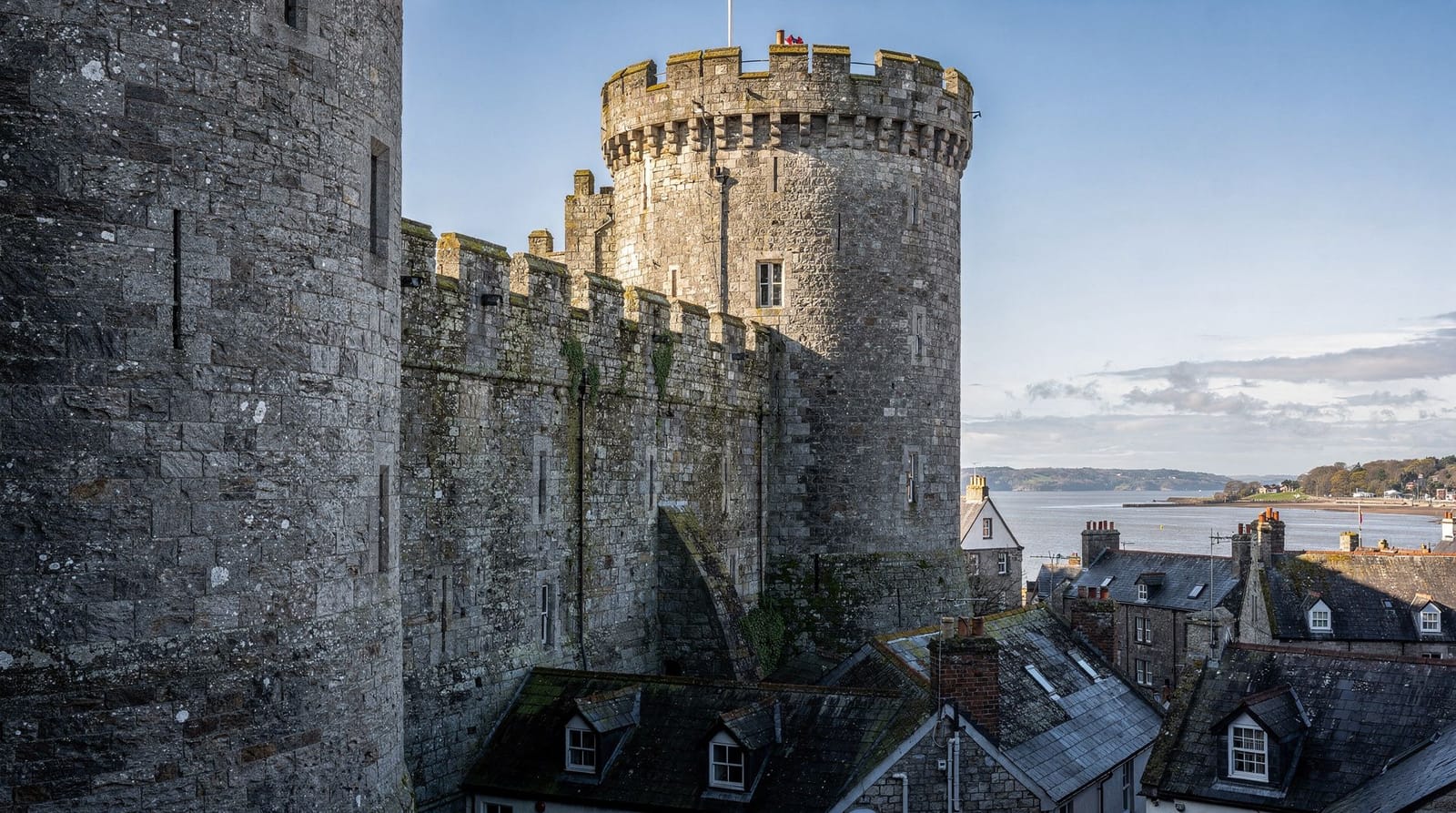
From within the castle, the Eagle Tower and Queen’s Tower both give elevated views back over the town’s rooftops and out toward the Menai Strait and Anglesey — genuinely dramatic sightlines that convey the castle’s strategic command of the estuary far better than ground-level photographs can. Because Caernarfon draws heavy coach-tour traffic in peak summer months, an early arrival — ideally at opening time — gives noticeably better photographs and a more contemplative visit than a midday arrival during July or August.
Visiting with children
Caernarfon’s scale and the genuine sense of exploring a small, self-contained stone town-within-a-town tend to hold children’s attention well, particularly the climbable towers and the regimental museum’s displays of uniforms and medals, which often appeal even to children with limited patience for purely architectural history.
Cadw provides family activity materials at busier periods, and the castle’s size means there’s enough to explore that a family visit can comfortably fill an hour and a half to two hours without repetition. Given the more involved journey from Chester, families without a car may find a guided day tour — which removes the need to manage train and bus connections with children in tow — a more practical option than independent public transport travel.
Getting to Caernarfon from Chester
Caernarfon is one of the less straightforward North Wales castles to reach by public transport, since its original railway station closed in the 1970s and no direct rail line currently serves the town. The practical route from Chester involves a train to Bangor, taking roughly 1hr20-1hr40 depending on connections, followed by local bus service 5C (running frequently between Bangor and Caernarfon) or a taxi for the final 20-30 minute leg. Some coach and long-distance bus services offer more direct routes on certain days, worth checking if you’re planning independent travel.
Given this added complexity, many visitors instead choose the guided day tour from Chester covering North Wales and Caernarfon Castle, which handles the full return journey and typically combines Caernarfon with other regional stops in a single day — a considerably simpler option than managing train and bus connections independently, particularly if your time in the region is limited to a single day trip from Chester. By car, the drive takes around 1hr15-1hr30 via the A55 and A487, faster and more flexible than public transport if you’re comfortable driving on unfamiliar roads.
Caernarfon is two hours west of Chester and its castle belongs to the ring Edward I built to hold Gwynedd, which means the drive through the mountains is part of the argument: a North Wales and Caernarfon Castle tour from Liverpool covers that line.
Guided tours once you’re in Caernarfon The Caernarfon Castle guided tour with entry ticket departing from Holyhead is a useful option if your North Wales trip is centred on Anglesey or a cruise stop at Holyhead rather than Chester directly, combining transport and a guided castle visit with entry included. For visitors who want to explore the wider historic town beyond the castle walls, the guided walking tour of Caernarfon’s historic town covers the medieval town walls (which, like Conwy’s, largely survive and are walkable) and the town’s later Georgian and Victorian development, giving context the castle alone doesn’t provide.
Caernarfon town beyond the castle
Caernarfon’s own medieval town walls, while less famous than Conwy’s, survive substantially intact and are worth a walk if you have the time, offering views back toward the castle and out over the Menai Strait. The town itself has a strong Welsh-language character — Caernarfon has one of the highest proportions of Welsh speakers of any town in Wales, and it’s common to hear Welsh as the primary language of daily conversation on the streets, a genuinely different atmosphere from more anglicised North Wales coastal towns like Llandudno.
The harbour area and waterfront give good views back across the water toward Anglesey, and several cafés and pubs around the town square (Y Maes) offer reasonable value compared with prices immediately at the castle entrance.
Combining Caernarfon with the rest of North Wales
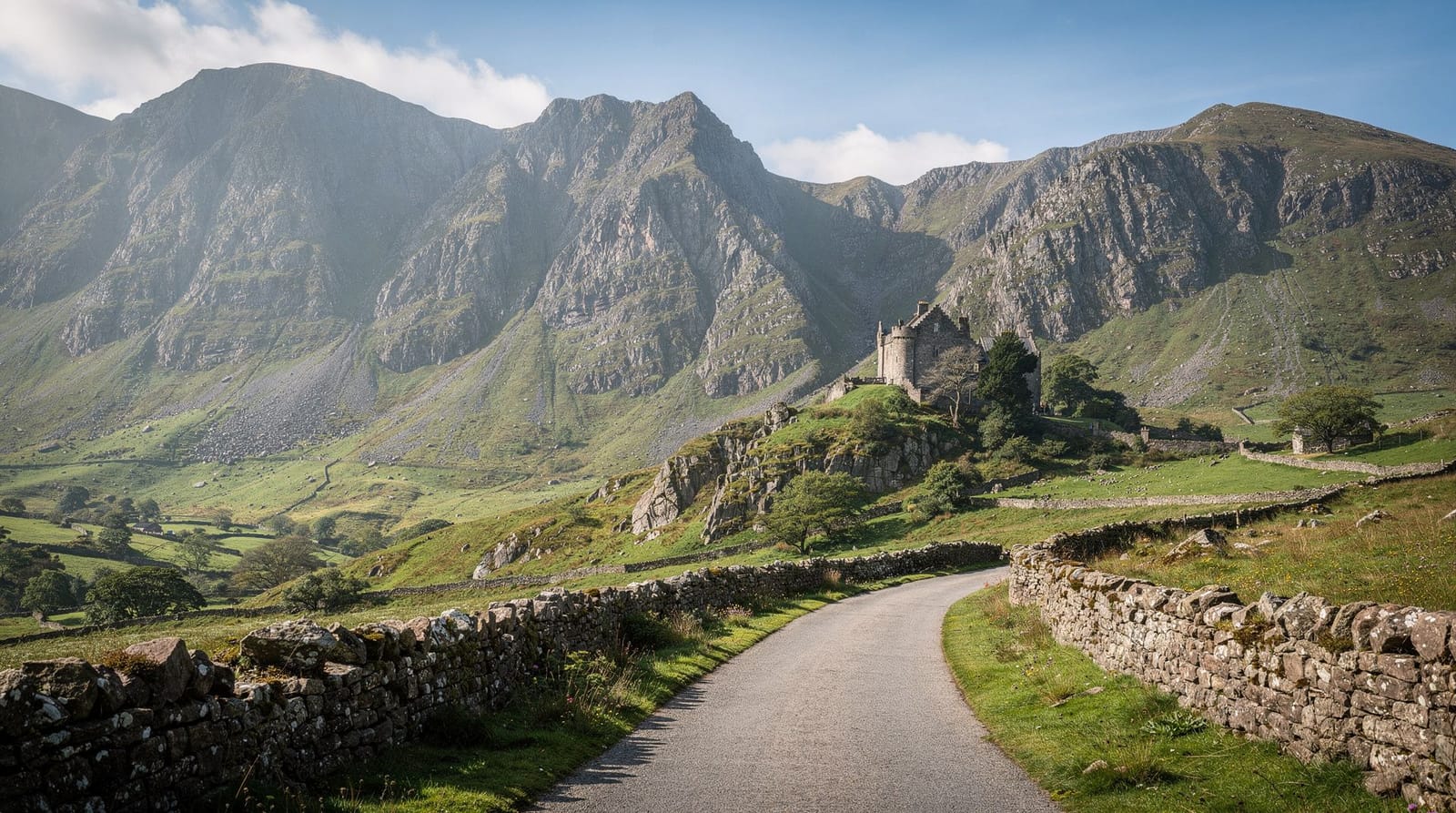
Caernarfon’s position close to the Menai Strait makes it a natural pairing with Anglesey attractions, including Beaumaris Castle a short distance across the strait, and several guided tours combine the two. It also sits within reasonable reach of Snowdonia’s western side, making it a plausible base or stop for visitors combining castle history with mountain scenery.
Our Welsh castles 2-day itinerary pairs Caernarfon with Conwy and Beaumaris across a weekend, the most efficient route through the region’s UNESCO castle cluster, while the 3-day Chester and North Wales itinerary allows more time to add Snowdonia or Anglesey exploration around the castle visits.
Caernarfon versus Beaumaris and Harlech
Set against the other two UNESCO castles in the same World Heritage listing, Caernarfon occupies a distinct middle ground. Beaumaris, on Anglesey, is the most geometrically perfect of Edward’s Welsh castles — a textbook concentric design, symmetrical and mathematically precise, but smaller in scale and lacking Caernarfon’s imposing town-wall integration and dramatic waterfront setting.
Harlech, by contrast, relies almost entirely on its spectacular natural clifftop position for its impact, with a more compact fortress that doesn’t attempt Caernarfon’s scale or symbolic architectural programme. Of the three, Caernarfon is generally considered the most historically and architecturally significant single site, largely because of the combination of its size, its unique polygonal-tower design referencing Constantinople, and its ongoing use for royal ceremony centuries after its original construction — a level of continued relevance none of the other Welsh castles can claim.
What visitors underestimate before arriving
Most first-time visitors underestimate two things about Caernarfon: how much walking the full circuit actually involves once you factor in multiple towers and wall-walks, and how genuinely different the town’s atmosphere feels from Chester or Conwy given how widely spoken Welsh is on the streets.
Neither is a problem exactly, but both are worth knowing ahead of time so a first visit doesn’t feel rushed or, in the case of the language point, mistaken for something unusual rather than simply the normal character of a strongly Welsh-speaking town. Budgeting slightly more time than a quick castle-ticking visit, and approaching the town itself as worth a slower look rather than a rush back to the car park or bus stop, tends to leave visitors with a considerably better impression of Caernarfon overall.
Weather and seasonal visiting notes
Caernarfon’s exposed coastal position means wind is a genuine factor for tower visits, particularly on the higher wall-walks and the Eagle Tower’s upper levels, where a blustery day can make photography and even comfortable walking noticeably more difficult than at more sheltered inland sites. Summer generally brings the calmest conditions alongside the heaviest crowds, while spring and autumn offer a reasonable compromise between manageable weather and lighter visitor numbers.
Winter visits see the castle’s interior courtyards and lower levels remain fully accessible, though the more exposed tower-top viewpoints can be genuinely unpleasant in high wind or driving rain — check conditions and dress accordingly if visiting outside the summer months, since the coastal microclimate here can differ noticeably from inland Chester on the same day.
Visiting solo or as a couple versus a family group
Solo travellers and couples can move through Caernarfon’s towers and wall-walks at their own pace without much extra planning, and the castle’s scale gives enough to explore for a genuinely satisfying couple of hours without feeling padded. Families should budget a little more slack for the regimental museum and the climbable towers, which tend to hold children’s attention longer than the purely architectural detail, and should factor the more involved journey from Chester into deciding whether independent travel or a guided tour suits the group better on the day.
Tourist traps and practical notes
Parking near the castle in central Caernarfon is limited during peak summer months; the town’s main car parks a short walk from the castle are generally the more reliable option than seeking on-street parking directly adjacent. As with most heavily visited castle towns, food and souvenir prices immediately around the castle entrance and Y Maes square run higher than side streets a few minutes further into town — worth the short walk for better value, particularly for a full meal rather than a quick coffee.
Caernarfon, Conwy and Beaumaris at a glance
| Castle | Design focus | Best reached from Chester by | Signature moment |
|---|---|---|---|
| Caernarfon | Scale and imperial symbolism | Train to Bangor + bus, or guided tour | Eagle Tower views, investiture history |
| Conwy | Preservation and compactness | Direct train, ~55 min | Full circuit of intact town walls |
| Beaumaris | Theoretical concentric perfection | Car, or train to Bangor + bus | Flat, symmetrical double-ring plan |
| Harlech | Dramatic natural setting | Train + bus/car | Clifftop silhouette |
If time only allows one, Caernarfon gives the broadest single-visit story — architecture, conquest history and continuing royal ceremony all in one site — but it also demands the most travel effort from Chester of the four.
Regimental museum and what else fills a longer visit
Beyond the main circuit, the Royal Welch Fusiliers Museum inside one of the towers adds a genuinely different layer to a visit for anyone with an interest in more recent military history, covering regimental service well beyond the castle’s medieval origins. Visitors budgeting a longer, unhurried visit — closer to two hours than 90 minutes — typically split their time roughly evenly between the wall-walks and towers, the regimental museum, and a slower look at the information panels covering the 1294 uprising and the castle’s construction financing, rather than rushing the whole circuit in one pass.
Booking the guided tour versus going independently
For visitors weighing the guided day tour against independent train-and-bus travel, the trade-off is fairly clear-cut: independent travel costs less but adds real complexity (two changes minimum, plus the Bangor-Caernarfon leg), while the guided day tour from Chester costs more but removes all the logistics and typically bundles in other regional stops.
Families with young children, or anyone travelling with limited mobility, generally get more value from the guided option given how much smoother it makes an otherwise multi-leg journey. Solo travellers or those comfortable navigating UK public transport independently can save meaningfully by going it alone, provided they build in a reasonable buffer around bus connections in Bangor.
Planning your visit
Caernarfon Castle is open year-round with seasonal variation in hours, generally longer in summer months and reduced in winter — check current Cadw opening times before travelling. Given the more involved journey from Chester compared with Conwy’s direct rail link, Caernarfon works best either as part of a guided day tour that removes the transport logistics entirely, or as one stop within a longer, multi-day North Wales itinerary where the extra travel time is easier to absorb.
For the fuller comparison against the other three UNESCO-listed Edward I castles, see our Welsh castles guide and Edward I castles guide.
Frequently asked questions about Caernarfon Castle
Why is Caernarfon Castle famous for royal investitures?
Caernarfon has hosted the investiture of the Prince of Wales twice in the modern era — Prince Edward (later Edward VIII) in 1911 and Prince Charles (now King Charles III) in 1969 — both held deliberately at this specific castle because of its historic and symbolic association with English royal authority over Wales dating back to Edward I's original conquest.Is Caernarfon Castle bigger than Conwy Castle?
Yes, considerably. Caernarfon covers a larger footprint with more elaborate polygonal towers and a more complex internal layout, reflecting its intended role as the administrative capital of English-ruled North Wales rather than a purely military garrison — Conwy, while extremely well preserved, is a more compact, vertically dramatic fortress by comparison.Why do Caernarfon's towers look different from other Welsh castles?
Caernarfon's towers are polygonal (many-sided) rather than the plain round towers used at Conwy, Harlech and Beaumaris, and the walls feature bands of different coloured stone. This design deliberately echoes the Theodosian walls of Constantinople, tying Edward I's new fortress to the legend of the Roman emperor Magnus Maximus, a figure with deep roots in Welsh political mythology.How do you get to Caernarfon Castle without a car?
There's no direct rail line to Caernarfon since its original station closed in the 1970s. The practical route from Chester is train to Bangor (around 1hr20-1hr40 depending on connections), then local bus service 5C or a taxi for the final 20-30 minutes, or a coach service that runs more directly on certain routes. Many visitors instead join a guided day tour from Chester that handles the full return journey.How long should you budget for a Caernarfon Castle visit?
At least 1.5-2 hours given its larger size compared with other Welsh castles, longer if you want to see the regimental museum housed within one of the towers or properly explore all the wall-walks and towers, several of which are open to visitors and offer different vantage points over the town and the Menai Strait.Is Caernarfon worth combining with a visit to Anglesey?
Yes, geographically it makes sense — Caernarfon sits close to the Menai Strait crossing into Anglesey, home to Beaumaris Castle and other attractions. Several guided day tours combine Caernarfon with Anglesey stops, and it's a natural pairing if you're exploring the region over more than a single day.
Top experiences
Bookable activities with verified prices and instant confirmation on GetYourGuide.