Llandudno: Wales's best-preserved Victorian seaside resort
Llandudno day trip guide from Chester: the Great Orme headland, Victorian pier, Alice in Wonderland links and honest advice on getting there.
Llandudno: City Sightseeing Hop-On Hop-Off Bus Tour
Quick facts
- From Chester
- ~1h07 direct by train, roughly £10 each way
- Known for
- The Great Orme headland, Victorian pier, Alice in Wonderland connections
- Pier length
- 2,295 ft — the longest pier in Wales
- Great Orme access
- Cable car (longest passenger cabin cable car in Britain) or Victorian tramway
- Currency
- GBP (£)
Quick answer: Llandudno is a direct, roughly 1h07 train ride from Chester (about £10 each way) and is widely considered Wales’s best-preserved Victorian seaside resort, built almost entirely in the 1850s-1870s around a curved bay between two headlands. Its main draws are the Great Orme (a limestone headland reachable by cable car or vintage tramway), a 2,295ft pier, and a set of genuine Alice in Wonderland connections. Half a day covers the town; a full day adds the Great Orme properly.
| Where | North Wales coast, ~1h07 direct train from Chester |
| Cost | ~£10 each way by train; Great Orme extras £10-20 |
| Time needed | Half a day for the town, a full day with the Great Orme |
| Getting there | Direct train to Llandudno station, short walk to the front |
| Best time | May to September for full pier, beach and Orme opening hours |
A resort built to a plan, not grown organically
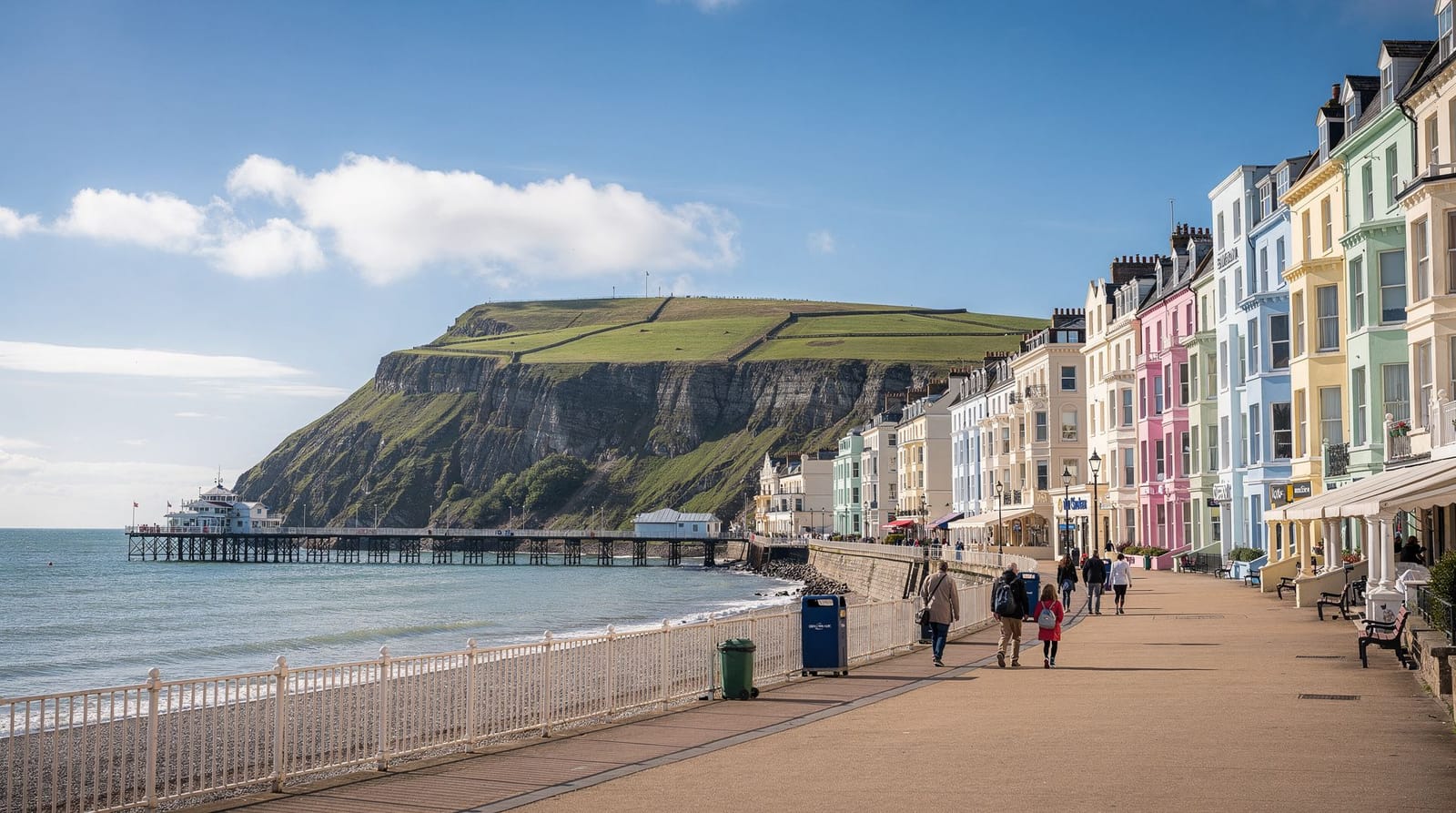
Unlike most British seaside towns, Llandudno wasn’t a fishing village that grew into a resort — it was deliberately planned and built from the 1850s onward as a purpose-designed Victorian holiday destination, laid out around the curved Marine Drive and North Shore promenade with wide streets and consistent architecture that still defines the town’s character today. That planned uniformity is part of why it reads as unusually well-preserved compared to seaside towns that grew more haphazardly.
The Great Orme: coastal views without a mountain hike
The Great Orme is a 207m limestone headland forming the town’s northern boundary, and it’s the main reason to budget a full day rather than a half day in Llandudno. Two options get you to the top without walking: the Great Orme Cable Car, Britain’s longest passenger cabin cable car at just under a mile, and the Great Orme Tramway, the only cable-hauled street tramway still operating in Britain, running since 1902 in two sections up the hillside.
The headland itself is also home to a herd of feral Kashmiri goats, descended from a pair gifted to Queen Victoria in the 1870s and now a genuinely wild, self-sustaining population that occasionally wanders down into the town itself — a minor local news story whenever it happens, and a distinctive enough sight that they’ve become something of an unofficial town mascot.
At the summit, a small visitor centre, café and the remains of Bronze Age copper mines (among the largest prehistoric mines discovered anywhere in the world, dating back around 4,000 years) give reason to stay beyond the view itself. Coastal path walks around the headland range from easy 20-minute loops to more ambitious multi-hour circuits. Full detail at Great Orme Llandudno and the family angle at Family Days Out Cheshire if you’re combining with a Cheshire-based trip.
Two shores, two personalities
Llandudno is unusual among British seaside resorts in having two distinct beaches on either side of the same headland, and they’ve developed genuinely different characters. The North Shore, facing the main bay with the pier and the classic Victorian promenade of hotels, is the busier, more traditionally “seaside resort” side, with a shingle-and-sand beach and the town’s main tourist infrastructure.
The West Shore, a short walk across the headland’s base, is quieter, sandier, and looks out toward Conwy and the Snowdonia mountains rather than open sea — genuinely worth the walk across if the North Shore’s crowds and amusement-arcade atmosphere aren’t what you’re after, and it’s also the shore most associated with the Liddell family’s holiday visits and the Alice in Wonderland connection.
The pier: the longest in Wales
Llandudno Pier stretches 2,295 feet into the bay, the longest pier in Wales, built in 1878 and largely intact in its Victorian ironwork despite a couple of historical fires. It’s a genuinely pleasant walk with sea views on both sides, lined with traditional arcades and kiosks — worth doing at a slow pace rather than treating as a quick photo stop.
Alice in Wonderland: a genuine, if slightly stretched, literary link
Llandudno markets itself heavily on its connection to Alice Liddell, the real-life inspiration for Lewis Carroll’s Alice in Wonderland, whose family had a holiday home in the town (still standing, now a hotel) during the 1860s. Whether Carroll himself actually visited Llandudno to meet the family there is disputed by biographers — the stronger, verified fact is simply that the Liddells holidayed here, and the town has built statues, trails and a genuine cottage industry around the connection regardless. Worth knowing as an honest caveat if you’re expecting definitive documented history rather than a marketed literary association.
Happy Valley and the Little Orme
Between the pier and the Great Orme, Happy Valley is a small Victorian ornamental garden built into the hillside, a pleasant, low-key green space that’s easy to miss if you head straight from the pier to the cable car. On the opposite side of the bay, the Little Orme (smaller and less developed for tourism than its more famous neighbour) offers quieter coastal walking and is a genuine local nesting site for seabirds, including kittiwakes and guillemots in season — a reasonable alternative for visitors who find the main Great Orme attractions too commercialised and want a plainer coastal walk instead.
Mostyn Street and the Victorian shopping arcades
Llandudno’s main shopping street, Mostyn Street, retains a genuinely Victorian character in its architecture, including several original glass-canopied arcades that have survived where equivalent structures in many British seaside towns were demolished during 20th-century redevelopment. It’s a pleasant wander rather than a major shopping destination — expect independent gift shops, tea rooms and a scattering of antique dealers rather than significant retail variety.
The Alice trail: statues and a full themed walking route
The town has leaned into its Alice Liddell connection with a series of bronze statues and interpretation boards scattered through the town centre and along the promenade, forming an informal “Alice Trail” that families with children particularly enjoy tracking down — the White Rabbit, the Mad Hatter and the Cheshire Cat all feature among the installations. It’s a low-cost, self-guided activity that works well alongside the more passive sightseeing of the pier and beach, and the local tourist information centre stocks a printed map of the trail’s locations if you want to do it systematically rather than stumbling across statues at random.
Getting there and around
Chester to Llandudno runs direct in about 1h07 on the North Wales coast line, roughly £10 each way — one of the more straightforward and reliable train connections covered in this guide, without the change-of-train complications that affect Liverpool or the Lake District routes. Once there, the town centre, promenade and pier are all walkable; the Great Orme requires the cable car, tramway, or a proper uphill walk.
Llandudno hop-on hop-off bus tour is a reasonable option if you want to cover the town, promenade and Great Orme approach without walking the full distance, running on a 24-hour ticket basis.
Copper mining beneath the golf course
The Great Orme’s summit isn’t just a viewpoint — the Bronze Age copper mines discovered here in the 1980s are recognised as among the largest and best-preserved prehistoric mine workings found anywhere in the world, dating back roughly 4,000 years and worked using stone and bone tools rather than metal, since metal tools didn’t yet widely exist when mining began.
A visitor centre and guided tunnel sections let you descend into the actual worked passages, a genuinely different kind of attraction from the headland’s other, more scenery-focused draws — worth an hour if you’re already at the summit for the cable car or tramway. Above ground, part of the same headland doubles as a golf course and a dry ski slope, an odd but functional use of the limestone grassland that most first-time visitors don’t expect.
Llandudno versus Blackpool and Conwy: an honest comparison
Llandudno occupies a genuine middle ground between this guide’s other coastal destinations. Compared to Blackpool, it’s calmer, more architecturally coherent, and free of the fairground-and-rollercoaster intensity — a better fit for visitors wanting Victorian seaside atmosphere without the noise, though correspondingly less exciting for anyone specifically wanting big rides.
Compared to Conwy, Llandudno has more to fill a full day (the pier, both shores, the Great Orme’s several separate attractions) but lacks Conwy’s dense medieval history — Llandudno is a planned Victorian resort rather than a genuinely ancient settlement, and its oldest buildings date only to the 1850s. Which of the two suits a given day depends on whether you want history (Conwy) or a fuller day of scenery and seaside activity (Llandudno).
The Cottage Loaf and other small local landmarks
Beyond the headline attractions, Llandudno rewards a bit of slower wandering — the town’s original Victorian bandstand still hosts occasional summer performances, and several of the North Shore hotels retain original period features (ornate ironwork balconies, stained glass) that repay a closer look rather than a passing glance on the way to the pier. This is a town that generally suits an unhurried pace better than a tightly scheduled itinerary; several of its best moments (a bench on the promenade at sunset, the goats on the Orme, an empty stretch of the West Shore off-season) aren’t things you can plan around a departure time.
Using Llandudno as a base for the wider coast
Llandudno’s position makes it a workable overnight base for reaching Conwy (a few minutes further along the coast) and for day tours into Snowdonia, Anglesey or Portmeirion, several of which depart directly from the town rather than requiring a transfer.
Portmeirion, Snowdonia and castles tour from Llandudno runs about 9 hours and combines several of the region’s highlights in one day — a practical option if you’re staying in Llandudno rather than Chester and want a single comprehensive day out.
Scenic Anglesey and ancient relics private tour covers the Menai Strait island and its prehistoric sites (including burial chambers older than Stonehenge) for travellers wanting to go beyond the immediate coast. See Conwy, Anglesey and Snowdonia for the destinations themselves.
Where to eat and stay
Llandudno’s dining leans toward traditional seaside fare — fish and chips, tea rooms, and a genuine afternoon-tea culture connected to its Victorian resort identity — plus a growing number of independent cafés along Mostyn Street. The Grand Hotel and Imperial Hotel on the promenade are both genuine Victorian-era survivors rather than modern reproductions, and several of the North Shore’s guesthouses occupy original 19th-century townhouses, giving overnight stays here a more historically authentic feel than the equivalent experience in many rebuilt seaside towns.
It’s a comfortable rather than adventurous food destination; don’t expect Manchester or Liverpool’s range, though the quayside seafood restaurants toward Conwy make a worthwhile short trip for a better meal if you’re staying more than a night.
Llandudno’s conference and events trade
Beyond tourism, Llandudno has quietly built a second identity as a conference town — its Venue Cymru complex hosts several major UK political party conferences and other large events each year, a legacy of the town’s large stock of Victorian hotel rooms originally built for seaside holidaymakers and now equally useful for delegates. This can occasionally affect hotel availability and pricing during conference season, worth a quick check if you’re planning a visit and booking accommodation close to the date, since a major conference can fill much of the town’s room stock with limited notice to casual visitors.
Practical planning notes
Llandudno railway station sits a short, flat walk from the promenade and pier, making it one of the more straightforward arrivals in this guide compared to Chester’s own longer station-to-centre walk. The town is generally well-suited to visitors with limited mobility at street level — the promenade, pier and Mostyn Street are all flat and paved — though the Great Orme summit attractions (the copper mine tunnels specifically) involve uneven underground passages not suited to wheelchair access, and the coastal path around the headland has some steeper, unpaved sections. The cable car and tramway both offer step-free or minimal-step boarding at their base stations, making the summit views themselves more accessible than the mine tour.
Honest cautions
The Great Orme cable car and tramway both run reduced or closed schedules outside the main April-October season — check current opening before planning a visit specifically around them in winter, and note that the cable car in particular suspends operation in high winds, a genuine risk on an exposed headland even on days that seem calm at sea level.
Parking in the town centre gets tight on summer weekends and bank holidays, and some of the seafront amusement arcades charge tourist-resort prices for fairly basic activities — fine as a nostalgic hour, not something to budget significant time or money around. Unlike Conwy, which is compact enough to see everything in half a day, Llandudno’s Great Orme attractions (cable car, tramway, copper mines, Alice Trail) can genuinely fill a full day on their own if you do more than one — plan accordingly rather than assuming a brief look at the summit covers the headland’s full offering.
Llandudno’s seafront hotels and the promenade at night
Beyond a daytime visit, Llandudno’s North Shore promenade takes on a different, quieter character in the evening, with the Grand and Imperial hotels’ period lighting and the pier’s illuminations visible along the curve of the bay — worth knowing if you’re staying overnight rather than day-tripping, since the town’s evening pace is genuinely more relaxed than its daytime bustle around the pier entrance and Mostyn Street.
A half-day plan if you’re tight on time
If you’re only staying a few hours between trains, prioritise the promenade and pier walk (about 45 minutes at an unhurried pace), then choose one of the Great Orme access options rather than trying to fit both the cable car and tramway in. The West Shore, a short walk across the headland’s base, is worth the detour if you want a quieter photo stop away from the main promenade crowds, and it takes only 15-20 minutes there and back from the pier entrance. Skipping the copper mines and the full Alice Trail is the easiest way to compress a full day down to a genuine half day without feeling rushed.
Day trips that start from Llandudno itself
Because several regional tours depart directly from the town rather than requiring a transfer back through Chester, Llandudno works as more than a single destination — it’s also a practical launchpad for reaching Snowdonia, Portmeirion and the wider North Wales castle circuit without your own car. If you’re staying overnight rather than day-tripping from Chester, this local departure point can save an hour or more of travel time compared with booking the equivalent tour from Chester itself, since you skip the initial train leg entirely.
Suggested next steps
Pair Llandudno with Conwy for a combined coastal day, or use it as a base within a longer North Wales trip — see North Wales for the regional overview and North Wales Castles Road Trip for a multi-day plan that includes the coast towns alongside the Iron Ring castles.
Frequently asked questions about Llandudno
Is Llandudno worth visiting if I’ve already been to Conwy?
Yes — the two are complementary rather than duplicative. Conwy is dense medieval history in a compact walled town; Llandudno is Victorian seaside resort atmosphere with the Great Orme headland, and combining both in one day works well given the short hop between them.
Do I need a full day, or is a half day enough?
Half a day covers the pier, promenade and town centre comfortably. A full day is needed if you want to properly add the Great Orme’s cable car or tramway, the copper mines and both shores.
Top experiences
Bookable activities with verified prices and instant confirmation on GetYourGuide.