Blackpool: the Tower, the Illuminations and honest expectations
Blackpool day trip guide from Chester: the Tower, Pleasure Beach, the autumn Illuminations, and an honest read on whether it suits your trip.
Blackpool: Tower Eye Entry Ticket
Quick facts
- From Chester
- No direct train; ~1h45-2h15 via Preston or Manchester, or ~1h15-1h30 by car
- Blackpool Tower
- 158m, opened 1894, modelled on the Eiffel Tower
- Illuminations season
- Roughly late August/early September to early January
- Tramway
- One of the oldest electric tramways in the world still running (from 1885)
- Currency
- GBP (£)
Quick answer: Blackpool is a classic British seaside resort on the Lancashire coast, notably further from Chester than this guide’s other day trips — there’s no direct train, and the realistic journey (via Preston or Manchester) runs 1h45-2h15, or about 1h15-1h30 by car. It’s worth the longer trip specifically for Blackpool Tower, Pleasure Beach’s rollercoasters, and the famous autumn Illuminations, but it’s a genuinely different, louder, more fairground-focused day than anything else covered on this site.
| Where | Lancashire coast, Irish Sea |
| Cost | Free promenade; Tower attractions and Pleasure Beach rides sold separately |
| Time needed | A full day; longer than this site’s other day trips |
| Getting there | ~1h45-2h15 by train (via Preston/Manchester); ~1h15-1h30 by car |
| Best time | Summer for the beach and rides; Sep-Oct for the Illuminations |
An honest read on whether Blackpool fits your trip
Blackpool is the odd one out in this guide’s day-trip roster: everything else here (Liverpool, Manchester, North Wales) is reachable from Chester in about an hour or so. Blackpool takes noticeably longer and delivers a fundamentally different kind of day — mass-market British seaside entertainment rather than heritage, history or hiking.
If you came to this site for Roman walls and castle architecture, Blackpool is a deliberate change of register, not a natural extension of the same itinerary. It suits travellers specifically wanting classic seaside nostalgia, a big day out with kids built around rides, or a look at one of England’s most culturally significant working-class holiday resorts — one of the first mass-tourism seaside towns anywhere, shaped by the rise of Lancashire’s industrial mill-town workforce and their annual “wakes weeks” from the mid-19th century onward.
Blackpool Tower: the town’s defining landmark
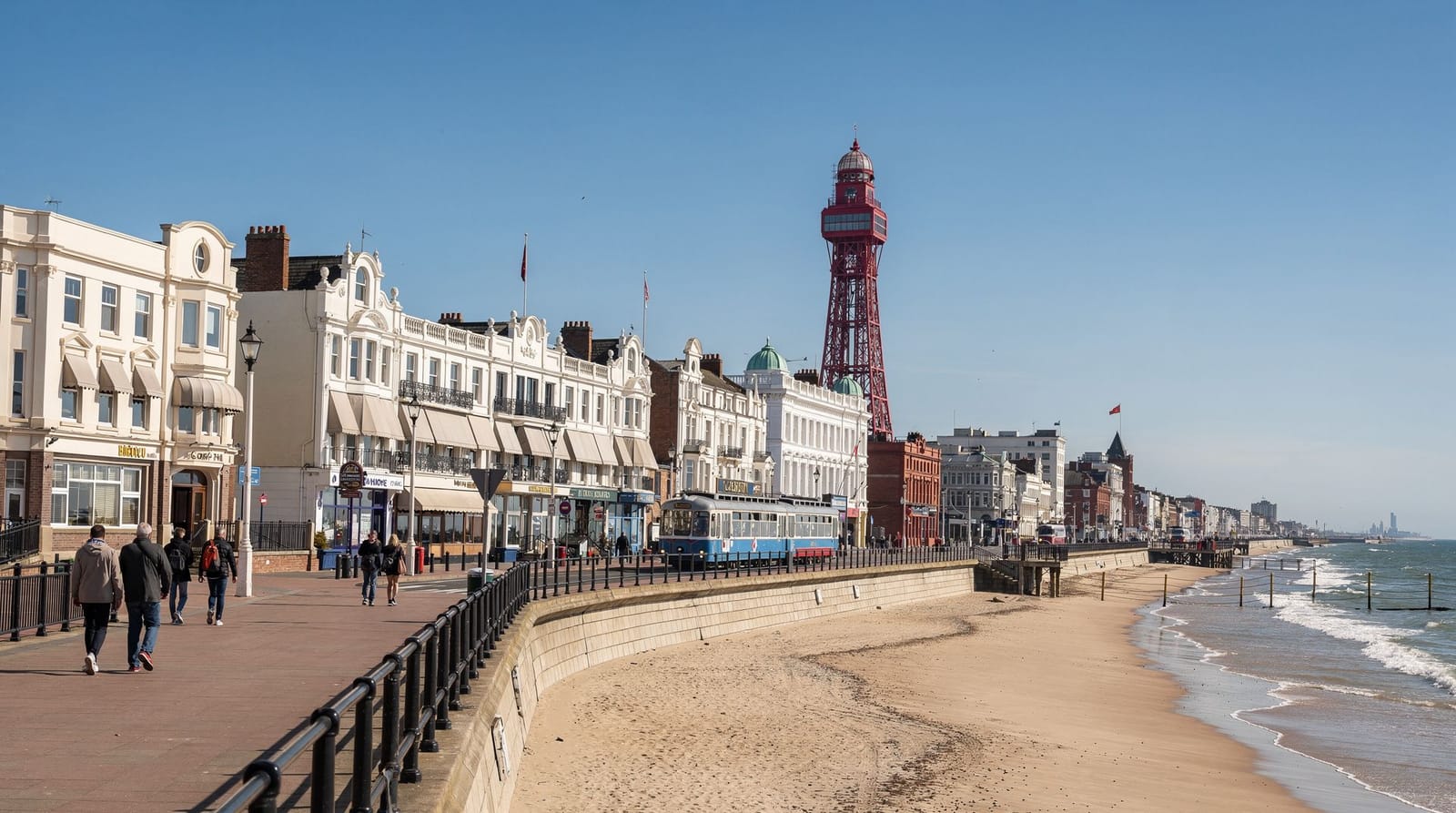
Blackpool Tower, opened in 1894 and standing 158m tall, was explicitly modelled on the Eiffel Tower (built five years earlier) as part of a wave of European tower-building rivalry in the late 19th century. It houses several separate paid attractions rather than a single ticket: the Tower Eye observation deck (including a glass floor section), the Tower Circus (a still-operating traditional circus in the base of the tower), the Tower Dungeon (a themed horror-history experience in the same vein as the London Dungeon), and the Tower Ballroom.
Blackpool Tower Eye entry ticket covers the observation deck — worth doing on a clear day for views along the coast, considerably less worth it in poor visibility, which is a genuine risk on the Lancashire coast.
Blackpool Tower Dungeon entrance is a themed, actor-led experience covering Lancashire’s darker history (witch trials, plague, local legends) with a horror-attraction format rather than a museum — fine as entertainment, not a substitute for genuine local history if that’s what you’re after.
The Tower Ballroom: a genuinely significant piece of British dance history
The Tower Ballroom, with its ornate Victorian and Baroque-revival interior and sprung dance floor, has hosted dancing continuously since 1894 and gained a further layer of fame as a filming location for the BBC’s Strictly Come Dancing, whose annual “Blackpool special” episode — filmed here since the show’s early years — is one of the most-watched instalments of the series each season and has introduced the ballroom to a generation of viewers who might otherwise never have heard of it.
The interior’s Wurlitzer organ, rising from beneath the stage on a hydraulic lift during live sessions, is a genuine period piece rather than a modern addition, and the ballroom remains a working dance venue with regular tea dances alongside its tourist visits. It’s one of the more architecturally impressive interiors in Blackpool and worth a look even for visitors with no interest in dancing itself.
Blackpool Tower Ballroom entrance covers daytime entry to view the ballroom outside of its evening dance sessions.
Pleasure Beach: one of Britain’s oldest amusement parks
Blackpool Pleasure Beach, dating from 1896, is one of the longest continuously operating amusement parks in the world and holds a genuinely strong reputation among rollercoaster enthusiasts — the Big One, opened in 1994, was the tallest and fastest rollercoaster in the world at the time and remains a significant ride today. Unlike the Tower’s multiple separate paid attractions, Pleasure Beach entry is generally free, with rides paid individually or via a wristband — worth checking current pricing structures before you go, since this changes the maths considerably depending on how many rides your group wants to do.
Beyond the Big One: what else is at Pleasure Beach
Pleasure Beach’s ride roster extends well beyond its headline coaster — Icon, opened in 2018, and the wooden Grand National (dating from 1935 and still one of the park’s most-loved rides despite its age) both sit alongside a genuine range of gentler family rides, meaning the park isn’t purely a thrill-seeker destination despite the Big One’s reputation. The park’s Sea Life Blackpool aquarium sits adjacent, a reasonable rainy-day fallback if weather rules out the outdoor rides for part of your visit — worth knowing given the Lancashire coast’s unpredictable weather, similar in that respect to the North Wales coast covered elsewhere in this guide.
The Illuminations: a genuinely unique autumn draw
Blackpool’s Illuminations — a roughly six-mile stretch of the seafront strung with elaborate light displays and installations — run from around late August or early September through to early January, switched on each year in a televised ceremony. This is arguably Blackpool’s strongest honest recommendation on this page: the Illuminations extend the town’s tourist season well past the point most British seaside resorts wind down, and a visit specifically timed for September or October avoids peak summer crowds while still catching the full display.
Blackpool’s social history: Britain’s original mass-tourism resort
Blackpool’s rise as a resort is directly tied to the Industrial Revolution’s Lancashire cotton mills, whose workers were given a mandatory week off each summer — “wakes week,” staggered by town so that mills could keep running while workers rotated through their break — and Blackpool, connected by early railway lines to the mill towns, became the default destination for hundreds of thousands of working-class holidaymakers from the mid-19th century onward.
This history matters for understanding what Blackpool actually is: not a resort that gentrified downward over time, but one purpose-built from the outset for affordable, high-volume, working-class leisure, which is why its attractions (the Tower, the Pleasure Beach, the arcades) lean toward accessible entertainment rather than the more genteel Victorian character of Llandudno, which was built with a different, wealthier clientele in mind from the start.
The trams: transport as heritage
Blackpool’s tramway, running along the seafront since 1885, is one of the oldest electric tramways still operating anywhere in the world, and it remains a genuinely practical way to get up and down the resort’s considerable length (the promenade stretches several miles) rather than purely a heritage novelty — worth using rather than walking the full distance between the Tower, Pleasure Beach and the North Shore.
The Winter Gardens and Blackpool’s ongoing regeneration
The Blackpool Winter Gardens, a large Victorian entertainment complex a short distance from the Tower, hosts conferences, concerts and — since the early 2000s — several major UK political party conferences, an odd but genuine second identity for a town otherwise associated purely with seaside fun. Blackpool has also faced well-documented economic struggles in recent decades as British seaside tourism shifted toward package holidays abroad, and the town has been the subject of ongoing regeneration efforts, including a new conference centre and seafront investment.
It’s worth knowing this context: parts of the town beyond the immediate seafront strip show visible signs of the economic pressure that’s affected many traditional British seaside resorts, a contrast to the more consistently affluent presentation of Chester or Llandudno covered elsewhere in this guide.
Getting there from Chester, honestly
This is the least straightforward day trip in this guide from a transport standpoint. There’s no direct train from Chester; the realistic route changes at Preston or Manchester and takes roughly 1h45-2h15 depending on connections — see Chester Trains Day Trips for current timetable patterns, meaningfully longer than any of the site’s other rail day trips. By car, the M56/M6 route takes about 1h15-1h30, making driving the more practical option if you have access to a vehicle. Given the longer travel time, an early start matters more here than for Liverpool or Llandudno.
Family planning notes
Blackpool is one of the more genuinely child-friendly destinations in this guide, but a few practicalities are worth knowing before committing a full day: the promenade stretches several miles, so use the trams rather than assuming everything is walkable together; Pleasure Beach’s individual ride costs (on top of free park entry) can add up quickly for a family, so decide on a wristband versus pay-per-ride approach before arriving rather than mid-visit; and the Tower’s various paid attractions (Eye, Dungeon, Circus, Ballroom) are genuinely separate products often requiring separate queues, so build in more time than a single “visit the Tower” line item on an itinerary might suggest.
The Comedy Carpet and Blackpool’s cultural footnotes
Blackpool has a genuine, if lower-profile, cultural history worth a mention beyond its rides and lights: the Comedy Carpet, a large public artwork on the promenade near the Tower, is inlaid with the words of hundreds of jokes and catchphrases from British comedians, many of whom got their start performing in Blackpool’s theatres and clubs during the resort’s mid-20th-century peak as a launchpad for entertainers before national television careers.
The town’s Grand Theatre, a genuine Frank Matcham-designed Victorian theatre (the same architect behind several of London’s West End houses), still operates as a working venue rather than a museum piece, hosting touring productions throughout the year — a reminder that Blackpool’s entertainment identity runs deeper than the seafront attractions most day-trippers see.
Practical planning notes
Blackpool North station is the main rail arrival point and sits a short walk or tram ride from the central Tower and Pleasure Beach area (Pleasure Beach itself has its own dedicated station, Blackpool South, closer to the park entrance if arriving specifically for the rides). The tramway, running the full length of the seafront, is genuinely the most efficient way to move between the Tower, Pleasure Beach and the North Shore rather than walking the full distance, and day tickets are better value than single fares for a day covering more than two stops. Given the longer journey from Chester, arriving by mid-morning and planning a late-afternoon or early-evening return gives a realistic full day without an excessively early alarm.
Where to eat
Blackpool’s food scene is built firmly around seaside classics — fish and chips, candy floss, rock (the striped seaside sweet, with “Blackpool” traditionally printed through the middle of the stick) — rather than a food-destination reputation. It’s honest, cheap, and exactly what the genre promises; don’t expect the range you’d find in Manchester or Liverpool — see Liverpool Food Guide for a stronger food-focused day trip.
Honest cautions
The journey from Chester is genuinely longer than this site’s other day trips, so weigh whether Blackpool’s specific appeal (rollercoasters, the Tower, the Illuminations) justifies roughly double the travel time of Liverpool or North Wales. Several of the Tower’s attractions (Dungeon, Circus, Ballroom, Eye) are sold separately or as combined tickets that change in value depending on how many you actually want to do — check current bundle pricing rather than assuming one ticket covers everything. And Pleasure Beach’s ride costs can add up quickly beyond the (often free) park entry, so budget for this separately from a simple “day out” estimate.
How Blackpool compares to other British seaside resorts
For travellers weighing Blackpool against other UK seaside options, it’s worth knowing where it sits in the pecking order: it’s larger and more purpose-built for entertainment than most equivalents (Scarborough, Weston-super-Mare, Southend), with genuinely more rides and attractions concentrated in one place than almost anywhere else on the British coast, a legacy of its historical role as the dominant working-class resort for the entire industrial North of England rather than a single region.
Where it falls short of some rivals is in the surrounding town’s general upkeep and the narrower, more concentrated nature of its “good bits” — venture a street or two back from the immediate seafront strip and the town’s economic difficulties become more visible than in, say, Llandudno’s more evenly maintained centre. If a wider regional trip is on the cards, North West England 5 Days shows how Blackpool can fit alongside Chester’s other stops rather than standing alone.
Blackpool’s beach itself
It’s easy to overlook amid the Tower and Pleasure Beach, but Blackpool’s beach is a genuinely large stretch of sand — one of the widest in England at low tide, stretching for several miles along the full length of the promenade. Donkey rides along the sand, a seaside tradition dating back well over a century, still operate in summer, and the beach itself is free to use regardless of which paid attractions you choose. Swimming is generally considered safe in designated lifeguarded sections during the main season, though the Irish Sea here runs noticeably colder than southern English beaches even in midsummer — a genuine consideration if a swim is part of the plan rather than just building sandcastles.
Should you go?
If your trip is built around Chester’s Roman heritage, North Wales castles or Liverpool’s Beatles-and-football draw, Blackpool is a genuine detour rather than a natural extension — worth it specifically for families wanting a big rides-and-lights day, or anyone drawn to the cultural significance of Britain’s original mass-tourism seaside resort, but not an obvious add-on if your remaining time is limited.
See Day Trips from Chester and Best Day Trips by Train for how it compares against this site’s other options, and Lake District for an alternative longer day trip that leans scenic rather than fairground-focused.
Blackpool through the seasons
| Season | Conditions | What’s on |
|---|---|---|
| Spring (Mar-May) | Mild, fewer crowds | Pleasure Beach reopens for the season; good for a quieter Tower visit |
| Summer (Jun-Aug) | Warmest, busiest | Peak beach and rollercoaster weather; book Tower tickets ahead |
| Autumn (Sep-early Jan) | Cooling, dark evenings | The Illuminations — Blackpool’s strongest honest recommendation |
| Winter (mid-Jan-Feb) | Cold, many attractions closed for the season | Not the season to plan a Blackpool trip around |
Booking the Tower attractions: what actually saves money
Combined tickets covering two or more of the Tower’s attractions (Eye, Dungeon, Circus, Ballroom) are usually better value than buying each separately if you genuinely plan to do more than one, but check the current bundle contents carefully — some combinations exclude the Circus or Ballroom depending on the season, since the Circus in particular runs a separate performance schedule rather than continuous entry. Booking online in advance, rather than at the door, is worth doing in summer specifically for the Eye, since clear-day slots sell out and a same-day walk-up risks arriving during poor visibility instead.
Should you go? A quick self-check
Blackpool suits you specifically if rollercoasters, the Tower’s various attractions or the autumn Illuminations are the draw — in which case the extra travel time from Chester is genuinely worth it. It suits you less if you’re weighing it as a generic “seaside day out,” since Llandudno is closer, more evenly maintained and a gentler day if fairground energy isn’t specifically what you want. Families with young children tend to get the most out of Blackpool; travellers prioritising heritage or quiet scenery are usually better served elsewhere on this site.
Top experiences
Bookable activities with verified prices and instant confirmation on GetYourGuide.