Caernarfon: the most ambitious of Edward I's Welsh castles
Caernarfon travel guide from Chester: the UNESCO castle built for princely investiture, Snowdon access and the Welsh Highland Railway terminus.
Caernarfon: Guided Walking Tour of the Historic Town
Duration: 1.5 hours
Quick facts
- From Chester
- No direct train; ~1h40 via Bangor plus bus, or ~1h15 by car via the A55/A487
- UNESCO status
- Caernarfon Castle, part of the Edward I North Wales World Heritage castles
- Notable event
- Investiture site of the Prince of Wales in 1911 and 1969
- Also a gateway to
- Snowdon (Llanberis Path trailhead area) and the Welsh Highland Railway
- Currency
- GBP (£)
Quick answer: Caernarfon is a walled town on the Menai Strait, home to the largest and most architecturally ambitious of Edward I’s North Wales castles, part of the same UNESCO World Heritage listing as Conwy, Beaumaris and Harlech. There’s no direct train from Chester — the realistic public-transport route runs via Bangor (roughly 1h40 total with a bus connection) or about 1h15 by car via the A55 and A487. It’s also one of the more useful bases for reaching Snowdon and the Welsh Highland Railway.
| Where | Menai Strait, North Wales |
| Cost | Castle entry roughly £11-16 adult; Segontium and town walls free |
| Time needed | Half a day for castle and town; a full day with Snowdon or the railway |
| Getting there | ~1h15 by car; ~1h40 by train via Bangor plus bus |
| Best time | May-September for full castle hours and the railway’s season |
A castle built to impress, not just defend
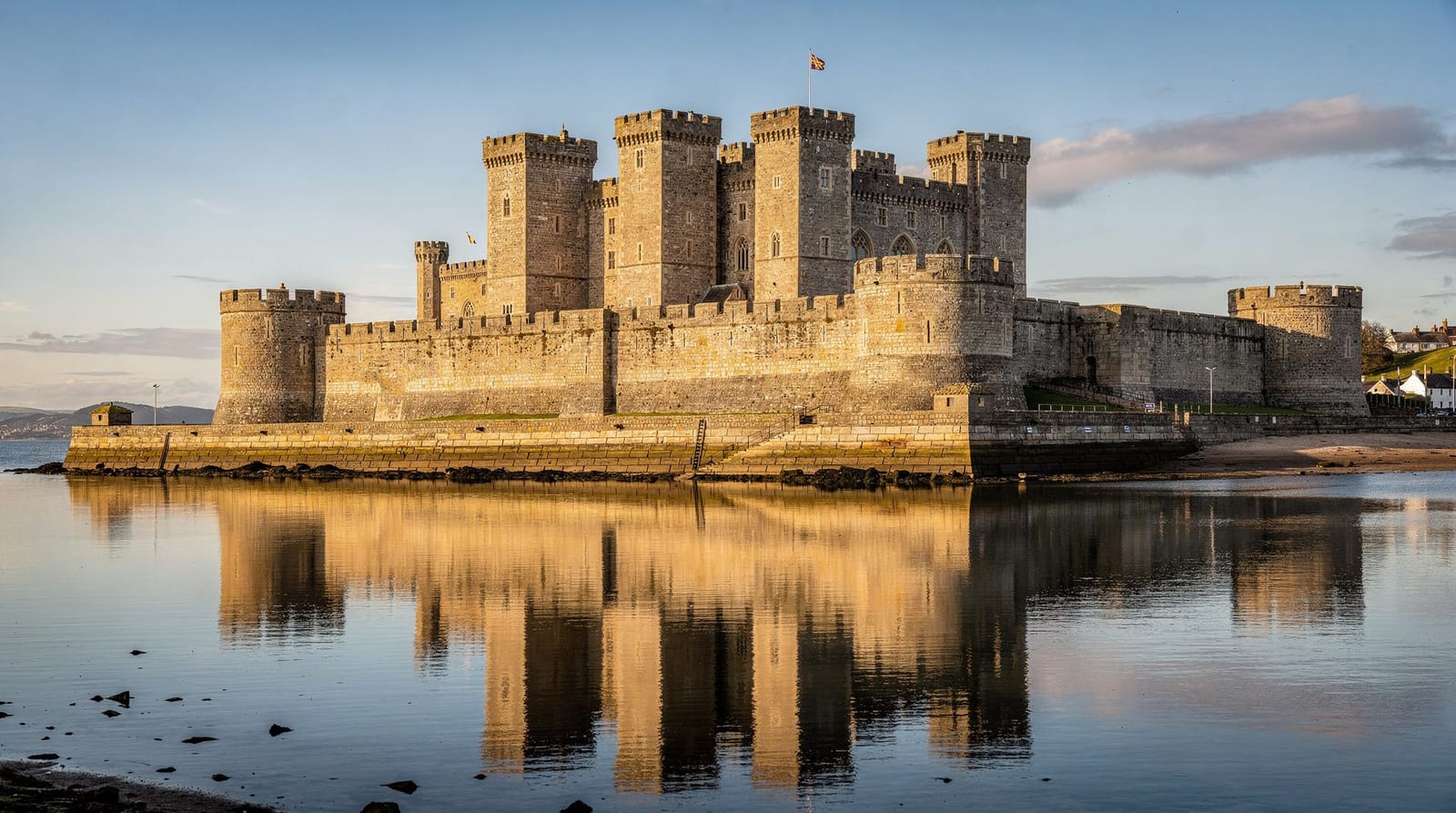
Caernarfon Castle, begun in 1283 and never fully completed, was designed with polygonal towers and banded masonry deliberately modelled on the walls of Constantinople — a calculated piece of imperial symbolism rather than purely defensive architecture, intended to project Edward I’s authority over a newly conquered principality. It’s the largest of the four UNESCO-listed North Wales castles by area and arguably the most visually striking, with the Eagle Tower’s distinctive turrets recognisable from photographs even to people who’ve never visited.
The castle has genuine royal history beyond its medieval origins: it was the site of the investiture of the Prince of Wales in both 1911 (Edward, later Edward VIII) and 1969 (Charles, later King Charles III), a ceremony broadcast globally and one of the more unusual modern uses of a 700-year-old fortress. Entry takes about an hour to explore properly, including several tower climbs with views over the Menai Strait toward Anglesey.
Guided walking tour of historic Caernarfon runs about 1.5 hours and covers the castle exterior, town walls and the walled old town beyond just the castle itself — a good option if you want the investiture history and the town’s Welsh-language cultural context explained rather than self-navigated (Caernarfon has one of the highest proportions of Welsh-speakers as a first language of any town in Wales, and the atmosphere reflects that more than the more anglicised coastal resorts).
The Eagle Tower and Queen’s Tower: what’s actually inside
The castle’s two most substantial surviving towers, the Eagle Tower and Queen’s Tower, both hold small on-site exhibitions rather than being empty shells — the Queen’s Tower houses the Royal Welch Fusiliers Museum, covering the regiment’s history from the 17th century through both World Wars, a genuinely worthwhile stop for military history visitors that many castle-only itineraries skip past.
The Eagle Tower, the tallest and most architecturally distinct of the castle’s towers with its triple-turreted crown (the eagle sculptures that gave it its name are heavily weathered but still visible), gives the best overall views back across the town walls and out toward the Menai Strait and Anglesey — worth the climb despite the narrow, uneven spiral stairs.
The town walls and harbour
Caernarfon’s town walls, built in the same 1283 campaign as the castle, form a complete circuit around the old town and are free to walk in sections. The harbour and Menai Strait waterfront give good views back toward the castle and across to Anglesey — a genuinely photogenic angle that’s less crowded than the equivalent views at Conwy.
A quick word on Welsh language and identity here
Caernarfon has one of the highest proportions of Welsh-speakers as a first language of any town in Wales, and this shapes the visitor experience more noticeably than at most other stops covered on this site — shop conversations, market chatter and local radio are as likely to be in Welsh as English, and the town has historically been a stronghold of Welsh cultural and political activism (Plaid Cymru, the Welsh nationalist party, has deep roots in the area).
This isn’t a barrier to visiting — English is universally understood — but it’s a genuinely different atmosphere from the more anglicised holiday-resort feel of Llandudno or Conwy, and worth knowing if you’re specifically interested in contemporary Welsh culture rather than just medieval history.
Segontium: the Roman layer beneath the medieval one
Just outside the town walls sit the remains of Segontium, a Roman auxiliary fort dating from around AD 77 — a useful reminder that Edward I’s castle-builders weren’t the first to recognise Caernarfon’s strategic position on the Menai Strait. The site is modest (foundations and interpretation boards rather than standing walls) but free and worth 20-30 minutes for anyone interested in the Roman-to-medieval continuity that also defines Chester itself.
Caernarfon as a Snowdon gateway
Caernarfon sits closer to several Snowdon trailheads than the more commonly used Llanberis or Pen-y-Pass starting points for some routes, and buses run from the town toward Llanberis for the Snowdon Mountain Railway or toward Pen-y-Pass for the Pyg and Miners’ Tracks.
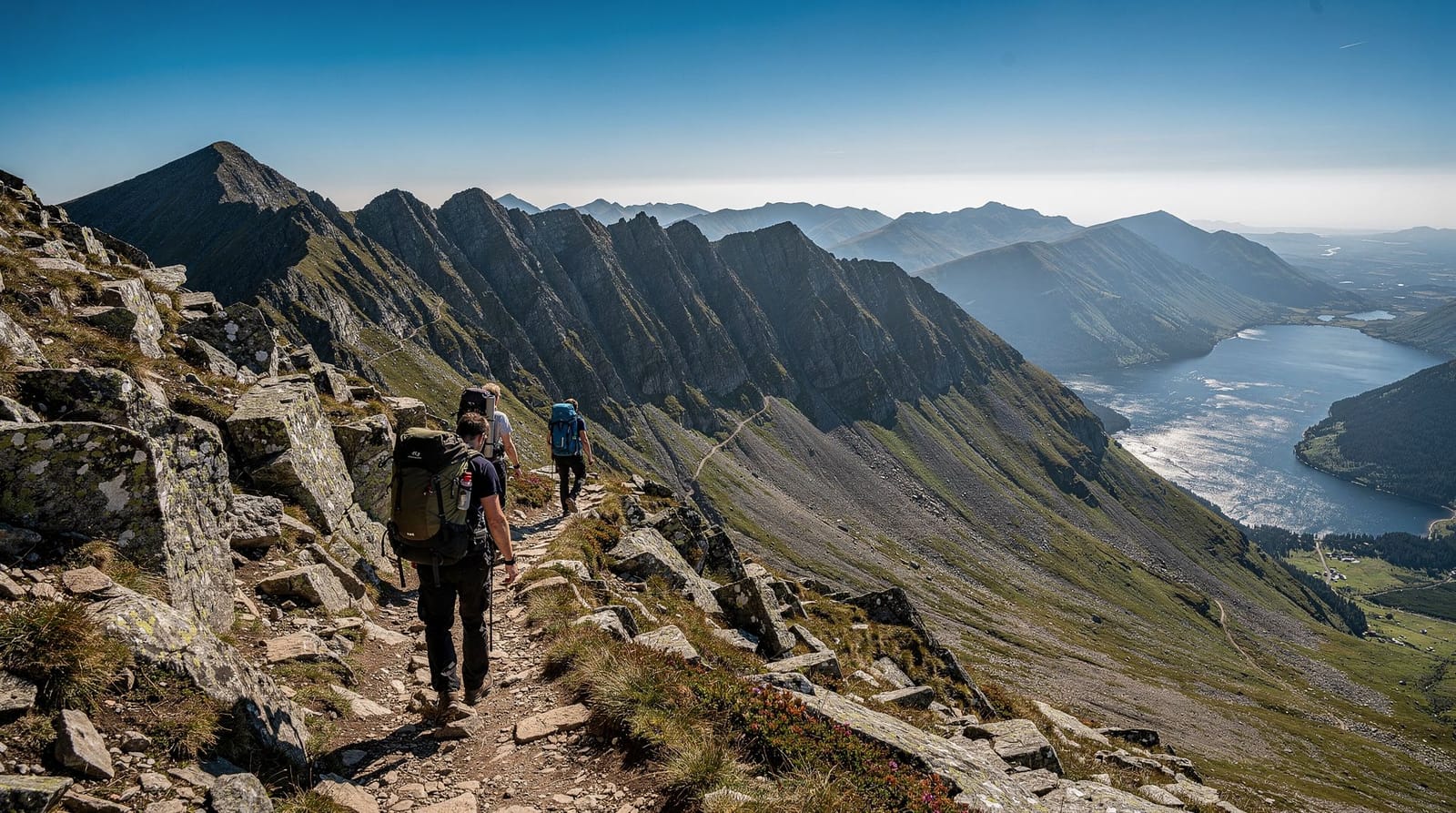
Mount Snowdon summit hike from Caernarfon is a practical option if you’re based in the town rather than driving directly to a trailhead car park — useful given how quickly the Pen-y-Pass car park fills on summer weekends. See Snowdonia and Snowdon Hiking Routes for full route detail.
The Welsh Highland Railway terminus
Caernarfon is one terminus of the Welsh Highland Railway, the longest heritage railway in Britain at just under 25 miles, running through genuinely dramatic Snowdonia scenery — skirting the base of Snowdon itself near Rhyd Ddu and passing through the Aberglaslyn Pass, regularly cited as one of the most scenic stretches of railway in Wales — to Porthmadog. The full round trip takes most of a day (around 4 hours each way including stops), though shorter partial-return options exist for visitors with less time.
It’s a good option that doesn’t require hiking fitness, and a natural pairing with a castle visit since both start from the same town — the railway’s Caernarfon terminus sits a short walk from the castle and harbour. See Welsh Highland Railway and Heritage Railways North Wales.
Practical planning notes
Cadw, which manages Caernarfon Castle alongside Conwy, Beaumaris and Harlech, offers multi-site tickets that are worth checking before paying individual entry at each castle if you’re planning to visit more than one on the same trip — the saving adds up meaningfully across three or four sites.
The castle’s various towers involve narrow, uneven medieval spiral stairs without handrails in several sections, and while the ground-floor courtyard and main gatehouse areas are reasonably accessible, the full tower-climbing experience isn’t straightforwardly suited to visitors with mobility limitations. Photography-wise, the best angles are from across the harbour looking back at the castle’s water-facing towers, and from the Anglesey side of the Menai Strait looking back toward the town as a whole.
A market town with a genuine everyday life beyond the castle
Unlike some of the more tourism-saturated coastal towns further along the North Wales coast, Caernarfon functions as a genuine working market town for the surrounding rural area, not solely as a heritage attraction — the Saturday market on Castle Square has run for centuries and mixes local produce stalls with the usual tourist-facing goods, and the town retains a working harbour and fishing-adjacent economy alongside its visitor trade.
This gives Caernarfon a noticeably different, less manicured atmosphere than Conwy or Llandudno — some visitors find it more authentic as a result, others find the town centre beyond the castle itself relatively low-key and are surprised there isn’t more to see once the castle visit is done.
Anglesey: a short hop across the water
The Menai Suspension Bridge (Thomas Telford, 1826) and the later Britannia Bridge connect the mainland to Anglesey a short distance from Caernarfon, making the island a natural half-day or full-day extension for anyone based here. Anglesey holds Beaumaris Castle (the fourth of the UNESCO-listed Iron Ring castles), South Stack lighthouse with its dramatic clifftop setting, and prehistoric sites including Bryn Celli Ddu, a Neolithic burial chamber older than Stonehenge. See Anglesey for the full guide — combining Caernarfon and Anglesey in a single day is a realistic plan if you have a car, considerably harder relying purely on local buses.
Getting there from Chester, honestly
This is the one destination in this guide where the honest advice is: a car makes a genuinely large difference. Without one, the route runs via Bangor (itself reached by direct or one-change train from Chester, roughly 1h20-1h30) followed by a bus connection into Caernarfon, adding up to around 1h40 total and depending on bus frequency, which thins out in the evening. By car via the A55 and A487, the same trip takes about 1h15 with far more schedule flexibility.
North Wales and Caernarfon Castle day tour from Chester is the practical alternative if you don’t want to manage the bus connection yourself — a full day covering the coast road and the castle without needing your own transport or timetable research.
Combining Caernarfon with the rest of the coast
Caernarfon pairs naturally with Anglesey (a short hop across the Menai Strait) and with Snowdonia’s western approaches. It’s a quieter alternative to Conwy if you’ve already done one Iron Ring castle and want a less crowded second visit — Caernarfon sees meaningfully fewer coach-tour groups than Conwy or Llandudno’s immediate surroundings, partly a function of the longer journey time from the main English gateway towns. See Day Trips from Chester for how this compares to the site’s other options.
The 1969 investiture: a genuinely divisive piece of history
Worth knowing before you visit: the 1969 investiture of Charles as Prince of Wales, while presented in most tourism material as a straightforward moment of royal ceremony, was and remains genuinely controversial in Wales — Welsh nationalist groups protested the event at the time (including a bombing attempt near the castle by a militant group, which killed two of its own members before the ceremony), and the underlying question of whether an English royal title imposed on a historically conquered nation deserves unqualified celebration is still debated in Welsh political and cultural discourse today.
This isn’t presented here to discourage a visit — the castle itself is worth seeing regardless of where you land on the politics — but an honest planner’s guide shouldn’t present the investiture purely as pageantry without acknowledging that plenty of Welsh people view the ceremony, and the wider colonial history of Edward I’s castles generally, with genuine ambivalence rather than straightforward pride.
Caernarfon compared to Conwy: which castle town to prioritise
Visitors with time for only one of the two most commonly promoted North Wales castle towns should weigh a few genuine differences: Conwy is smaller, more walkable in a single short visit, and easier to reach without a car; Caernarfon is larger in scale, has the more architecturally ambitious castle and a stronger claim to royal-history significance, but demands considerably more effort to reach by public transport and offers a less immediately walkable town experience once you’re there. Neither is a wrong choice, but the honest recommendation is Conwy for a car-free, time-limited day, and Caernarfon for travellers with a car and a specific interest in the castle’s scale, the investiture history, or onward access to Snowdon and Anglesey.
Where to eat
Caernarfon’s dining options cluster around the castle square and harbour — solid pub and café fare rather than a food-destination reputation, with a genuinely Welsh character to several menus (cawl, Welsh rarebit, local lamb) that’s less diluted by tourist-facing generic pub food than some of the more anglicised coastal resorts.
Combining Caernarfon with Snowdonia and the Llŷn Peninsula
Beyond the more commonly promoted pairing with Snowdon and Anglesey, Caernarfon also sits at the gateway to the Llŷn Peninsula, a quieter, less-visited stretch of coastline south-west of the town with its own beaches, small fishing villages and Bardsey Island (a historic pilgrimage site) visible off its tip. Most first-time visitors don’t have time for the Llŷn on a single Caernarfon-focused trip, but it’s worth knowing about if Caernarfon becomes a base for a longer North Wales stay rather than a single day’s stop — it offers a genuinely different, more remote character than the busier castle-and-coast circuit covered elsewhere in this guide.
Honest cautions
The lack of a direct train is the main planning obstacle here — don’t assume the North Wales coast line reaches Caernarfon itself (it doesn’t; the town lost its rail connection to closures decades ago, and the Welsh Highland Railway serves tourism rather than general transport). Bus connections from Bangor thin out notably in the evening, so plan your return journey with margin rather than assuming an hourly service all day. And the castle’s tower staircases are narrow, uneven medieval stone — manage expectations if mobility or a fear of tight spiral stairs is a concern.
Photography and the best time of day
The classic Caernarfon Castle photograph — the polygonal towers reflected in the harbour waters — works best around an hour before sunset, when the low sun catches the eastern-facing stonework and the harbour water tends to be calmer than during the day’s boat traffic. The castle also floodlights its exterior after dark in the main season, giving a genuinely different, more dramatic view for evening visitors staying in the area overnight rather than day-tripping straight back to Chester or Bangor.
Suggested next steps
Pair this page with Anglesey for the Menai Strait crossing, Snowdonia for the mountain side of a Caernarfon-based trip, and Welsh Castles Guide for how Caernarfon compares directly to Conwy, Beaumaris and Harlech. For itinerary planning, Welsh Castles 2 Days and North Wales Castles Road Trip both build multi-stop routes that include Caernarfon alongside the other Iron Ring sites.
Caernarfon versus Conwy at a glance
| Caernarfon | Conwy | |
|---|---|---|
| Castle scale | Largest of the four UNESCO castles | Smaller, more compact |
| Getting there without a car | Train to Bangor + bus, ~1h40 | Direct train, easier |
| Town character | Working market town, strong Welsh-language identity | More tourism-focused, anglicised resort feel |
| Best for | A car, and interest in scale/history/Snowdon access | A time-limited, car-free day |
Parking and arriving by car
The main visitor car parks sit close to the castle and old town, though they fill by mid-morning on summer weekends and during the Welsh Highland Railway’s busiest departures — arriving before 10am gives a meaningfully easier parking experience than arriving at midday. A park-and-ride option operates from the edge of town during peak season, worth using if the central car parks look full on arrival rather than circling for a space.
A realistic day budget
A typical day per adult, on top of transport: castle entry around £11-16; the Royal Welch Fusiliers Museum is included in castle admission; a pub lunch around £10-16; Segontium is free. Add the Welsh Highland Railway (partial return options generally run £25-45, the full round trip more) or a Snowdon guided hike (£60-90+) if either is part of the day, and budget parking of around £4-6 if driving into the town centre rather than using a park-and-ride option. A castle-and-town-only day comes in comfortably under £30 per person; adding the railway or a hike roughly doubles or triples that.
Time of year for the railway and Snowdon combination
The Welsh Highland Railway only runs its full timetable in the main season, roughly Easter through October, with a reduced service either side and closure over winter — check current dates before building a whole day around the round trip, since a partial-return or castle-only visit is the fallback outside the main season. The same seasonality broadly applies to Snowdon: while the mountain is climbable year-round for experienced hikers with the right gear, the well-trodden Llanberis and Pyg Track routes are far more approachable, and considerably busier, from late spring to early autumn.
Top experiences
Bookable activities with verified prices and instant confirmation on GetYourGuide.