Welsh Highland Railway guide
Caernarfon: Guided Walking Tour of the Historic Town
Duration: 1.5 hours
How long is the Welsh Highland Railway and what does it show you?
The Welsh Highland Railway runs about 25 miles between Caernarfon and Porthmadog, the longest heritage narrow-gauge line in Britain, passing directly beneath the western side of Snowdon. A full one-way journey takes around 2 hours, with return fares for the complete route typically £45-£55 for adults.
Britain’s longest heritage narrow-gauge railway
The Welsh Highland Railway is a modern success story built on old bones. An earlier Welsh Highland Railway operated fitfully in the early 20th century before closing in 1937, its track lifted and largely forgotten for decades. The current railway was rebuilt in stages from the 1990s onward by the same organisation that runs the Ffestiniog Railway, reusing sections of the original trackbed and completing the full 25-mile route between Caernarfon and Porthmadog in 2011 — a genuinely large engineering undertaking, including a new bridge across the Aberglaslyn Pass and a tunnel section that had to be reopened after decades of disuse.
The result is the longest heritage narrow-gauge railway in Britain, and arguably the most scenically dramatic of the North Wales steam lines, because unlike the Ffestiniog’s wooded valley route, the Welsh Highland runs through much more open mountain country, passing directly beneath the western flank of Snowdon itself between Rhyd Ddu and Beddgelert.
| Where | Caernarfon to Porthmadog, ~1.5hr drive from Chester |
| Cost | Around £45-£55 adult return for the full route |
| Time needed | ~2 hours one-way, 4-4.5 hours full round trip |
| Getting there | Car via A55, or train to Bangor plus bus to Caernarfon |
| Best time | Spring-autumn; Christmas specials only in winter |
A troubled first life, and a long, contested rebuild
The original Welsh Highland Railway, formed in 1922 from an amalgamation of earlier failed lines, was never commercially successful. It struggled financially throughout its short existence, closed to passengers in 1936, lost its final freight traffic the following year, and was formally abandoned in 1941 when its rails were requisitioned for the war effort — a common fate for struggling branch lines during the Second World War. For half a century afterward, the trackbed sat derelict, reclaimed in places by farmland and forestry.
The modern revival, beginning seriously in the 1990s, was not without controversy. Rebuilding the line required negotiating with landowners along the entire 25-mile route, securing funding from Welsh and European sources, and — more contentiously — resolving a long-running dispute over whether the rebuilt railway should terminate inside Caernarfon using a section of trackbed also wanted for other purposes. The eventual 2011 completion of the full route, connecting seamlessly at Porthmadog with the Ffestiniog Railway under joint management, represented one of the largest railway rebuilding projects undertaken anywhere in Britain in modern times.
Route and what you’ll see
Starting from Caernarfon, trains leave from a station a short walk from Caernarfon Castle and the town’s medieval walls, climbing gradually through farmland before entering genuine mountain scenery around Waunfawr and Rhyd Ddu, where Snowdon’s summit is visible on a clear day rising directly above the line — arguably a better mountain view than you get from inside Llanberis itself, since you’re looking at the peak from a different angle across open moorland.
The line then descends through the Aberglaslyn Pass, a narrow, wooded gorge that’s one of the most photographed stretches of railway in Wales, before reaching Beddgelert (a worthwhile stop in its own right, with the legendary grave of Gelert the faithful hound a short walk from the station) and finally Porthmadog, where it connects directly with the Ffestiniog Railway.
A full one-way journey takes around 2 hours; the return round trip, doable in a single (long) day, takes 4-4.5 hours of pure travel time before you add any stops. Most visitors either do the full length one way and return by road or bus, or pick a shorter section — Caernarfon to Beddgelert, or Beddgelert to Porthmadog — rather than committing to the whole round trip on the train alone.
Beddgelert and the legend of Gelert
Beddgelert is arguably the prettiest village on the entire route, a cluster of stone cottages at the confluence of two rivers, and it takes its name (meaning “Gelert’s grave”) from a much-loved but almost certainly invented legend: that a 13th-century Welsh prince, Llywelyn the Great, returned from hunting to find his baby’s cradle overturned and his faithful hound Gelert covered in blood, killed the dog in a fit of rage assuming it had attacked the child, then discovered the baby alive and a dead wolf nearby — realising too late that Gelert had actually saved the child.
Historians generally regard the grave itself, and the story attached to it, as a Georgian-era tourist invention rather than genuine medieval history, but it remains a popular, gently melancholy short walk from the village centre regardless of its authenticity, and it hasn’t stopped generations of visitors making the pilgrimage.
The Aberglaslyn Pass in more detail
If there’s one section of this railway worth planning your seat choice around, it’s the Aberglaslyn Pass, a narrow, steep-sided gorge where the Afon Glaslyn forces its way between rock faces close enough in places that the original Victorian-era railway builders had to blast and tunnel rather than simply lay track. The modern reconstruction reused much of this original alignment, including a short tunnel that had been bricked up and forgotten for decades before restoration crews reopened it in the 2000s.
Trains slow noticeably through this stretch, partly for safety on the tight curves and partly, one suspects, because the operators know it’s the section every passenger wants time to photograph. The river below runs a startling turquoise-green in good light, fed by minerals draining from the slate country further up the valley, and the combination of rock, water, and steam locomotive smoke drifting through the gorge is the single image most associated with this railway in tourist photography. Arrive with a camera ready rather than fumbling for it once you’re already through — the pass passes in a few genuinely fast minutes.
Waunfawr and the quieter middle section
Between Caernarfon and Rhyd Ddu, the line passes through gentler farming country around Waunfawr, home to a small heritage centre and a well-regarded local brewery that has become an unofficial stop for railway enthusiasts combining a pint with trainspotting — the pub sits close enough to the line that passing steam locomotives are clearly audible from its beer garden. This middle section is often overlooked by visitors focused on the Snowdon views further south or the Aberglaslyn Pass drama near Porthmadog, but it offers a useful sense of the working agricultural landscape that the railway passes through for much of its length, a contrast to the more dramatic mountain and gorge scenery either side.
Fares and booking
Adult return fares for the complete Caernarfon-to-Porthmadog route typically run £45-£55, with shorter point-to-point fares available for partial journeys (useful if you only want to ride the Aberglaslyn Pass section, for instance). Combined tickets covering both the Welsh Highland and Ffestiniog Railway exist for visitors doing both lines within a set period, which works out cheaper than buying each separately if you’re spending a full day on the rails. Children generally travel at around half the adult fare.
Trains run daily through the main summer season with a reduced timetable in shoulder months and very limited winter operation, mostly around Christmas specials. Peak summer weekends can sell out on popular departure times, so booking a few days ahead is sensible rather than assuming you can turn up and board.
Caernarfon: worth a full stop, not just a station
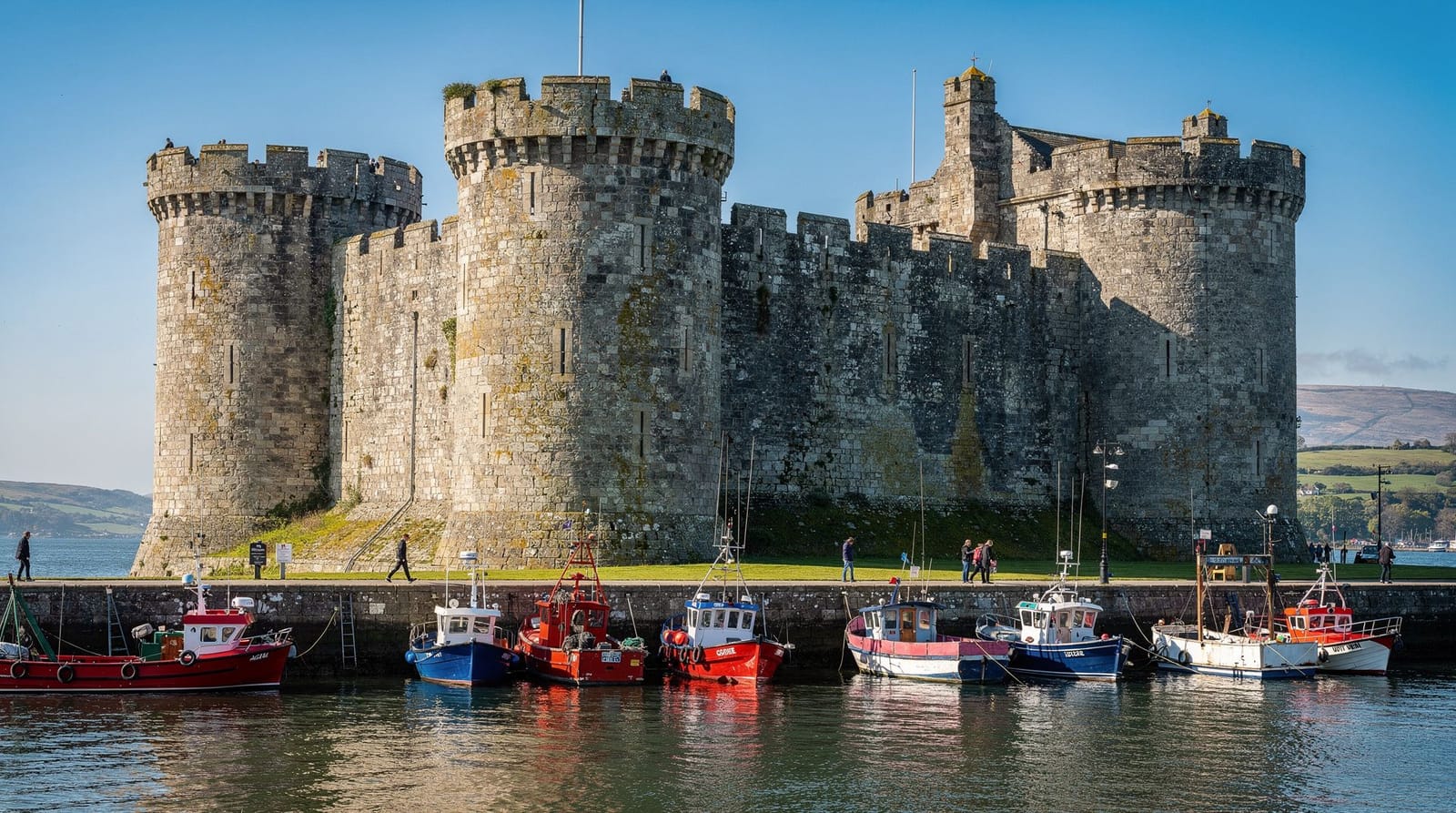
Caernarfon deserves more time than most visitors give it before or after their train. Caernarfon Castle, built by Edward I in the late 13th century as the most powerful statement piece of his conquest of Wales, is one of the best-preserved medieval castles in Britain and a UNESCO World Heritage Site alongside Conwy, Beaumaris, and Harlech. The town’s medieval walls, largely intact, are walkable in their own right, and the harbourside promenade along the Menai Strait gives good views across to Anglesey.
The guided walking tour of historic Caernarfon covers the castle precinct and town walls in around 1.5 hours, a sensible way to see the highlights if your train departure limits your time. If you’re arriving via Holyhead (cruise passengers, for instance), the Caernarfon Castle guided tour with entry ticket from Holyhead combines the transfer and the castle visit in one booking.
Getting there from Chester
Caernarfon has no direct rail line — the nearest mainline station is Bangor, connected to Caernarfon by regular bus (around 30 minutes) since the original branch line closed in 1970. From Chester, the realistic route is train to Bangor (roughly 1 hour 15 minutes) then bus onward, or driving the full way via the A55 in around 1 hour 30 minutes to 1 hour 45 minutes. Most visitors drive, particularly if combining the railway with the castle and other North Wales stops in a single day.
Combining it with Snowdon and the coast
Because the Welsh Highland Railway runs so close to Snowdon’s western side, it pairs naturally with a broader Snowdonia day rather than standing alone. Rhyd Ddu station sits at the start of the Rhyd Ddu Path, one of the quieter routes up the mountain covered in our Snowdon hiking routes guide, and hikers occasionally use the railway to reach or return from the trailhead rather than parking at both ends.
If you’re spending two or three days in the region rather than a single rushed day trip, our three-day Chester and North Wales itinerary and Snowdonia adventure itinerary both build in enough time to ride a meaningful section of the line without treating it as a box-ticking exercise.
Onboard experience and what to bring
Carriages are modern-build in the style of narrow-gauge heritage lines, generally more spacious and comfortable than some of the vintage Victorian-era stock found on the Ffestiniog Railway, since much of the Welsh Highland’s rolling stock was purpose-built or substantially rebuilt during the 1990s-2010s reconstruction rather than inherited from the original early-20th-century line. Some services include a licensed bar carriage and light refreshments; check the specific timetable for which trains carry catering, since not every departure does. Bring a camera charged and ready for the Aberglaslyn Pass section in particular, widely regarded as the single best few minutes of scenic railway in North Wales.
Weather and seasonal considerations
Running mostly through valleys and lower mountain slopes rather than to a summit, the Welsh Highland Railway is considerably more weather-resilient than the Snowdon Mountain Railway, though the more exposed moorland sections around Rhyd Ddu can still be affected by high wind on a bad day. Spring and early summer bring the best chance of clear views of Snowdon itself from the train; autumn colour along the wooded Aberglaslyn Pass section rivals anything on the Ffestiniog line. Winter operation is limited largely to Christmas specials, so this is very much a spring-to-autumn activity for most visitors.
Honest comparison with the Ffestiniog Railway
If you can only ride one narrow-gauge line in this part of Snowdonia, the choice usually comes down to scenery preference. The Welsh Highland gives you open mountain views and the genuinely spectacular Aberglaslyn Pass; the Ffestiniog gives you the older history, the Dduallt spiral, and a shorter, less committing journey. Doing both in one day is only realistic if you start early and accept a long day of mostly sitting on trains rather than exploring on foot — see our Ffestiniog Railway guide for the direct comparison, and our North Wales heritage railways overview for how both fit alongside Llangollen and the Conwy Valley Line.
Tourist traps and honest pricing notes
Caernarfon town, being a major tourist draw in its own right thanks to the castle, has a handful of parking areas close to the railway station and castle that charge noticeably more than council-run car parks a short walk further out — worth a quick check of signage rather than paying the first rate offered. Food and souvenir prices immediately outside the castle gates and railway station also run somewhat higher than a few streets back into the town’s ordinary high street, a pattern common to most heavily visited historic towns rather than anything specific to Caernarfon.
Common mistakes to avoid
The most common planning error is underestimating just how long the full round trip takes — at 4-4.5 hours of pure travel time, attempting the complete Caernarfon-Porthmadog return in a single day alongside other activities like Caernarfon Castle or Portmeirion usually means picking one or the other, not both, unless you’re prepared for a genuinely long day with little time to actually explore either end. A second common mistake is assuming Beddgelert, roughly the midpoint, offers a quick five-minute stop; the village and Gelert’s grave walk comfortably fill 45 minutes to an hour, and rushing through misses much of what makes the line worth riding in the first place.
Accessibility
Because much of the Welsh Highland Railway’s rolling stock was purpose-built during the 1990s-2010s reconstruction rather than inherited from decades-old vintage carriages, accessibility is generally somewhat better than on some of the region’s older heritage lines, with certain carriages offering step-free or ramped boarding and dedicated wheelchair spaces. This still varies by specific service and rostered rolling stock on the day, so confirm directly with the railway if accessibility is a firm requirement for your visit, and allow extra time at Caernarfon or Porthmadog stations for staff to assist with boarding.
Best seats and where to sit for the views
Because the line’s most dramatic scenery — the open Snowdon views around Rhyd Ddu and the Aberglaslyn Pass — largely appears on one side of the train depending on direction of travel, it’s worth thinking about which side to sit on if a specific view matters to you. Staff at Caernarfon or Porthmadog can usually advise on the day which side gives the better outlook for the current direction, since it can vary with which locomotive and carriage configuration is running. Open-sided or larger-window carriages, where available, give a noticeably better photography experience than standard compartment seating, worth requesting when booking if photography is a priority for your visit.
Practical notes
Toilets and light refreshments are available on longer services but not guaranteed on every train, so check before boarding if this matters for your journey. As with all the region’s heritage lines, weather rarely stops services outright at this lower altitude, but layers are still worth carrying, since carriage heating on some rolling stock can be inconsistent, particularly in shoulder-season months when temperatures swing more than the daytime forecast in Caernarfon or Porthmadog might suggest.
Honest verdict
Of the region’s narrow-gauge lines, the Welsh Highland Railway makes the strongest case for itself on scenery alone. The combination of open Snowdon views around Rhyd Ddu and the genuinely spectacular Aberglaslyn Pass gives it a variety that the shorter Ffestiniog and gentler Llangollen lines don’t quite match, and the modern reconstruction means the rolling stock and infrastructure feel less improvised than some of the region’s older preservation projects.
The trade-off is time and cost: at 25 miles and up to 4.5 hours for a full return trip, it demands a bigger commitment than any other heritage line covered here, and it works best as the centrepiece of a full day rather than a quick add-on squeezed between other attractions. Treat it accordingly, pair it with Caernarfon Castle at one end or Portmeirion near Porthmadog at the other, and it earns its reputation as one of the best days out in North Wales for anyone with a genuine interest in trains, mountains, or both.
Combining the railway with the rest of North Wales
Because the line touches both Caernarfon and the Porthmadog area, it fits naturally into a wider North Wales itinerary rather than standing alone. Our Portmeirion guide covers the Italianate village a short drive from Porthmadog, a natural pairing if you ride the southern half of the line, and our Welsh castles guide sequences Caernarfon Castle alongside the other UNESCO fortresses if castles feature elsewhere in your trip.
For a broader look at how the region’s heritage railways fit together, heritage railways of North Wales compares all of them side by side, and our adventure North Wales guide covers Zip World and other activities if you want a mix of scenery and adrenaline across a longer stay. If you’re deciding between this line and the Snowdon summit railway, our Snowdon Mountain Railway guide covers that comparison from the other direction.
The Welsh Highland versus the Ffestiniog, at a glance
| Welsh Highland Railway | Ffestiniog Railway | |
|---|---|---|
| Length | 25 miles | Shorter, under 14 miles |
| Scenery | Open mountain views, Aberglaslyn Pass | Wooded valley, Dduallt spiral |
| Full round trip | 4-4.5 hours | Under 3 hours |
| Rolling stock | Mostly modern-build | Mix of vintage and modern |
| Best for | A full-day scenic commitment | A shorter, more flexible add-on |
Frequently asked questions about Welsh Highland Railway guide
Should I ride the whole Welsh Highland Railway or just a section?
Only ride the full 2-hour one-way length if you have a full day to spare, since the round trip takes 4-4.5 hours of pure travel time. Most visitors on a tighter schedule pick a single section, either Caernarfon to Beddgelert or Beddgelert to Porthmadog, and return by road or bus instead.Is the Welsh Highland Railway suitable for a day trip from Chester?
It's tight but doable if you focus on one section rather than the full round trip, combined with a stop at Caernarfon Castle. Given the roughly 1.5-hour drive each way from Chester, the full return journey plus travel time makes for a genuinely long day.
Top experiences
Bookable activities with verified prices and instant confirmation on GetYourGuide.