Ffestiniog Railway guide
From Llandudno: Portmeirion, Snowdonia and Castles Tour
Duration: 9 hours
What is the Ffestiniog Railway and where does it run?
The Ffestiniog Railway is a narrow-gauge steam railway running about 13.5 miles between Porthmadog and Blaenau Ffestiniog through Snowdonia, one of the oldest working railways in the world. A return trip takes roughly 2.5 hours including a stop, and adult return fares are typically around £34-£40 depending on the day and how far in advance you book.
| Where | Porthmadog to Blaenau Ffestiniog, Snowdonia |
| Cost | around £34-£40 adult return |
| Time needed | ~2.5 hours return travel, plus any stopover |
| Getting there | No direct train from Chester; ~1h15 drive via A55/A470, or rail via Llandudno Junction |
| Best time | Spring-autumn for the full timetable; steam gala weekends for enthusiasts |
A railway built to move slate, not tourists
The Ffestiniog Railway opened in 1836, decades before most of Britain’s main rail network, and it was built for one job: hauling slate from the quarries above Blaenau Ffestiniog down to the port at Porthmadog for shipping around the world. Welsh slate roofed a large share of Victorian Britain, and this narrow-gauge line — just under 2 feet between the rails — was the reason it got there. That working history is still visible in the route itself: the line drops around 700 feet from Blaenau to sea level at Porthmadog, following the original gravity-fed gradient that once let loaded slate wagons coast downhill with empty wagons hauled back up by horse, and later steam.
Today the railway carries passengers rather than slate, running steam and occasionally diesel-hauled trains along roughly 13.5 miles of track that curls through oak woodland, along the shore of Llyn Mair, and past the dramatic Dduallt spiral — a section where the line loops back over itself to gain height, one of only a handful of such spirals on any railway in the world.
The reservoir that nearly ended the railway
The Ffestiniog Railway’s survival into the modern era wasn’t guaranteed. Passenger services ended in 1939 and slate traffic dwindled through the following decade as the industry itself declined, and the line closed entirely in 1946. What makes its later revival remarkable is that the original trackbed was partly submerged: in the early 1950s, the Central Electricity Generating Board built the Tanygrisiau reservoir as part of a new hydroelectric scheme, flooding a section of the original route near Ffestiniog.
When volunteers began restoring the railway from 1954 onward — one of the earliest railway preservation efforts in the world, predating many of the movements that later saved other British lines — they eventually had to build an entirely new deviation, including the Dduallt spiral itself, specifically to climb around the reservoir rather than through the flooded original route. The full restored line wasn’t reopened throughout until 1982, a project that took the best part of three decades of volunteer labour.
Journey time and fares
A full return journey from Porthmadog to Blaenau Ffestiniog and back takes around 2.5 hours travelling time, plus whatever stopover you choose at the far end. Adult return fares run roughly £34-£40, with day-rover style tickets available if you also want to ride the connecting Welsh Highland Railway, which shares management, staff, and in places track with the Ffestiniog Railway under the combined Ffestiniog & Welsh Highland Railways operation. Children typically travel at around half the adult fare, and family tickets can work out cheaper than buying individually if there are two adults and two or more children.
Trains run most days from spring through autumn, with a reduced winter timetable on selected dates around Christmas (including “Santa specials”) rather than a full daily service. Unlike the Snowdon Mountain Railway, which closes completely over winter because of ice at altitude, the Ffestiniog Railway’s lower-altitude route means at least some winter operation is possible, though it’s far more limited than the summer timetable.
Several “steam gala” weekends are held through the year, when multiple historic locomotives run together and enthusiasts travel from across the country — genuinely worth timing a visit around if you have any interest in railway heritage, though these dates also see the heaviest crowds and the earliest ticket sell-outs.
| Season | Service level | Note |
|---|---|---|
| Spring-autumn | Full timetable, most days | Busiest and most reliable window |
| Steam gala weekends | Multiple locomotives running | Heaviest crowds, book earliest |
| Winter | Reduced, selected dates | ”Santa specials” around Christmas |
Photography along the route
The line offers several genuinely distinctive photo opportunities beyond the general valley scenery. The Dduallt spiral itself is best appreciated from a slightly elevated vantage where the loop is visible in a single frame, though this generally means stepping off the train rather than photographing it from a carriage window, since the spiral’s full effect is hard to capture from inside a moving train.
Llyn Mair, the small lake the line skirts partway up, photographs particularly well in the still, calm light of early morning departures, when the water is less disturbed by wind than later in the day. At the Blaenau Ffestiniog end, the enormous grey slate tips overshadowing the town make a striking, slightly severe backdrop that contrasts deliberately with the greener scenery further down the valley — worth a few frames even if slate quarrying isn’t your primary interest in visiting.
Combining with Portmeirion and a longer North Wales day
Porthmadog’s proximity to Portmeirion makes a genuinely efficient pairing for visitors not staying locally. Our Portmeirion guide covers the Italianate village in full, and the Portmeirion destination page has the practical visiting detail. For a wider view of how this fits a longer North Wales trip from Chester, see day trips from Chester and Chester trains and day trips for the realistic transport logistics either way.
What the carriages are like
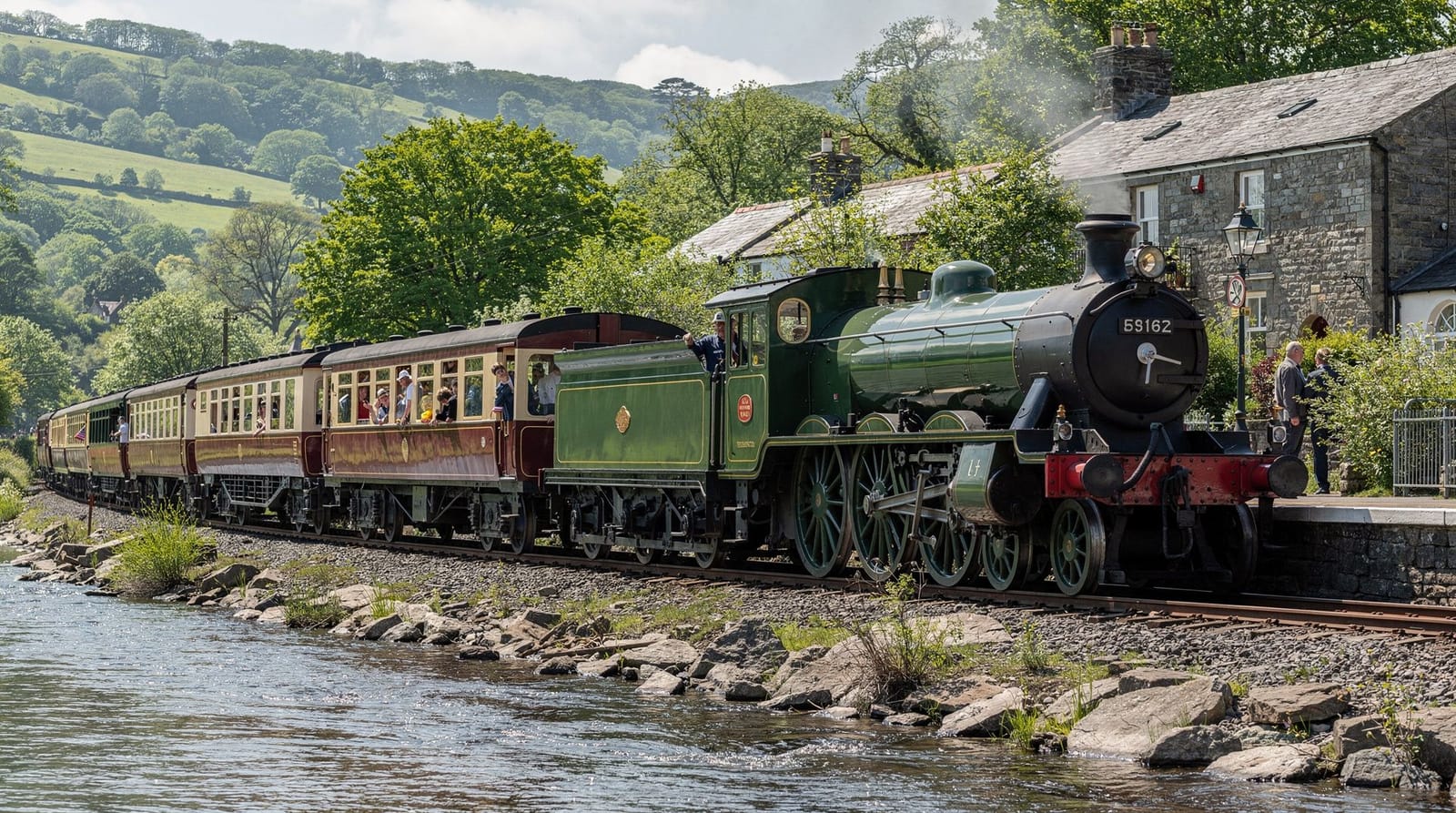
Rolling stock ranges from Victorian-era observation carriages, some dating in modified form to the railway’s earliest passenger era, through to more recent “Pullman” style carriages offering table seating and an at-seat buffet service on selected trains, at a price premium over standard class. Standard carriages are simple and functional, with bench-style seating that suits the leisurely pace of the journey rather than long-distance comfort. On a clear day, the open-sided observation carriages (available on some services) give unobstructed views of the Dduallt spiral and the valley scenery in a way fully enclosed carriages don’t quite match, though they also offer less shelter if the weather turns.
Porthmadog end: harbour town with a Portmeirion detour
Porthmadog station sits a short walk from the town’s harbour, itself built on land reclaimed by the same 19th-century engineering that made the slate trade possible — the Cob, the causeway across the Glaslyn estuary that both created the harbour and enabled the original railway route, was itself a significant engineering project of its own era. The town has a workaday, non-touristy feel compared with somewhere like Llandudno, with a handful of solid cafés and a maritime museum.
It’s also the closest railway town to Portmeirion, the Italianate village made famous by the 1960s TV series The Prisoner, a 10-minute drive or short taxi away — worth combining if you’re spending a full day in the area rather than just riding the train there and back. The Portmeirion, Snowdonia and castles tour from Llandudno covers Portmeirion as part of a wider day if you’d rather not organise the logistics of visiting it independently from Porthmadog.
Blaenau Ffestiniog end: slate country
Blaenau Ffestiniog itself is a former slate-mining town wedged into a steep valley, its terraced streets overshadowed by enormous grey quarry tips that give the whole area a distinctive, slightly severe character quite different from the postcard prettiness of Betws-y-Coed or Conwy 20 minutes away. At its industrial peak in the late 19th century, the quarries here were among the largest slate producers in the world, employing thousands of men in genuinely dangerous conditions, and the town’s Welsh-language chapel architecture and terraced housing still reflect that rapid Victorian industrial growth.
The town’s main draw beyond the railway station is the old Llechwedd quarry site, now home to underground attractions run by Zip World: Bounce Below, a trampoline course strung through former slate caverns, alongside underground zip lines. It’s an easy add-on if you’ve timed your railway trip to leave an hour or two at the Blaenau end before the return journey — see our full Zip World guide for how the different sites compare.
At Blaenau Ffestiniog station, the Ffestiniog Railway shares a cross-platform interchange with the Conwy Valley Line, the regular Transport for Wales service running through Betws-y-Coed to Llandudno Junction. This makes a genuinely useful one-way loop possible: ride the heritage steam line up from Porthmadog, then continue by regular train down the Conwy Valley to the coast, rather than doubling back the way you came.
Intermediate stops most visitors skip past
Because most riders treat the Ffestiniog Railway as a there-and-back trip between the two terminus towns, the intermediate stations get comparatively little attention, which is a shame given what’s on offer. Tan-y-Bwlch, roughly the midpoint of the line, has long served as an unofficial refreshment stop, with a small tea room a short walk from the platform that predates most of the railway’s modern tourist infrastructure. Minffordd station connects (via a short walk) to Portmeirion village, an alternative to driving from Porthmadog if you’d rather arrive by rail.
Tanygrisiau, near the reservoir that once threatened to end the railway altogether, sits close to the Ffestiniog Power Station visitor facilities, for anyone interested in the hydroelectric engineering that reshaped this valley in the 1950s. None of these stops require advance booking beyond your original ticket — trains will stop on request at most intermediate halts, though it’s worth confirming with staff on board if you plan to break your journey partway.
Wildlife and scenery along the route
The lower section between Porthmadog and Tan-y-Bwlch runs through oak woodland that’s home to a reasonable population of native birdlife, including buzzards frequently seen riding thermals above the valley and, in the right season, pied flycatchers in the woodland canopy. Llyn Mair, the small lake the line skirts partway up, is a popular subject for photographers riding in the open observation carriages, particularly in autumn when the surrounding woodland turns a genuinely striking gold and copper. The upper section, climbing into the more exposed slate country around Blaenau Ffestiniog, trades woodland for bare rock and heather moorland, with views back down the valley toward Porthmadog and, on a genuinely clear day, out to Cardigan Bay.
The slate trade’s global reach, briefly explained
It’s worth pausing on just how far this valley’s output travelled at its industrial peak. Slate quarried above Blaenau Ffestiniog and carried down this line to Porthmadog’s harbour was shipped not just around Britain but to continental Europe, North America, and beyond — Welsh slate roofs can still be found on 19th-century buildings in Germany, the United States, and South America, a genuinely global footprint for a product dug out of a single steep Welsh valley.
The scale of that trade explains why a railway this substantial was built through such difficult mountain terrain in the first place, decades before most of Britain’s mainline network existed: the economic incentive to move slate efficiently outweighed the engineering challenge of the gradient.
Getting there from Chester
There is no direct train from Chester to Porthmadog or Blaenau Ffestiniog; the practical rail route involves a change, typically via Llandudno Junction and the Conwy Valley Line to reach Blaenau Ffestiniog (roughly 2.5-3 hours total with connections), or driving via the A55 and A470 to Porthmadog in around 1 hour 15 minutes. Most visitors doing this as a day trip from Chester drive, since the connecting public transport adds significant time on both ends of the day.
If you’re touring North Wales over two or three days rather than squeezing it into a single day trip, our three-day Chester and North Wales itinerary builds in a base near Betws-y-Coed or Porthmadog that makes the railway a half-day excursion rather than the centrepiece of an exhausting single day.
Comparing it with the Welsh Highland Railway
Visitors often ask whether to ride the Ffestiniog Railway, the Welsh Highland Railway, or both. They’re run by the same organisation and share the Porthmadog terminus, but they go in opposite directions and offer different scenery: the Ffestiniog climbs into slate country with tight curves and the Dduallt spiral, while the Welsh Highland runs the other way toward Caernarfon, skirting the western flank of Snowdon itself with wider, more open mountain views.
If you only have time for one, the Welsh Highland arguably has the more dramatic mountain scenery, but the Ffestiniog has the longer history and the more famous spiral. Doing both back to back, with a break at Porthmadog, is possible in a very long day but more comfortably split across two visits — see our dedicated Welsh Highland Railway guide for the full comparison.
Which side to sit on, and other small details that matter
Regular riders generally recommend sitting on the left-hand side travelling from Porthmadog to Blaenau Ffestiniog for the best views of Llyn Mair and the Dduallt spiral, though since the train loops back on itself at the spiral, no single side gives a perfect view of everything — accept that you’ll be swapping sides mentally rather than physically for the full journey.
Observation carriages, where available, solve this problem by offering open views to both sides, at the cost of more exposure to wind and rain. If travelling with a pushchair or significant luggage, check in advance which carriages can accommodate it, since space varies between vintage and modern rolling stock and staff will generally direct you to the right coach if asked at the ticket office.
Accessibility
Some modern carriages on the Ffestiniog Railway offer step-free or ramped access and space for a wheelchair, but this varies by specific train and rolling stock rostered for the day, and not every historic carriage can accommodate a wheelchair user comfortably. Contact the railway directly ahead of your visit if accessibility is a firm requirement, since staff can advise which specific service to book and arrange assistance at Porthmadog or Blaenau Ffestiniog stations, both of which have step-free platform access.
Common mistakes to avoid
Visitors sometimes assume that because the line is short, any train time will work for a day trip built around other activities like Portmeirion or Zip World — but with only a handful of daily departures and a full round trip taking 2.5 hours, missing your intended train can genuinely derail a tightly planned day. Check the specific day’s timetable before committing to a schedule rather than assuming an hourly service like a typical commuter line. Another common oversight is not checking whether your chosen train is steam or diesel-hauled if that distinction matters to you — not every service on a given day uses a steam locomotive, and the website’s timetable usually indicates which is which.
A note on toilets and refreshments before boarding
Because onboard toilets aren’t available on shorter services, use the facilities at Porthmadog or Blaenau Ffestiniog stations before departure rather than assuming a mid-journey stop, and pick up snacks or a drink at either terminus if you’re not booked onto a Pullman service with at-seat catering, since none of the intermediate halts beyond Tan-y-Bwlch’s small tea room offer reliable refreshments.
Dogs and cyclists on board
Well-behaved dogs on a lead travel free or at a small charge on most services, worth confirming at booking if travelling with a larger dog on a busier summer service. Bicycles are generally accommodated in limited numbers with advance notice given to staff, useful if you’re combining the railway with cycling around Porthmadog’s flatter harbour-side routes rather than the steeper terrain further inland.
Booking and practical tips
Book ahead for peak summer Saturdays and school holidays, when popular departure times sell out. Standard class is perfectly comfortable for most visitors; first class (called “Pullman” on some services) adds table seating and, on selected trains, an at-seat buffet, at a meaningful price premium that’s worth it mainly for a special occasion rather than routine sightseeing. Dogs are welcome in some carriages on a lead. The train has no onboard toilets on shorter journeys, so use the facilities at Porthmadog or Blaenau Ffestiniog stations before departure.
Weather rarely stops the Ffestiniog Railway outright — the low-altitude, wooded route is far more sheltered than Snowdon’s summit line — but Welsh rain is still Welsh rain, and the open sections of some carriages mean a waterproof is worth carrying even if the forecast in Porthmadog looks dry. For a wider view of how this line fits with the region’s other heritage lines, see our North Wales heritage railways overview, and for castles within easy reach of Porthmadog and Blaenau, our Welsh castles guide covers Harlech, a short drive south along the coast.
Honest verdict
The Ffestiniog Railway rewards visitors who treat it as more than a photo opportunity from a carriage window. Understanding what you’re actually looking at — a route engineered for gravity-fed slate wagons over a century and a half ago, rebuilt by volunteers around a reservoir that swallowed part of the original line, still run today largely by people who do it because they love the railway rather than because it’s a well-paid job — adds real weight to what might otherwise be a pleasant but unremarkable train ride through pretty scenery.
Pair it with a stop at Blaenau Ffestiniog’s slate attractions or a Portmeirion detour from Porthmadog, allow enough time not to rush the connections, and it’s one of the more genuinely worthwhile half-day activities in this part of Snowdonia. For a different kind of Snowdonia scenery on the same trip, the region’s waterfalls covered in our Snowdonia waterfalls guide make a natural complement if you’re spending more than a single day in the area.
Frequently asked questions about Ffestiniog Railway guide
Does the Ffestiniog Railway run in winter?
Yes, but on a much reduced timetable. Because it's a low-altitude, sheltered route unlike the Snowdon Mountain Railway, some winter operation is possible, including "Santa special" services around Christmas, but it's far more limited than the spring-to-autumn schedule.Can you combine the Ffestiniog Railway with Portmeirion in one day?
Yes. Porthmadog station is a short drive or taxi ride from Portmeirion, and many visitors combine a Ffestiniog Railway journey with a Portmeirion visit on the same day, particularly if travelling from further afield rather than staying locally in Porthmadog itself.
Top experiences
Bookable activities with verified prices and instant confirmation on GetYourGuide.