Portmeirion, the Italianate village built for a film that never lets you forget it
Quick answer: Portmeirion is a privately built Italianate village on the Dwyryd estuary near Porthmadog, created by architect Clough Williams-Ellis between 1925 and 1975 and made internationally famous as the filming location for the 1960s TV series The Prisoner. Entry runs roughly £15-18 for adults, and two to three hours covers the village and gardens properly.
| Where | Near Porthmadog, Gwynedd, on the Dwyryd estuary |
| Cost | Around £15-18 for adults, covering village and gardens |
| Time needed | 2-3 hours for a proper visit; a full day if walking every garden trail |
| Getting there from Chester | Around 1.5-2 hours by car; no practical direct public transport |
| Best time | Early on a weekday, before coach-tour groups arrive mid-morning |
What Portmeirion actually is
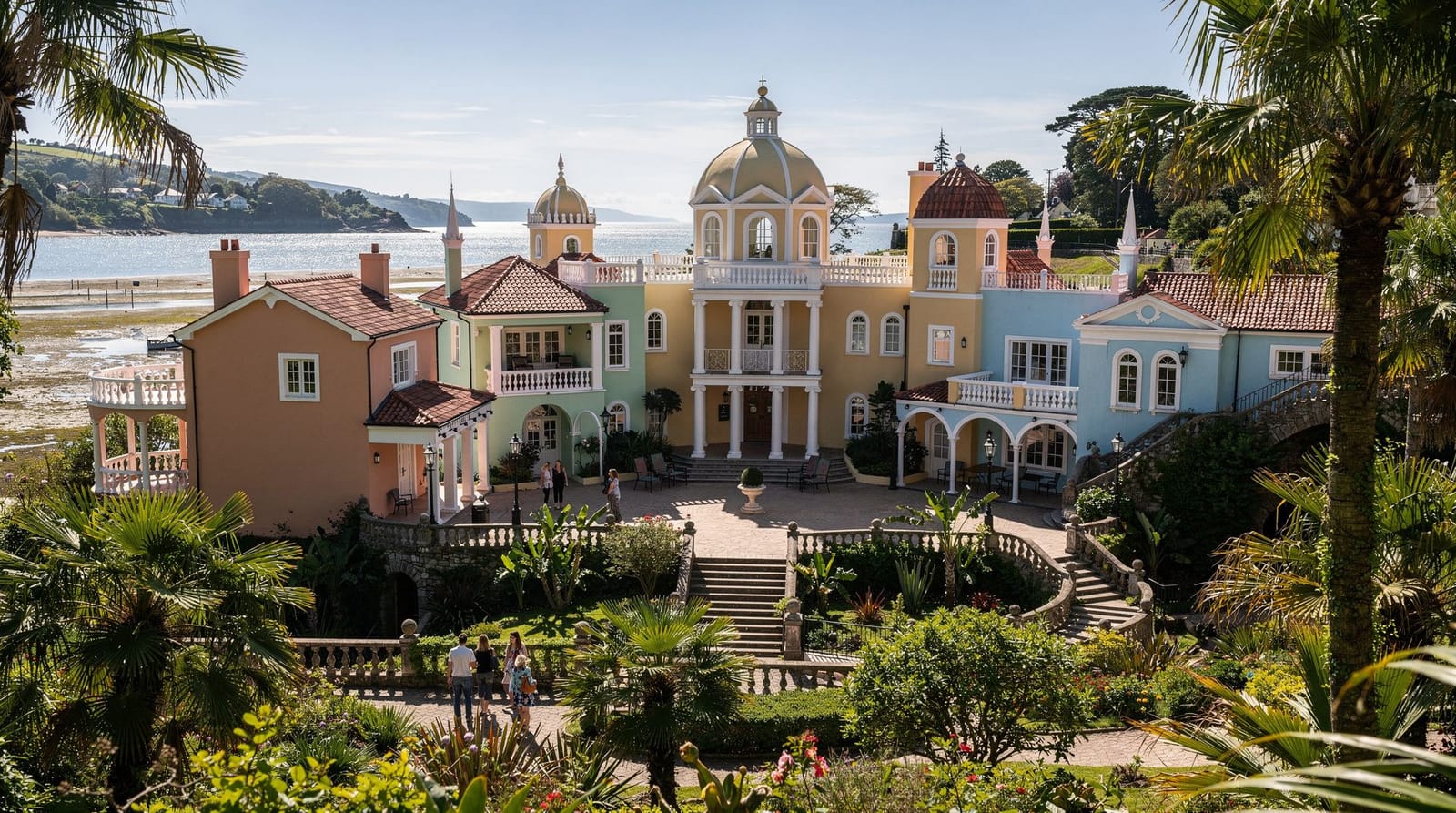
It’s easy to assume Portmeirion is a restored historic village. It isn’t — it’s an invented one, built from scratch over five decades by Clough Williams-Ellis as a demonstration that a naturally beautiful site could be developed without ruining it. The result is a cluster of pastel-coloured, vaguely Mediterranean buildings — domes, colonnades, a campanile — arranged around a central piazza, sitting somewhat incongruously on a wooded Welsh peninsula overlooking the Dwyryd estuary.
It shouldn’t work, aesthetically, and yet it does, largely because Williams-Ellis was genuinely skilled at borrowing architectural fragments (some buildings incorporate salvaged pieces from demolished English country houses) rather than simply copying Italy wholesale.
The Prisoner angle, and why it still matters
Portmeirion’s global recognition owes almost everything to The Prisoner, the 1967 British TV series starring Patrick McGoohan, which used the village as the visual setting for “The Village” — the surreal, unnamed location where the show’s protagonist is held. The series has a genuine cult following that persists decades later, and Portmeirion leans into this rather than downplaying it: there’s a small Prisoner-themed shop, and fans of the show make up a real, recognisable slice of visitors, some in it for architecture and gardens, others specifically retracing filming locations from a show that first aired in black-and-white Britain nearly sixty years ago.
You don’t need to know the show to enjoy the village, but if you do, the central piazza, the campanile, and several of the distinctive buildings will already feel familiar before you’ve read a single information panel.
What’s actually there
Beyond the piazza and its buildings, Portmeirion includes genuinely extensive subtropical gardens — around 70 acres of woodland trails, exotic plantings that take advantage of the mild Welsh coastal microclimate, and several viewpoints over the estuary. The Hotel Portmeirion itself, where Noël Coward reportedly wrote Blithe Spirit during a stay, is a working hotel rather than a museum piece, and its restaurant is open to day visitors as well as guests. There’s a gift shop selling the distinctive Portmeirion Pottery (a separate but related brand that predates and outlived some of the village’s own ventures), a café, and an ice cream parlour that’s popular enough in summer to have a genuine queue.
Honest cost and timing
Adult entry is typically in the £15-18 range, with the price covering both the village and the gardens. Two to three hours is enough to see the village properly and walk a reasonable stretch of the gardens; a full day is achievable if you want to walk every garden trail, eat at the hotel, and browse the shops without rushing. It’s not a cheap day out for what is, ultimately, a village and some gardens, but the sheer unlikeliness of the place — and the quality of the gardens — generally justifies it for a once-per-trip visit rather than something you’d repeat.
Getting there from Chester
Portmeirion sits near Porthmadog in Gwynedd, and there’s no meaningful direct public transport route from Chester — this is one of the North Wales day trips where a car, or a guided tour, is genuinely the practical choice rather than a preference. By car, expect around 1.5-2 hours depending on route, mostly via the A55 and then south through Snowdonia’s western side. Public transport involves multiple train changes and bus connections that can turn a two-hour drive into most of a day each way, which for most visitors isn’t worth it for a single village, however photogenic.
A guided tour combining Portmeirion with Snowdonia and castle stops is the most practical way to see it without renting a car, and makes more sense of the day by pairing it with other North Wales highlights rather than a long round trip for one stop. There’s also a day tour from the Conwy/Llandudno area covering the same ground if you’re already based on the coast rather than in Chester itself.
Combining it with the rest of North Wales
Because of the drive involved, Portmeirion works best as part of a wider Snowdonia day rather than a solo trip. It sits reasonably close to the Ffestiniog Railway’s southern terminus at Porthmadog, so pairing a Portmeirion visit with a ride on the narrow-gauge steam railway up into the slate country around Blaenau Ffestiniog makes efficient use of a long drive that far south. Harlech Castle, one of the more dramatic and less crowded of Edward I’s Welsh castles, is also within a reasonable distance if castles are part of your day.
A little more history
Clough Williams-Ellis bought the peninsula site — then a semi-derelict Victorian mansion estate called Aber Iâ — in 1925, and spent the next five decades building Portmeirion in stages as funds allowed, rather than to a single fixed masterplan. This piecemeal construction is part of why the village doesn’t feel like a single coherent architectural statement so much as a collage — buildings were added, adapted and repositioned across decades, including some genuinely rescued from demolition elsewhere in Britain and re-erected here rather than built new. Williams-Ellis lived to see his creation become internationally famous through The Prisoner and died in 1978, having spent effectively his entire working life on the one project.
Photographing Portmeirion
The central piazza is the obvious shot, best in the earlier part of the day before coach-tour groups arrive in numbers, typically from mid-morning. The view down over the estuary from the higher garden paths, particularly around the lighthouse folly at the peninsula’s tip, gives a genuinely different perspective from the piazza-level photos most visitors come away with. Low tide exposes wide sandbanks across the Dwyryd estuary that photograph well in late-afternoon light, while high tide gives a more conventional “sea view” — worth checking tide times if a specific look matters to your visit.
Dining and staying over
The Hotel Portmeirion’s restaurant, open to day visitors as well as overnight guests, leans into the setting with a menu that’s a notch above typical tourist-attraction catering, though it’s priced accordingly — expect a proper sit-down meal cost rather than a quick, cheap lunch. For visitors wanting more than a day trip, staying overnight at the hotel or in one of the self-catering cottages within the village grounds is a genuinely different experience from a day visit, since it lets you see the piazza empty in the early morning and evening once day-trippers have left — arguably the best version of Portmeirion, if the extra cost fits your trip.
Accessibility
Portmeirion’s paths within the village core are reasonably level and manageable for most visitors, including pushchairs, but the wider woodland garden trails involve genuine slopes, steps and uneven surfaces in places, so anyone with significant mobility restrictions should check the current accessibility guidance before planning a full garden walk. The village itself, being built rather than naturally occurring terrain, is somewhat more manageable than a typical Welsh coastal or mountain site, but it’s not flat throughout.
Is it worth the drive from Chester
Given the roughly two-hour round-trip commitment each way, it’s a fair question whether Portmeirion earns its place on a Chester-based itinerary at all. The honest answer: if you have any interest in unusual architecture, gardens, or The Prisoner specifically, yes — there’s genuinely nowhere else quite like it in Britain, and that novelty is worth the drive on its own. If your priority is maximising castles, mountains or coastline per hour of travel, Portmeirion is more of a detour than an efficient stop, and skipping it in favour of Conwy, Caernarfon or Snowdonia proper is a reasonable trade-off for a shorter, more tightly focused trip.
What to know before you go
Portmeirion is privately owned and run as a business (it also generates revenue through the hotel and self-catering cottages within the estate), so don’t expect the National Trust or Cadw feel of some of North Wales’s other historic sites — it’s polished, well-maintained, and unmistakably commercial in a way that’s honest about what it is rather than pretending otherwise.
Weekends and school holidays get busy, particularly around the piazza and the ice cream parlour; an early arrival on a weekday gets you the gardens and village at their quietest. Wear proper shoes for the woodland trails, which can be muddy even when the village itself is dry, and check the estuary tide times if a walk along the shoreline paths is part of your plan — some sections are only accessible at low tide.
Who Portmeirion suits, and who it doesn’t
Portmeirion works best for visitors interested in architecture, gardens, or genuine screen history rather than those wanting a conventional castle-and-mountain North Wales day. It’s a slower, more contemplative visit than Conwy Castle or Caernarfon Castle, with no real physical challenge beyond garden paths, which makes it a good pick for a gentler day or for visitors with mixed mobility interests within the same group. It suits families reasonably well too, though very young children may find the appeal harder to grasp than they would a castle with towers to climb or a zoo with animals to see.
A practical day plan combining Portmeirion with nearby sights
Given the roughly two-hour drive each way from Chester, most visitors get more value treating Portmeirion as part of a longer Snowdonia day rather than a solo round trip. A realistic plan: an early start from Chester, a mid-morning arrival at Portmeirion for two to three hours in the village and gardens, lunch at the hotel restaurant or nearby Porthmadog, then either a ride on the Ffestiniog Railway if timings allow or a stop at Harlech Castle on the way back, depending on which direction you’re returning. Trying to add a full Snowdon visit to the same day on top of this is realistically over-ambitious given the drive already involved.
Related planning
For the wider region, see our Snowdonia destination guide and the welsh castles guide for nearby castle stops that pair well with a Portmeirion day. Our Portmeirion destination page has the full practical details — opening hours, parking, and accessibility.
If you’re building a longer North Wales trip around this, the 3-day Chester and North Wales itinerary slots Portmeirion in alongside Conwy and Snowdonia without over-scheduling any single day, and our Harry Potter and North Wales post covers some of the other film-and-fantasy angles the region trades on if Portmeirion’s Prisoner connection has you curious about the wider filming-location trail.