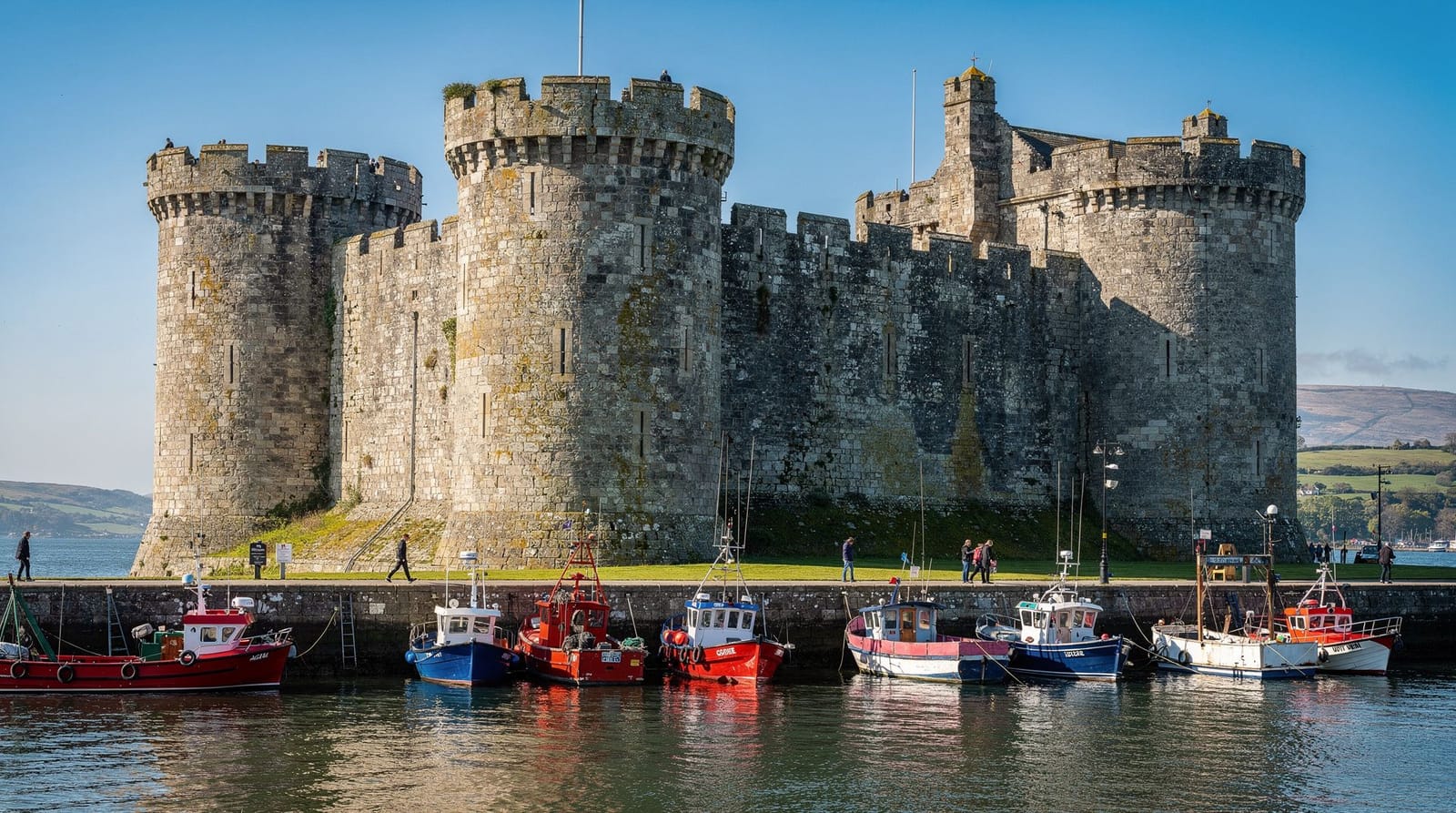
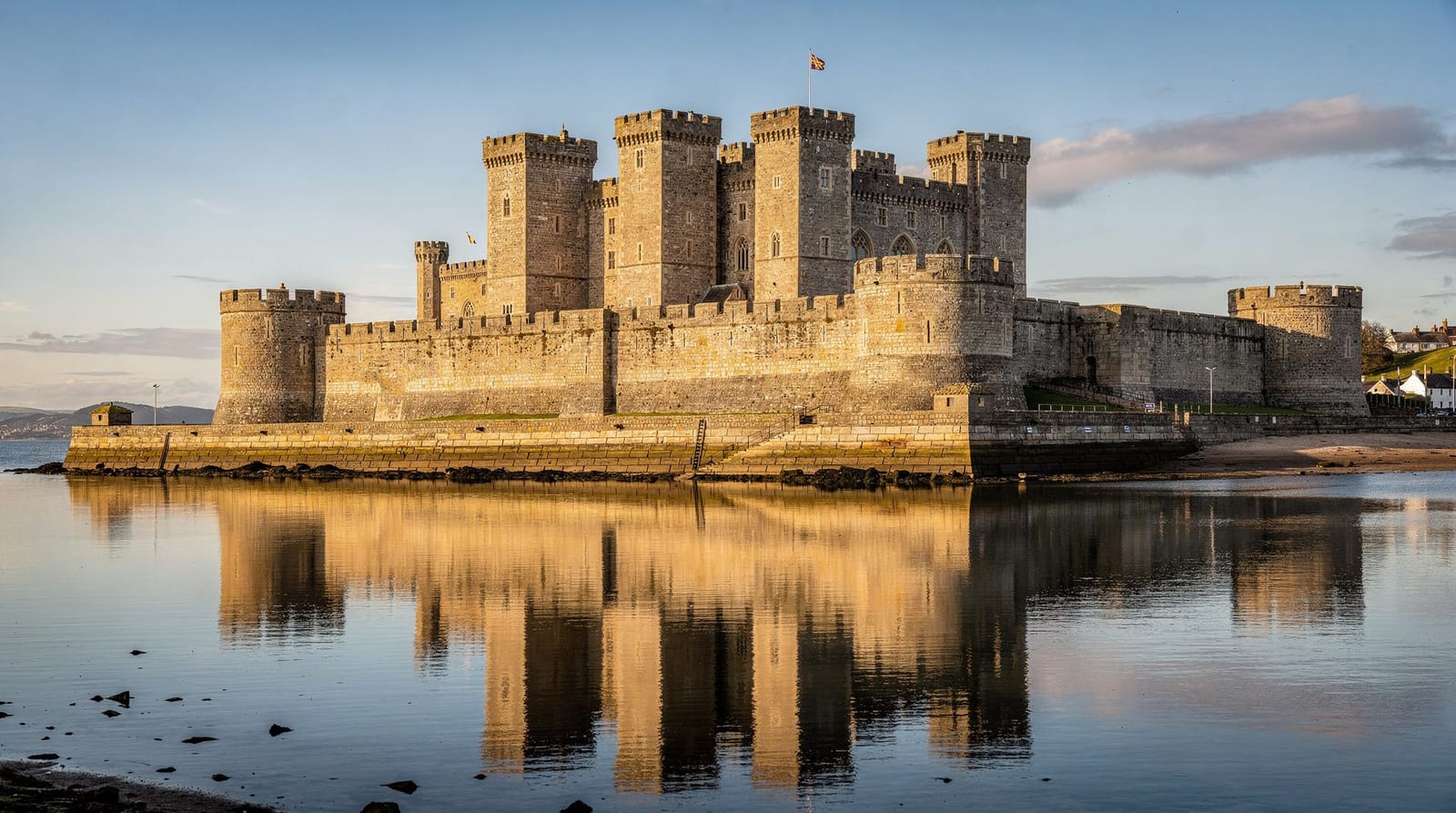
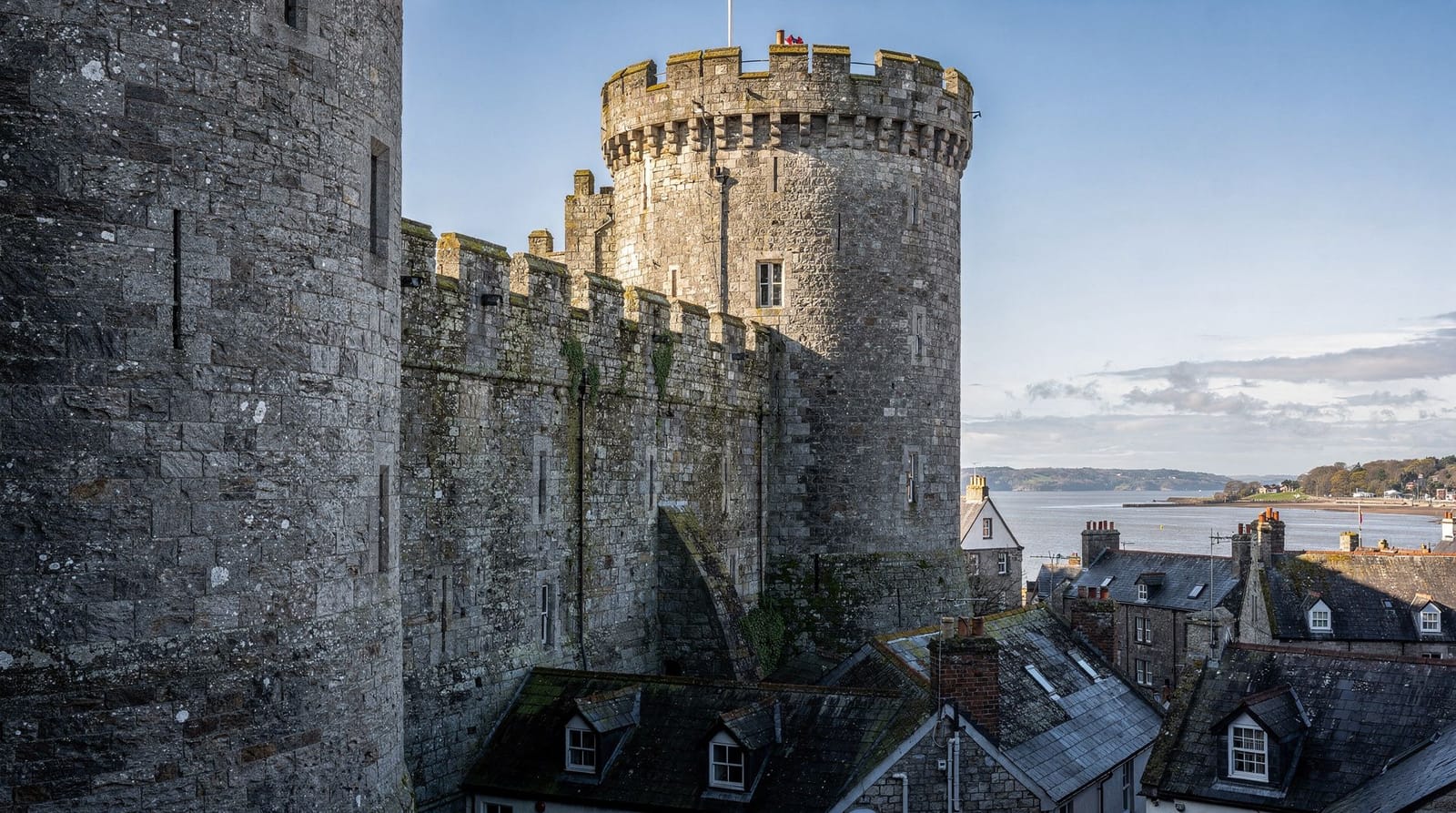
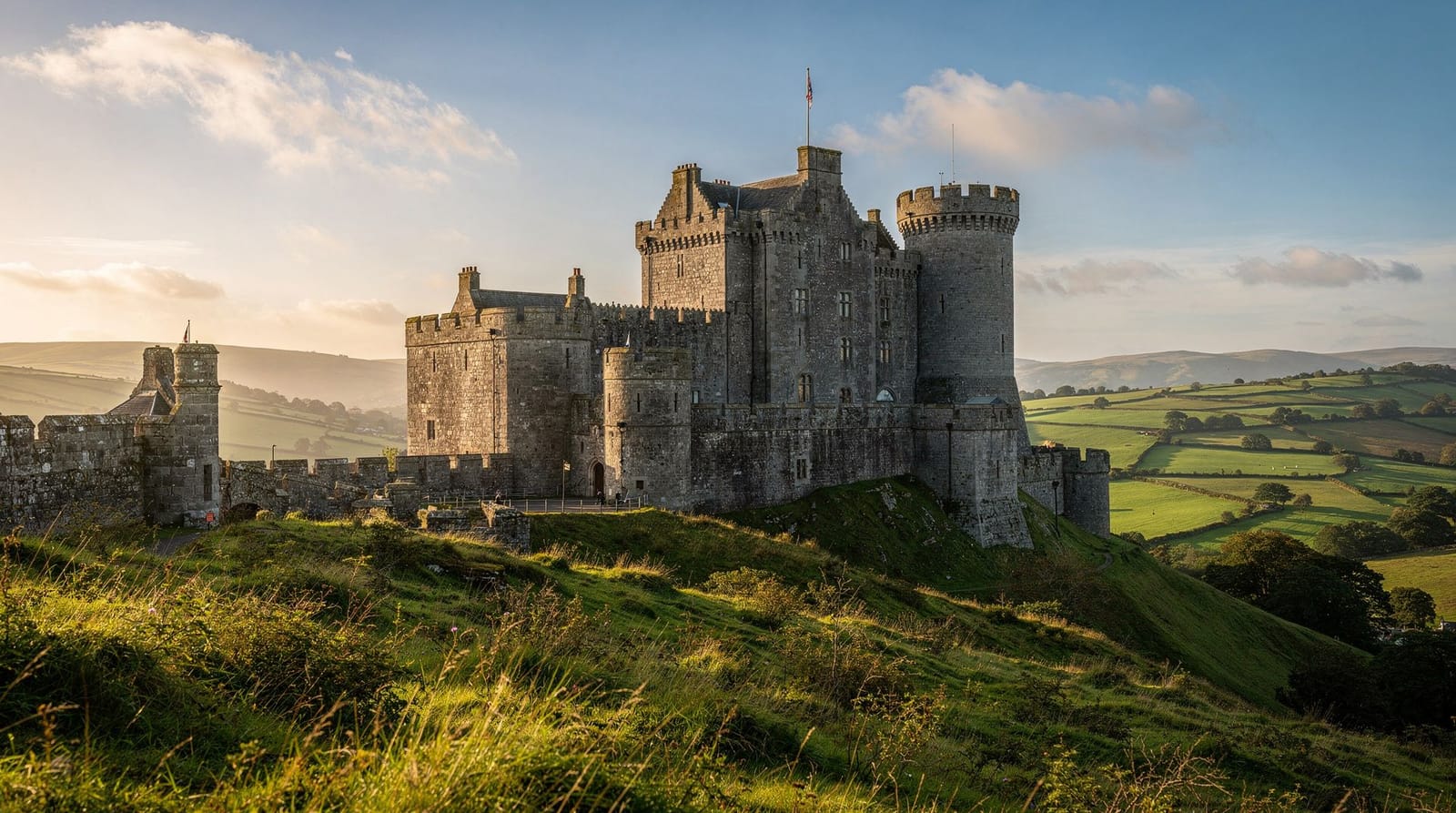
Beaumaris Castle — the unfinished masterpiece of Edward I's castle-building
Why was Beaumaris Castle never finished?
Construction began in 1295 but was repeatedly interrupted and eventually abandoned in the early 14th century as Edward I's wars in Scotland drained royal finances. The concentric design — widely regarded as the most geometrically perfect of any castle built in Britain — was never completed to full height, meaning what survives today, while impressive, is a fraction of the originally planned fortress.
Beaumaris Castle, on Anglesey a short crossing from Caernarfon, is the last and — in purely architectural terms — most theoretically perfect of Edward I’s Welsh fortresses, even though it was never actually finished. This guide covers the history, what survives today, and how to fit it into a North Wales trip from Chester.
| Where | Anglesey, across the Menai Strait from Caernarfon |
| Built | From 1295, never fully completed |
| Time needed | 60-90 minutes, plus time in Beaumaris town |
| Getting there | Car recommended (~1hr30-1hr45 from Chester); train + bus possible via Bangor |
| Best time | Spring or early autumn for light crowds and manageable weather |
The last and most ambitious of Edward’s Welsh castles
Beaumaris Castle, on the island of Anglesey a short crossing from Caernarfon across the Menai Strait, was the final and, in purely architectural terms, most ambitious fortress in Edward I’s chain of North Wales strongholds. Construction began in 1295, more than a decade after work started at Conwy and Caernarfon, prompted by a serious Welsh uprising the previous year led by Madog ap Llywelyn, which briefly captured Caernarfon and made clear to Edward that his conquest of North Wales, more than a decade after the death of Llywelyn ap Gruffudd, still needed reinforcing with new fortifications.
Unlike its predecessors, Beaumaris was built on flat, open ground rather than a defensible natural rock outcrop, freeing its designer — again James of St George, Edward’s master of works for the whole Welsh castle programme — to pursue a purely theoretical, textbook concentric design without having to compromise around an awkward natural site.
The result, architectural historians generally agree, is the most geometrically perfect concentric castle ever built in Britain: two complete rings of defensive walls, one inside the other, each ring with its own towers and gatehouses, designed so that even if an attacking force breached the outer wall, they would find themselves trapped in a killing ground overlooked by the inner wall’s defenders from every angle.
A masterpiece never completed
Despite that architectural ambition, Beaumaris was never finished. Construction proceeded in phases through the 1290s and early 1300s, but funding was repeatedly diverted as Edward I’s attention and treasury shifted toward his increasingly expensive and prolonged wars in Scotland, and building work at Beaumaris slowed and eventually stopped well short of the original design’s full height and completeness.
What survives today — impressive as it is, and enough to have secured Beaumaris’s place alongside Conwy, Caernarfon and Harlech on the UNESCO World Heritage list as “Castles and Town Walls of King Edward in Gwynedd” — represents only a portion of what was originally planned, with towers and walls that in several places never reached their intended full height.
This incompleteness is, paradoxically, part of why architectural historians rate Beaumaris’s design so highly: because the site was flat and unconstrained by terrain, the surviving plan represents Edward’s castle-building programme in its purest, least compromised theoretical form, even though the actual execution fell short of the ambition. Visitors expecting the towering, dramatic silhouette of Conwy or Caernarfon should adjust expectations accordingly — Beaumaris is lower, flatter and in some ways less immediately dramatic to look at, but rewards visitors who understand what they’re looking at architecturally rather than purely visually.
The site Beaumaris replaced
Beaumaris takes its name from the Norman French “beau marais” — beautiful marsh — a reasonably accurate description of the low, flat, marshy ground the castle was built on, reclaimed and drained as part of the construction project itself. Before the castle, this site was occupied by Llan-faes, a Welsh town with a documented market and a Franciscan friary founded by Llywelyn the Great in memory of his wife Joan, an important Welsh settlement in its own right.
As with Conwy’s displacement of Aberconwy Abbey, Edward I’s engineers cleared Llan-faes to make way for the new castle and its planned English settler town, relocating the existing Welsh population several miles away to a new site — a pattern of displacement that recurs across Edward’s Welsh castle-building programme and reflects the deliberate, systematic nature of the conquest rather than incidental collateral damage.
Beaumaris town itself was founded as a new, walled settlement intended specifically for English settlers, part of a policy that also barred Welsh residents from living within several of these new castle towns for generations afterward — a detail worth knowing alongside the architectural history, since it’s easy to admire the castle’s design in isolation without registering the human cost of its construction.
James of St George’s wider career and legacy
James of St George’s work at Beaumaris capped a remarkable career that began in his native Savoy, where he built and improved fortifications for the Counts of Savoy before Edward I, impressed by what he’d seen of Savoyard castle design during his own travels through the region on crusade, recruited him to lead the Welsh castle-building programme. By the time work began at Beaumaris, James had already overseen Conwy, Caernarfon and Harlech, along with several lesser fortifications, giving him roughly two decades of continuous, intensive experience refining concentric and semi-concentric castle theory under real military and financial pressure.
He was eventually knighted and granted the constableship of Harlech Castle in recognition of his service, an unusually high honour for a mason and military engineer rather than a nobleman by birth, and he remains one of the very few named individual architects from medieval Britain whose specific body of work can be traced across multiple still-standing major buildings.
The moat, the dock and Beaumaris’s naval advantage
Beaumaris’s moat was more than a conventional defensive ditch — it was engineered to connect directly to the sea via a purpose-built tidal dock, allowing supply ships to sail directly up to a gate in the castle’s outer wall and unload provisions, building materials or reinforcements without needing to pass through the surrounding countryside at all.
This gave the garrison a level of resupply security that landlocked castles couldn’t match, since a besieging army would need to control the sea approach as well as the surrounding land to fully cut the castle off — a genuinely sophisticated piece of military engineering that’s easy to overlook when walking the now-dry moat today, since the tidal connection that once made it functional has long since been altered by centuries of subsequent land drainage and coastal change in the surrounding area.
Concentric castle theory in a European context
Beaumaris’s fully concentric, symmetrical design places it within a broader European tradition of double-walled fortification that developed across the 12th and 13th centuries, influenced partly by castles built during and after the Crusades in the Holy Land, where European crusaders encountered sophisticated Byzantine and Islamic fortification techniques and brought elements of that knowledge back to Western Europe.
Edward I himself had been on crusade before becoming king, and it’s generally accepted that his own direct exposure to Eastern Mediterranean fortifications, combined with James of St George’s Savoyard expertise, shaped the increasingly sophisticated concentric designs that culminated at Beaumaris. Very few castles anywhere in Europe achieve quite as pure and symmetrical a concentric plan as Beaumaris’s design, even accounting for the fact it was never fully completed — a genuinely significant claim for what can, on a quick visual impression, look like a comparatively modest ruin next to the taller, more dramatic towers of Conwy or Caernarfon.
Accessibility and visiting with family
Because Beaumaris sits on flat ground rather than a rock outcrop or hillside, it’s one of the more physically accessible of Edward’s Welsh castles, with level or gently graded surfaces throughout much of the site, though individual towers and wall-walks still involve original stone stairs without lift alternatives.
This flat layout also makes Beaumaris a comfortable choice for families with young children or visitors with limited mobility who want to experience the concentric design without extensive climbing, in contrast to the more strenuous stair-heavy visits at Conwy and Caernarfon. Cadw provides family-oriented interpretation materials at busier periods, and the castle’s manageable scale means a visit rarely needs to exceed 60-90 minutes even with children in tow.
What to see today
The concentric design is best appreciated by walking the inner ward first, then out through the elaborate gatehouses (themselves never fully completed to their intended grandeur) to the outer ward and surrounding moat, which — unusually for these castles — was originally connected directly to the sea, allowing supply ships to dock right against the castle walls, a design feature that gave Beaumaris genuine strategic flexibility that landlocked sister castles lacked.
Information panels throughout explain the concentric defensive theory in detail, useful since the design’s logic isn’t always immediately obvious without some explanation, particularly to visitors who’ve already seen Conwy or Caernarfon and are expecting a similar single-ring layout.
The castle’s flat setting also means the surrounding town of Beaumaris, developed alongside the castle as a planned English settlement (like several of Edward’s other Welsh castle towns, designed explicitly to be populated by English settlers rather than the displaced Welsh population), is easy to explore on foot afterward, with a pleasant seafront promenade looking out across the Menai Strait toward Snowdonia’s mountains on the mainland — a genuinely attractive view that adds to a castle visit even on a day when the ruins themselves feel comparatively modest next to their more dramatic sister sites.
Beaumaris after the Middle Ages
Like the other Edward I castles, Beaumaris saw renewed military use during the English Civil War, when it was held for the Royalist cause before eventually surrendering to Parliamentarian forces in 1646, part of the same wave of sieges that also brought down Chester itself after a long siege the same year. Unlike some of its sister castles, Beaumaris was not deliberately slighted (partially demolished) after the war, which is one reason its surviving walls, however incomplete relative to the original design, remain in relatively good structural condition today compared with castles that suffered deliberate post-war demolition.
By the 18th and 19th centuries, the castle had fallen into picturesque ruin and became, like many British castles of the period, a subject for Romantic-era painters and early tourists drawn to its atmospheric decay — a status that arguably helped preserve it, since the site’s growing recognition as a scenic and historic curiosity discouraged the kind of wholesale stone-robbing for building material that reduced some other medieval structures to bare foundations. Beaumaris town itself grew through this period into a genteel seaside and market town, a character its seafront promenade and Georgian-era buildings still reflect today, quite different from the more overtly medieval atmosphere of Conwy or Caernarfon’s old towns.
Getting to Beaumaris from Chester
Beaumaris has no rail station of its own and, like Caernarfon, requires a combination of train and bus or a longer drive. The practical public transport route from Chester involves a train to Bangor (roughly 1hr20-1hr40 depending on connections), followed by a local bus across the Menai Bridge to Beaumaris, adding a further 20-30 minutes. This makes Beaumaris one of the more time-consuming North Wales castles to reach independently by public transport from Chester, and it’s often visited as part of a wider Anglesey day tour rather than a standalone rail-based day trip.
By car, the drive from Chester takes around 1hr30-1hr45 via the A55 and across the Menai Bridge, and combining Beaumaris with a stop at Caernarfon on the same day is straightforward given the short crossing between the two, roughly 20 minutes by road via the Menai or Britannia bridges.
Beaumaris Courthouse and Gaol
A short walk from the castle, Beaumaris’s restored Victorian courthouse and gaol — separate attractions from the castle itself, with their own admission — give an unusually well-preserved look at 19th-century justice and imprisonment, including original condemned cells and the mechanism of a working execution shed, presented with a level of unflinching detail that some visitors find genuinely unsettling rather than merely educational.
They’re not part of Cadw’s remit and are run as separate heritage attractions, but for visitors with time beyond the castle itself, they add a substantially different historical period and tone to a Beaumaris day out — a useful contrast to the medieval focus of the castle, and one of the more distinctive things to do in the town beyond the waterfront and castle grounds.
Photography and the best time to visit
Beaumaris’s flat, symmetrical layout photographs differently from the dramatic vertical towers of Conwy or Caernarfon — the best images tend to come from directly outside the main gatehouse, capturing the full width of the outer wall and moat in a single frame, or from within the inner ward looking out through the gatehouse toward the Menai Strait and Snowdonia beyond.
Because Beaumaris draws noticeably fewer visitors than its more famous sister castles, even a midday summer visit rarely feels as crowded as a comparable visit to Caernarfon, making it one of the more relaxed photography experiences among the four UNESCO castles. Spring and early autumn offer a good balance of daylight and manageable weather, while the castle’s flat, exposed setting means winter visits can be genuinely cold and windswept given the lack of any natural shelter from the surrounding open ground.
Combining Beaumaris with the rest of Anglesey and North Wales
Because Beaumaris sits on Anglesey rather than the mainland, it pairs naturally with wider exploration of the island — its coastline, smaller heritage sites and the dramatic Menai Strait crossings themselves — rather than functioning as an easy add-on to a single castle-focused day trip from Chester the way Conwy does.
Our Welsh castles 2-day itinerary includes Beaumaris alongside Conwy and Caernarfon across a weekend, the most efficient way to see all three without excessive backtracking given how the two-day structure allows the awkward Anglesey crossing to be built in deliberately rather than squeezed into a single rushed day. The Anglesey destination guide covers the wider island beyond Beaumaris in more depth if you have time to explore further.
Tourist traps and practical notes
Because Beaumaris draws a smaller volume of day-tripping visitors than Conwy or Caernarfon, it rarely suffers the same tourist-trap pricing pressure immediately around its entrance — a genuine practical advantage of visiting a somewhat less famous site within the same UNESCO listing. Parking in Beaumaris town is generally straightforward outside the busiest summer weekends, with a car park a short walk from the castle entrance. As with the other Edward I castles, check current Cadw opening hours and admission prices before travelling, since these are reviewed and adjusted periodically.
A final word on expectations
Visitors who arrive at Beaumaris straight after Conwy or Caernarfon sometimes feel a flicker of disappointment at the lower, flatter, more obviously incomplete ruins in front of them — a natural reaction if you’re judging purely on visual drama rather than architectural substance. Recalibrating that expectation before you arrive, and understanding what the concentric design actually represents in terms of medieval military theory, turns Beaumaris from a potential anticlimax into arguably the most intellectually satisfying of the four UNESCO castles to properly understand, even if it’s rarely the most photogenic.
Planning your visit
Beaumaris rewards visitors specifically interested in castle architecture and design theory more than those looking for a single dramatic photograph — its flat setting and unfinished state mean it doesn’t have quite the same immediate visual impact as Conwy’s estuary-side towers or Caernarfon’s imposing scale, but its concentric design is, by most architectural historians’ assessment, the most theoretically accomplished of any castle built in medieval Britain.
Combined with a walk around Beaumaris town and its seafront, it’s a worthwhile half-day addition to a North Wales trip that already includes the other Edward I castles, rather than necessarily a standalone reason to visit on its own. For the fuller comparison against Conwy, Caernarfon and Harlech, see our Welsh castles guide and Edward I castles guide, both of which place Beaumaris’s unfinished, purely theoretical design within the wider arc of Edward’s decades-long Welsh castle-building campaign.
Beaumaris against the other three UNESCO castles
| Castle | Standout feature | Completeness | Visitor experience |
|---|---|---|---|
| Beaumaris | Most theoretically perfect concentric plan | Never finished | Flat, accessible, uncrowded |
| Conwy | Best-preserved curtain walls and town walls | Largely complete | Dramatic, compact, busiest |
| Caernarfon | Largest, most symbolically loaded design | Largely complete | Imposing scale, coach-tour crowds |
| Harlech | Most dramatic natural clifftop setting | Largely complete | Compact, striking silhouette |
None of the four is a “skip” — they’re different enough in character that visiting all four across a longer trip, rather than picking a single favourite, is genuinely worthwhile if your schedule allows it.
Food and facilities in Beaumaris town
Beaumaris’s seafront has a reasonable spread of cafés, pubs and a couple of proper restaurants overlooking the Menai Strait, generally better value than anything immediately at the castle gates. A short walk from the castle entrance, the town’s Georgian-era high street has independent bakeries and tea rooms that make a pleasant lunch stop before or after a visit, and there’s no need to rely on the castle’s own limited catering for a full meal given how walkable the town centre is.
Visiting with the Courthouse and Gaol on the same day
Pairing the castle with the nearby Victorian courthouse and gaol makes for a fuller half-day in Beaumaris, since the two attractions cover genuinely different periods and tones — medieval military architecture at the castle, 19th-century justice and imprisonment at the courthouse. Budget an extra 45-60 minutes if you want to see both properly, and note that the courthouse and gaol run separate admission and opening hours from Cadw’s castle, so check both before travelling rather than assuming a single combined ticket covers everything.
A note on Anglesey’s wider appeal
Because Beaumaris sits on Anglesey rather than the mainland, visitors with more than a single day to spare often extend a Beaumaris visit into a broader look at the island — its coastline, South Stack lighthouse further west, and the dramatic Menai Strait crossings themselves via the Menai and Britannia bridges. Our Anglesey destination guide covers these wider options if a single castle visit doesn’t use up your full day, and pairing Beaumaris with even a short coastal drive elsewhere on the island makes the longer journey from Chester feel more worthwhile than a castle-only stop.
Accessibility details worth knowing before you book
Beyond the flat, level ground that makes Beaumaris more accessible than Conwy or Caernarfon overall, it’s worth knowing the specific limitations: the wall-walks and individual towers still involve original, uneven stone stairs with no lift alternative, so visitors who need step-free access throughout will get a genuine sense of the castle’s ground-level layout and concentric design without being able to climb to the upper viewpoints. Cadw’s own accessibility information, checked ahead of a visit, is the most reliable source for current provision, since facilities are occasionally updated between seasons.
Frequently asked questions about Beaumaris Castle
Is Beaumaris Castle worth visiting if I've already seen Conwy or Caernarfon?
Yes, but recalibrate your expectations first. Beaumaris is lower, flatter and less immediately dramatic than Conwy or Caernarfon, but its concentric design is widely regarded by architectural historians as the most theoretically perfect of any castle built in medieval Britain — it rewards visitors interested in castle design as much as visual spectacle.How long does a visit to Beaumaris Castle take?
Most visitors need 60-90 minutes for the castle itself, longer if combined with a walk around Beaumaris town's seafront promenade or a stop at the nearby Courthouse and Gaol, which are separate attractions with their own admission.