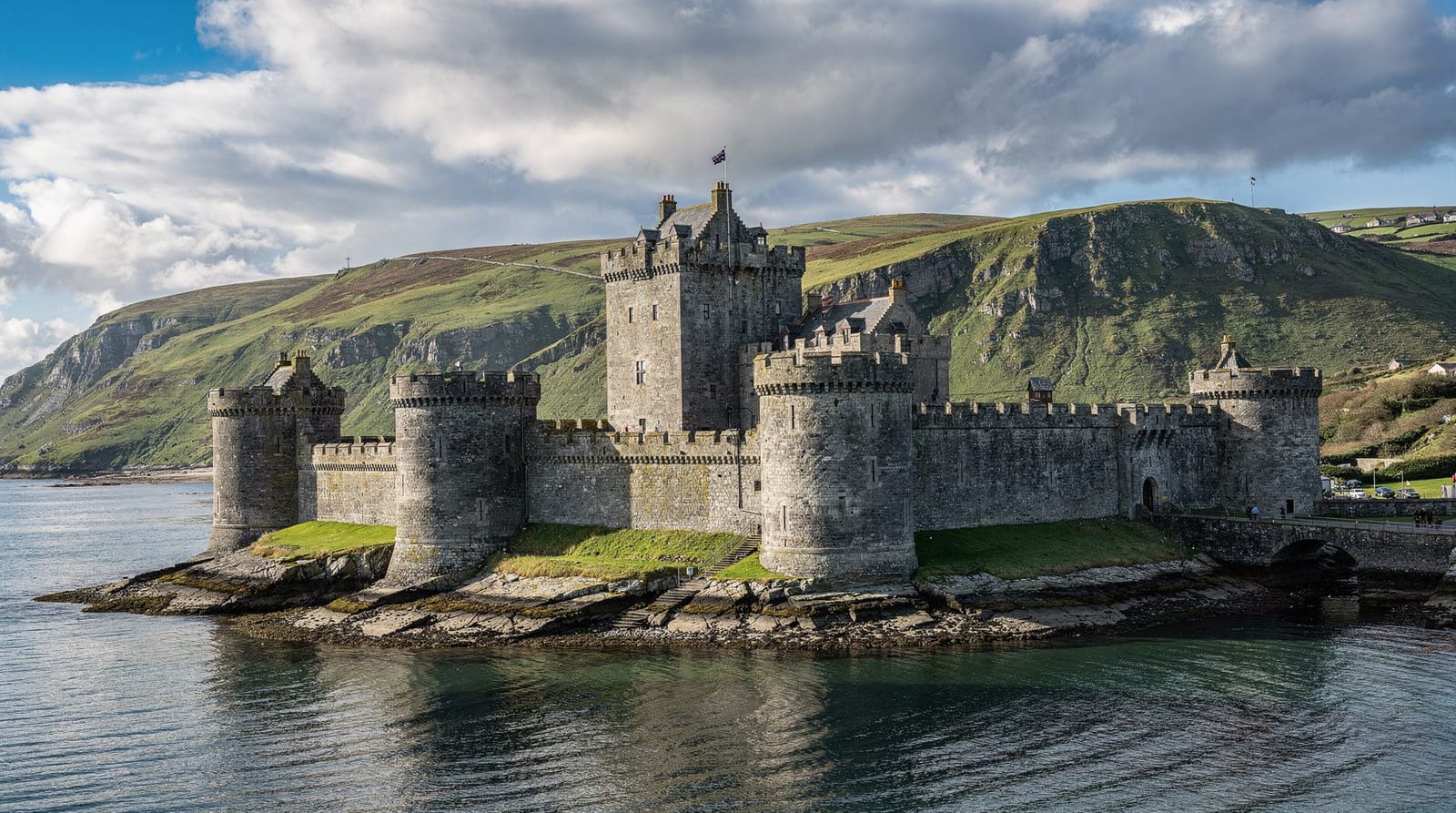
Flint Castle — the first link in Edward I's Iron Ring
Is Flint Castle free to visit and how do you get there from Chester?
Yes, Flint Castle is free and unstaffed, managed by Cadw with no ticket office or set opening hours — you can walk around the site at any time. Flint has its own railway station directly on the Chester-to-North Wales coast line, roughly 15-20 minutes from Chester by train, making it one of the easiest and cheapest castle day trips covered on this site.
| Where | Flint, on the Dee estuary, North Wales coast line |
| Cost | Free, unstaffed, no ticket |
| Time needed | 20-30 minutes |
| Getting there | Direct train from Chester, ~15-20 minutes |
| Best time | Low tide for the best estuary photography angle |
Setting expectations before you go
It’s worth being direct about what Flint is and isn’t before making the trip: this is a genuinely ruined, fragmentary site without the towering, largely intact walls of Conwy or the imposing scale of Caernarfon, and visitors expecting a similarly dramatic castle experience should recalibrate expectations accordingly. What Flint offers instead is historical significance disproportionate to its physical remains — the literal starting point of one of medieval Europe’s most ambitious castle-building campaigns, a genuine Shakespearean connection, and an entirely free, flexible visit that costs nothing beyond the short train fare from Chester.
The castle that started it all
Flint Castle doesn’t draw anywhere near the visitor numbers of Conwy or Caernarfon, and its ruins are considerably more fragmentary than either — but it holds a genuine claim to historical significance that those grander, better-preserved sites can’t match: it was the very first castle Edward I built during his conquest of North Wales, construction beginning in 1277, a full six years before work started on Conwy or Caernarfon. For visitors interested in the full story of Edward’s “Iron Ring” of Welsh castles, covered in our Edward I castles guide, Flint is where that story genuinely begins.
Flint’s position, on the Dee estuary within easy reach of Chester by both land and river, wasn’t accidental — it reflects just how central Chester was to Edward’s entire Welsh campaign, functioning as the logistical base from which men, materials and supplies flowed into the new fortress during its construction. That close relationship between Chester and Flint continues today in a much more mundane form: Flint sits directly on the rail line connecting Chester to the North Wales coast, making it one of the simplest, cheapest castle day trips available to anyone based in Chester.
Construction details worth knowing
Building Flint involved a workforce drawn from across England and even Gascony (Edward’s continental territory in southwestern France), reflecting the same pattern of large-scale, geographically dispersed labour conscription that characterised the later, more famous castles in the programme, albeit at a smaller scale given Flint’s more modest overall size compared with Conwy or Caernarfon.
Construction proceeded in phases through the late 1270s and into the 1280s, with the surrounding town — like the later castle towns at Conwy and Caernarfon — laid out as a new, planned settlement intended for English settlers, part of the same systematic pattern of demographic control that ran through Edward’s whole Welsh castle-building programme, covered in more depth in our Edward I castles guide.
An unusual design — the donjon
Architecturally, Flint differs from Edward’s later, more famous castles in one significant respect: it includes a large, separate circular tower known as the donjon, physically detached from the main castle by its own moat and connected only by a drawbridge, functioning as a self-contained keep of last resort distinct from the rest of the fortress.
This design, with clear influence from French and continental European castle architecture of the period rather than the more integrated concentric approach James of St George would later refine at Beaumaris, makes Flint historically distinctive even among Edward’s own Welsh castles — an early, somewhat experimental design that wasn’t repeated in quite the same form at any of the later sites in the programme.
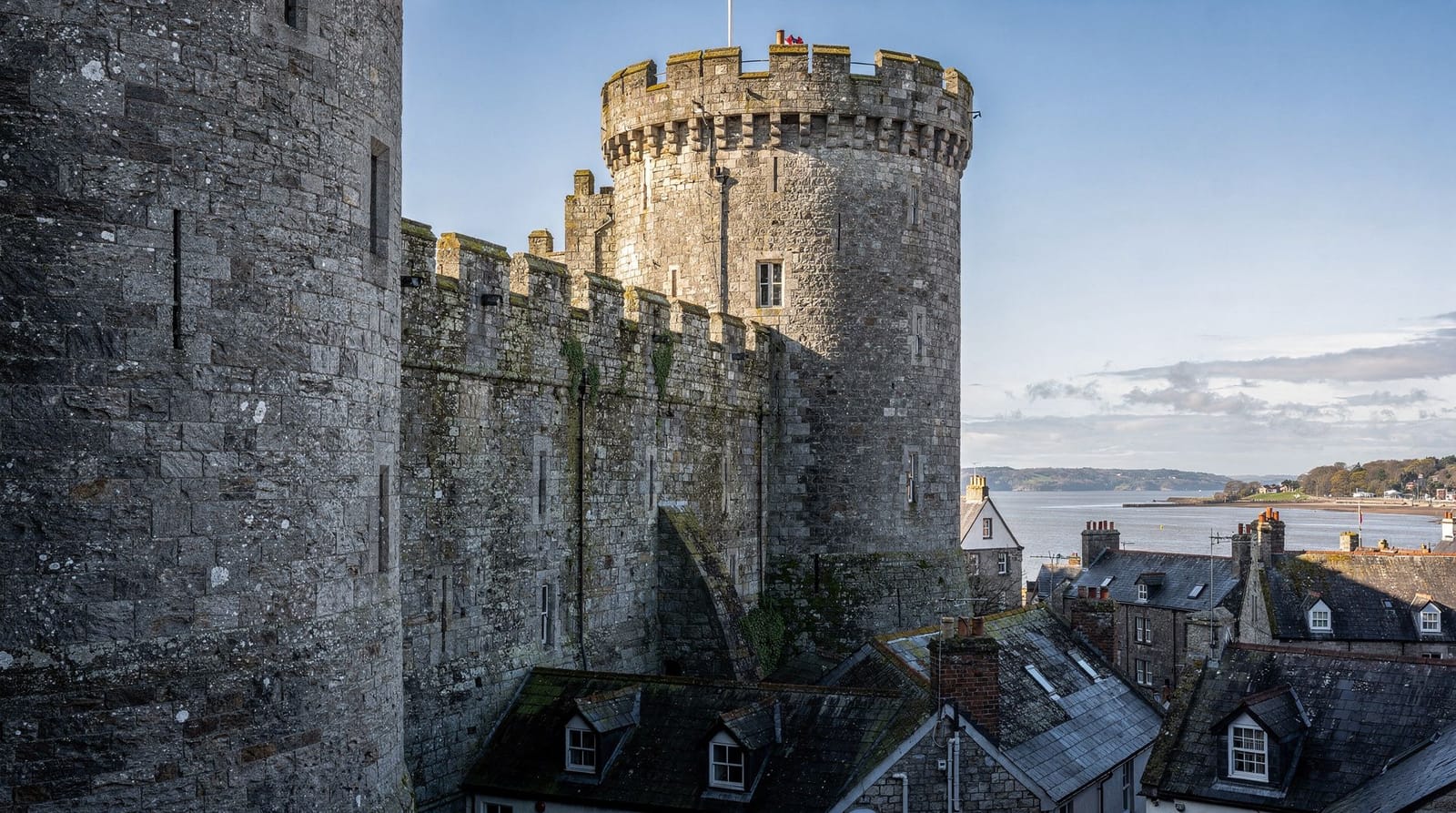
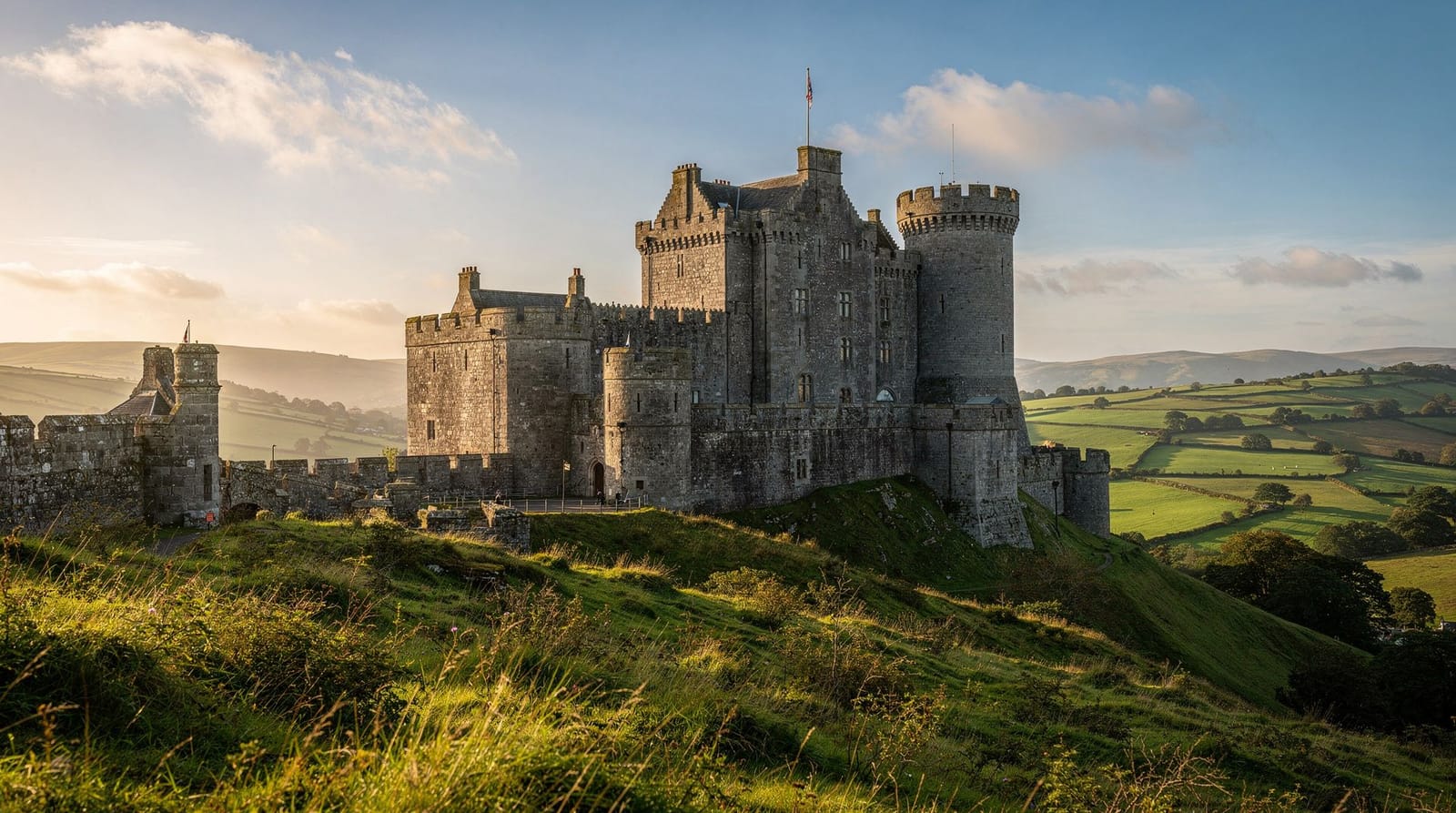
The donjon and the main castle’s other three corner towers, along with sections of curtain wall, survive today in a genuinely ruined but still legible state, allowing visitors to trace the castle’s original layout clearly even without the more complete standing walls found at Conwy. Cadw’s information panels on-site explain both the construction history and this distinctive donjon design in more detail.
Richard II’s surrender — Shakespeare’s Flint
Flint’s most famous historical moment came in 1399, when King Richard II, having returned from a campaign in Ireland to find his kingdom in open revolt behind him, was intercepted and effectively taken captive at Flint Castle by the forces of Henry Bolingbroke, the future Henry IV. This episode — Richard’s humiliating surrender of royal authority at Flint, shortly before his forced abdication and mysterious death in captivity the following year — is dramatised directly in Shakespeare’s play Richard II, which sets a pivotal scene of the king’s downfall specifically at Flint Castle, giving this otherwise lesser-known Welsh ruin a genuine place in English literary history alongside its military and political significance.
Standing at the site today, it’s worth pausing on this connection — a comparatively modest, now-ruined castle on the Dee estuary was, for one brief moment in 1399, the stage for the effective end of a king’s reign, an event significant enough that England’s greatest playwright chose to dramatise it directly two centuries later.
Flint compared to Rhuddlan
Flint’s sister castle from the same 1277 construction phase, Rhuddlan, sits a short distance further west along the coast and offers a useful point of comparison for anyone interested in this earliest stage of Edward’s Welsh campaign.
Rhuddlan is generally considered the more architecturally sophisticated of the two first-phase castles, benefiting from an ambitious contemporary engineering project that diverted and canalised the River Clwyd to allow direct sea access to the castle — a scaled-down precursor to the more famous supply innovations later built into Harlech’s “way from the sea” and Beaumaris’s tidal dock. Rhuddlan also holds its own significant place in constitutional history as the site where the Statute of Rhuddlan was issued in 1284, formally restructuring North Wales under English administrative and legal control.
Visiting both castles on the same day, given their relative proximity along the coast, gives a genuinely useful before-and-after picture of how Edward’s engineering ambitions scaled up rapidly even within this earliest phase of the campaign, well before the more famous second-phase castles at Conwy and Caernarfon were even begun.
| Flint Castle | Rhuddlan Castle | |
|---|---|---|
| Built | From 1277 | From 1277 |
| Cost | Free | Free |
| Design | Detached donjon, French influence | Sea-access canal engineering |
| Constitutional significance | Richard II’s 1399 surrender | Statute of Rhuddlan, 1284 |
| From Chester | Direct train, ~15-20 min | Short drive further along the coast |
Cadw’s approach to unstaffed sites like Flint
Flint is one of a genuine category of Cadw-managed monuments that operate without staff, ticketing or fixed opening hours, a deliberate approach that keeps sites like this accessible and low-cost to maintain while concentrating paid staff and visitor infrastructure at the flagship UNESCO castles further along the coast.
This model works well for sites with modest visitor numbers and limited surviving fabric, since the cost of staffing a ticket office and facilities wouldn’t be justified by the numbers of people actually coming through, and it means visitors can genuinely turn up at any hour, including outside standard tourist-season daylight hours, without needing to plan around published opening times. The trade-off is minimal on-site interpretation beyond a handful of information panels, so visitors wanting the fuller historical picture benefit from reading up beforehand rather than expecting a guided or heavily signposted experience on arrival.
Extending the day to Conwy or Caernarfon
Because Flint’s visit is so short, most visitors combine it with a longer stop further along the coast rather than treating it as a full day out. Conwy and Caernarfon are the natural next stops on the same rail line and road, and our day trips from Chester overview covers how to sequence a longer North Wales day around a brief Flint stop.
For visitors wanting to see the full arc of the Iron Ring across more than one day, the two-day Welsh castles itinerary and best castles near Chester both help with planning beyond a single afternoon.
Flint’s more recent industrial history
Beyond its medieval significance, Flint developed into a notable industrial town in more recent centuries, particularly known for lead and other mineral processing linked to mining activity in the nearby Halkyn Mountain area, and later for paper manufacturing and other heavier industry along the Dee estuary.
This more recent industrial character gives the town a rather different atmosphere from the more determinedly picturesque, tourism-oriented centres of Conwy or Llandudno further along the coast — Flint feels like a genuine working Welsh town that happens to have a significant medieval ruin within it, rather than a place whose entire identity and economy has been built around castle tourism. Some visitors find this more understated, lived-in character a refreshing contrast to the more commercialised UNESCO sites, even if it means fewer dedicated visitor amenities around the castle itself.
Later history and decline
Flint saw further military action during the English Civil War in the 1640s, changing hands between Royalist and Parliamentarian forces before being slighted (deliberately damaged) by Parliament after the war, in common with many English and Welsh castles considered a continuing security risk if left intact. This slighting is a major reason Flint survives in a considerably more ruined state than Conwy or Caernarfon, which escaped equivalent large-scale post-Civil War demolition.
By the 18th and 19th centuries the site had settled into the kind of picturesque, overgrown ruin state that attracted Romantic-era artists and early tourists, and it remains today an unstaffed, freely accessible heritage site managed by Cadw with minimal on-site infrastructure beyond information panels and pathways.
Photography and getting the best view
Flint’s flat, low-lying setting on the Dee estuary means the most effective photographs generally come from a slight distance rather than close up against the ruins themselves — the estuary foreshore just beyond the castle gives a clean angle taking in the donjon, the main castle towers and the wide expanse of water and Wirral coastline beyond, particularly attractive at low tide when the exposed estuary mudflats and channels add visual interest, or during a good sunset when the flat western horizon over the water catches the light well. Because the site draws far fewer visitors than the UNESCO castles, getting an uncluttered photograph rarely requires the early-morning timing strategy needed at busier sites like Caernarfon.
Visiting with children
Flint’s compact, free, unstructured nature makes it a low-pressure stop for families — there’s no ticket queue, no fixed route and no pressure to “see everything” given there’s relatively little formal interpretation on-site beyond a handful of panels. Children generally enjoy the freedom to explore the ruined towers and donjon at their own pace, though the uneven, sometimes muddy ground and lack of any barriers around drops or the moat mean supervision is important, more so than at the more visitor-managed Cadw flagship sites. Given the short visit duration, Flint works well as a brief, flexible stop within a longer family day trip rather than a destination requiring significant time investment or forward planning.
Visiting Flint today
Because it’s free and unstaffed, a Flint Castle visit is inherently low-commitment — there’s no ticket to buy, no opening hours to work around, and the site can be explored at whatever pace suits you, typically 20-30 minutes for a thorough look at the surviving towers, donjon and curtain wall remains. The flat, low-lying site sitting directly beside the Dee estuary also offers pleasant views across the water toward the Wirral, and the surrounding grounds include walking paths suitable for a short stroll beyond the castle ruins themselves.
Flint town itself is a modest, unpretentious place without the tourist infrastructure of Conwy or Caernarfon — there’s little in the way of dedicated castle-adjacent shopping or dining, so this is best treated as a quick, standalone stop rather than a destination to build a full day around, unless you’re specifically interested in the town’s own more recent industrial history.
Getting to Flint Castle from Chester
Flint has its own railway station on the North Wales Coast line, reached from Chester in roughly 15-20 minutes on frequent services — making it, alongside Conwy, one of the very few North Wales castles reachable by a short, direct, inexpensive train journey with no changes required. The castle itself sits a short walk from the station, easily manageable on foot without needing a taxi or bus connection, which is a genuine practical advantage over Caernarfon, Beaumaris or Harlech, none of which offer anything close to this level of simplicity from Chester.
By car, the drive takes around 25-30 minutes via the A548, similarly straightforward and quick compared with the longer drives required for the more westerly castles.
Combining Flint with a wider North Wales day
Given its short visit duration and direct rail connection, Flint works well as a brief stop on the way to or from a longer day trip further along the coast — for visitors heading to Conwy or Llandudno by train, breaking the journey with a short Flint Castle stop costs relatively little extra time given the site’s proximity to its own station and its free, unticketed access.
It’s less suited as a standalone full-day trip on its own, given the modest scale of both the castle and the surrounding town, but as an add-on to a longer North Wales rail day, it’s an efficient way to see the actual starting point of Edward I’s entire castle-building campaign at essentially no additional cost.
Our Chester trains and day trips guide covers the practicalities of the North Wales coast rail line in more detail, useful for planning a day that combines Flint with one or more of the region’s other coastal stops.
What survives versus what’s been lost
It’s worth being specific about what actually remains at Flint today rather than relying on a vague sense of “ruined.” The donjon, the site’s most distinctive architectural feature, survives to a meaningful height and its separate moat and drawbridge connection to the main castle are still clearly traceable on the ground.
Three of the four corner towers of the main castle enclosure survive in varying states, along with sections of curtain wall connecting them, though the fourth tower and much of the original internal buildings — the great hall, chapel and domestic ranges that would have supported the garrison — have been lost entirely to time, later stone-robbing for other local building projects, and the deliberate Civil War-era slighting described above. This partial survival is precisely why on-site information panels matter more here than at the more completely preserved UNESCO castles, since imagining the missing structures requires more active engagement with the interpretation than simply walking through largely intact rooms.
Other free Cadw sites worth knowing about
Flint isn’t the only unstaffed, free-to-access Cadw site in North Wales, and it’s worth knowing this is a genuine category of attraction distinct from the ticketed flagship castles covered elsewhere in this guide series. Several smaller medieval sites across the region operate on a similar basis — open access, minimal interpretation, no admission fee — and collectively they offer a useful, budget-friendly way to add historical depth to a North Wales trip without the cumulative cost of multiple full-price castle tickets.
If budget is a genuine consideration for your trip, building a day around one or two free sites like Flint alongside a single paid flagship castle visit is a sensible way to balance cost against seeing the region’s most significant attractions.
A practical checklist for a Flint visit
Given the site’s unstaffed nature, a few practical points are worth planning around rather than assuming. Bring your own water and any snacks, since there’s nothing available on-site. Wear footwear suited to potentially uneven, sometimes muddy ground, particularly after Cheshire and North Wales’s frequent rain. Check the tide times if photography of the estuary setting is a priority, since the site’s visual appeal shifts noticeably between high and low tide. And because there’s no dedicated car park directly at the castle, check current local parking arrangements in Flint town before arriving by car, since options can be more limited than at the larger, purpose-built visitor facilities found at Conwy or Caernarfon.
Tourist traps and practical notes
There’s essentially no tourist-trap risk at Flint given its free admission and lack of any significant on-site commercial activity — a genuine contrast to the pricing pressures sometimes found immediately around Conwy or Caernarfon’s castle entrances. The main practical consideration is simply that Flint, being unstaffed, has no toilets, café or shop on-site, so plan accordingly if you’re combining it with a longer day of travel.
Flint’s place in Chester’s own history
Because Flint was built specifically to be supplied and reinforced from Chester, its story is inseparable from Chester’s own role as the military and administrative hub of the entire Anglo-Welsh frontier — a role Chester had already played once before, a thousand years earlier, as the Roman legionary fortress of Deva Victrix, and would play again in the following century as Edward’s campaign expanded westward to Conwy, Caernarfon and beyond.
Visiting Flint with this context in mind turns what might otherwise read as a minor, fragmentary ruin into a genuinely meaningful marker of exactly when and where this particular chapter of Chester’s long military history as a frontier base began. Our Chester history guide ties this Flint connection into the fuller chronological story of the city and its surrounding region, from Roman fortress through medieval frontier town to the present.
Why Flint deserves more attention than it gets
Flint Castle’s modest scale and fragmentary ruins mean it’s easy to dismiss in favour of the grander, better-preserved UNESCO sites further west, and most visitors with limited time are right to prioritise Conwy or Caernarfon if forced to choose. But for anyone genuinely interested in the full arc of Edward I’s conquest of Wales — where it started, how the design evolved over subsequent decades, and the specific literary and historical weight of Richard II’s downfall — Flint offers a free, quick, and genuinely significant stop that rewards the short detour.
Combined with its position directly on the Chester-North Wales rail line, there’s very little reason not to include it, even briefly, on a longer North Wales day trip. For the fuller context of how Flint fits into Edward’s wider castle-building programme, see our Edward I castles guide and Welsh castles guide, both of which trace the campaign’s evolution from this modest first fortress through to the architectural sophistication of Conwy, Caernarfon and Beaumaris in the following decades.
Frequently asked questions about Flint Castle
Do you need to book Flint Castle in advance?
No. Flint Castle is free and unstaffed with no ticket office, so there's nothing to book. You can walk around the site at any time of day, though it's worth checking Cadw's website for any temporary access restrictions before a special-occasion visit.How long does a Flint Castle visit take?
Most visitors spend 20-30 minutes exploring the surviving towers, the donjon and the curtain wall remains thoroughly. It's a compact site rather than a full-day destination, so it works best as a brief add-on to a longer North Wales rail day rather than a standalone trip.