Chester history guide — from Roman fortress to modern city
Chester: Deva Roman Experience
What is Chester most famous for historically?
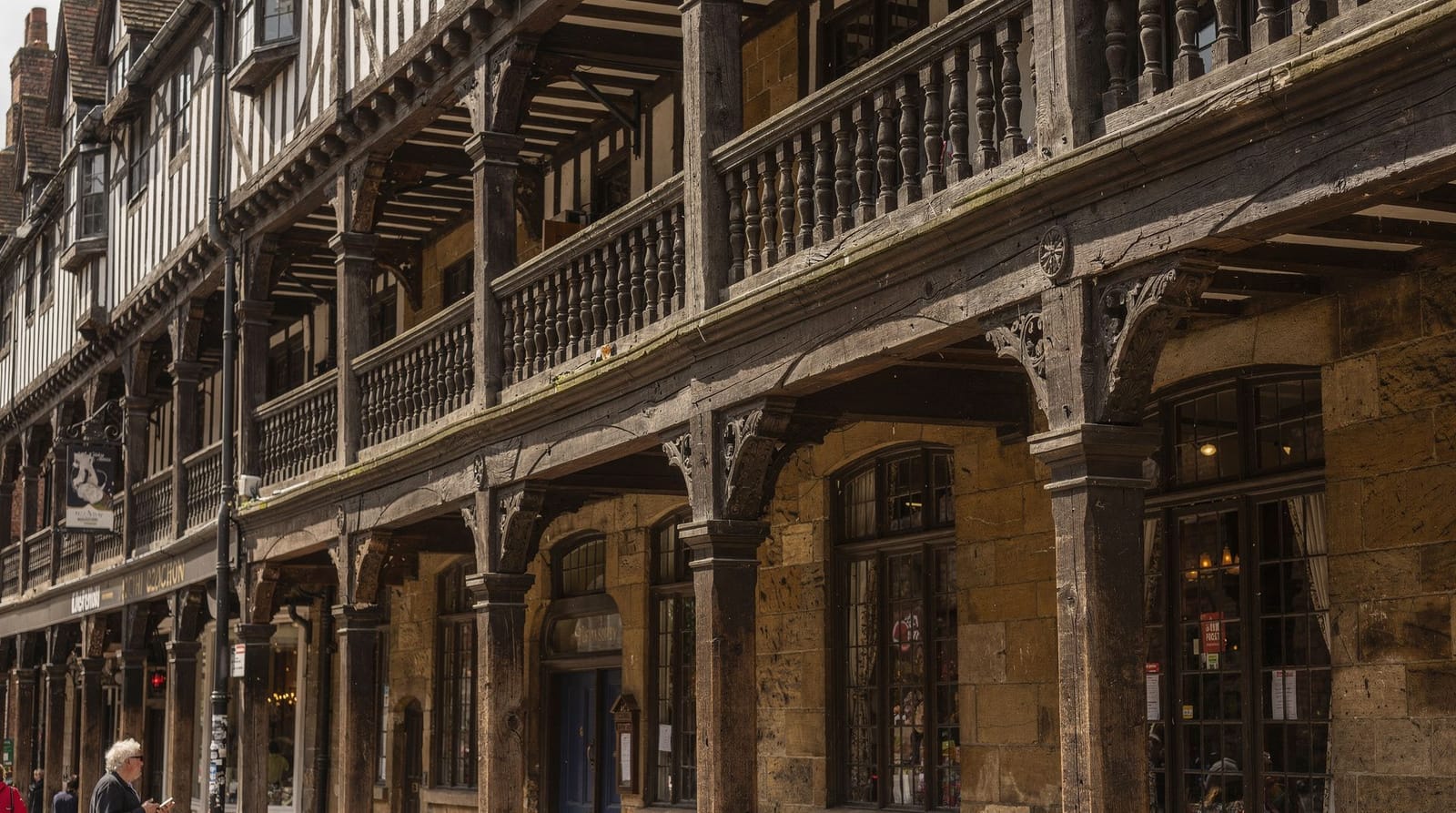
Chester is best known for being one of only three permanent Roman legionary fortresses in Britain (Deva Victrix), for its near-complete circuit of city walls, and for the Rows — unique two-tier medieval shopping galleries found nowhere else in the country. Its history runs continuously from the AD 70s to the present, with almost every intervening period leaving visible traces in the modern city.
| Where | Chester’s walled old town — walls, cathedral, Rows, amphitheatre |
| Cost | Free (walls, amphitheatre); small charge for the cathedral |
| Time needed | A full day to see the key sites in sequence; readable in 15 min |
| Getting there | Fully walkable within the old town |
| Best time | Any time — history is visible year-round, weekdays are quieter |
A city where almost every century left something visible
Few English cities let you trace nearly two thousand years of continuous history in a single afternoon’s walk the way Chester does. From the Roman legionary fortress that gave the city its shape, through a medieval trading town that developed a unique architectural form found nowhere else in Britain, to a Civil War siege that nearly destroyed it and a Georgian and Victorian rebuilding that gave the old town much of its current look — Chester’s history isn’t confined to museum cases. It’s built into the streets, walls and buildings you walk past on an ordinary visit.
This guide works through that history roughly chronologically, with links to fuller guides on each individual site or period where relevant, so you can either read it as background before visiting or use it to decide which specific sites matter most for the time you have.
Roman Chester — Deva Victrix (AD 74 onward)
Chester began as a purpose-built Roman legionary fortress, one of only three permanent bases of its kind anywhere in the province of Roman Britain, alongside York and Caerleon. Deva Victrix, named after the River Dee, was built from around AD 74-79 and garrisoned for roughly three centuries, first by the 2nd Adiutrix Legion and then, for most of its history, by the 20th Legion (Legio XX Valeria Victrix). Its exceptional scale — around 60 acres, larger than strictly necessary for a single legion — has led some historians to speculate it may briefly have been considered a candidate provincial capital, though that remains speculative rather than confirmed.
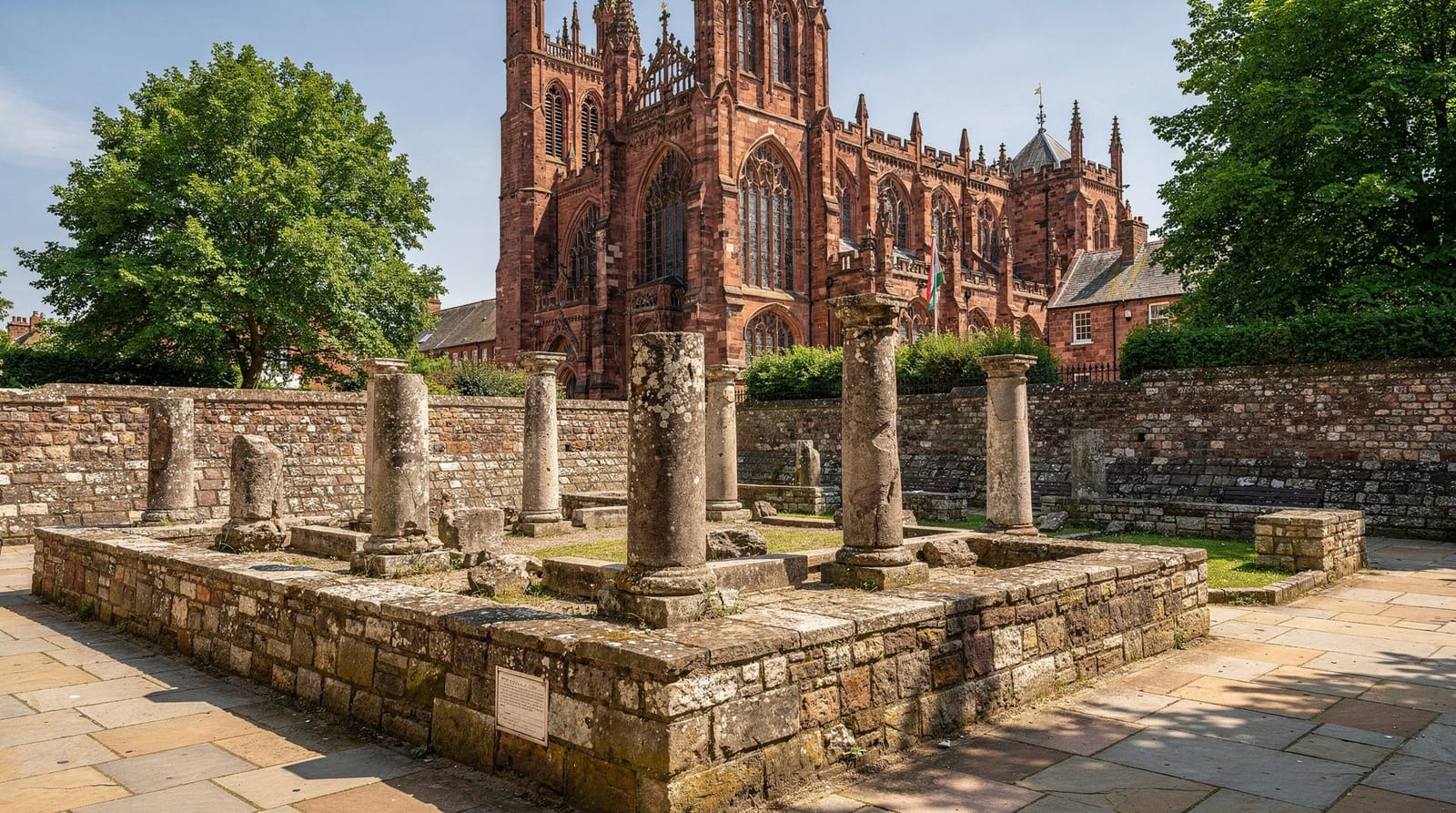
The fortress’s legacy is everywhere in the modern city: the city walls follow its original defensive alignment on two sides, the Rows run along streets that trace its internal road grid almost exactly, and the Roman amphitheatre — the largest yet found in Britain — sat just outside its southeast corner, built to entertain a garrison and civilian population running into several thousand people.
The Grosvenor Museum holds the finest collection of Roman military tombstones in the country, mostly recovered from later wall foundations where medieval masons had unknowingly reused them as ready-cut building stone.
When the legion was finally withdrawn in the early 5th century as Roman administration in Britain collapsed, the civilian settlement that had grown up around the fortress didn’t disappear — it persisted, and gradually evolved into the medieval town that followed, inheriting the Roman walls and street plan more or less intact. That continuity, rather than abandonment and later refounding, is part of what makes Chester’s history so legible today.
Saxon and early medieval Chester
Documentary evidence for Chester in the centuries immediately after the Roman withdrawal is thin, but the settlement clearly persisted at some scale — it appears in Anglo-Saxon sources as a fortified burh (a defended settlement) under Æthelflæd, Lady of the Mercians, who refortified the town around AD 907 as part of a wider programme of defences against Viking raids across Mercia. An earlier religious foundation, a Saxon minster church, occupied roughly the site where Chester Cathedral now stands, predating the Norman abbey by more than a century.
Chester’s strategic value — controlling the Dee crossing and access into Wales — meant it remained militarily and administratively significant through the Saxon period, setting up its continued importance after the Norman Conquest.
Norman Chester and the medieval city (11th-15th centuries)
William the Conqueror’s forces took Chester in 1070, one of the last parts of England to submit to Norman rule, and the city became the seat of a powerful semi-autonomous earldom — the Earls of Chester held authority closer to that of a marcher lord than an ordinary English nobleman, reflecting the region’s role as a frontier zone against Wales. Chester Castle, largely rebuilt in later centuries and today mostly a Georgian and 19th-century complex housing courts and a small military museum, dates its origins to this Norman period.
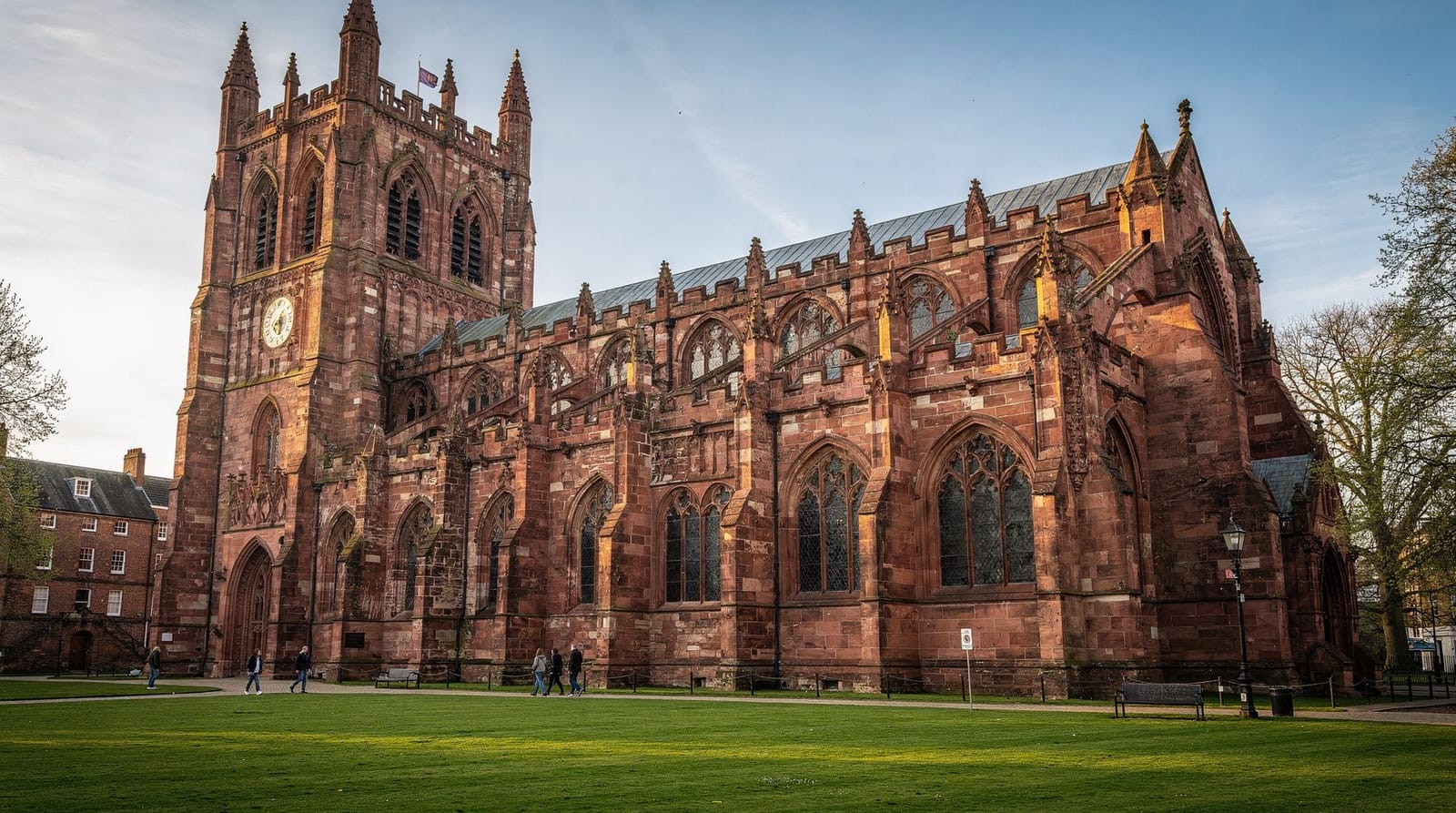
St Werburgh’s Abbey, a Benedictine monastery, was founded in 1092 on the site of the earlier Saxon minster and grew over the following centuries into the substantial monastic complex whose cloisters, refectory and chapter house survive today as part of Chester Cathedral — a rare case of a monastic footprint surviving almost completely intact into the present because of what happened next at the Dissolution.
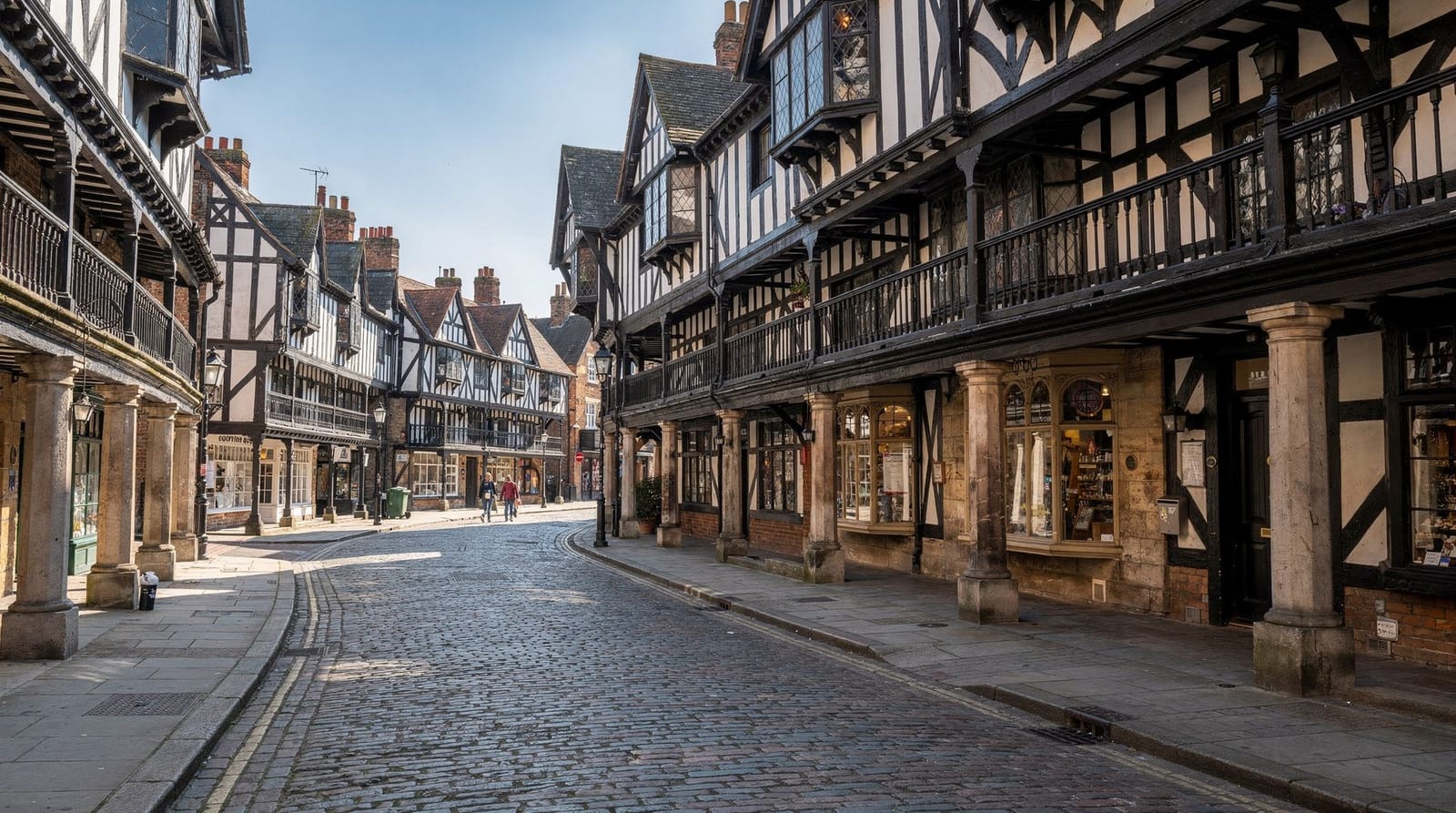
It was also during this medieval period, most likely across the 13th and 14th centuries, that the Rows developed into their distinctive two-tier form — a genuinely unique piece of urban architecture whose exact origin historians still debate, though the leading theory points to uneven ground levels left by Roman-era rubble that later builders worked around rather than cleared. Chester prospered as a major port and trading centre through this period, its position on the Dee giving access to Ireland and the Irish Sea trade, though the river’s gradual silting from the late medieval period onward would eventually undermine that advantage.
Dissolution and the birth of Chester Cathedral (1541)
Henry VIII’s dissolution of the monasteries in the 1530s and 1540s ended St Werburgh’s Abbey as a working monastery, but rather than being demolished like so many other English abbeys, it was refounded in 1541 as the cathedral of a new diocese of Chester. This pragmatic reuse is why Chester Cathedral retains monastic infrastructure — cloisters, refectory, chapter house — that most English cathedrals, built from the ground up rather than converted from an abbey, never had in the first place.
The English Civil War siege (1643-1646)
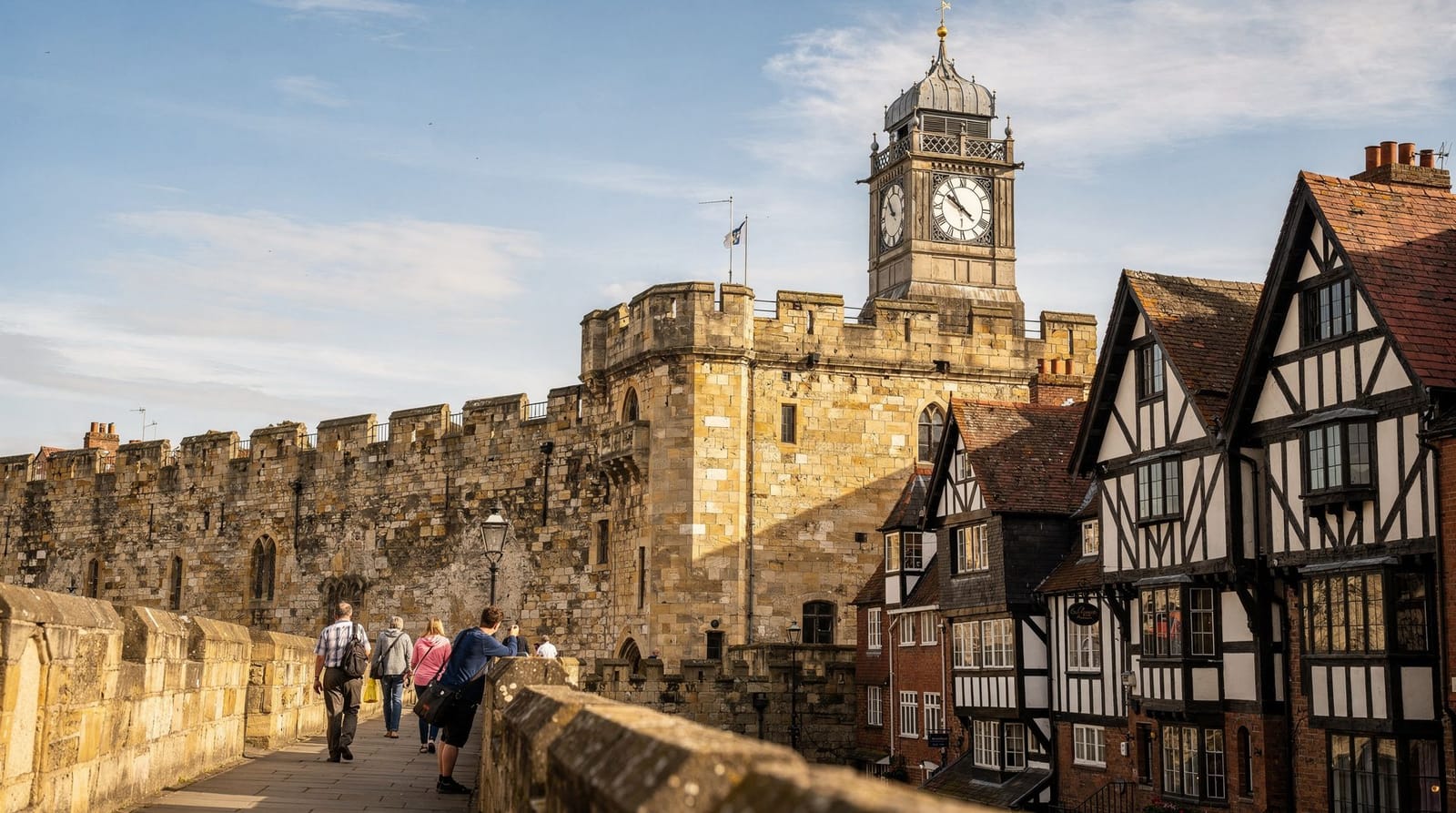
Chester’s most dramatic single historical episode came during the English Civil War, when the city — a Royalist stronghold — endured a prolonged siege by Parliamentarian forces between 1643 and 1646. The siege reached its climax in September 1645, when a Royalist relief force was decisively defeated at the Battle of Rowton Moor, just outside the city. Tradition holds that Charles I himself watched the defeat from the roof of King Charles’s Tower (also called the Phoenix Tower) on the city walls’ northeast corner — a story that’s become the walls’ best-known single anecdote, even if some of the finer historical details are impossible to verify with certainty this many centuries later.
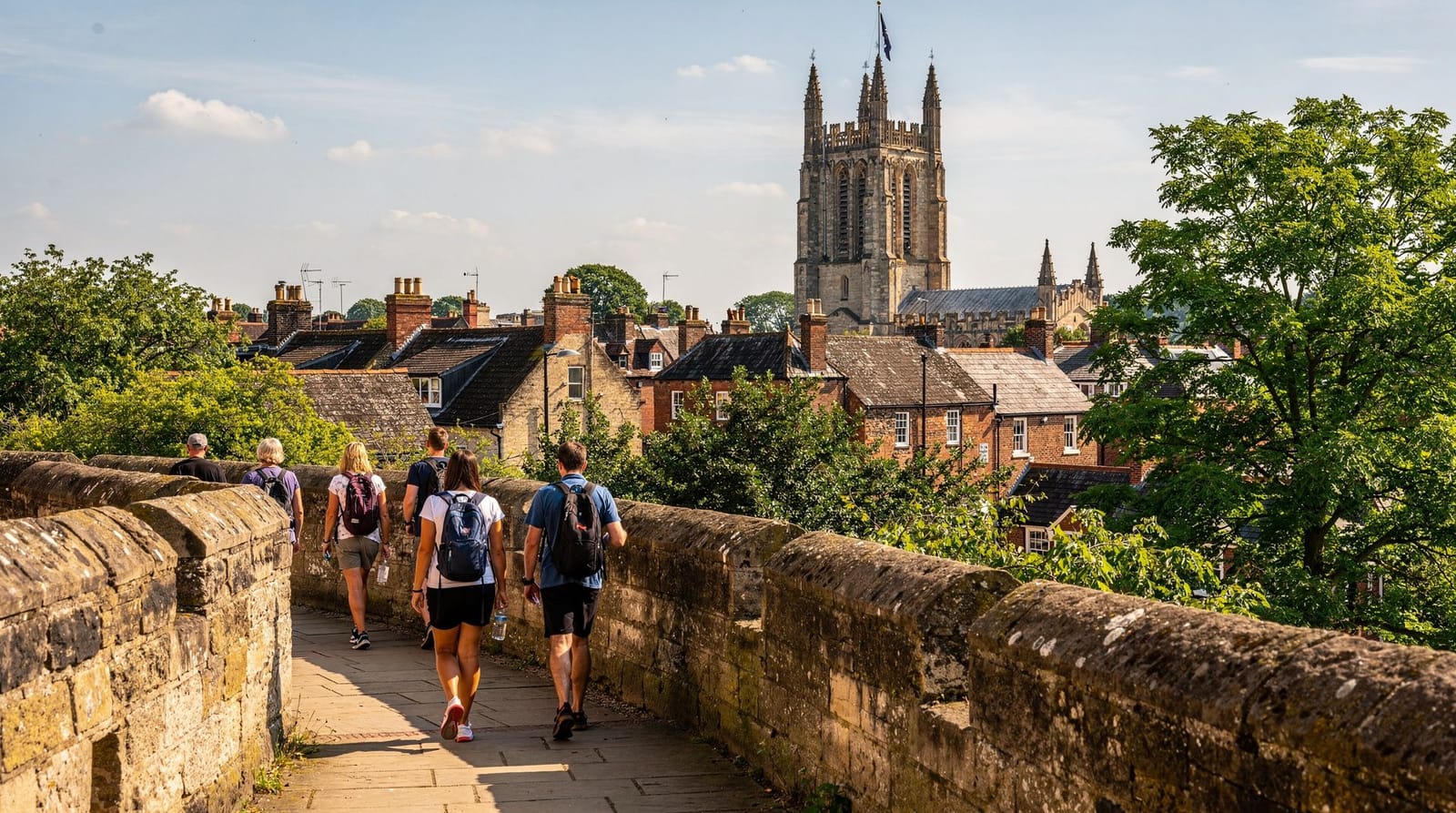
Chester finally surrendered to Parliamentarian forces in February 1646, its defenders and population having endured serious hardship, including reported outbreaks of disease and severe food shortages during the siege’s final months. The city walls themselves, walkable in full today via our city walls walk guide, bear the physical legacy of this period at King Charles’s Tower, which houses a small exhibition on the siege.
Georgian and Victorian rebuilding
Much of Chester’s most photographed “medieval” appearance today is, in fact, later reconstruction. Chester Castle was substantially rebuilt in a Georgian neoclassical style in the early 19th century, replacing most of its medieval fabric with the courts and administrative buildings visible today.
More significantly for the look of the old town, a deliberate Victorian architectural revival in the second half of the 19th century — driven partly by prominent local architect John Douglas and partly by civic ambition to boost Chester’s appeal as a tourist and shopping destination — rebuilt and re-fronted many buildings along the Rows in an elaborate black-and-white mock-Tudor style. A fair amount of what looks centuries-old on Eastgate and Bridge Street in particular actually dates from this period, genuinely handsome but not original medieval fabric.
The Eastgate Clock, now one of Chester’s most photographed features, was erected in 1899 to mark Queen Victoria’s Diamond Jubilee two years earlier — a thoroughly Victorian addition to a much older gate, and a good example of how layered Chester’s apparent “history” actually is once you look closely at any individual feature.
Chester Zoo and the city’s modern additions
Not every significant Chester institution dates from the Roman or medieval periods. Chester Zoo, founded in 1931 a few miles north of the city centre, has grown into one of the largest and most visited zoos in Britain and is today one of Chester’s biggest single visitor draws, entirely separate from the historic core’s Roman and medieval attractions covered in this guide.
It’s a useful reminder that modern Chester isn’t purely a heritage museum-piece frozen in an earlier century — the city has continued adding major attractions and evolving its economy well into the 20th and 21st centuries, even as it’s protected its historic centre with unusual rigour. Our Chester Zoo guide covers this more recent, and in visitor-numbers terms rather dominant, part of the city’s modern identity in full.
The 20th century — decline, conservation and a new economy
Chester avoided the heaviest industrialisation that transformed nearby Manchester and Liverpool during the 19th and 20th centuries, in part because its river had already silted up too much for large-scale shipping and its economy shifted instead toward administration, retail, tourism and services.
This relative lack of heavy industry, while a mixed blessing economically at the time, turned out to be a significant advantage for historic preservation — Chester avoided both the wholesale Victorian industrial redevelopment and the mid-20th-century wartime bomb damage that erased much of the historic fabric in cities like Liverpool and Coventry, leaving its walled centre unusually intact by the mid-20th century compared with many English cities of similar age.
That intact historic core became the basis for a deliberate conservation and tourism strategy from the mid-20th century onward.
Chester was among the first English towns to adopt a proactive conservation area policy, protecting the Rows, the walls and the wider historic centre from the kind of aggressive post-war redevelopment that damaged historic streetscapes elsewhere, and the city’s modern economy has leaned heavily into heritage tourism as a result — a strategy that’s made Chester one of the more visited historic towns in England relative to its modest population size, and one still very much shaping the city’s priorities today, from ongoing debate over the future of the unexcavated southern half of the Roman amphitheatre to continued restoration work on individual Rows buildings.
Chester’s heritage protections and what they mean for visitors
The historic core, including the walls, the Rows and Chester Cathedral, sits within a conservation area with numerous individually listed buildings, meaning alterations are tightly controlled and much of what you see has been actively protected rather than simply surviving by accident. This matters practically for visitors in a few ways: shopfronts along the Rows, even for modern chain retailers, are subject to design controls that limit how much they can alter historic facades, which is part of why the Rows retain a more coherent visual character than a typical modern high street even where the actual businesses inside are entirely contemporary.
Similarly, the city walls and amphitheatre are protected as scheduled monuments and English Heritage sites respectively, meaning any future development or archaeological work — including a hypothetical future excavation of the amphitheatre’s southern half — is subject to a lengthy formal process rather than a quick council decision, part of why some of the longer-running local debates covered elsewhere in our Roman heritage guides move so slowly.
Chester today — a living Roman and medieval city
What makes Chester unusual isn’t any single period of its history but the fact that so many periods remain simultaneously visible and legible within a compact, walkable old town. A single day can take you past genuine Roman foundations, medieval monastic cloisters, Civil War siege sites and Victorian revival architecture, often within a few minutes’ walk of each other — a density of visible layered history that few English cities outside London can match.
For a structured route through the key sites in roughly chronological order, our one-day Chester itinerary and two-day itinerary both sequence the Roman sites, the Rows and the cathedral into a workable day. To go deeper into any individual era, see our dedicated guides on Deva Victrix, the city walls, the Roman amphitheatre, the Grosvenor Museum, the Rows and Chester Cathedral.
Royal and civic traditions that survive today
Chester retains a number of ceremonial and civic traditions with roots stretching back centuries, some tied directly to its history as a frontier and garrison city. Chester Races, held at the Roodee — reputedly the oldest racecourse still in use in England, with racing recorded here since the 1500s on what was originally the Roman fortress’s harbour area before the river silted up — continues a sporting tradition that’s older than almost anything else still functioning in the city today, covered in more detail in our Chester Races guide.
The city’s historic charter status and civic offices, including the ceremonial role of the Lord Mayor and Sheriff, also trace back to medieval royal grants, a reminder that Chester’s self-governing status was itself a hard-won and politically significant medieval privilege rather than a given.
More broadly, the title Earl of Chester has periodically been held by heirs to the English throne, tying the city into national royal history in a way that persisted long after its Norman-era frontier significance had faded — a detail that surprises some visitors who associate the title “Prince of Wales” purely with Wales itself rather than with Chester’s own layered constitutional history.
A note on how reliable this history is
Not every detail in Chester’s popular historical narrative carries the same level of evidential certainty. The Roman-era chronology — fortress construction dates, the identity of garrisoning legions, the amphitheatre’s excavation phases — rests on solid, extensively published archaeological evidence built up over more than a century of excavation.
Some of the more colourful later anecdotes, particularly around the Civil War siege and King Charles’s Tower, are historically plausible and widely repeated by guides and heritage bodies but rest more on strong local tradition than fully documented contemporary sources, a distinction worth keeping in mind if you want to separate solid history from well-established local legend as you explore the city. This guide has tried to flag that distinction where it matters, rather than presenting every popular Chester story with equal certainty.
A one-day route through Chester’s history in order
If you want to walk Chester’s timeline roughly chronologically rather than jumping between sites, a workable route runs: start at the Roman amphitheatre and a stretch of the city walls near Newgate for the Deva Victrix era, move to Chester Cathedral for the Saxon minster site and its 1541 refounding story, walk the Rows for the medieval two-tier galleries, then finish at the Eastgate Clock for the Victorian rebuilding that gives much of the old town its current photogenic look.
This sequence takes a comfortable half-day at a relaxed pace with time to read the panels at each stop, and it’s the order this guide has followed chronologically above, just translated into an actual walking route rather than a reading list.
Why Chester’s history feels unusually legible compared with other English cities
Part of what makes Chester’s layered history easy to follow on the ground, rather than requiring a museum visit to piece together, is the sheer physical compactness of the walled core — every major period from Roman fortress to Victorian revival sits within a roughly 15-20 minute walk of every other, unlike cities where Roman, medieval and later development are scattered across a much larger modern footprint. Combined with the conservation protections covered above, this compactness means a visitor with no prior background can genuinely absorb two thousand years of continuous history in a single well-paced day, which is rarer than it might sound among England’s historic cities.
Bringing the history to life
For visitors who want the Roman period made vivid rather than abstract, the Deva Roman Experience reconstructs a fortress street with life-size costumed figures a short walk from the Rows. The Heart of Chester walking tour covers the walls, Rows and cathedral exterior with a guide who can explain what’s genuinely old versus later rebuilding — a distinction, as this guide has hopefully shown, that matters more in Chester than in most English towns.
For a darker angle on the same history, focused on the Civil War siege and centuries of recorded local hauntings, the Dark Chester dark tourism walking tour takes a different, evening-oriented route through much of the same old town.
Once you’ve covered Chester’s own layered history, the story continues outward: North Wales holds Edward I’s chain of 13th-century castles, covered in our Welsh castles guide, built not long after Chester’s medieval prosperity peaked and directly connected to the same Anglo-Welsh frontier politics that shaped Chester’s earlier Norman and Saxon history.
Frequently asked questions about Chester history guide
What is the best order to see Chester's historical sites in?
Roughly chronological works well on the ground too — start with the city walls and Roman amphitheatre (Deva Victrix era), move to the cathedral (Saxon origins, 1541 refounding) and the Rows (medieval), then take in the Georgian and Victorian rebuilding visible along Eastgate and Bridge Street as you walk between them.How much of what looks medieval in Chester is actually original?
Less than most visitors assume. Much of the Rows' black-and-white timber-framed appearance is a Victorian and Georgian reinterpretation rather than untouched medieval fabric, part of a deliberate 19th-century civic effort to romanticise Chester's historic image. The genuinely old material survives mostly below street level and in fragments of the city walls.
Top experiences
Bookable activities with verified prices and instant confirmation on GetYourGuide.