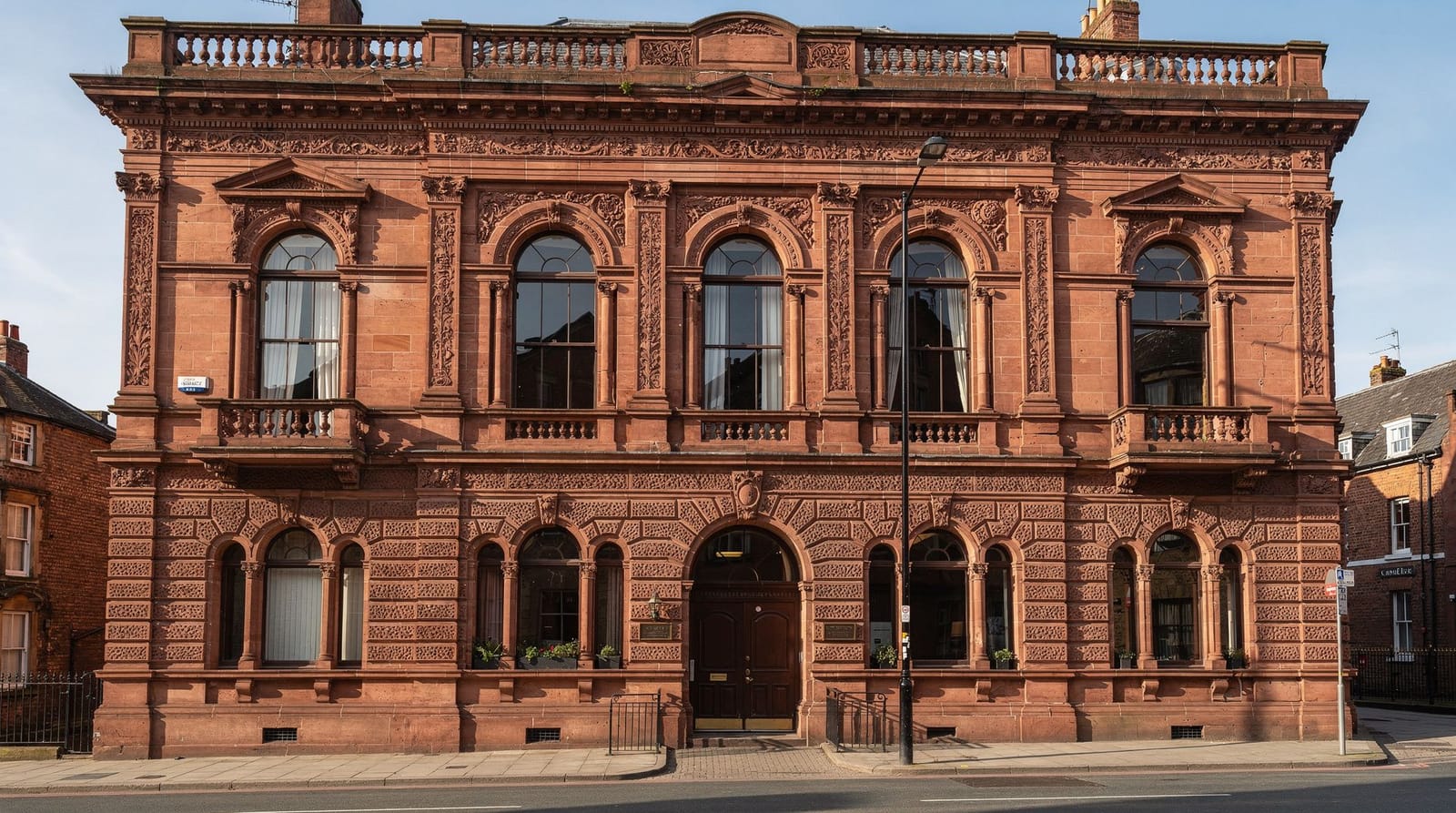
Chester city walls walk — the complete 2-mile circuit
Chester: The Heart of Chester Walking Tour
Duration: 1.5 hours
How long does it take to walk the Chester city walls?
The full circuit is about 2 miles (3.2km) and takes roughly 1.5-2 hours at an easy pace with stops for photos and reading the information panels. It's free, open at all times, and doable in either direction — most visitors start at Eastgate and walk clockwise toward the cathedral and the river.
| Where | 2-mile loop around Chester’s old town, starting anywhere on the circuit |
| Cost | Free — public right of way, no tickets or booking |
| Time needed | 1.5-2 hours for the full circuit at an easy pace |
| Getting there | Start at Eastgate, a 2-minute walk from the Rows and Cathedral |
| Best time | Early morning or the two hours before sunset for the best light |
A walk that predates the city by two thousand years
Chester’s city walls are the reason the old town has the shape it does — a near-complete circuit, roughly two miles around, that traces the outline of the Roman legionary fortress of Deva Victrix and then the medieval town that grew up inside it. Few British cities let you walk an unbroken loop of fortification this old; York’s walls are the obvious comparison, and Chester’s are generally reckoned the more continuous of the two, even if York’s are marginally longer.
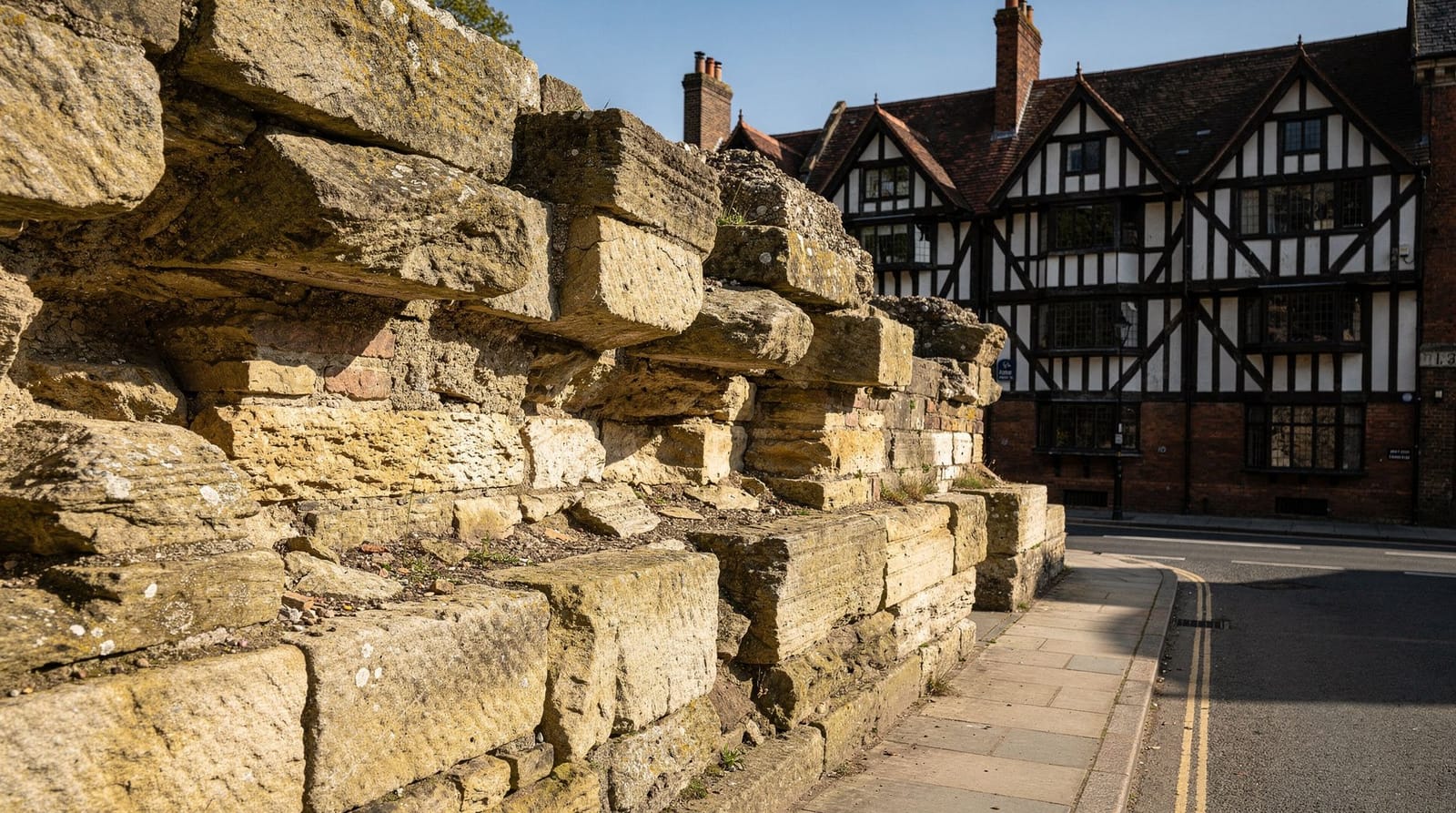
What you’re actually walking on is layered history rather than a single monument. The Roman legion first raised earth-and-timber defences here around AD 70-80, replaced in stone a few decades later. Almost none of that original Roman masonry is visible today — centuries of rebuilding, subsidence repair and deliberate heightening (mostly 12th to 14th century, with Georgian and Victorian restoration on top) mean the walls you see are mostly medieval sandstone, quarried locally and showing the same weathering pattern as Chester Cathedral a few hundred metres inside the loop.
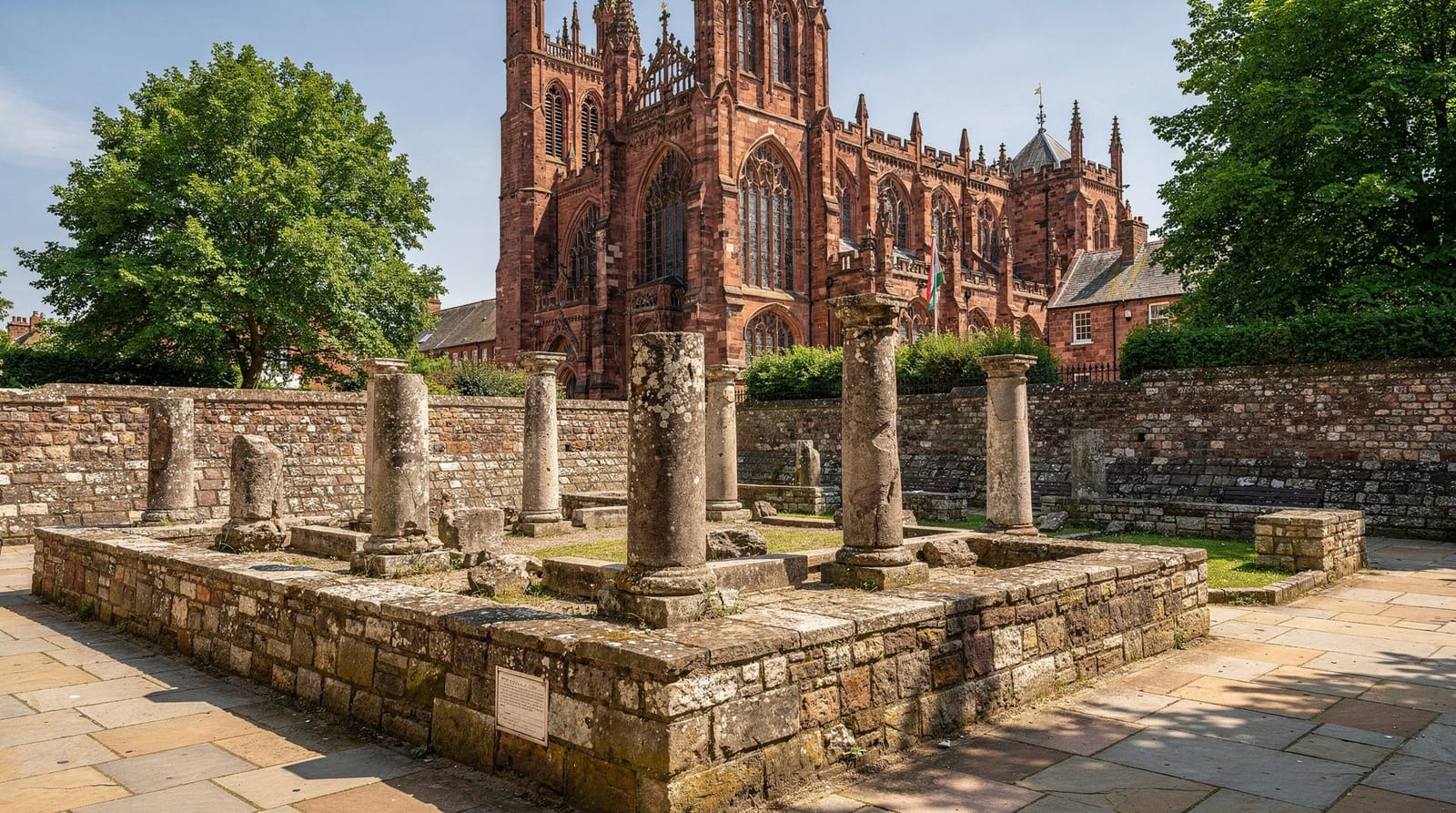
A handful of spots — notably near the Amphitheatre and the Roman Gardens — do expose genuine Roman-period stonework at or below ground level, and it’s worth slowing down there rather than treating the whole circuit as uniformly medieval.
The route, gate by gate
Most visitors start at Eastgate, partly because it’s the most central point and partly because of the clock — an ornate wrought-iron structure erected in 1899 to mark Queen Victoria’s diamond jubilee two years earlier, and reputedly the second-most-photographed clock in Britain after Big Ben. It’s a Victorian addition, not an ancient feature, but it’s become the visual shorthand for Chester and a natural point to orient yourself before setting off.
Walking clockwise from Eastgate takes you first toward Newgate, a 1938 addition built to ease traffic rather than a historic gate, and past this point the wall runs directly above the Roman Amphitheatre and the Roman Gardens — worth a short detour off the wall itself, covered in full in our Roman Amphitheatre guide. This stretch is the one place on the circuit where you’re genuinely walking above verified Roman-period foundations rather than later rebuilding.
Continuing around brings you to the southeast corner and down toward the River Dee, where the wall runs above the Groves — Chester’s Georgian riverside promenade, popular for a coffee stop with a view of rowing crews on the water — before crossing near the Old Dee Bridge, one of the oldest working bridges in Britain, parts of it dating to the 14th century. From here the wall turns north along Watergate, marking the point where, before the river silted up in the medieval period, ships could once dock directly against the city.
The northwest corner brings the Northgate, rebuilt in its current form in 1810 and sitting above what was once the city gaol, before the final stretch runs east past King Charles’s Tower (also called the Phoenix Tower) back toward Eastgate. This corner tower carries Chester’s best single anecdote: Charles I is traditionally said to have watched from its roof as his own Royalist forces were routed at the Battle of Rowton Moor in September 1645, a defeat that effectively ended his hopes of relieving the city during the Civil War siege. The tower now houses a small exhibition on the siege, worth the few minutes it takes if the door happens to be open (hours are limited and seasonal, so treat it as a bonus rather than a plan).
Timing the walk and where to break it up
Budget 1.5 to 2 hours for the full loop at an unhurried pace, longer if you stop to read every panel or detour down into the Rows partway round. The walk works in either direction and at any time of day, but early morning (before 9am) gives the best light for photographs at Eastgate and the emptiest paths, while a golden-hour circuit in the two hours before sunset puts good light on the sandstone and the river views from the Groves.
It doesn’t need to be walked in one continuous session. Plenty of visitors do it in two halves — the Eastgate-to-Watergate stretch (river side, roughly 45 minutes) on one day and the Watergate-to-Eastgate stretch (Northgate side, roughly 45 minutes) on another, breaking each half with time in the city centre or the Rows. If you’re only in Chester for a few hours between trains, walking just the river-facing southeast quarter — Eastgate to the Groves — gives the best return for the shortest time commitment, since it covers the clock, a genuine Roman-adjacent stretch, and the river view in under 40 minutes.
Stories and legends along the route
Beyond the verified history, the walls carry a thick layer of local legend that guides and information panels both draw on. King Charles’s Tower’s Civil War story is the best-documented of these, but plenty of less certain tales circulate too — reports of a headless drummer boy said to haunt the walls near Northgate, tied loosely to Civil War-era executions, and various accounts of ghostly Roman soldiers reported by walkers on the stretch above the amphitheatre, where the wall runs closest to genuine Roman-period ground level.
None of these are verifiable history in the way the siege of Chester is, but they’re a genuine part of how the city presents itself to visitors, particularly on the evening ghost-tour circuit, and worth knowing about even if you’re approaching the walk as straightforward history rather than folklore.
The walls also feature in Chester’s civic ceremonial life in a more official capacity — the ancient office of Sheriff of Chester still involves a ceremonial “beating of the bounds” tradition in some years, walking the boundary the walls represent, a custom with roots going back centuries and one of several ways the walls remain more than a purely historical relic in the city’s ongoing civic identity.
Access and practical notes
The walls are a public right of way, free and open at all times — there’s no ticket booth, no closing time and no seasonal closure. That said, “complete circuit” comes with a caveat: a couple of short sections divert down to street level where later road building broke the original alignment, most noticeably around Newgate and a short stretch near the Amphitheatre. These detours are signposted and rejoin the wall within a few hundred metres, so you won’t get lost, but don’t expect a single unbroken elevated path the entire way.
Surface and accessibility vary by section. Long stretches — particularly Watergate to Northgate and the section above the Groves — are flat, paved and manageable with a pushchair or wheelchair. Others, especially around Wolfgate and a set of steps near parts of the Eastgate section, involve stairs with no ramp alternative, so a fully step-free loop isn’t possible today. If accessibility is a firm requirement, plan a partial route using the flatter sections rather than committing to the full circuit.
Wear proper shoes rather than sandals — the sandstone paving is uneven in places and can be slick after rain, which is a regular occurrence in this part of Cheshire. There’s no shade for most of the route, so summer walkers should carry water, and winter walkers should expect the northern and river-facing stretches to be genuinely cold and exposed.
Guided options versus walking it yourself
The walls are simple enough to navigate unguided with a map or the on-site information panels, and plenty of visitors do exactly that. A guided walk adds value mainly through context you won’t get from the panels — the politics of the Civil War siege, how the Rows relate to the walls structurally, and which stretches of stone are genuinely Roman versus later rebuilding, which isn’t always obvious to the untrained eye.
The Heart of Chester walking tour runs about 90 minutes and covers the walls alongside the Rows and cathedral exterior with a local guide, a reasonable option if you want one session that ties the city’s layered history together rather than reading it off individual panels. For a more interactive option — useful with children or a group that wants a bit of gamification rather than a straight lecture — the city walking tour and exploration game turns the same route into a self-paced puzzle trail, letting you set your own timing while still following a structured route around the walls and old town.
If your real interest is the Roman garrison rather than the medieval city that replaced it, pair the walk with the Deva Roman Experience, an indoor exhibition near the Rows that reconstructs what the fortress and its soldiers looked like — it’s a useful primer before or after the walk, since so little of the actual Roman stonework is visible above ground on the walls themselves.
Chester’s walls compared with York’s
Chester and York are the two English cities most often compared on their wall circuits, and the comparison is worth making explicit since both cities market themselves partly on this feature. York’s walls are marginally longer at around 2.1 miles against Chester’s 2 miles, and York’s circuit includes more surviving medieval gatehouses (called “bars” in York) in something closer to their original form.
Chester’s advantage is continuity and Roman depth — the alignment traces an actual Roman legionary fortress rather than a later medieval town wall built without a Roman-era predecessor, and Chester’s walk connects far more directly to a genuine Roman amphitheatre, a near-complete Roman street grid still in commercial use, and a legionary fortress story with only two direct parallels anywhere in the country.
If you’re choosing between the two cities for a single visit, York arguably has the more dramatic minster and a denser concentration of visibly medieval streets, while Chester’s walls plus Rows combination gives a more legible sense of continuous occupation from the Roman period onward. Our Chester versus York comparison guide goes into this in more depth if you’re deciding between the two as a short-break destination.
The walls through the seasons
Chester’s weather, like most of Cheshire and the wider North West, is unpredictable and rain-prone year-round, so there’s no single “best” season for the walk in the way there might be for, say, a Snowdonia hike dependent on visibility. Spring and early summer (April to June) generally offer the most reliable combination of decent weather and manageable visitor numbers, before the peak summer school-holiday crowds arrive. High summer (July-August) brings the busiest pavements, particularly around Eastgate and the Rows-adjacent stretches, though the walls themselves rarely feel as crowded as the streets below since foot traffic spreads out along the full two-mile loop.
Autumn gives some of the best light for photography, particularly along the Groves stretch where the riverside trees turn colour, while winter walks are perfectly viable — the walls don’t close — but expect shorter daylight hours, a genuine chill on the more exposed northern and river-facing sections, and wet sandstone paving that’s more slippery than in drier months. Chester’s Christmas market, covered in our Chester Christmas market guide, adds seasonal atmosphere to a winter walls walk if your visit falls in late November or December, with market stalls visible from several points on the wall above Northgate and the city centre.
Photography and the best viewpoints
If photography is a priority, a handful of specific spots consistently produce the best results. The view of Eastgate and its clock from the wall itself, rather than from street level, gives a cleaner angle without the crowds of tourists photographing from directly beneath the clock. The stretch above the Groves offers river views with rowing crews, swans and the Old Dee Bridge in frame, particularly good in the golden hour before sunset when the light catches the water.
King Charles’s Tower, at the northeast corner, photographs well both as a subject itself and as a high point looking back over the northern half of the old town and out toward the Welsh hills on a clear day. Early morning, before 9am, consistently gives the emptiest paths and softest light across the whole circuit, a worthwhile trade-off against a slightly later start to the day if photography matters to your visit.
What the walls tell you about the rest of Chester
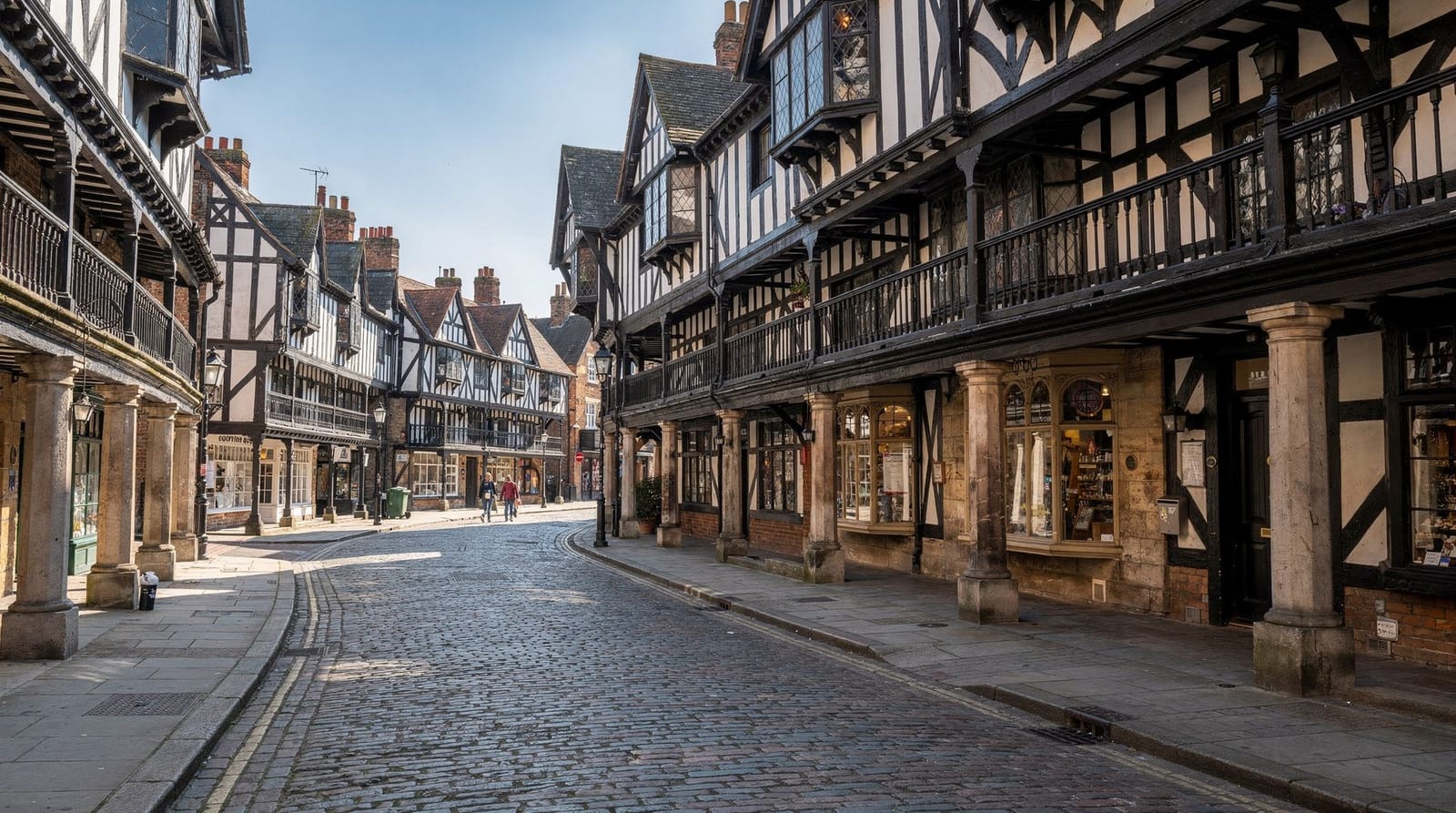
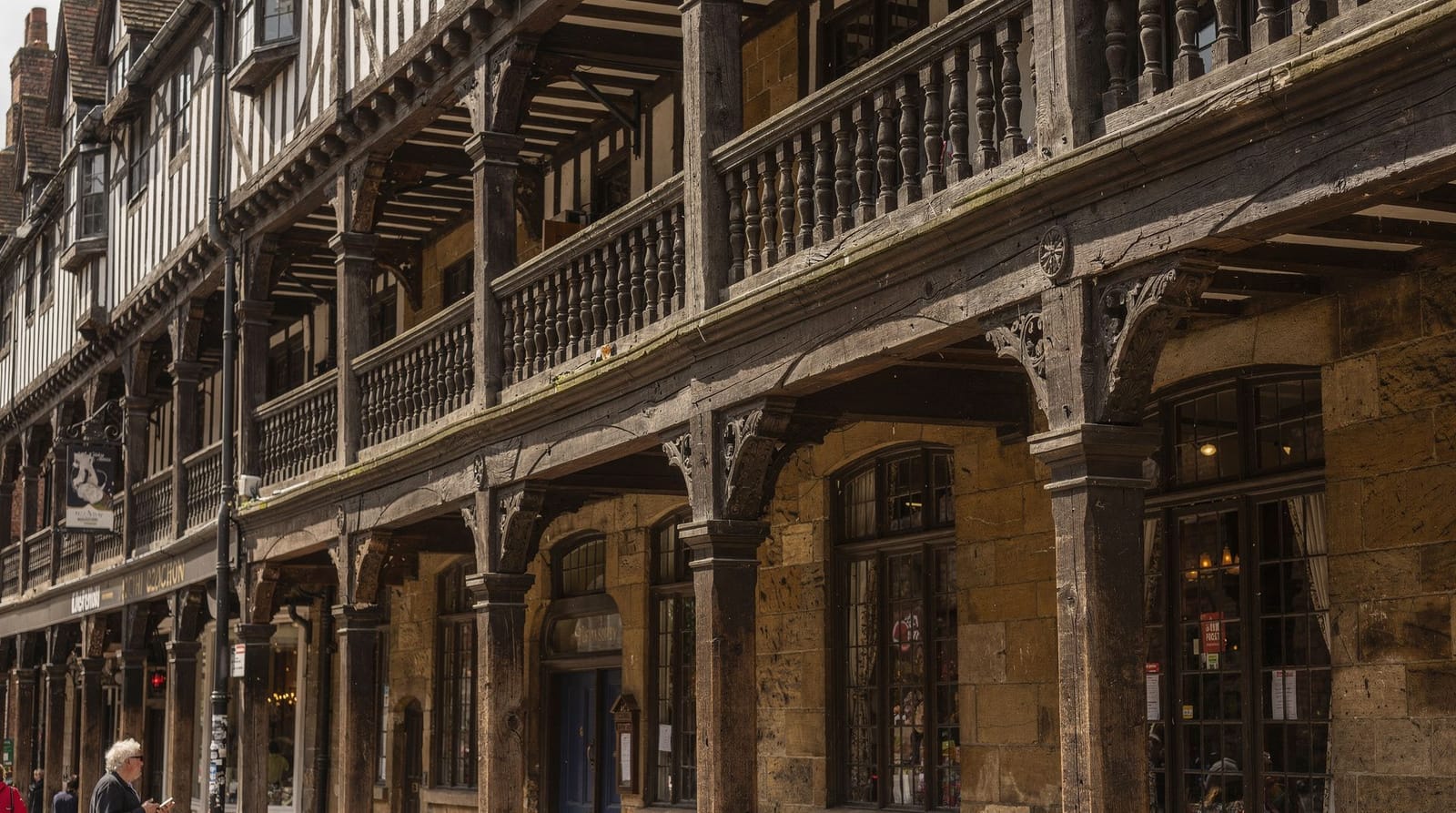
The walls aren’t just a standalone attraction — they’re the organizing structure for the whole historic centre. The four main streets (Eastgate, Northgate, Watergate and Bridge Streets) run in a cross from the four gates toward the centre, and the Rows, Chester’s distinctive two-tier covered shopping galleries, line those same four streets. Walking the walls first, before exploring the Rows at street level, makes the city’s Roman-grid layout click in a way that’s harder to grasp from inside the shopping streets alone.
The walls also connect to Chester’s Roman identity more broadly. Deva Victrix, the fortress that gave Chester its shape, was one of only three permanent legionary bases in Roman Britain, alongside York and Caerleon, and the wall circuit is the clearest surviving evidence of how large and permanent that garrison was meant to be. The Grosvenor Museum, a short walk from Eastgate, holds the best collection of Roman tombstones and inscriptions recovered from in and around the walls, several of which were literally built into later wall repairs by medieval masons who had no idea what they were reusing.
Running the walls
The full loop is also a genuinely popular local running route, flat enough for most fitness levels and scenic enough to make repeat laps enjoyable rather than a chore — a fair number of Chester residents use it as their regular exercise circuit, and early morning, before the paths fill with sightseers, is when you’ll see the most local runners out. If you’re a visitor who runs and wants to combine exercise with orientation on your first morning in the city, a slow lap of the walls before breakfast covers the same ground as the sightseeing walk while doubling as a workout, though be mindful of the uneven sandstone paving mentioned above, which is a genuine trip hazard at running pace, particularly in low early-morning light or after rain.
A note on wayfinding and signage
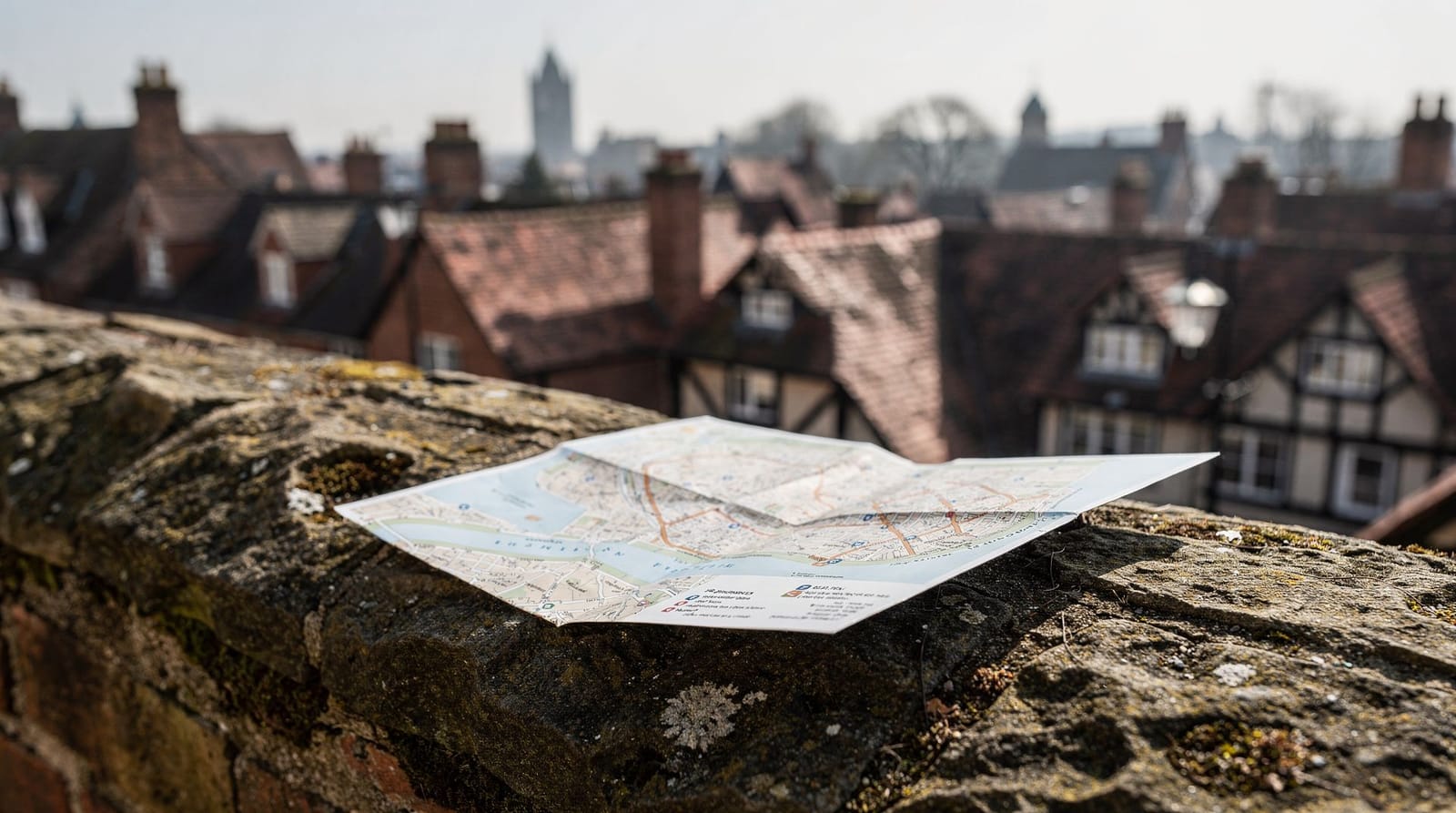
The walls are generally well signposted with regular information panels explaining the history at each gate and major tower, but the panels vary in density — some stretches have a panel every few hundred metres, others go a longer distance without one, particularly on the quieter northern and western sections away from the main tourist core. A physical map or a phone map with the route marked is a sensible backup even though getting properly lost is difficult given the wall’s continuous, mostly elevated nature; it’s more useful for confirming which of the short street-level detours you’re on and where it rejoins the wall, since the detour signage itself is less prominent than the main circuit’s own waymarking.
Tourist traps to avoid
There’s little to overpay for on the walls themselves since they’re free and unticketed, but be wary of unofficial “guides” who approach walkers near Eastgate offering informal tours for cash with no fixed itinerary or credentials — stick to booked tours with clear reviews if you want a guided option. Parking near the walls in the city centre is expensive and limited; if you’re driving in, use one of Chester’s Park & Ride sites rather than the pricier central car parks, a point covered in more detail in our Chester parking guide and Park & Ride guide.
What locals notice that visitors often miss
Beyond the headline gates and towers, a handful of smaller details reward a slower pace: sections of the parapet show genuinely different stone colouring where Victorian and later repairs sit alongside older medieval sandstone, visible if you look closely at the joints rather than treating the whole wall as visually uniform.
Several stretches carry small carved or inscribed stones — masons’ marks, dates, occasional graffiti dating back further than you’d expect — worth a slower look if you’re walking with someone who enjoys spotting this kind of detail rather than simply covering the distance. Locals doing the loop regularly, for exercise rather than sightseeing, also tend to know which sections offer the best river views without stopping, useful if you’re walking with a dog or in a hurry but still want to catch the highlights along the way.
Toilets, benches and practical stops along the way
Public toilets are available at a handful of points around the circuit rather than continuously, generally clustered near the busier gates (Eastgate, Northgate) and absent from longer quieter stretches, so it’s worth using facilities before setting off on a section without a nearby town-centre stop. Benches are similarly more frequent on the popular southeast quarter above the Groves than on the quieter northern stretches, worth factoring in if you’re walking with someone who needs regular rest stops. Cafés and pubs sit just below wall level at multiple points around the loop, making it easy to break the walk into shorter segments with a coffee or lunch stop rather than committing to the full 1.5-2 hours in one continuous push.
Doing the walk with a dog
The walls are a popular local dog-walking route, and well-behaved dogs on leads are welcome for the full circuit — a useful option if you’re travelling with a dog and want a genuinely scenic, traffic-free walk rather than pavement walking through the city centre streets below. Be aware of the narrower sections and the handful of staircases mentioned above, which are manageable for most dogs but worth approaching with a shorter lead in the busier stretches near Eastgate and the Rows, where the wall narrows and foot traffic is heaviest.
Combining the walls with the rest of your visit
The walls walk is the natural spine of a first visit to Chester and slots neatly into any of the standard day plans. Our one-day Chester itinerary builds the whole day around a morning walls walk followed by the Rows and cathedral in the afternoon, while the two-day Chester itinerary spreads the walls, Rows, cathedral and a river cruise or day trip across a more relaxed schedule.
If you’re basing a longer stay here, see our broader Chester walking tours guide for how the walls compare to other guided walking options in the city, and the Chester destination guide for the full range of things to see beyond the historic core.
For visitors who want to go deeper into Chester’s Roman story before heading further afield to North Wales and its castles, our Chester history guide ties together the walls, the amphitheatre and Deva Victrix into a single chronological narrative, useful background reading before or after you actually walk the loop.
Frequently asked questions about Chester city walls walk
Are the Chester city walls free to walk?
Yes, entirely free and open year-round, 24 hours a day, since they're a public right of way rather than a ticketed attraction. There's no gate, turnstile or booking required at any point on the circuit.Can you walk the full loop of the Chester walls?
Almost — the circuit is close to complete, which is unusual for a British city, but a couple of short sections divert onto street level around Newgate and the Amphitheatre because of later road building. Signposted detours are well marked and rejoin the wall within a few hundred metres.Is the Chester walls walk suitable for pushchairs or wheelchairs?
Only in parts. Long stretches are flat, paved and step-free, particularly the Watergate-to-Northgate section and the stretch above the Groves, but a handful of sections — notably around Newgate, Wolfgate and some staircases near the Eastgate — involve steps with no ramp alternative, so a full step-free loop isn't currently possible.What's the best place to start the walk?
Eastgate, right beside the clock, is the most central starting point and puts you a two-minute walk from the Rows and Chester Cathedral. From there most people walk clockwise toward Newgate and the Roman Amphitheatre first, since that section covers the Roman-era history before the medieval stretches.How old are the Chester city walls?
The core alignment dates to the Roman fortress of Deva Victrix, built from around AD 70-80 by the 20th Legion. Almost nothing of the original Roman stonework survives above ground — what you walk today is mostly medieval and later sandstone, rebuilt and heightened between the 12th and 18th centuries, with some sections repaired as recently as the Victorian era.Are there guided tours of the walls?
Yes. Several operators run themed walking tours that follow all or part of the wall circuit, mixing Roman history, medieval politics and (for the evening options) ghost stories. A guided route works well if you want context you'd otherwise have to piece together from the information panels yourself.Which gate on the walls is the most historic?
King Charles's Tower, on the northeast corner, has the strongest single story — Charles I is said to have watched his own army's defeat at the Battle of Rowton Moor from its roof in 1645, during the English Civil War siege of Chester. The Eastgate itself is more photographed, but that's largely down to its ornate 1899 clock rather than age.
Top experiences
Bookable activities with verified prices and instant confirmation on GetYourGuide.