The Rows, Chester — Britain's unique two-tier medieval galleries
Chester: City Walking Tour & Exploration Game
Duration: 2.5-3.5 hours
What are the Rows in Chester?
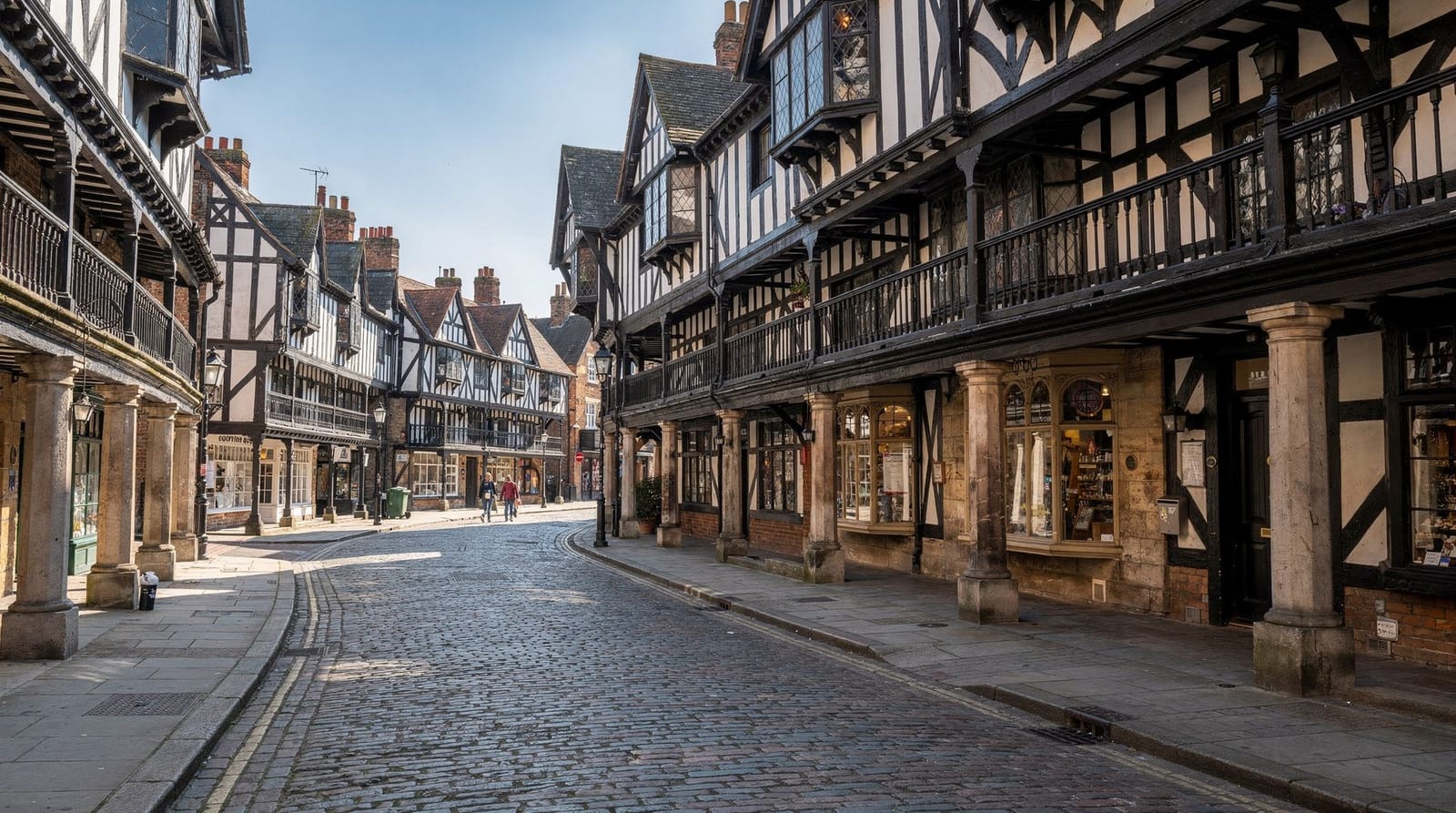
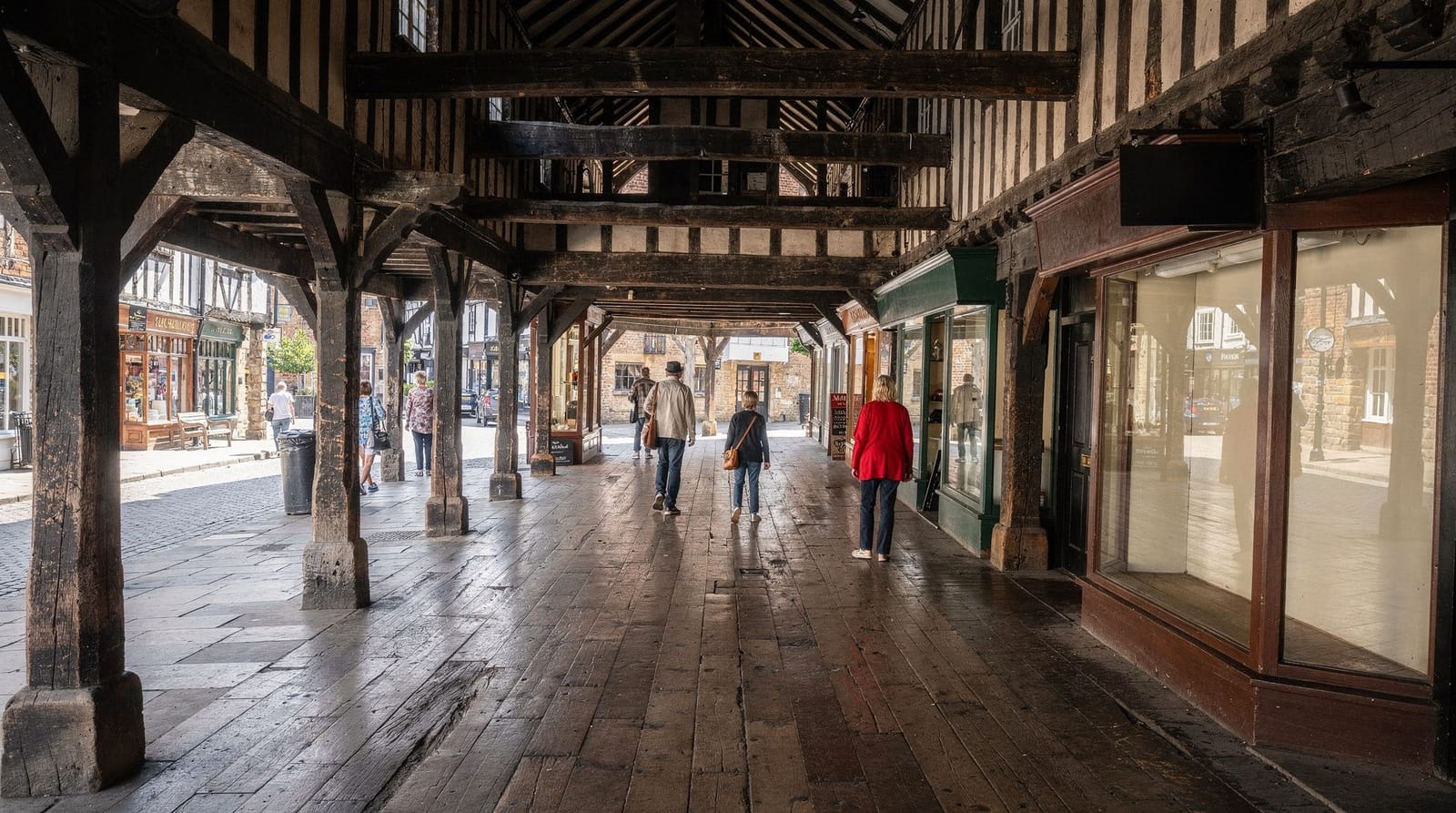
The Rows are covered, two-tier pedestrian galleries running along the first floor of buildings on Chester's four main medieval streets — Eastgate, Northgate, Watergate and Bridge Street — with shops at both street level and on the elevated walkway above. They're unique in Britain; no other city has anything quite like them, and their exact origin is still debated by historians.
| Where | Eastgate, Northgate, Watergate and Bridge Street, inside the walls |
| Cost | Free to walk and browse; shop and café prices as normal |
| Time needed | 1 hour for a first look, 2-3 hours to browse properly |
| Getting there | Central within Chester’s walled core, walkable from the station |
| Best time | Weekday mornings for the quietest browsing |
A form of street architecture found nowhere else in Britain
Walk down any of Chester’s four main streets and you’ll notice something odd within the first minute: there are shops at street level, and then a second row of shops one floor up, reached by frequent short staircases and connected by a covered, arcaded walkway running the length of the street. This is the Rows, and despite Chester’s medieval street plan being fairly typical of an old English town otherwise, nothing quite like this two-tier gallery system survives — or was ever built, as far as anyone can tell — anywhere else in the country.
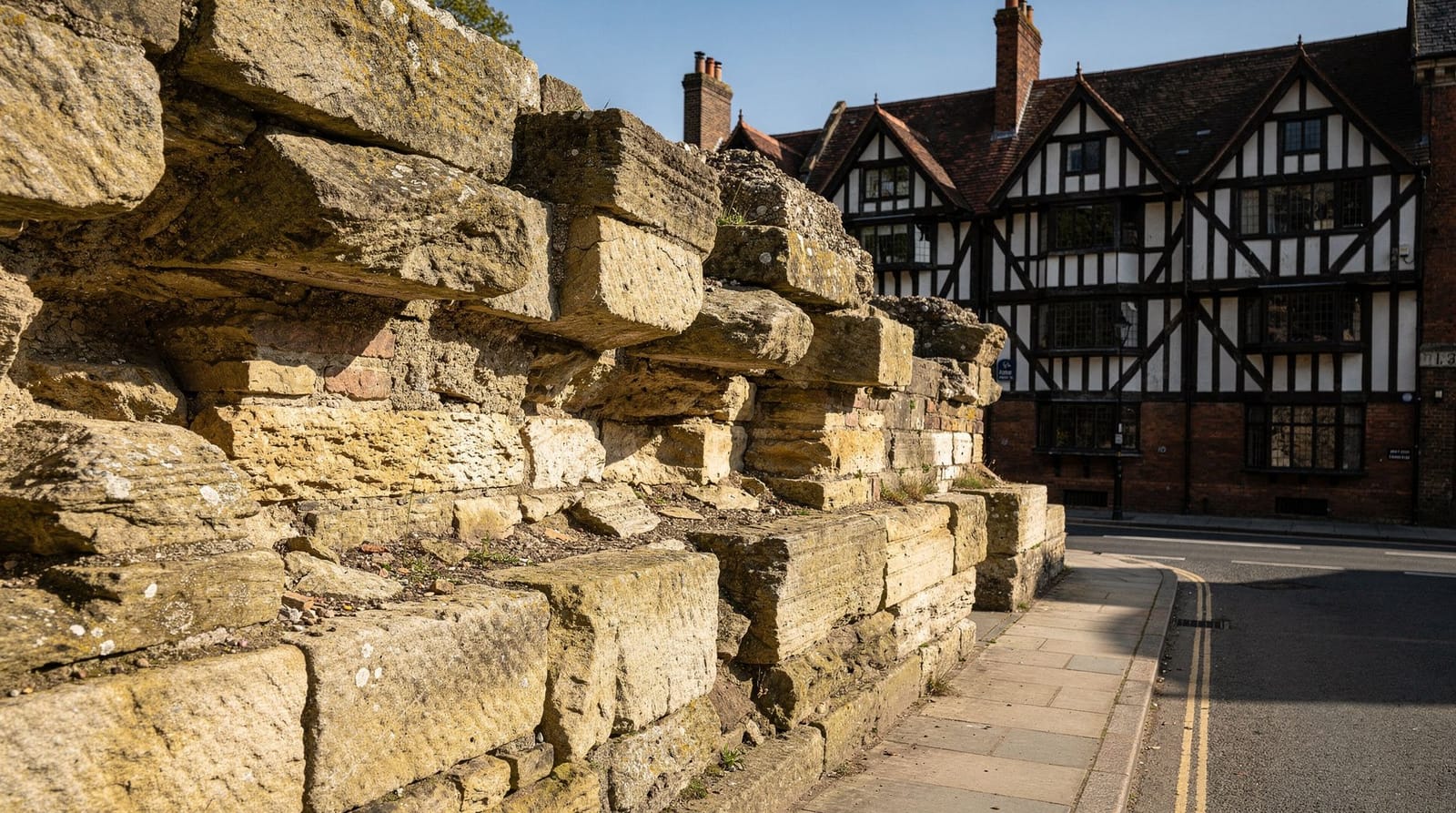
The Rows run along all four of the streets radiating from the old city centre — Eastgate Street, Northgate Street, Watergate Street and Bridge Street — which not coincidentally are the same four streets that trace the layout of the Roman fortress of Deva Victrix. The correspondence between the Roman street grid and the medieval Rows isn’t an accident: whatever process created the Rows worked within, and preserved, boundaries the Romans had laid down more than a thousand years earlier.
Where the Rows came from — a genuinely unresolved question
Historians and archaeologists don’t fully agree on why Chester developed this form and no comparable town did, which makes the Rows one of the more interesting unresolved questions in English urban history rather than a settled fact you can just be told.
The most widely cited theory holds that after the Roman fortress was abandoned, its ruined stone buildings and accumulated debris left uneven ground levels along the main streets — builders in the 12th and 13th centuries, rather than clearing the rubble, built directly on top of it, creating natural raised platforms at what became first-floor height. Shops and undercrofts (stone cellars) developed at the original, lower ground level, while a new pedestrian walkway and shop frontage developed on the raised platform above, eventually roofed over into the continuous galleries visible today.
A competing theory points to defensive or commercial logic — separating pedestrian shopping traffic from cart and livestock traffic on the streets below, similar in principle to arcaded market towns on the European continent, though none of those parallels quite match Chester’s specific two-tier form. Whatever the precise mechanism, documentary evidence shows the Rows were substantially established by the 13th century and have been continuously used, altered and rebuilt ever since — what you’re walking through today is a working commercial structure that’s been in near-continuous use for roughly 800 years, not a preserved museum piece.
What survives beneath the street — the undercrofts
Beneath a number of shops along the Rows, particularly on Bridge Street and Watergate Street, stone-vaulted undercrofts survive from the medieval period, originally used for storage or as workshops given their cool, dark conditions — useful for wine merchants and similar trades that needed stable temperatures.
A handful of these undercrofts incorporate genuinely Roman-era masonry or foundations, since the Rows sit directly above the line of Deva Victrix’s Roman streets and buildings. Access to see these undercrofts varies entirely by which shop occupies the space above — some businesses display their undercroft as a feature, others use it purely as storage with no public access, so treat any undercroft viewing as a pleasant bonus rather than something to plan a visit around.
Victorian rebuilding and what’s genuinely old
Not everything that looks medieval on the Rows actually is. A significant amount of the black-and-white timber-framed appearance along Eastgate and Bridge Street in particular dates from a deliberate Victorian architectural revival in the second half of the 19th century, when Chester’s civic leaders and prominent architects (most notably John Douglas) rebuilt and re-fronted many buildings in a romanticized “old English” mock-Tudor style, partly to boost the city’s appeal as a tourist and shopping destination even then. This means a fair amount of what photographs as ancient timber-framing is genuinely handsome Victorian design rather than 500-year-old original fabric.
Watergate Street generally holds the most convincing genuinely medieval stretch, with timber-framed buildings whose structural framing dates to the 14th and 15th centuries, though even here later restoration has altered details over the centuries. Telling Victorian revival from genuine medieval fabric isn’t always obvious to an untrained eye — a guided walk, covered below, is the most efficient way to actually learn to spot the difference rather than guessing.
Buildings to look out for
A handful of individual buildings on the Rows are worth deliberately seeking out rather than just passing. Bishop Lloyd’s House on Watergate Street, dating largely from the early 17th century, has some of the most elaborate surviving carved timber-framing in the city, including biblical scenes and heraldic carvings on its street-facing gable — a genuine highlight for anyone interested in Jacobean domestic architecture rather than the later Victorian revival style seen elsewhere. Leche House, also on Watergate Street, is another of the more convincingly old timber-framed survivals, with a documented history stretching back to the medieval period despite later alterations.
On Bridge Street, look for buildings with visible undercroft entrances — some shops mark these with small plaques or glazed viewing panels even where the space itself isn’t open to browse — as one of the more tangible ways to see the medieval-below-street-level structure without needing a guided tour to point it out. The Chester Cross, at the junction of the four main streets and Rows, marks the historic centre point of the medieval town and is a useful orientation landmark if you’re trying to work out which direction leads to which gate.
Comparing the Rows to other European arcaded towns
Historians researching the Rows’ origins have occasionally drawn comparisons to arcaded market towns on the European continent — the covered arcades of Bologna in Italy, or the galleried market squares found in parts of Belgium and the Netherlands, both traditions where covered pedestrian walkways developed alongside ground-floor commerce. The comparison is useful for context but ultimately limited: those continental examples are generally single-tier colonnades at street level, providing weather shelter for pedestrians rather than a genuine second full tier of shops accessed from an elevated walkway.
Chester’s specific combination — two complete, separately shoppable levels connected by frequent internal staircases, running continuously along four intersecting streets — has no true parallel anywhere else that historians have identified, in Britain or on the continent, which is precisely why the “why did this happen only in Chester” question remains open rather than settled by pointing to a wider tradition Chester simply participated in.
Seasonal shopping and the Christmas market
The Rows take on a different character in late November and December, when Chester’s Christmas market — one of the more established seasonal markets in the North West — fills the area around the Town Hall and cathedral precinct with stalls, and the Rows themselves are strung with lights and seasonal window displays. It’s a genuinely different, busier atmosphere than the rest of the year, worth experiencing if your visit falls in that window, though it also means significantly heavier foot traffic and higher demand for the more popular independent cafés along Watergate Street.
Our Chester Christmas market guide covers dates, what to expect and how it affects the wider city centre in more detail. Outside the festive period, the Rows operate on standard UK retail hours with no particular seasonal closures, though individual independent shops sometimes reduce hours in the quieter winter months of January and February.
Eating and drinking along the Rows
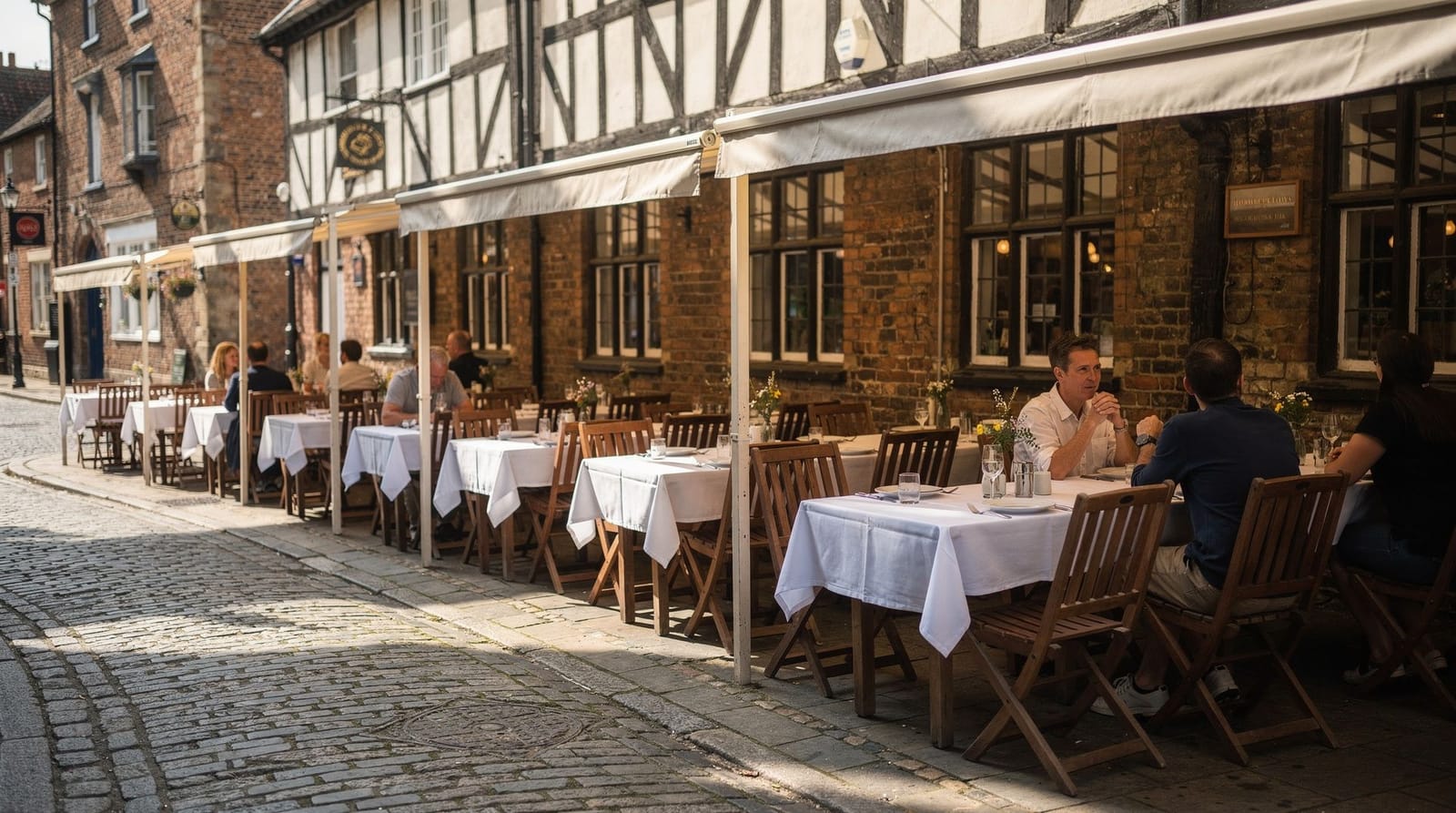
Beyond shopping, the Rows host a genuine concentration of Chester’s food and drink scene, with cafés and restaurants occupying both ground-floor and upper-gallery units — the upper-level restaurants in particular often make a feature of their Rows-facing balconies or windows, giving diners a slightly elevated view over the street below that’s part of the appeal.
Watergate Street carries a reputation for a stronger independent café and restaurant scene than the more chain-dominated Eastgate and Bridge Street stretches. Our Chester restaurants guide and Chester afternoon tea guide both cover specific recommendations if you want to build a Rows visit around a meal rather than shopping alone.
Shopping the Rows today
The Rows function as Chester’s principal retail district, mixing national high-street chains at street level with a higher concentration of independent shops, cafés and specialist retailers on the upper gallery level — jewellers, antique dealers, tailors and a scattering of genuinely old-fashioned shopfronts that have resisted the pull toward generic retail branding. Watergate Street in particular has a reputation for antiques and higher-end independent retail, while Eastgate and Bridge Streets carry more of the mainstream chain stores.
Because the upper Rows level is reached by short flights of stairs at frequent intervals rather than one continuous staircase, it’s easy to zigzag between the two levels as you walk, checking both tiers of shops on a single street without doubling back. Budget more time than you’d expect for a “quick look” — the layout naturally slows you down, and it’s easy to lose 30-45 minutes just on one street if the shops interest you.
Guided tours versus exploring independently
The Rows are straightforward to explore without a guide — there’s no ticket, no fixed route and shops are self-evidently open to browse — but a guided tour adds real value here specifically because the architectural history (genuine medieval versus Victorian revival, which undercrofts are worth a look, why the Rows exist at all) isn’t something the buildings themselves explain. The city walking tour and exploration game routes through the Rows as part of a broader old-town circuit and works well for families or groups wanting a self-paced, puzzle-driven route rather than a straight lecture-style tour.
The Heart of Chester walking tour covers the Rows alongside the city walls and cathedral exterior with a guide, useful if you want the full old-town context in one session rather than piecing it together yourself. If food is more your interest than architecture, the Chester food and drink tour uses the Rows and surrounding streets as its route, stopping at several independent food and drink businesses along the way — a good option if you want to combine sightseeing with an actual meal rather than treating them as separate stops.
Photographing the Rows well
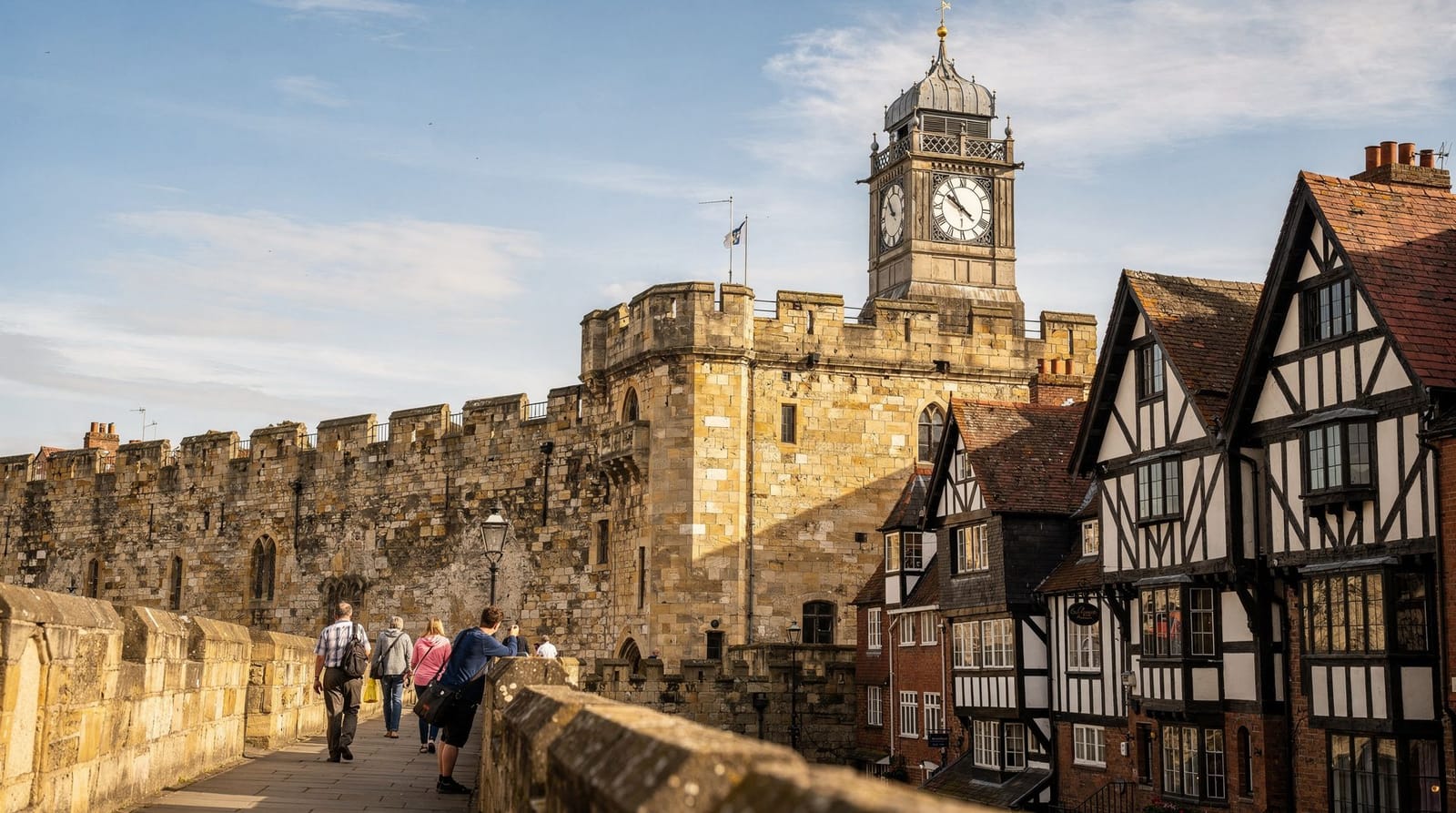
The Rows photograph well from several distinct vantage points: straight down the covered gallery for a sense of the repeating arcade structure, looking up from street level to capture both tiers in one frame, and from inside a Rows-facing café or restaurant window for an elevated view over the street below. Morning light works best on Watergate Street’s west-facing stretch, while Eastgate Street’s clock and gallery combination suits a late-afternoon shot when the light angles down the street. Chester’s Instagram spots guide covers the specific angles locals and repeat visitors rate most highly if photography is a genuine priority for your visit.
How the Rows connect to the rest of Chester’s history
The Rows only make full sense in the context of Deva Victrix, the Roman fortress whose street grid they still follow almost exactly, and of the city walls, which enclose the same historic core. Walking the walls first, then the Rows, makes the relationship between the Roman-era street plan and its medieval reuse far more legible than seeing either in isolation. The Grosvenor Museum, a short walk south of the Rows, displays finds recovered from beneath and around them, including tombstones and everyday objects that show what stood on this exact ground before the Rows themselves existed.
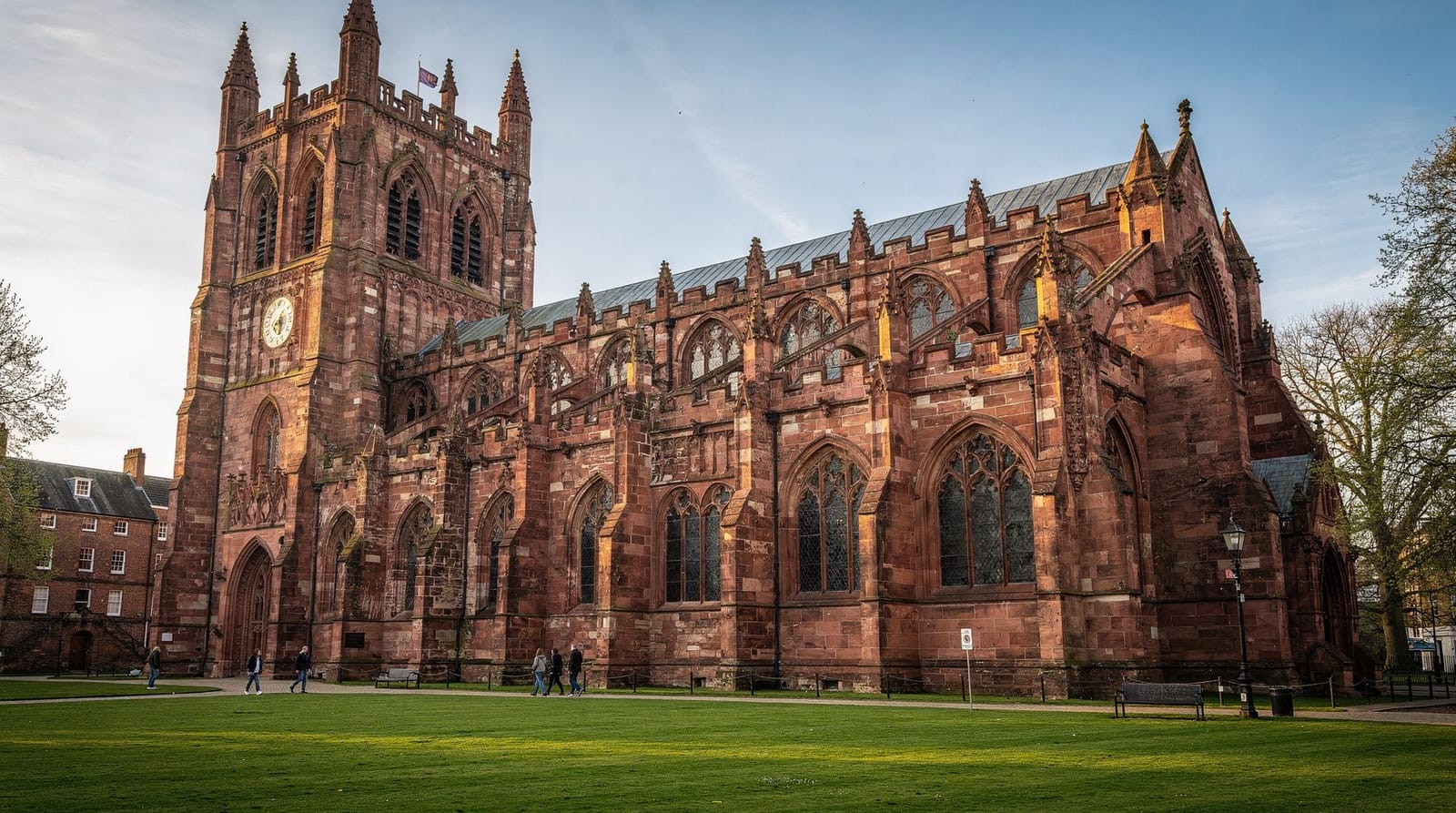
Chester Cathedral sits immediately off Northgate Street, one of the four Rows streets, making it easy to combine a cathedral visit with Rows shopping in a single loop without backtracking. For the fuller narrative tying the Roman fortress, the Rows and the cathedral together chronologically, see our Chester history guide.
Practical tips for a comfortable visit
Because the upper Rows level involves frequent short staircases with varying step heights — some Victorian, some genuinely medieval and correspondingly uneven — comfortable, flat shoes make a noticeable difference over the course of an afternoon spent zigzagging between levels. The covered gallery does provide genuine shelter from rain, which is a meaningful practical advantage in Chester’s frequently wet climate; on a rainy day, sticking to the upper Rows level for shopping is markedly more comfortable than the open street below, one of the more underrated functional benefits of this unusual architecture beyond its historical interest.
Weekday mornings, particularly outside the summer school holidays, are consistently the quietest time to explore the Rows without heavy foot traffic, while Saturday afternoons and the run-up to Christmas are the busiest. If crowds are a concern, an early start followed by the walls walk or cathedral once the streets fill up later in the day tends to work better than the reverse order.
What locals actually use the Rows for
Beyond the tourist experience, the Rows remain a working part of daily life for Chester residents — a bank branch, a pharmacy, a handful of independent grocers and specialist food shops sit alongside the more visitor-oriented antique dealers and gift shops, particularly on the less-photographed stretches away from the Cross.
Locals tend to navigate the Rows with a practical, destination-focused pace rather than the browsing, photograph-stopping rhythm of a first-time visitor, and weekday lunchtimes see a distinct crowd of office workers grabbing food rather than tourists. It’s worth noticing this dual character as you walk — the Rows function simultaneously as heritage attraction and ordinary high street, which is part of what keeps them feeling genuinely alive rather than preserved purely for visitors.
A short architectural glossary
A handful of terms recur throughout any deeper discussion of the Rows, worth knowing before you read a plaque or listen to a guide. An undercroft is the stone-vaulted basement chamber beneath street level, originally used for storage. A jetty refers to an upper floor that projects outward over the one below, a common medieval timber-framing technique visible on several Rows buildings, increasing usable floor space without extending the building’s footprint at ground level.
Mock-Tudor or Chester black-and-white revival describes the deliberate 19th-century architectural style, discussed above, applied to many buildings that aren’t actually medieval. Recognising these terms turns a walk along the Rows from simply admiring old buildings into genuinely understanding what you’re looking at.
A note on independent versus chain retail
Chester’s Rows have seen the same pressure toward national chain retailers as most historic British high streets over recent decades, and it’s fair to say the balance has shifted somewhat from independent to chain businesses compared with a generation ago. That said, Watergate Street in particular has retained a stronger independent character than the other three Rows streets, partly through deliberate local business support initiatives and partly through rents that have historically been somewhat lower than the most prime Eastgate frontage. If supporting independent local business is a priority for you while shopping, prioritising Watergate Street over the other three is the more reliable strategy.
Tourist traps and practical notes
The Rows themselves have no admission charge and no meaningful tourist-trap risk beyond ordinary retail pricing, though a handful of “historic Chester” branded souvenir shops charge a noticeable premium for generic gift items versus what you’d pay for similar products elsewhere — nothing dishonest, just worth comparison-shopping if souvenirs are a priority. Café and restaurant prices directly on the most photographed stretches of the Rows run somewhat higher than a few streets away; our Chester restaurants guide and Chester pubs guide both flag better-value options a short walk from the busiest tourist core.
Parking directly in the city centre is limited and expensive; use the Park & Ride service or one of the options in our Chester parking guide rather than circling for an on-street space near the Rows themselves.
The Rows at night
Most Rows shops close by early evening, following standard UK retail hours, but the covered galleries themselves remain open and walkable after dark, when the character of the streets changes substantially — quieter, atmospherically lit, and popular with the evening ghost-tour operators who use the Rows’ genuinely atmospheric mix of shadow, uneven stone and centuries-old timber framing as a backdrop for Chester’s well-established local ghost-story tradition.
If you’re staying in Chester overnight rather than passing through on a day trip, a post-dinner walk through the empty upper Rows gives a very different impression from the busy daytime shopping crowds, worth doing at least once even if ghost tours themselves aren’t your particular interest — see our Chester ghost tours guide if the evening angle does appeal.
Fitting the Rows into your visit
Our one-day Chester itinerary places Rows shopping and lunch in the middle of the day, between the morning walls walk and an afternoon at the cathedral or Grosvenor Museum, and the two-day itinerary gives enough time to properly browse all four Rows streets rather than rushing one or two. For a broader look at Chester’s shopping beyond the historic Rows themselves, our Chester shopping guide covers the full retail picture, and the Chester destination guide ties the Rows into everything else worth seeing in the city.
The four Rows streets compared
| Street | Character | Best for |
|---|---|---|
| Watergate Street | Strongest genuinely medieval fabric, independent shops | Antiques, café culture, architecture |
| Eastgate Street | Mix of medieval, Victorian revival, mainstream chains | Photo of the Eastgate Clock, chain retail |
| Bridge Street | Visible undercroft entrances, mixed retail | Roman-era masonry glimpses |
| Northgate Street | Leads to the Cathedral | Combining shopping with a Cathedral visit |
Where to stay and go next
If you’re building a Rows visit into a longer stay, our where to stay in Chester guide covers hotels within easy walking distance, and self-guided Chester walk folds a Rows loop into a wider free walking route. For visitors interested in the Roman street grid the Rows still follow, Deva Victrix covers the fortress that laid it out, and Chester’s history guide ties the Roman, medieval and Victorian layers of the story together in one place. Rainy visits work well here too — see rainy day Chester for how the covered galleries fit a wet-weather itinerary.
Frequently asked questions about The Rows
Why does Chester have the Rows and no other city?
Nobody knows for certain. The leading theories point to the uneven ground level left by Roman-era rubble and building platforms that later medieval builders worked around rather than levelling, creating a natural first-floor walkway that got built up into a permanent covered gallery over the 13th and 14th centuries. Whatever the exact cause, the result — a genuinely unique urban form — never spread to other English towns, even nearby ones with similar Roman origins like York.Are the Rows free to walk through?
Yes, entirely free — they're public pedestrian walkways above street-level shopfronts, not a ticketed attraction, and you can walk the full length of all four streets' Rows at any time the shops are open (generally standard UK retail hours, roughly 9am-5.30pm, later on some evenings).What's the difference between the Rows and a normal high street?
A conventional high street has one row of shops at ground level. The Rows have two full tiers — ground-floor shops accessed directly from the street, and a second tier of shops accessed via a covered, partly open-air gallery at roughly first-floor height, connected by frequent short staircases. You can shop, browse or just walk the entire loop without descending to street level at all if you choose.Do real Roman ruins survive under the Rows?
In places, yes. Several undercrofts (stone-vaulted basement chambers) beneath shops on the Rows date to the medieval period and, in a handful of locations, incorporate genuine Roman-era masonry or sit directly on Roman foundations, since the Rows follow the same four streets that trace Deva Victrix's original Roman grid. Some shops give a glimpse of these undercrofts, though access varies by business and isn't guaranteed.Which street has the best-preserved Rows?
Watergate Street is generally considered to have the most historically intact stretch, with some genuinely medieval timber-framed buildings, while Eastgate and Bridge Street have a mix of medieval, Victorian "Chester black-and-white revival" rebuilding (a 19th-century architectural fashion that added mock-Tudor facades to many buildings) and modern shopfronts. Telling the two apart isn't always obvious without a guide.Is Chester Rows accessible for wheelchairs or pushchairs?
Street level is fully accessible throughout. The upper Rows level is a mix — some sections have ramps or lifts installed by individual businesses, but many stretches are only reachable via stairs, so a wheelchair user can comfortably shop the ground floor but won't be able to access every part of the upper gallery.How long should I spend at the Rows?
An hour is enough for a first look at all four streets, but budget 2-3 hours if you plan to browse shops, stop for coffee or seek out the specific historic buildings covered in this guide. It's easy to lose track of time zigzagging between levels once the shops interest you.Can you eat and drink on the Rows themselves?
Yes, extensively — cafés and restaurants occupy both the ground-floor and upper-gallery units, with Watergate Street carrying the strongest independent food and drink reputation of the four streets.
Top experiences
Bookable activities with verified prices and instant confirmation on GetYourGuide.