Chester Cathedral — visiting the former abbey of St Werburgh
Chester: The Heart of Chester Walking Tour
Duration: 1.5 hours
How much does it cost to visit Chester Cathedral?
General admission for adults runs around £9-10, with the Cathedral at Height rooftop tour booked separately for roughly £10-12 on top, usually with fixed time slots. Worship services are free to attend, and admission is typically waived during services and on Sundays for those attending church rather than sightseeing — check the cathedral's own site for current prices and exceptions before visiting.
| Where | Northgate Street, in the heart of the old town |
| Cost | Around £9-10 general admission; Cathedral at Height rooftop tour £10-12 extra |
| Time needed | 45 min-1 hr for a general visit; add 45-60 min for the rooftop tour |
| Getting there | Two-minute walk from the city walls and the Rows |
| Best time | Weekday mornings for the fullest access and quietest galleries |
From Benedictine abbey to Anglican cathedral
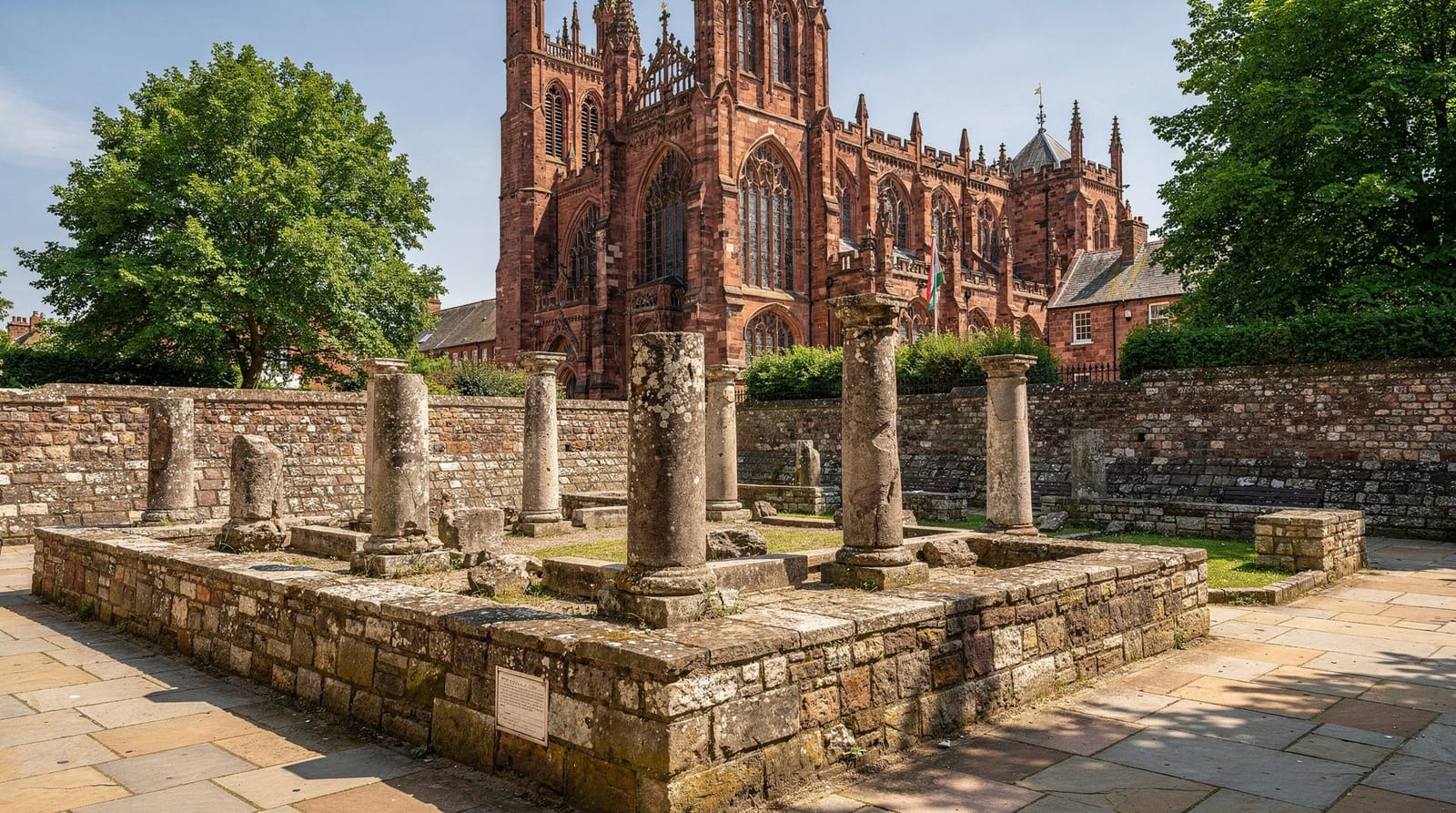
Chester Cathedral has been a place of worship for over a thousand years, but the building visible today is the product of one specific historical accident: Henry VIII’s dissolution of the monasteries. Until 1541, this was St Werburgh’s Abbey, a Benedictine monastery that had grown steadily since its foundation in 1092 on the site of an earlier Saxon minster.
Rather than demolishing it like so many other monastic buildings during the Dissolution, Henry VIII refounded it as the cathedral of a new diocese of Chester, carved out largely from the diocese of Lichfield — a pragmatic reuse that’s why Chester Cathedral has the layout, cloisters and monastic outbuildings of an abbey rather than the more typical ground-up cathedral plan you’d see at, say, Salisbury or Lincoln.
That monastic origin is visible throughout the building. The cloisters, refectory (monks’ dining hall) and chapter house all survive largely intact, which is unusual — most English cathedrals that started life as parish churches or minsters never had this kind of purpose-built monastic infrastructure to begin with, and most former abbeys that did have it lost it to demolition after the Dissolution. Chester kept its full monastic footprint essentially by chance, since the building was simply repurposed rather than torn down and rebuilt.
What to see inside
The cathedral is built from local red sandstone, the same stone as the city walls, and the weathering is visible on the exterior in a way that’s become part of the building’s character rather than something restoration has fully corrected. Inside, the medieval choir stalls are the standout feature for most visitors — richly carved oak seats from the 14th century with misericords (the small carved ledges under the hinged seats, designed to give monks something to lean on during long standing services) showing a mix of religious scenes and genuinely odd secular imagery, including grotesques and folklore figures that have nothing obviously to do with monastic life.
The cloisters, rebuilt in their current form in the late 15th and early 16th centuries after earlier Norman cloisters, enclose a garden that’s one of the quietest spots in the old town centre, a useful contrast if you’ve just come from the crowds around the Rows a few minutes’ walk away. The refectory, now used for exhibitions and the cathedral’s café, retains its original stone pulpit — a rare survival, used historically for readings during silent monastic meals — and the Chapter House holds a small display on the abbey’s history and the diocese’s founding.
The Cathedral at Height rooftop tour
For a different perspective on the building, the Cathedral at Height tour takes small groups up through the cathedral’s roof spaces and central tower, with views out over Chester’s old town, the walls and — on a clear day — toward the Welsh hills. It runs on a fixed schedule with limited group sizes for safety reasons (the route involves narrow stairs and walkways not part of the normal visitor route), so slots can sell out on busy weekends and during school holidays; booking ahead directly through the cathedral is worth doing if this is a firm plan rather than a maybe.
It’s a genuinely different experience from a standard cathedral visit — you’re walking through service spaces and roof voids rather than the nave and choir — but it isn’t for everyone: there’s a reasonable amount of climbing involved, it’s not accessible for visitors with mobility restrictions, and children below a minimum age (check current cathedral guidance, as this is reviewed periodically) typically aren’t permitted for safety reasons.
Stained glass, memorials and architectural details worth slowing down for
The cathedral’s stained glass spans several centuries and styles, since much of the medieval original glass was lost — some to Reformation-era iconoclasm, some simply to age and later replacement — and what survives today is a mix of genuinely old fragments incorporated into later windows and substantial 19th and 20th-century additions, including work by prominent Victorian and Edwardian glass studios brought in as part of a wider programme of cathedral restoration and beautification during that period. The great west window and several windows in the south transept are worth particular attention if stained glass interests you, showing biblical scenes alongside more unusual imagery tied to the abbey’s own history and local saints.
Throughout the building, memorials and monuments record centuries of Cheshire’s civic and military history — bishops, deans, local nobility and, in the cloisters and grounds, a number of First and Second World War memorials reflecting the cathedral’s ongoing role as the county’s principal Anglican place of remembrance. The Consistory Court, a small surviving ecclesiastical courtroom within the cathedral complex, is a rare example of this kind of specialised legal space and worth seeking out if the building’s more unusual corners interest you beyond the main nave and choir.
Choral tradition and cathedral music
Chester Cathedral maintains a full professional and volunteer choral tradition, with choral evensong sung on most weekdays during term time and a fuller schedule of choral services on Sundays — a genuinely different way to experience the building’s acoustics and atmosphere compared with a daytime sightseeing visit, and free to attend as a member of the congregation rather than a paying visitor.
The cathedral also hosts concerts, recitals and occasional larger musical events throughout the year, making use of its considerable pipe organ and the natural reverberation of the stone nave. If choral or classical music interests you alongside the architecture, checking the cathedral’s events calendar before your visit can turn an ordinary sightseeing stop into something more memorable.
How Chester Cathedral compares to other English cathedrals
Visitors familiar with England’s larger, more famous cathedrals — Canterbury, York Minster, Durham — sometimes arrive at Chester expecting something on a similar physical scale and are surprised to find a more modestly proportioned building. Chester Cathedral is smaller than most of England’s other diocesan cathedrals, a reflection of its comparatively late founding as a cathedral (1541, centuries after most of England’s other sees were established) and its origin as a monastic rather than a purpose-built cathedral church.
What it lacks in raw scale, it makes up for in the completeness of its surviving monastic complex — the cloisters, refectory and chapter house together give a far more complete sense of how a working medieval abbey actually functioned than most English cathedrals, which typically lost their monastic outbuildings entirely at the Dissolution, can offer. For visitors who’ve already seen one or two of England’s grander cathedrals, Chester’s smaller scale and intact monastic footprint make it a worthwhile and quite different addition rather than a redundant repeat.
Prices, hours and practical visiting notes
General admission covers the nave, choir, cloisters, refectory and chapter house, with the Cathedral at Height tour and any special exhibitions booked and charged separately. Prices have risen in recent years as the cathedral, like most English cathedrals, relies on visitor admission to fund an expensive historic building’s upkeep — check the cathedral’s own website for current figures rather than relying on older published prices, since these are reviewed annually.
The cathedral operates as a working church first and a visitor attraction second, which has practical implications: access to parts of the building is restricted or unavailable during services, weddings and other events, and Sundays in particular see reduced visitor access as the building is given over to worship. If sightseeing is your priority, a weekday visit gives the most reliable full access; if you want to experience the building as intended, attending a service (usually free) is arguably the more authentic way to see it, even if it means missing some areas open only to paying daytime visitors.
The cathedral gardens, refectory café and taking a break
The cathedral’s grounds extend beyond the main building into gardens around the cloisters and the wider precinct, generally quieter and less visited than the interior — a genuinely peaceful spot to sit for a few minutes even if you’re not planning a full cathedral visit, and free to walk through even outside admission hours in some areas.
The refectory, the former monastic dining hall, now operates in part as a café serving light lunches, cakes and coffee beneath a genuinely striking medieval timber roof — one of the more atmospheric places in central Chester for a tea break, and worth building into a visit rather than treating the cathedral purely as a walk-through sightseeing stop. It gets busy around midday on weekends and during school holidays, so an earlier or later visit avoids the longest queues.
Photography and visiting etiquette
Photography is generally permitted throughout most of the cathedral’s public areas for personal, non-commercial use, though flash and tripods are typically restricted in certain spaces and photography is not permitted during active services — check current signage on arrival, since policies are reviewed periodically and vary depending on whether a wedding, evensong or other event is scheduled that day. As a working church rather than a pure museum, a degree of quiet and respectful behaviour is expected throughout, particularly in the choir and areas nearest the altar, even when no service is actively underway.
How Chester Cathedral fits the Roman story
Unlike Deva Victrix itself or the Roman amphitheatre, the cathedral isn’t a Roman-era structure — the earliest confirmed religious building on this site is Saxon, centuries after the legionary fortress was abandoned.
It earns its place in Chester’s Roman-heritage story indirectly: the cathedral sits within the footprint of the old fortress, built from stone quarried from the same sources the Romans used, and its position at the heart of the walled city reflects a continuity of settlement — sacred, administrative and defensive functions have clustered on this same ground for close to two thousand years, even as the buildings themselves changed completely.
The Grosvenor Museum, a short walk south, is a useful complement if you want the Roman-era context the cathedral itself doesn’t provide — its tombstone collection shows what stood on and around this same ground before the abbey, and before the fortress town, existed.
Weddings, events and why access sometimes varies
Because Chester Cathedral is a genuinely active, in-demand wedding and events venue alongside its role as a working parish and diocesan cathedral, visitor access can occasionally be more restricted than the standard published hours suggest — a private booking, a diocesan event or a filming request (the cathedral and its cloisters have been used as a filming location on several occasions given their photogenic, atmospheric interiors) can all temporarily close off sections of the building at short notice.
This is worth bearing in mind if your visit is tightly scheduled around a specific opening window; checking the cathedral’s own website or calling ahead on the day is a sensible precaution if you’re travelling some distance specifically to see the interior rather than passing through as part of a wider Chester day.
Chester Cathedral’s bishops and the diocese today
The Diocese of Chester, created at the cathedral’s founding in 1541, originally covered a substantial territory across Cheshire and parts of Lancashire, though its boundaries have been adjusted several times in subsequent centuries as the Church of England reorganised dioceses to match population shifts, particularly the growth of Liverpool and Manchester into major cities in their own right with dioceses of their own carved out of what had once been Chester’s territory.
The cathedral remains the seat of the current Bishop of Chester and the mother church for Anglican worship across the diocese, a role that continues alongside its function as a major visitor attraction — a dual identity that shapes practical details like visitor access during services, covered earlier in this guide.
The cathedral’s chapter and clergy also maintain an active role in Chester’s wider civic life, participating in major city ceremonies and events throughout the year, and the cathedral itself regularly hosts civic services, university graduations (Chester holds university status through the University of Chester, whose graduation ceremonies are held here) and other significant local gatherings beyond its purely religious functions.
A quieter alternative to the Rows crowds
For visitors who find the Rows and central shopping streets overwhelming during peak season, the cathedral’s calmer interior and gardens offer a genuine change of pace within a two-minute walk of the busiest part of the old town — a practical, not just historical, reason to build a cathedral stop into a Chester day even if ecclesiastical architecture isn’t your primary interest. Its position at the quiet northern edge of the main shopping streets makes it an easy retreat between busier stops rather than requiring a separate special trip.
Getting there and combining with the rest of the city
Chester Cathedral sits at the very centre of the old town, immediately off Northgate Street and a two-minute walk from the city walls and the Rows. There’s no dedicated cathedral car park; use one of the city centre car parks or the Park & Ride service covered in our parking guide, since the whole historic core is compact enough to explore entirely on foot once you’ve arrived.
A cathedral visit pairs naturally with a walk along the adjoining stretch of city walls (the cathedral is visible from, and close to, the wall’s southeast section near the amphitheatre) and with the Rows for shopping and lunch. The Heart of Chester walking tour passes the cathedral exterior as part of its route and gives useful context on how the building fits the city’s wider history, though it doesn’t include entry — book cathedral admission separately if you want to go inside.
For visitors more drawn to the ghost-story side of Chester’s history than the architectural one, the Dark Chester dark tourism walking tour passes the cathedral precinct and covers some of the darker local folklore associated with the abbey’s monastic past.
Family visits and what to expect with children
Chester Cathedral welcomes family visitors, and the sheer scale and atmosphere of the nave generally makes an impression on children even without detailed historical context — the Cathedral at Height rooftop tour in particular tends to appeal to older children and teenagers drawn to the novelty of climbing through normally inaccessible roof spaces, though the minimum age restriction means younger children in a family group may need to split up, with one adult doing the rooftop tour while another explores the ground-floor galleries and cloisters with younger family members.
The cathedral occasionally runs family-oriented events and trails, particularly during school holidays — worth checking the events calendar if visiting with children is a specific priority for your trip alongside Chester’s other family attractions.
Booking the Cathedral at Height tour
Because the tour uses narrow original stairways and roof-space walkways not built for large volumes of foot traffic, group sizes are kept deliberately small, which means demand regularly outstrips the number of slots available on a busy day, particularly weekends and school holidays.
Booking directly through the cathedral’s own website ahead of your visit, rather than hoping to buy a same-day ticket on arrival, is the more reliable approach if the rooftop tour is a firm part of your plan rather than a nice-to-have. If a specific time slot matters — say, you want the golden-hour light for photographs from the tower — book as far ahead as the cathedral’s system allows, since the most popular slots (typically mid-morning and early afternoon) sell out first.
The Song School and the cathedral’s working choir today
Beyond the historic choral tradition covered above, Chester Cathedral maintains an active Song School programme training young choristers, part of a lineage of cathedral music education that stretches back centuries at English cathedrals of this kind. Visitors who attend an evensong service sometimes have the chance to hear this training choir alongside the adult professional voices, a genuinely different experience from a purely visitor-facing sightseeing stop, and one more reason evensong is worth prioritising if choral music interests you at all beyond simply admiring the building’s acoustics from a guidebook description.
What to skip if you’re short on time
If you only have 20-30 minutes rather than a full hour, prioritise the nave and the medieval choir stalls with their misericords — the single most distinctive interior feature — over the cloisters and refectory, which reward a slower pace better suited to a longer visit. The Cathedral at Height tour needs its own dedicated booking and time slot regardless of how much time you have for the rest of the building, so decide whether it’s part of your plan before arriving rather than trying to fit it in as an afterthought.
Visitors combining the cathedral with a full walls circuit and the Rows in a single day often find the shorter version sufficient, saving a longer, unhurried cathedral visit for a return trip or a second day.
Fitting it into a Chester itinerary
Our one-day Chester itinerary places the cathedral in the late morning, after the walls walk and before lunch on or near the Rows, which works well given how central it is to everything else. The two-day itinerary gives more room to add the Cathedral at Height tour without rushing, useful if you want to actually book a rooftop slot rather than treating it as optional.
For the fuller chronological picture of how the cathedral, the Roman fortress and the medieval walled city connect, see our Chester history guide, and for what else is worth seeing in the immediate area, the Chester destination guide covers the full range of the city’s attractions beyond its Roman and medieval core.
Frequently asked questions about Chester Cathedral
How long should I budget for a Chester Cathedral visit?
A general visit covering the nave, choir, cloisters, refectory and chapter house takes 45 minutes to an hour at an unhurried pace. Add the Cathedral at Height rooftop tour separately, which runs on fixed time slots and typically adds another 45-60 minutes including the climb.Can I visit Chester Cathedral for free?
Worship services are free to attend, and admission is typically waived during services and on Sundays for those attending church rather than sightseeing. Daytime sightseeing outside of services carries the standard admission charge, with the rooftop tour booked and charged separately.
Top experiences
Bookable activities with verified prices and instant confirmation on GetYourGuide.