Chester vs York
Chester: The Heart of Chester Walking Tour
Duration: 1.5 hours
Is Chester or York better to visit?
Both are compact, walled historic cities with genuine Roman roots, but they suit different trips. York has a bigger single-city draw (the Minster, the Shambles) and works well as a standalone break; Chester is smaller but sits at the centre of a wider day-trip network into North Wales, Liverpool and Manchester that York can't match.
Chester and York get compared constantly, and for good reason: both are English cities built inside substantially intact defensive walls, both have real Roman foundations under their medieval streets, and both have made history and heritage the centre of their tourism identity rather than an afterthought. The honest answer to which is “better” depends less on the cities themselves — they’re genuinely comparable in quality — and more on what you want the rest of your trip to look like around them.
| Chester | York | |
|---|---|---|
| Walls loop | ~2 miles, river/racecourse/Roman mix | Slightly longer, Minster views |
| Signature street | The Rows (two-tier galleries) | The Shambles |
| Cathedral | Smaller, hosts the Christmas market | York Minster, one of Europe’s largest Gothic cathedrals |
| Day-trip range | Wales, Liverpool, Manchester | Yorkshire coast, moors, Leeds |
| Best for | Widest variety of day trips | A single deep, well-proven city break |
The walls: similar concept, different character
Both cities let you walk a substantial loop of their historic walls, and it’s the signature activity in each. York’s walls are slightly longer and, for many visitors, the more famous version of this experience, with views over the Minster and the medieval Shambles quarter from various points along the route. Chester’s walls form a roughly two-mile loop that takes in the Cathedral, the Roman amphitheatre, the racecourse and the River Dee — arguably a more varied set of views in a shorter, more manageable walk.
Neither is meaningfully “better” here; York’s walls feel grander given the Minster’s scale, while Chester’s feel more intimate and varied given the mix of river, racecourse and Roman remains packed into a tighter loop. See Chester city walls walk for the specifics of Chester’s route.
The signature historic centres: the Rows versus the Shambles
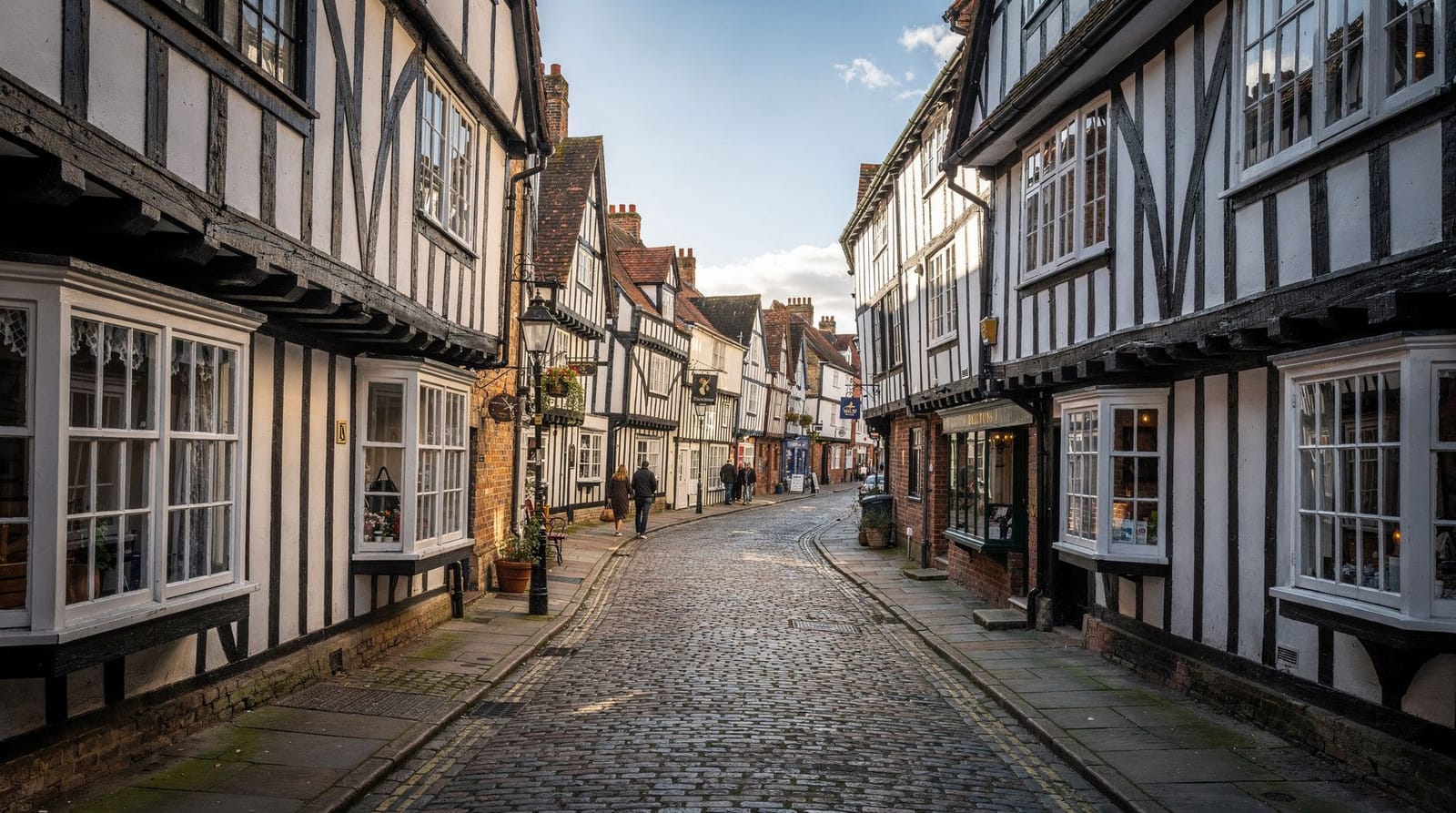
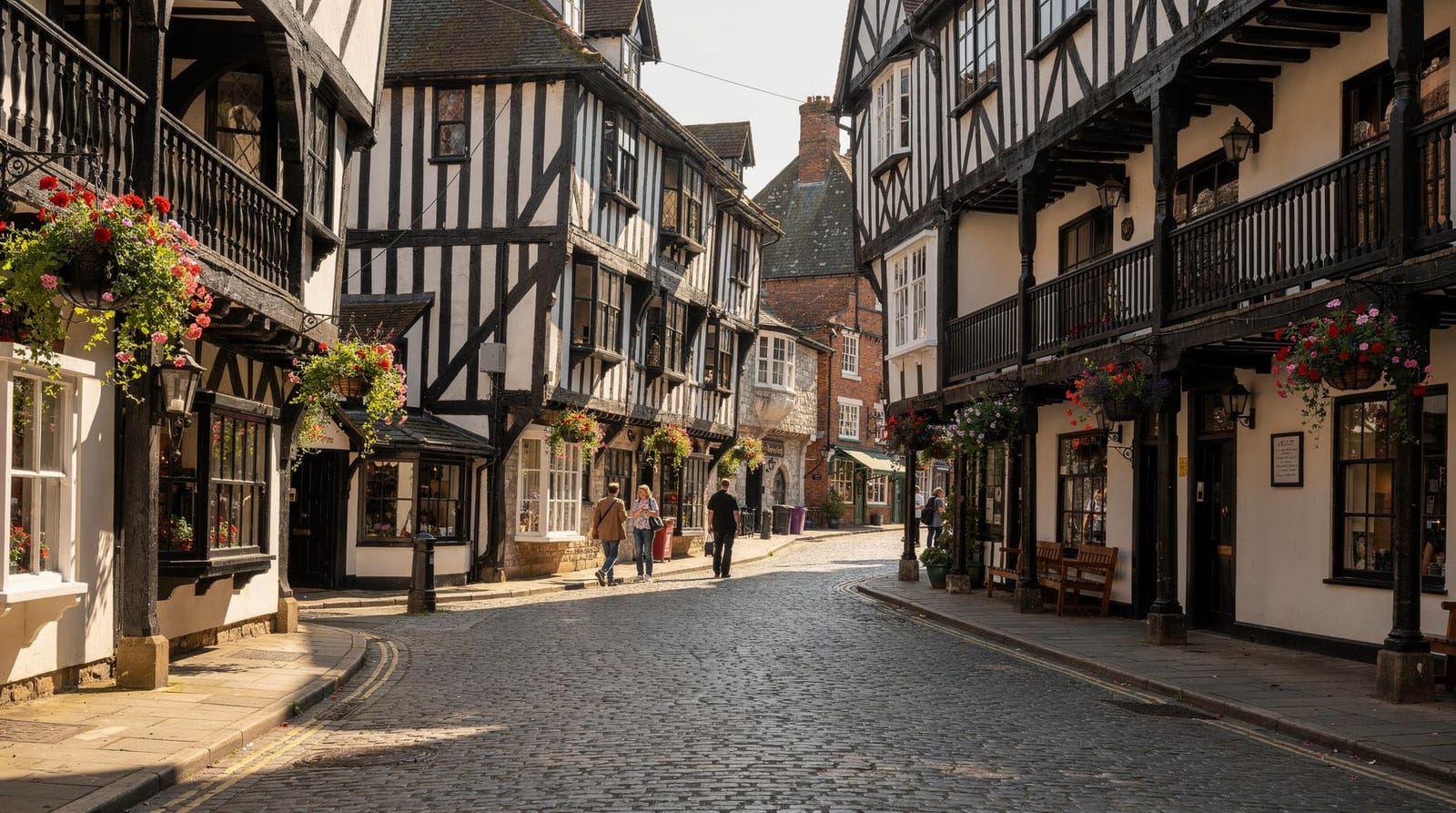
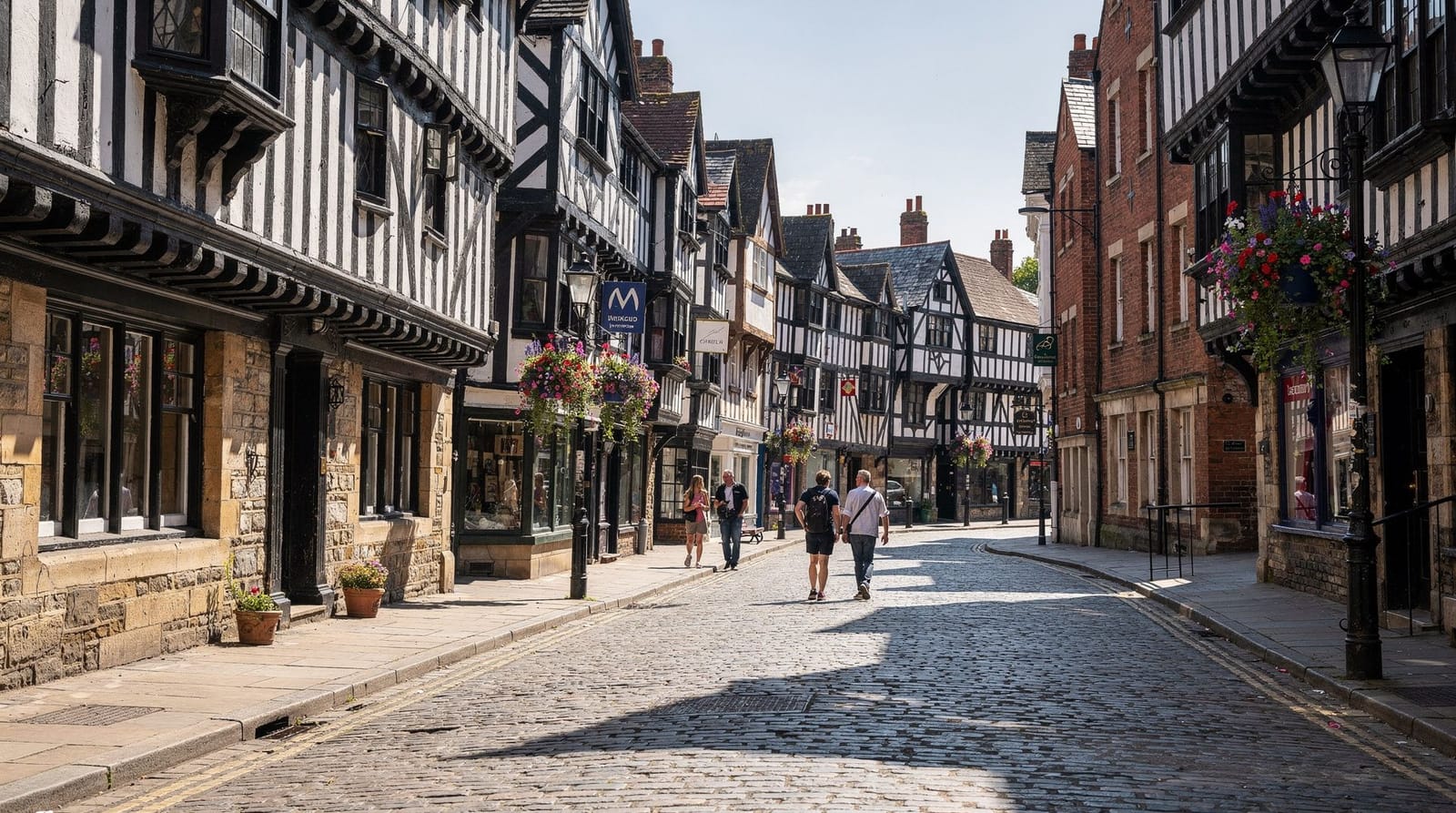
Chester’s Rows — two-tier medieval galleries where shops sit both at street level and on a covered upper walkway — are genuinely unusual and not replicated anywhere else in England in quite the same form. York’s Shambles, a narrow, overhanging medieval street now largely given over to shops, is more famous internationally (partly through Harry Potter associations that have brought a wave of new visitors) and has a denser, more atmospheric single-street character. Chester’s Rows cover more ground and offer a more varied browsing experience across multiple streets; York’s Shambles is more concentrated and, arguably, more photogenic in a single frame. See The Rows in Chester for how to navigate them.
Cathedral and Minster
York Minster is one of the largest Gothic cathedrals in Northern Europe and a genuinely significant sight in its own right, worth a dedicated visit rather than a quick look. Chester Cathedral is smaller and less internationally famous, but has its own considerable history and, notably, plays host to the city’s well-regarded Christmas market in its grounds each winter — a use of space York’s Minster precinct doesn’t replicate in quite the same way. If cathedral architecture on the grandest scale is a priority, York wins outright; if a smaller, more intimate cathedral combined with a genuinely good Christmas market matters more, Chester has the edge.
Roman heritage
Both cities were significant Roman settlements — York (Eboracum) was a legionary fortress and later imperial capital visit site, while Chester (Deva Victrix) was one of the largest Roman fortresses in Britain, and its amphitheatre is among the largest excavated in the country. York’s Roman remains are woven more subtly into the modern city and its museums; Chester’s amphitheatre and city walls make the Roman layer more immediately visible to a visitor walking the streets. Neither city’s Roman history is a minor footnote, and both reward visitors with a specific interest in it.
Day-trip potential: the real difference
This is where the comparison genuinely diverges rather than being a matter of taste. Chester sits within an hour or so of Liverpool, Manchester, the North Wales coast (Llandudno, Conwy) and, with a bit more effort, Snowdonia’s fringes — a network of day trips covering seaside towns, castles, football culture, Beatles history and genuine mountain scenery, all reachable without a long journey.
York’s day-trip range is real but narrower in variety: the North York Moors, the Yorkshire coast (Whitby, Scarborough) and Leeds are the standard options, strong on countryside and coastline but without Chester’s mix of Welsh castles, mountains and two major cities within easy reach. If day trips are central to your trip, Chester’s surrounding network is the more varied of the two. See Day trips from Chester for the full list.
Cost and crowds
Both cities draw significant tourist numbers, but York, with its larger single-city reputation and Harry Potter-driven Shambles fame, arguably sees denser crowding in its most famous single streets during peak season than Chester’s more spread-out historic core. Accommodation costs are broadly comparable between the two for a similar standard of central hotel, though Chester’s costs spike more specifically around Chester Races meetings and its Christmas market, while York’s spike around its own major events and peak summer weekends. Neither city is a budget destination at peak times, but neither is unreasonably expensive outside those windows either.
Football and modern culture
Chester’s surroundings bring in an angle York doesn’t have: Liverpool and Manchester’s football culture (Anfield, Old Trafford, the Etihad) and Beatles heritage are both within easy day-trip range, adding a modern cultural layer to a Chester-based trip that York’s countryside-and-coast day trips don’t replicate. If football or music heritage is part of what you want from a UK trip, that tips meaningfully toward Chester as a base, even if York’s core historic centre stands on its own equally well.
Which suits which traveller
If you want one standout historic city to explore deeply over several days, with strong countryside and coastal day trips either side, York is an excellent, well-proven choice — it’s set up for exactly that kind of visit and delivers it reliably. If you want a genuinely varied base — a smaller but equally atmospheric historic centre, with the ability to add Welsh castles, real mountains, two major football cities and a seaside town all within reach, without ever needing more than an hour’s travel — Chester’s surrounding network is hard to match.
Families balancing history with more varied activities (Chester Zoo, castle day trips accessible to children, a wider spread of things to do beyond walking historic streets) may also find Chester’s variety useful in a way York’s more history-concentrated offering doesn’t quite replicate.
Guided tours in each city
Both cities have well-developed guided walking tour offerings that make the most of a short visit — Chester’s history-and-heritage walks through the historic core and the Rows cover the same essential ground as York’s equivalent tours through the Shambles and Minster precinct. If you’re short on time in either city, a guided walk is a genuinely efficient way to get the key context (Roman origins, medieval development, the specific quirks of the Rows or the Shambles) that a self-guided wander won’t necessarily surface on its own. See Chester walking tours for the Chester side of this.
Getting there: which is easier from where
Access differs meaningfully depending on where you’re starting from. Chester sits close to the M56/M53 motorway network and has direct rail links to Crewe (and onward to London Euston), Liverpool, Manchester and North Wales, making it a natural fit for visitors arriving via Liverpool or Manchester airports or already planning a North West England trip.
York sits directly on the East Coast Main Line, with fast, frequent trains to London King’s Cross (around two hours) and Edinburgh, making it the more convenient choice for visitors travelling primarily along the London-to-Scotland corridor or flying into Leeds Bradford or Manchester from the east. Neither city is hard to reach, but the practical answer to “which is easier” often comes down to which airport or rail corridor your wider UK trip already uses.
Shopping: Rows and boutiques versus Shambles and chains
Chester’s Rows mix independent boutiques with recognisable high-street names across their two levels, while York’s Shambles has increasingly shifted toward gift shops and Harry Potter-themed retail as its fame has grown, alongside a broader high street beyond the famous single lane. Neither city is a dedicated shopping destination on the scale of Manchester or Liverpool, but Chester’s Grosvenor Shopping Centre gives it a slight edge for anyone wanting a proper shopping stop alongside the historic sightseeing, while York’s charm-shopping is more concentrated in a smaller, more tourist-oriented footprint.
Food and drink scenes
Both cities have strong, historic pub scenes built around genuinely old buildings rather than themed reproductions, and both support a reasonable range of independent restaurants alongside chain options. York’s food scene has grown a slightly stronger reputation in recent years for its independent café and bakery culture around the Shambles Market area; Chester’s strength leans more toward its historic pubs and a solid, if less internationally hyped, restaurant scene along Watergate Street and the Rows.
Neither city will disappoint a visitor prioritising food, but neither is quite in the same league as Liverpool or Manchester’s larger, more varied dining scenes — both work better as a base for day trips into those bigger cities if food variety is a priority.
Best time of year for each
Chester’s calendar is punctuated by Chester Races (May, June, July, September) and its Christmas market (late November to late December), both of which noticeably change the city’s atmosphere and accommodation pricing on those specific dates. York has its own event calendar, including race meetings at York Racecourse and a well-established Christmas market of its own, following a broadly similar seasonal pattern of summer activity and a festive winter peak. Neither city has a clearly “wrong” time to visit outside of avoiding the coldest, wettest weeks of winter if outdoor sightseeing is the priority — see Best time to visit Chester for Chester’s specific seasonal breakdown.
Could you do both?
There’s no reason to treat this as a strict either-or if your trip allows for it — both cities are reachable from similar transport hubs in the North West and North of England, and a two-centre trip covering Chester and York back to back is entirely feasible for a longer UK visit, though it does mean less time exploring either city’s day-trip network in depth. For a single, focused city-break decision, though, the honest answer comes down to whether you want York’s concentrated historic grandeur or Chester’s broader network of day trips built around a smaller but equally genuine historic centre.
Accommodation styles
Chester’s central accommodation leans toward historic coaching inns and boutique hotels within or just outside the walls, alongside a growing number of modern chain hotels near the station and racecourse. York offers a similarly historic mix, with a particularly strong concentration of boutique and heritage-building hotels near the Minster and city walls, reflecting its longer-established position as a major UK tourism destination. Both cities reward booking accommodation inside the walls, or close to them, over cheaper options on the outskirts, given how much of the appeal in either city is being able to walk everywhere without relying on transport.
Honest downsides of each
Chester’s downside is scale: if you’re not interested in any of the surrounding day trips, the city centre itself, while genuinely charming, is smaller than York’s and can be thoroughly explored in a day or two, leaving a longer standalone stay feeling thin without venturing further afield. York’s downside is exactly the opposite problem in a different form — its fame, particularly the Shambles’ Harry Potter association, means its single most photographed street can feel more like a themed attraction than an organic historic quarter during peak season, and central York can feel considerably more crowded and commercialised in its most famous corners than Chester’s more evenly spread historic core.
Museums and indoor attractions
York’s museum offering is broader than Chester’s, including its well-known railway museum and Viking-themed attractions that draw a specific type of visitor Chester doesn’t quite cater to in the same volume. Chester’s equivalent — the Grosvenor Museum and the Cathedral’s own historic displays — is solid but smaller in scale. For a family or visitor prioritising a deep bench of indoor, weatherproof attractions across several consecutive days, York’s broader museum offering gives it a practical edge on genuinely wet visits.
A simple way to decide
If your trip is built around one city carrying the whole visit — several days of deep exploration, day trips into Yorkshire’s countryside and coast, a single well-earned splurge on accommodation — York’s scale and reputation deliver that reliably.
If your trip is built around a base with the widest possible variety within an hour’s reach — Welsh castles one day, a Beatles-and-football day in Liverpool the next, real mountains in Snowdonia if you have the time — Chester’s position makes it the more versatile choice, even though its own historic centre is the smaller of the two. Most travellers instinctively already know which of those two trips they’re planning; the city comparison mostly confirms a decision the itinerary shape has already made for you.
The honest verdict
Neither city is the objectively “better” choice — both deliver real, substantial historic centres with walls, cathedrals and Roman roots, and either makes for a genuinely worthwhile UK city break. The deciding factor is what you want around the edges of the historic centre itself: York for a single deep, well-proven city break with strong Yorkshire countryside and coast day trips; Chester for a smaller core city paired with the widest, most varied network of day trips of any comparably sized English base — North Wales castles and mountains, two major football cities, Beatles heritage and a proper seaside town, all within about an hour.
For more on whether Chester specifically justifies a visit on its own merits, see Is Chester worth visiting, and for first-visit planning either way, Chester for first-timers.
Frequently asked questions about Chester vs York
Is Chester or York cheaper to visit?
Accommodation costs are broadly comparable for a similar standard of central hotel, though each city has its own price spikes — Chester's around Chester Races and its Christmas market, York's around its own major events and peak summer weekends. Neither is a budget destination at peak times, but neither is unreasonably expensive outside those windows.Which is better for day trips, Chester or York?
Chester, by variety. It sits within an hour or so of Liverpool, Manchester, the North Wales coast and Snowdonia's fringes — castles, mountains, two major football cities and Beatles history. York's day-trip range covers the North York Moors, the Yorkshire coast and Leeds, strong on countryside and coastline but narrower in variety than Chester's network.
Top experiences
Bookable activities with verified prices and instant confirmation on GetYourGuide.