Old Trafford tour: prices, what's included and getting there from Chester
Old Trafford: Manchester United Museum and Stadium Tour
How much is the Old Trafford stadium tour and how long does it take?
The Manchester United Museum and Stadium Tour costs roughly £30-35 for adults and lasts about 70-80 minutes, covering the trophy room, dressing rooms, tunnel and pitchside. It runs on most non-matchdays; the museum itself can be visited separately on matchdays when the stadium tour is suspended.
Scale is the whole selling point
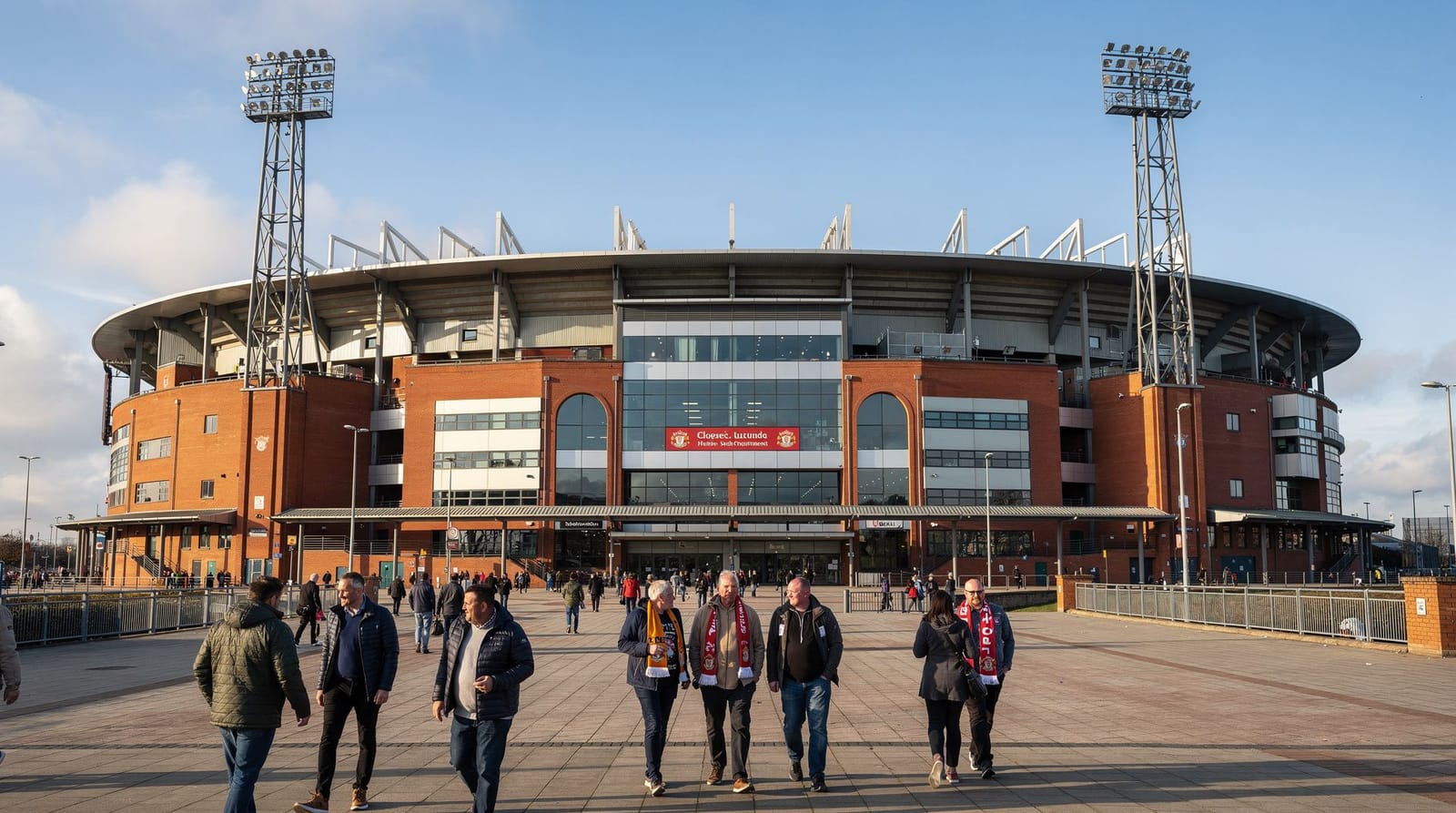
Old Trafford holds around 74,000 people, making it the largest club football stadium in England — bigger than Anfield, bigger than the Etihad, bigger than any other Premier League ground. Manchester United have played here since 1910 (with a rebuild after Second World War bomb damage), and the trophy room the tour walks you through reflects decades of silverware across very different eras of the club, from Busby to Ferguson to the present squad. Whatever your view of the club’s recent form, the museum doesn’t shy away from putting current struggles in context next to historic success — it’s presented as a continuous story rather than a highlight reel that stops a decade ago.
| Where | Old Trafford, Sir Matt Busby Way, Manchester |
| Cost | Around £30-35 for adults |
| Time needed | 70-80 minutes including museum |
| Getting there | Train from Chester (~1hr), then tram 15-20min |
| Booking | Book ahead for weekends and school holidays |
What’s included on the standard tour
Book the Manchester United Museum and Stadium Tour and the route runs through the players’ tunnel, both home and away dressing rooms, the press conference room where post-match interviews happen, the trophy room, and a pitchside walk along the touchline past the dugouts. The whole experience takes 70-80 minutes including museum time, with adult tickets typically £30-35 and family/child reductions available.
Groups move through on a timed, guided basis rather than wandering freely, so allow for a queue at busier periods — weekends and school holidays are the tightest times to get a same-day slot, and booking ahead removes that risk entirely.
For fans wanting more than the standard walk-through, the Official Match Day Experience bundles hospitality access with an actual fixture — a different (and considerably pricier) product aimed at people planning around a specific match date rather than a flexible day trip.
Matchday restrictions
The full stadium tour is suspended on matchdays — the dressing rooms and pitch need to be prepared, and public tours can’t run alongside that. If a home fixture falls during your Chester stay and you don’t have a match ticket, shift the tour to another day rather than turning up expecting access; check the current Premier League fixture list before booking, since operators update tour calendars around it but a manual check avoids surprises.
Getting to Old Trafford from Chester
Trains from Chester to Manchester take roughly an hour, sometimes with one change depending on the service and time of day. From central Manchester (Piccadilly or Deansgate), the Metrolink tram network runs directly to the Old Trafford stop, about 15-20 minutes, putting you a short walk from the stadium and museum entrance. A taxi covers the same ground in a similar time for around £15-20 depending on traffic.
Round trip, budget roughly 2.5-3 hours of travel if this is a single-purpose day trip, which is workable alongside a few hours in Manchester city centre for lunch and the Northern Quarter, but tight if you’re also trying to fit in the Etihad or the National Football Museum on the same day. Our Manchester football guide lays out how to sequence a fuller football-themed day, and the Manchester destination guide covers the wider city beyond football.
Old Trafford vs Etihad — Manchester’s two stadium tours
Manchester has two major club tours worth comparing directly if you’re spending a full day on football: Old Trafford (Manchester United) and the Etihad Stadium (Manchester City). They sit roughly 4 miles apart, connected by tram, and both run similarly priced tours of comparable length. Doing both in one day is physically possible — tram between them takes about 25-30 minutes — but it’s a long day focused entirely on football, and most visitors are better served picking one based on allegiance and using the other half of the day for the city itself, the Science and Industry Museum, or a walking tour.
Old Trafford vs Anfield
If you’re deciding between Manchester and Liverpool’s stadium tours rather than doing both, the honest comparison: Old Trafford wins on scale and trophy history, Anfield wins on atmosphere and how well the surrounding city (Beatles sites, waterfront) supports a full day trip from Chester. Neither tour is meaningfully better run or better value — the choice comes down to which club and which city fits your itinerary. See our Liverpool football guide for the direct comparison from the Merseyside side.
Combining with the rest of Manchester
A single-day trip from Chester works well as: morning train to Manchester, Old Trafford tour late morning, lunch in the city centre (Northern Quarter or Deansgate), and an afternoon at the National Football Museum or a walking tour before the train back. Our Chester weekend itineraries and the 5-day North West England itinerary both route through Manchester with Old Trafford as an optional add-on, sequenced so you’re not doubling back on trains.
For families combining football with a broader day out, our family days out in Cheshire guide and Chester with kids guide cover the non-football alternatives if only part of the group wants the stadium tour.
Tourist traps to avoid
Unofficial ticket resellers around the stadium on matchdays routinely mark up face value tours and merchandise — book only through the club’s own channel or a verified partner like GetYourGuide, and buy shirts from the official megastore rather than street vendors, where counterfeit kit is common. Parking directly at the stadium is limited on tour days and expensive on matchdays; the tram from central Manchester is both cheaper and less stressful than driving in.
Practical booking notes
Book a few days ahead if your dates fall in school holidays or over a weekend — slots for popular times sell out, and walk-up availability isn’t guaranteed. Bring ID matching the booking name, wear comfortable shoes for the concrete pitchside walk, and allow extra time at the entrance for bag checks, which have become more thorough at major English stadiums in recent seasons.
A short history worth knowing before you go
Old Trafford opened in 1910, replacing United’s earlier ground at Bank Street, and was badly damaged by German bombing in 1941, forcing the club to share Manchester City’s Maine Road ground for several years while repairs were made — a detail the museum covers and one that surprises visitors who assume the current stadium is a single continuous structure since 1910.
The ground’s modern identity is inseparable from Alex Ferguson’s 26-year managerial tenure from 1986 to 2013, during which the club won the bulk of its Premier League and European trophies, and the trophy room reflects that concentration of success even as it tries to give equal weight to the earlier Busby era (three European Cup wins in the 1960s, overshadowed by the 1958 Munich air disaster that killed several first-team players) and the club’s more mixed form since Ferguson’s retirement.
The stadium’s current capacity of around 74,000 makes it the largest club ground in England, a status that’s been unchanged for years even as Anfield and other grounds have expanded — though United have discussed redevelopment plans in recent seasons that could eventually change the stadium’s footprint.
Inside the museum
The museum runs on a self-paced basis after the guided walk ends, and it’s substantial enough to warrant 25-30 minutes if you want to read through it properly. Sections cover the Munich air disaster with appropriate gravity, the Busby Babes era, the treble-winning 1998-99 season, and individual player legacies from Best, Charlton and Law through to more recent squads. Interactive elements let visitors compare eras and trophy hauls, which works well for younger visitors who might otherwise find the older black-and-white sections less engaging than the modern trophy displays.
Accessibility and visiting with family
The tour route is step-free with lift access between levels, and the club offers accessibility-adjusted tour options (audio description, BSL) on request if arranged ahead of the visit rather than assumed on the day. Family and under-16 pricing is available, and under-fives typically go free. As with most stadium tours, younger children tend to engage more with the pitchside walk and dressing rooms than with the museum’s denser historical panels — treat the museum section as optional browsing rather than a fixed itinerary item if travelling with under-8s.
Food and drink near the stadium
Options directly around Old Trafford are limited to stadium catering and a handful of chain outlets aimed at matchday crowds — better food is a short tram ride away in central Manchester, particularly the Northern Quarter’s independent cafés and restaurants or Deansgate’s wider range. If you’re combining the tour with a day in the city, it’s worth saving lunch for after the tram ride back into town rather than settling for stadium-adjacent options.
Photography and what to bring
Photography is permitted throughout the tour, including in the dressing rooms and trophy room, matching the visitor-friendly policy most English clubs now use. Bag checks apply at entry and there’s no left-luggage facility, so keep bags small if you’re arriving with overnight bags from a train. Comfortable shoes matter — the pitchside walk and museum both involve sustained standing on hard flooring.
Best time of year to visit
Summer (June-August) is the most reliable season for tour availability, since there’s no competing fixture calendar and tours run at full frequency. During the season, cup replays and rearranged fixtures can disrupt the tour schedule at short notice, so if your Chester trip falls between September and May, check availability closer to your travel date rather than booking many months ahead.
Watching a match without a ticket
If your visit coincides with a home fixture you don’t have a ticket for, the pubs around Old Trafford and in central Manchester offer a better neutral’s experience than trying to find a resale ticket at inflated prices. The Bishop Blaize and the Trafford pubs near the ground fill with home supporters before kickoff and show the match on big screens — arrive well ahead of kickoff for a seat. It’s a genuinely good way to feel matchday atmosphere without the cost of a ticket, and leaves the stadium tour itself free to slot in on a different day of your stay.
Legends tours and hospitality options
Beyond the standard museum and stadium tour, United run occasional “legends” tours guided by former players, where a club great walks a small group through the dressing rooms and pitch sharing first-hand stories rather than a standard script — these sell out quickly when announced and cost significantly more than the standard tour, but for a genuine United fan they’re a different order of experience.
Match-day hospitality packages, which bundle a padded seat, pre-match meal and sometimes a legend Q&A with an actual fixture ticket, sit at the top end of the price range and are booked separately from the tour products covered here — worth knowing about if a special occasion (birthday, anniversary trip) justifies the spend, but overkill for a standard day-trip visit.
Nearby attractions worth combining
The National Football Museum, covering the sport’s history across English football rather than any single club, sits in central Manchester near Printworks rather than at the stadium itself — a natural pairing if you want context beyond Manchester United specifically, and easily reached by tram or a short walk from Piccadilly. The Manchester Science and Industry Museum, covering the city’s industrial and railway history, is another central option if part of your group isn’t interested in football at all. Both fit into an afternoon after a morning Old Trafford tour without requiring an extra day.
The megastore and what to buy
The official Manchester United Megastore sits adjacent to the museum entrance and is open to tour-goers and non-tour-goers alike, stocking current and retro kit, scarves and matchday programmes. Prices are broadly in line with other Premier League club stores — retro shirts and limited-edition items carry the biggest premium, while standard scarves and smaller souvenirs are a more affordable way to bring something home without a significant spend. Buying here rather than from a street vendor near the ground guarantees genuine merchandise; counterfeit kit sold outside the stadium on matchdays is a real and long-standing problem around most English grounds, not just Old Trafford.
Weather and what to wear
The pitchside section of the tour is outdoors and uncovered, so a Manchester downpour will reach you during that portion regardless of season — bring a compact waterproof if rain is forecast, since the tour proceeds on schedule rather than pausing for weather. The rest of the route (tunnel, dressing rooms, trophy room, museum) is fully indoor, making this one of the more weather-resilient Manchester activities overall if your Chester trip coincides with an unsettled forecast; see our rainy day activities guide for other indoor options to pair it with.
Comparing ticket types before you book
The standard museum and stadium tour is the right choice for the vast majority of visitors — it’s the cheapest option, runs most frequently, and covers everything a first-time visitor actually wants to see. The legends tours and hospitality packages exist for a different kind of visit entirely (special occasions, die-hard fans, or people who’ve already done the standard tour and want more). Don’t feel you’re missing out by booking the standard option; it includes the trophy room, dressing rooms and pitchside walk that make up the bulk of what people come to see, at roughly a third of the cost of the premium products.
| Standard tour | Legends tour | Match Day Experience | |
|---|---|---|---|
| Price | ~£30-35 | Significantly higher | Highest, includes fixture ticket |
| Guide | Standard route, fixed script | Former player, first-hand stories | Hospitality staff |
| Best for | First-time visitors | Die-hard fans, special occasions | Visitors wanting a live match |
| Availability | Most non-matchdays | Occasional, sells out fast | Tied to specific fixture dates |
The Manchester derby, briefly
Manchester United and Manchester City sit around 4 miles apart, and the Manchester derby has intensified since City’s ownership change in 2008 turned a historically one-sided local rivalry into a genuinely competitive one — for most of the 20th century United were comfortably the bigger club, and the shift in balance is part of what the Etihad’s own museum leans into. If you’re building a full football day around both clubs, our Etihad Stadium tour guide covers the City side of that same rivalry, and the two tours make a natural (if long) single-day pairing connected by a 25-30 minute tram ride.
Youth academy and Carrington, briefly
United’s first-team training ground, Carrington, sits separately from Old Trafford and isn’t part of the standard public tour — unlike Manchester City, who offer a combined stadium-and-academy tour at the Etihad Campus, United’s training facilities aren’t generally open to the public in the same way. If seeing a working training complex rather than just the matchday stadium is a priority, that’s one practical reason some visitors choose the City tour over United’s, regardless of allegiance.
Getting the most from a single visit
For visitors with only time for one Manchester football stop, the standard Old Trafford tour delivers the fullest experience per hour spent: the trophy room alone covers more concentrated history than most single-club museums in England, and the pitchside walk gives a genuine sense of scale that photographs don’t quite convey. Pair it with lunch in the Northern Quarter and, time allowing, the National Football Museum for broader context, and a half-day easily becomes a satisfying full day without needing to add the Etihad on the same trip.
Booking window and cancellation flexibility
The National Football Museum ticket and the stadium tour are separate bookings, so check each one’s own cancellation terms rather than assuming they match — the stadium tour’s policy can differ from the museum’s, particularly around how close to the visit date you can still get a refund if plans change. If your Chester trip dates aren’t fully locked in, look specifically for a flexible or free-cancellation option when booking either, since fixed, non-refundable slots carry more risk if a matchday reschedule or a change in your itinerary forces a switch.
Comparing the whole North West football trip
If Old Trafford is one stop in a longer Chester-based trip that also covers Liverpool, it’s worth deciding upfront which city gets the “football day” — trying to fit both Old Trafford and Anfield into a single short break, alongside everything else Chester, Liverpool and Manchester each offer, usually means rushing at least one. Our Manchester football guide covers the wider city picture including the Etihad, and the Liverpool football guide gives the equivalent breakdown for Anfield if you’re still deciding between the two.
Frequently asked questions about Old Trafford tour
Can you visit Old Trafford on a matchday?
The full stadium tour doesn't run on matchdays, but the museum sometimes opens on a reduced basis before kickoff for ticket holders. If your visit coincides with a home fixture and you don't have a match ticket, plan the tour for a different day of your stay instead.Is Old Trafford bigger than Anfield?
Yes — Old Trafford holds around 74,000, making it the largest club stadium in England, well above Anfield's roughly 61,000 post-redevelopment capacity. The scale is one of the tour's selling points; the walk pitchside genuinely feels vast compared with most Premier League grounds.How do you get from Chester to Old Trafford without a car?
Train from Chester to Manchester (around 1 hour, sometimes with a change), then a tram (Manchester Metrolink to Old Trafford stop, about 15-20 minutes from Piccadilly or Deansgate) or a taxi. There's no direct train to the stadium itself, so factor in the local transfer on both ends.What does the tour actually show you?
The route covers the players' tunnel, both dressing rooms, the trophy room (an extensive collection spanning the Busby, Ferguson and modern eras), the press conference room, and a pitchside walk past the dugouts. It's a fixed, guided route rather than free-roaming.Is the Old Trafford tour worth it if you don't support Manchester United?
The scale and trophy history make it interesting even for neutrals, though less so than Anfield's atmosphere-driven appeal for casual visitors. If you're choosing one stadium tour for a North West trip and have no strong club allegiance, decide based on which city — Liverpool or Manchester — fits your itinerary better rather than the stadium itself.Can you buy Old Trafford tour tickets on the day?
Walk-up tickets exist but sell out fast on weekends and school holidays. Booking online a few days ahead through a verified operator guarantees a specific time slot and avoids queuing at the ticket office with no guarantee of availability.
Top experiences
Bookable activities with verified prices and instant confirmation on GetYourGuide.