Liverpool walking tours — history, heritage and the waterfront on foot
Liverpool: Heritage, History & Culture Guided Walking Tour
What's the best walking tour to do in Liverpool for a first visit?
The Liverpool Heritage, History & Culture Guided Walking Tour is the strongest general introduction, covering the waterfront's Three Graces, the Georgian Quarter and the city's maritime and cultural history in around 2-2.5 hours for roughly £15-20. If your main interest is the Beatles specifically, book a dedicated Beatles walking tour instead.
A city with more layers than the Beatles alone suggest
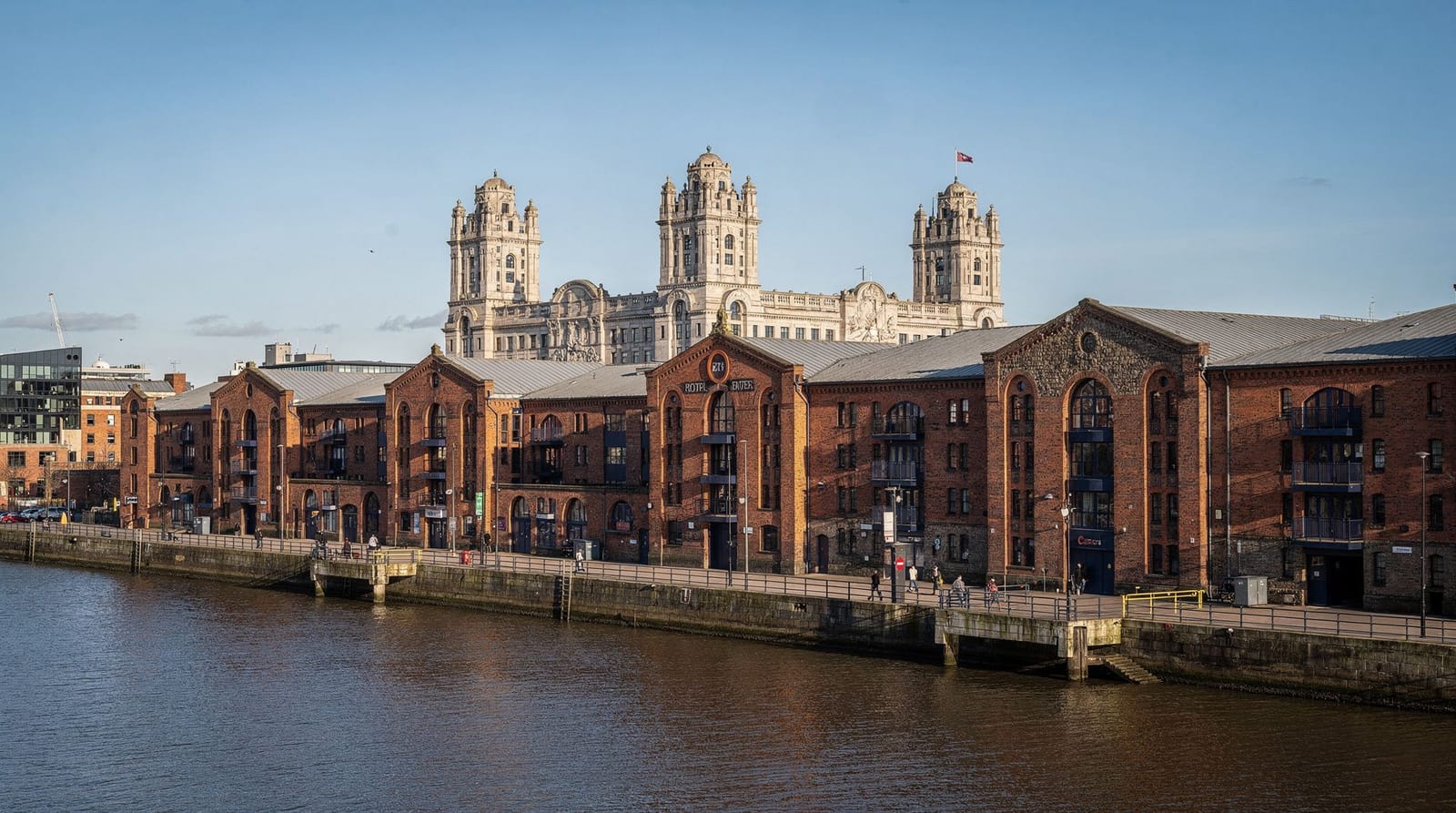
Liverpool’s tourist reputation runs heavily on the Beatles and football, and both are legitimate reasons to visit — but the city’s walking tour scene has just as much built around its wider history: a UNESCO-recognised (heritage-listed prior to a 2021 delisting decision, still architecturally intact) waterfront of Edwardian dock buildings, a Georgian Quarter of genuine 18th and 19th-century townhouses, and a maritime trading history that made it the British Empire’s second city for a long stretch of the 19th century, including its documented and uncomfortable role in the transatlantic slave trade.
This guide covers the general history and heritage walking tours — separate from the Beatles-specific tours covered elsewhere — so you can decide which angle on Liverpool suits your visit.
| Where | Liverpool waterfront, city centre and Georgian Quarter |
| Cost | Roughly £15-20/adult for group tours; several times that for private |
| Time needed | 2-2.5 hours for most tours |
| Getting there | 45 min train from Chester to Liverpool Lime Street |
| Best time | June-September for the longest daylight and mildest waterfront weather |
Why Liverpool’s history runs deeper than its music
Liverpool’s rise began with the transatlantic trade of the 18th century, and a walking tour that’s honest about the city’s history has to confront the uncomfortable part of that story directly: a significant share of the port’s early wealth came from its role in the transatlantic slave trade, with Liverpool ships carrying enslaved Africans as one leg of the “triangular trade” alongside sugar, cotton and manufactured goods. The International Slavery Museum at the Royal Albert Dock addresses this history in depth, and a good heritage walking tour will reference it rather than skip past it in favour of a purely celebratory narrative.
By the 19th century, Liverpool had grown into one of the world’s busiest ports, its docks handling a substantial share of British Empire trade and its population swelling with immigration, including a large Irish community following the Great Famine of the 1840s — a demographic legacy still visible in Liverpool’s culture and, some historians argue, its distinct accent and civic identity compared to the rest of Lancashire.
The 20th century brought decline as shipping patterns shifted and the docks fell into disuse, followed by a genuine and still-ongoing regeneration effort that culminated in Liverpool’s selection as European Capital of Culture in 2008 — the year that reset the city’s tourism trajectory and underpins much of what a modern heritage walking tour covers.
Liverpool: Heritage, History & Culture Guided Walking Tour
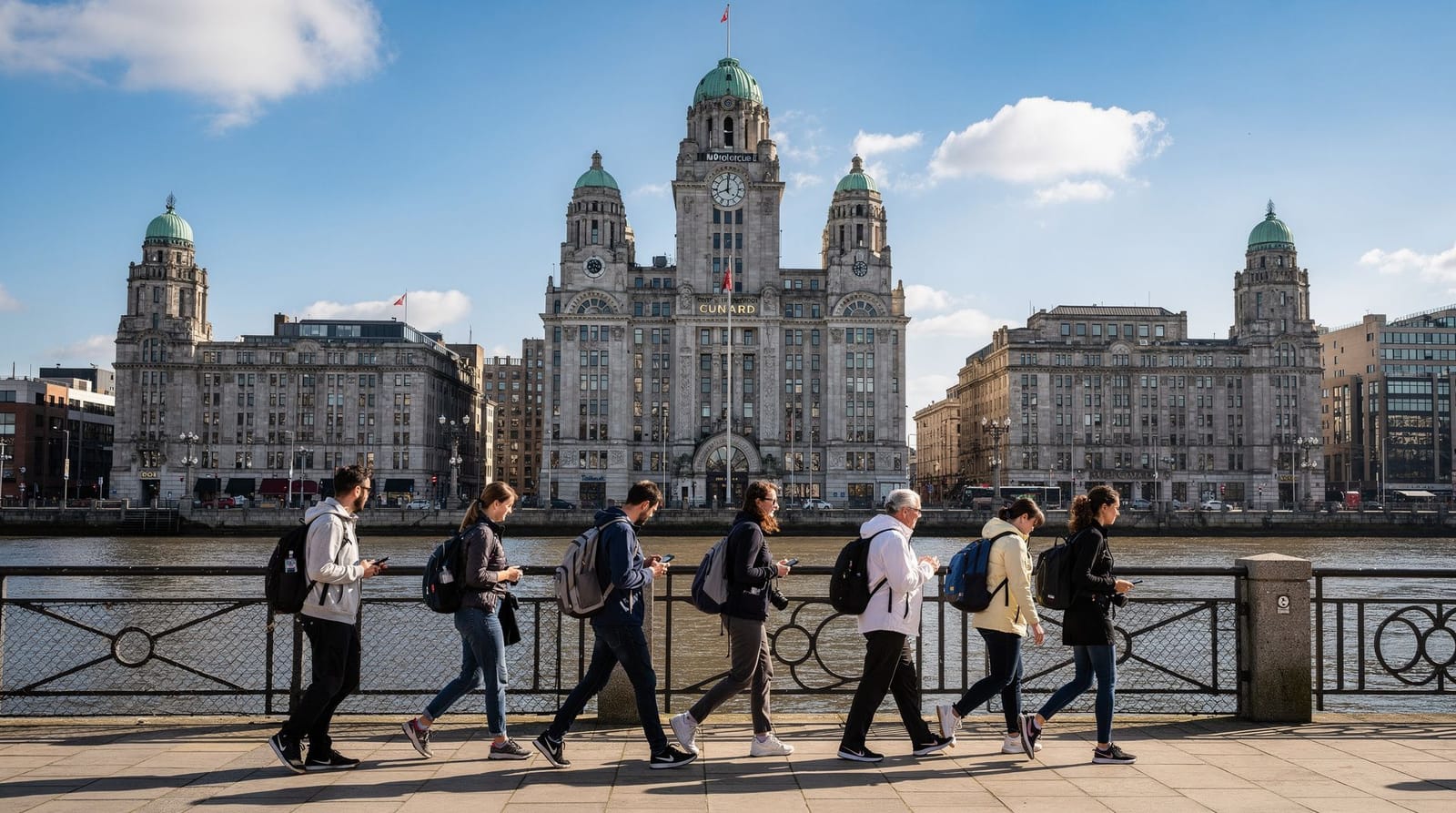
Liverpool: Heritage, History & Culture Guided Walking TourThe broadest of the general tours, covering the waterfront’s Three Graces (the Royal Liver Building, Cunard Building and Port of Liverpool Building), the docks’ trading history, and the city’s cultural evolution through to its 2008 European Capital of Culture year. Runs around 2-2.5 hours for roughly £15-20 and is the best single option for a first-time visitor who wants Liverpool’s full story rather than a single thread of it.
The route typically continues beyond the waterfront into the city centre proper, taking in the Georgian Quarter around Rodney Street — sometimes nicknamed the city’s “Harley Street” for its historic concentration of doctors’ consulting rooms in handsome 18th and 19th-century townhouses — before finishing near the main shopping and cultural district. This gives a genuinely rounded picture of Liverpool’s architecture across two very different eras, maritime Edwardian grandeur at the waterfront and refined Georgian domesticity a short walk inland.
Every walking route on the waterfront points at the same three buildings from ground level, and only one of them can be entered and climbed: a Royal Liver Building 360° tower tour supplies the view down onto the route you have just walked.
Liverpool: Guided City Walking Tour Liverpool: Guided City Walking Tour
A more general orientation walk through the city centre, useful if you want a lighter introduction before deciding which specific sights (Beatles sites, football stadiums, museums) to prioritise with your remaining time. This is a reasonable starting point if you’re only in Liverpool for a single day and want your bearings quickly, and it typically runs a little shorter than the full Heritage, History & Culture tour, making it a better fit if your schedule is tighter than a full 2-2.5 hour commitment allows.
Liverpool: City Highlights Walking Tour
Liverpool: City Highlights Walking TourSimilar in structure but built around a “greatest hits” route of Liverpool’s most photographed spots — the waterfront, the Cavern Quarter’s exterior (without going deep into Beatles history), and the main shopping and cultural streets. Good for visitors who want efficient sightseeing coverage over deep historical narrative, or who are combining the walk with a lot of photography and want the route optimised for that rather than for lingering at any single stop.
Private guided walking tours
Liverpool: Private Guided Walking TourFor families, small groups, or anyone with a specific angle they want the walk built around — architecture, dock history, a particular era — a private guide lets you set the pace and skip or dwell on sections as you like. Expect to pay several times the per-person price of a group tour, which is worth it for groups of three or more splitting the cost, less so for a solo traveller on a budget.
A private guide is also the practical choice if you have specific accessibility needs, since the route and pace can be adjusted on the day rather than fixed to a published group itinerary — worth discussing directly with the operator when booking if step-free access or a slower walking pace is a requirement.
Which tour to actually pick
For most first-time visitors, the Heritage, History & Culture tour gives the best overall picture of Liverpool beyond its music and football fame — it’s the one to book if you’re only doing one general walking tour. If your time in Liverpool is genuinely limited to a couple of hours, the City Highlights tour or the general Guided City Walking Tour cover more ground per minute with less depth. Save the dedicated Beatles walking tours (covered separately) for a second pass if the band’s history is your main draw — trying to combine both into a single tour usually means neither gets proper attention.
Accessibility of tour meeting points
Most walking tour meeting points sit within a short, flat walk of Lime Street station or the waterfront’s main transport links, and operators typically confirm exact meeting locations by email after booking, worth checking the day before to avoid last-minute confusion in a city centre with several similarly named streets and squares. If you’re arriving by train with luggage, most meeting points don’t offer left-luggage facilities directly, so plan for either a station locker at Lime Street or travelling light for the duration of the tour.
Budgeting a walking tour
At roughly £15-20 per adult for the main group tours, Liverpool’s walking tours are priced comparably to Chester’s own guided options and represent solid value against 2-2.5 hours of curated content covering multiple distinct neighbourhoods. Private tours run several times the group rate but are charged per group rather than per person, so for three or four people travelling together, the per-person cost can actually undercut booking multiple individual seats on a group tour, while giving you full control over pacing and focus.
The Three Graces up close
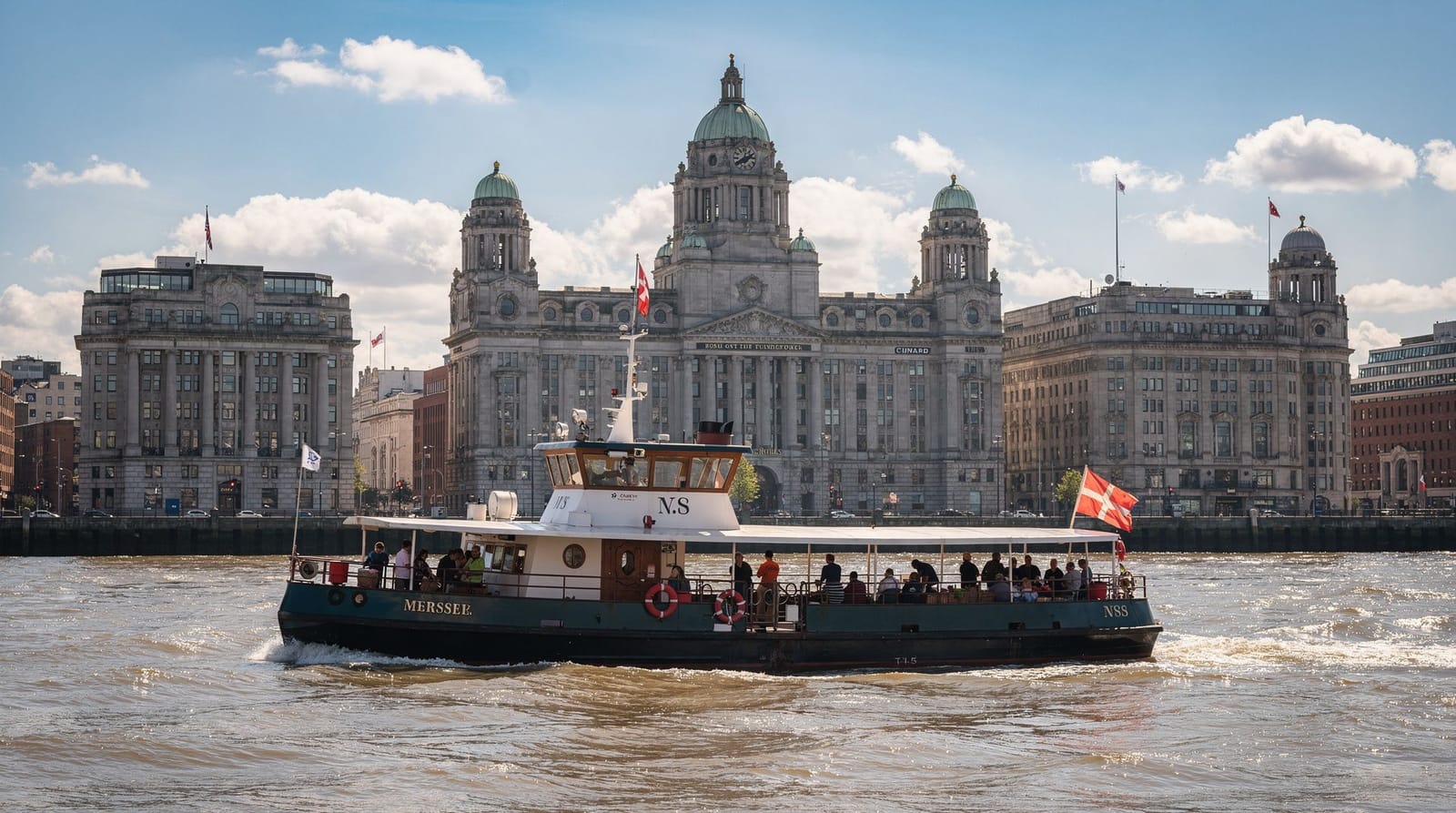
The waterfront’s Three Graces — the Royal Liver Building, the Cunard Building and the Port of Liverpool Building — anchor almost every general heritage tour, and it’s worth knowing a little about each before you arrive. The Royal Liver Building, completed in 1911, is topped by the two Liver Birds that have become Liverpool’s unofficial civic symbol, one famously said to watch over the sea for sailors’ safe return and the other over the city itself.
The Cunard Building once housed the offices of the Cunard shipping line, whose transatlantic liners made Liverpool one of the world’s great departure ports for emigration to America, while the Port of Liverpool Building reflects the more purely administrative, bureaucratic side of the docks’ operation. Seeing all three together, and understanding the different roles they played in the city’s maritime heyday, is a large part of what a good waterfront-focused tour delivers that simply photographing the skyline from a distance doesn’t.
How tour operators differ
Liverpool’s walking tour market has a genuine spread of operators, from long-established heritage-focused companies with formally trained guides to smaller, more informal outfits run by local enthusiasts. Reviews and specific guide credentials are worth checking before booking, particularly for the more specialist or story-driven tours, since quality can vary more between operators covering similar routes than the route itself would suggest. Group size also varies meaningfully — some operators cap tours at a dozen or so participants for a more personal experience, while others run larger groups that trade intimacy for a lower per-person price; check group size if that affects your preference.
Common mistakes to avoid
Getting to Liverpool from Chester
The train from Chester to Liverpool Lime Street runs regularly and takes around 45 minutes, typically with one change at Runcorn or Hooton depending on the specific service. Most walking tours start within a 10-15 minute walk of Lime Street, making this a comfortable half-day or full-day trip without needing a car. If you’re planning a longer stay, our Chester-to-Liverpool day trip guide covers the full train timetable and connection details, and our Chester-Liverpool weekend itinerary builds a full two-day plan around both cities.
Driving is also an option, roughly 45 minutes to an hour depending on traffic on the M53/M56 corridor, but Liverpool’s city centre car parks are considerably pricier than a train ticket once you account for a full day’s stay, and the train drops you within easy walking distance of most tour meeting points in a way that avoids city-centre driving and parking search time altogether. For a day trip specifically built around walking tours, the train is the more practical choice for most visitors.
Is it worth doing versus exploring Liverpool unguided
Liverpool’s waterfront and city centre are safe, well-signposted and easy to explore independently, so a guide’s value is squarely in the storytelling and context rather than navigation or safety. The Georgian Quarter and the docks’ trading history in particular benefit from a guide who can point out details (which buildings are original Georgian versus later reconstructions, what specific cargo moved through which dock) that aren’t obvious from information boards alone.
Where you can reasonably skip a guided tour: if you’ve done a similar heritage walking tour in another major British port city, or if you’re mainly here for a single specific sight (an Anfield stadium tour, the Beatles Story) and don’t have time to spare on a broader city overview.
Families and accessibility
Liverpool’s walking tours are generally well suited to families with children old enough to walk 2-3km at a relaxed pace and sit through history-focused narration without losing interest — realistically, upper primary age and older. The routes are flat throughout, a genuine advantage over Chester’s stairs and uneven medieval stonework, though cobbled sections around the historic dock areas require sturdy footwear and can be uncomfortable for pushchairs without decent suspension.
Wheelchair users will find Liverpool’s waterfront and city centre considerably more accessible than Chester’s walled core, since the modern regeneration of the docks was built with contemporary accessibility standards in mind. That said, standard group tours follow a fixed route and pace, so anyone needing a slower speed or specific stops should consider the private guide option, which allows the itinerary to flex around individual needs rather than a fixed group schedule.
What surprises first-time visitors
Visitors who arrive expecting Liverpool to be defined purely by the Beatles are often surprised by the scale and seriousness of the maritime and slave-trade history covered on a general heritage tour — the International Slavery Museum and the docks’ broader trading history make up a substantial, sobering thread that a good guide won’t shy away from. Equally, visitors who expect a small, provincial city are often struck by the genuine scale of the Georgian Quarter and the waterfront’s Edwardian architecture, both of which speak to a city that was, for a significant historical stretch, genuinely among the wealthiest and most globally connected in Britain.
When to go
Liverpool’s walking tours run year-round, with June to September offering the longest daylight and most comfortable walking conditions along the exposed waterfront. Winter tours still run but expect a shorter, brisker walk given daylight and weather — bring a proper waterproof, as the Mersey waterfront gets genuinely windy and wet weather blows in off the estuary with little warning.
Liverpool also hosts a busy events calendar that affects tour demand and city-centre crowding beyond simple seasonality — matchdays for Liverpool FC or Everton bring large crowds and higher hotel demand, while the Liverpool International Music Festival and other summer events can also affect availability. If you’re planning around a specific tour slot, check the local events calendar for your travel dates rather than assuming a typical weekday will be quiet.
Combining a walking tour with the rest of Liverpool
A history and heritage walking tour pairs naturally with the Museum of Liverpool or the Merseyside Maritime Museum at the Royal Albert Dock afterward, both of which expand on themes the tour introduces at street level. It also works well alongside a Mersey Ferry cruise, giving you the same waterfront from land and water on the same day. For visitors staying longer or specifically drawn by the band, follow up with a dedicated Beatles walking tour or the Cavern Club on a second day, or fold it all into our Beatles Liverpool day trip itinerary.
A workable single-day plan from Chester: take an early train to arrive by mid-morning, join a Heritage, History & Culture tour to get oriented across the waterfront and Georgian Quarter, have lunch around Bold Street, then spend the afternoon on either a football stadium visit or the Beatles sites depending on your priorities, finishing with a Mersey Ferry cruise before the return train if time allows. This sequencing covers Liverpool’s general history, food scene and one specific interest all within a single well-planned day trip.
The Georgian Quarter in more depth
The Georgian Quarter around Rodney Street is one of the parts of Liverpool that surprises first-time visitors most, since it doesn’t fit the maritime, industrial image the city’s tourism marketing often leads with. Rows of handsome 18th and 19th-century townhouses, many with original features intact, once housed the city’s professional classes — doctors, lawyers, merchants — and the area retains a genuinely different architectural character from either the waterfront’s Edwardian grandeur or the city centre’s more mixed, modern streetscape.
A good heritage tour will point out specific buildings of note, including the birthplace of some notable historical figures associated with the street, and explain how this residential quarter relates to the wealth generated by the docks a short walk away. Visitors with a specific interest in Georgian architecture sometimes extend their walking tour independently afterward, since the quarter rewards a slower, self-guided second pass once you know what you’re looking at.
Practical tips
- Wear comfortable, flat shoes — routes are flat but cover 2-3km, and cobbled sections around the docks can be uneven.
- Bring a waterproof layer regardless of season; the waterfront is exposed and Mersey weather changes quickly.
- Book ahead for weekend and summer slots, when the more popular general tours can fill up.
- If you only want a taste before committing to a paid tour, the Royal Albert Dock and Pier Head areas are freely walkable and give a strong first impression of the waterfront on their own.
- Combine with a stadium tour (Anfield or Everton’s Hill Dickinson Stadium) if football is part of your Liverpool visit — most walking tours don’t cover the stadiums, which sit outside the compact city centre; see our Liverpool football guide for planning both in one trip.
- Read the tour description carefully before booking — general history and Beatles-specific tours are separate products that don’t substitute for each other.
- Consider a private guide if travelling with a group of three or more, or if specific accessibility needs mean a fixed group pace doesn’t suit you.
Tourist-trap check
Liverpool’s established walking tour operators are generally reputable, priced comparably across similar products, and reviewed extensively online, so outright scams are uncommon. The one area to watch is unsolicited “free tour” offers approached in person near the waterfront by individuals not affiliated with a recognised operator — these sometimes pressure a large tip at the end regardless of quality. Booking a tour in advance through a recognised platform avoids this entirely and lets you compare reviews and pricing before committing.
Liverpool’s general history and heritage walking tours are the right starting point for understanding the city beyond its most famous exports — a genuinely rewarding couple of hours that sets up whatever more specific interest (music, football, maritime history) brings you back for a second visit.
Frequently asked questions about Liverpool walking tours
How is a Liverpool history walking tour different from a Beatles walking tour?
General history and heritage tours cover Liverpool's full story — its rise as the British Empire's second port, the transatlantic slave trade's uncomfortable legacy, Georgian architecture, the Blitz, and 20th-century regeneration — while Beatles-specific tours focus narrowly on band history, childhood homes and the Cavern Quarter. Many first-time visitors do one of each on separate days.How long does a Liverpool walking tour take and how much walking is involved?
Most guided tours run 2-2.5 hours and cover 2-3km at a relaxed pace, taking in the waterfront, city centre streets and sometimes the Georgian Quarter around Rodney Street. It's flat, easy walking throughout — Liverpool's centre has none of Chester's stairs or narrow medieval passages.Is a private walking tour of Liverpool worth the extra cost?
A private guide is worth it for families, small groups wanting flexibility on pace and stops, or anyone with specific interests (architecture, music history, dock heritage) they want the tour tailored around. For a first-time solo visitor or couple on a standard budget, a group tour covers the essentials at a fraction of the price.Can you do a Liverpool walking tour as a day trip from Chester?
Yes — the train from Chester to Liverpool Lime Street takes around 45 minutes, usually with one change, making a half-day or full-day walking tour a comfortable day trip. Most tours start within a 10-15 minute walk of Lime Street station.Is Liverpool safe and easy to walk around unguided?
Liverpool's city centre and waterfront are well-trodden, well-lit tourist areas that are straightforward and safe to explore independently during the day, using normal city-centre common sense. A guide's value here is context and storytelling, not personal safety.What should I wear for a Liverpool walking tour?
Comfortable, flat shoes and a waterproof layer regardless of season — routes are flat but cover 2-3km, cobbled sections around the docks can be uneven, and the waterfront is exposed to wind and sudden weather changes off the Mersey estuary.
Top experiences
Bookable activities with verified prices and instant confirmation on GetYourGuide.