Betws-y-Coed
Betws-y-Coed is Eryri's Victorian gateway village -- waterfalls, forest trails and a heritage railway junction, about 75 minutes from Chester.
Betws-y-Coed: Underground Caving Adventure in Snowdonia
Quick facts
- County
- Conwy, inside Eryri (Snowdonia) National Park
- Nearest station
- Betws-y-Coed, on the Conwy Valley Line
- From Chester
- ~1h15 by car; ~1h45-2h by train with a change at Llandudno Junction
- Entry cost
- Free village; paid parking at Swallow Falls and Zip World
- Population
- ~560
Is Betws-y-Coed worth a day trip from Chester? Yes, if you want a taste of Eryri (Snowdonia) without committing to a full hiking day — the village sits at the meeting point of three rivers, has a genuine waterfall within a 15-minute walk of the car park, and connects onward to Zip World, Llangollen and Conwy without much extra driving. It’s not a destination to build a whole holiday around, but as a two-to-four-hour stop on a North Wales loop it earns its place.
| Where | Eryri (Snowdonia) National Park, Conwy county |
| Cost | Free village; £2 Swallow Falls, £25-55 Zip World Fforest |
| Time needed | Half a day to a full day |
| Getting there | ~1h15 by car; ~1h45-2h by train via Llandudno Junction |
| Best time | May-September, weekdays if possible |
A Victorian resort built at the meeting of three rivers
Betws-y-Coed grew from a scattered farming parish into a tourist village during the Victorian era, after painters and later the Chester and Holyhead Railway (the line that eventually became the Conwy Valley Line) put it on the map as the “gateway to Snowdonia.” The name means roughly “prayer house in the wood,” a reference to St Michael’s Old Church, a 12th-century building that still stands beside the River Conwy on the edge of the village — worth the five-minute detour for the 500-year-old stone effigy inside, even if you skip everything else.
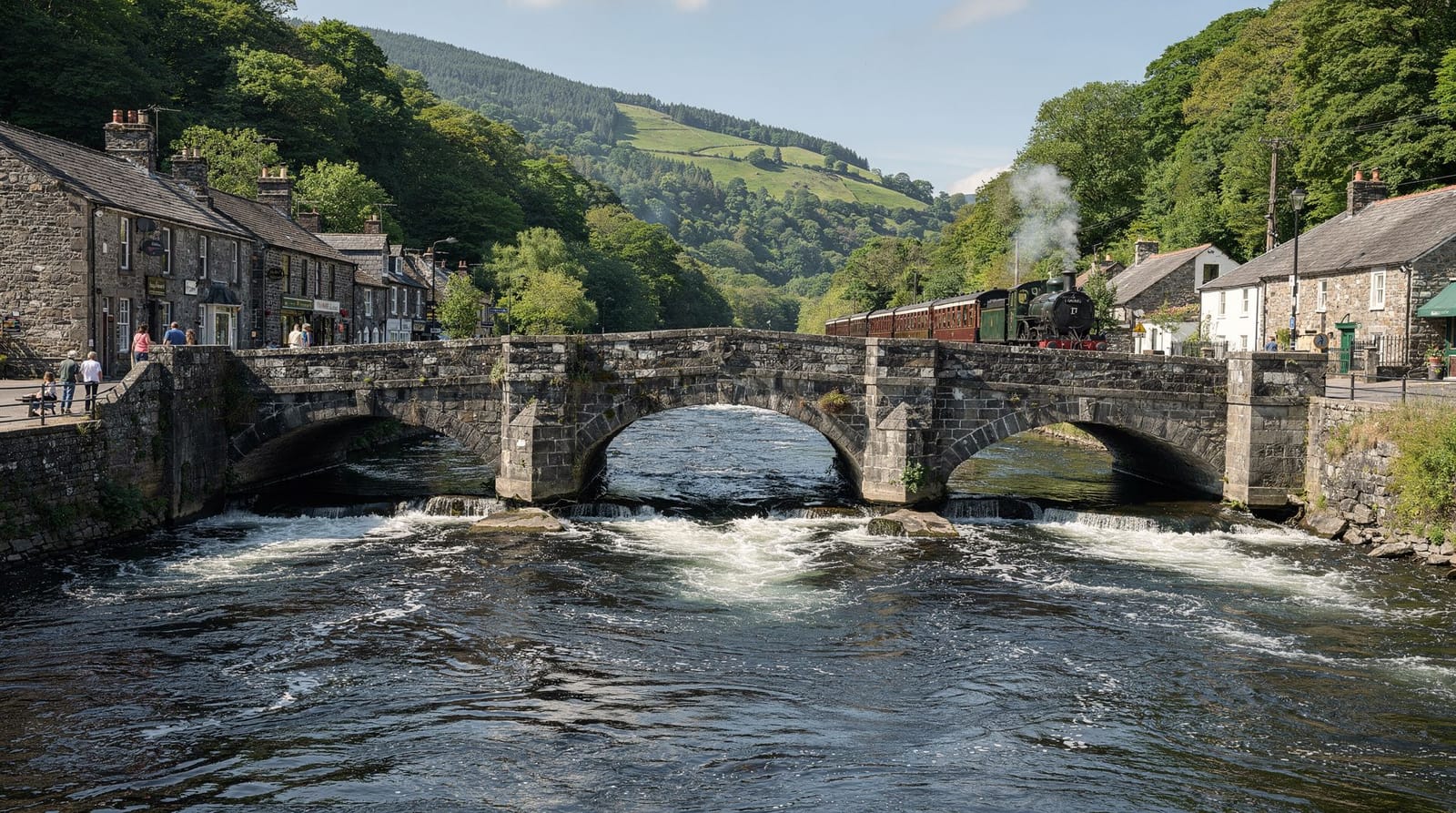
The village itself sits at the confluence of the Afon Conwy, Afon Llugwy and Afon Lledr, which is why it feels surrounded by water on every approach. Pont-y-Pair (“bridge of the cauldron”), a 15th-century stone bridge over a series of rock pools and small falls, is the most photographed spot in the centre and a genuinely good free stop — locals still swim in the pools below it on hot days, though the rocks are slick and a few serious injuries happen most summers, so treat it with more caution than the postcard shots suggest.
Getting to Betws-y-Coed from Chester
By car, it’s roughly 45 miles via the A55 and A470, taking about an hour to an hour and fifteen minutes depending on traffic through Llandudno Junction. Parking in the village (Trefriw Road car park or the National Park car park by the station) costs around £5-6 for the day.
By train, there’s no direct service. The standard route is Chester to Llandudno Junction (around 35-45 minutes, sometimes with a change), then the Conwy Valley Line south to Betws-y-Coed (about 30 minutes) — total journey time is usually 1h45-2h with the connection wait, and a single adult fare is typically £16-20.
The Conwy Valley Line itself is a scenic reward in its own right, running through the Fairy Glen gorge before reaching the village. Check times before travelling: this line has a patchy history of weekend engineering work and reduced winter frequency, so a same-day return isn’t guaranteed to run to the advertised timetable — confirm on National Rail the morning you travel rather than relying on a schedule looked up weeks earlier.
Swallow Falls and the river walks
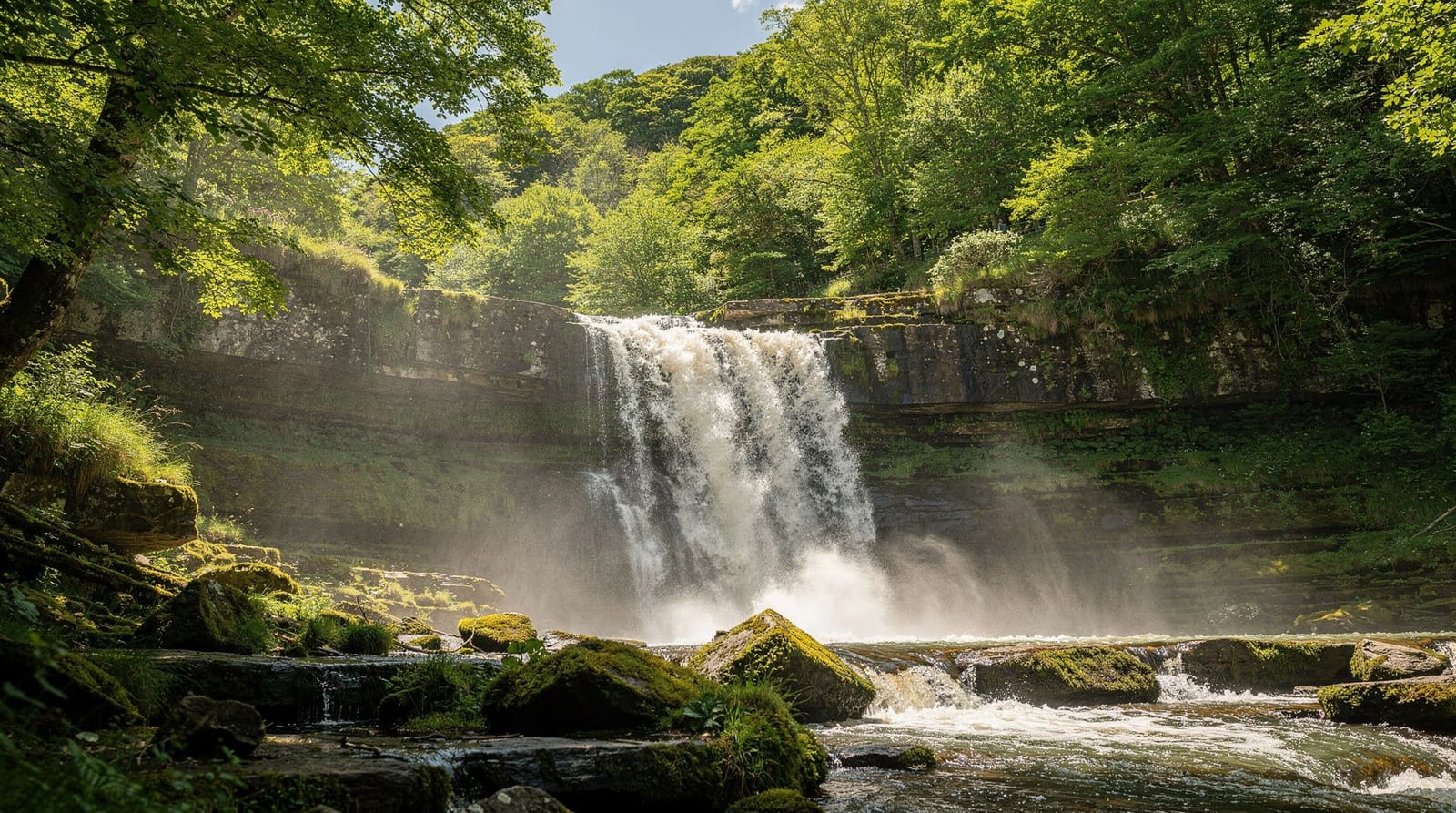
Swallow Falls (Rhaeadr Ewynnol), about a mile and a half west of the village on the A5, is the reason most people stop here. It’s a genuine series of cascades dropping through a wooded gorge, viewable from a short paid path (£2 in an honesty box or card machine at the entrance) that takes 10-15 minutes round trip. It photographs better in spring and after rain, when the flow is strongest — in a dry August it can look a lot less dramatic than the postcards suggest, which is worth knowing before you plan a special detour purely to see it.
For longer walks, the riverside path from the village centre up to the Miners’ Bridge (about 2 miles round trip) follows the Afon Llugwy through oak woodland and is manageable for most fitness levels. The Gwydir Forest, immediately north and east of the village, has waymarked trails through old lead-mining country, including short loops to the abandoned Parc mine workings — interesting if you like industrial archaeology, though the mine shafts themselves are fenced off and not safe to explore.
Zip World, caving and the adventure crowd
Zip World Fforest, on the edge of the village, runs the Fforest Coaster (an alpine-style mountain coaster through the trees) and a network of zip lines and rope courses aimed at families and thrill-seekers alike — prices run from around £25 for the coaster to £45-55 for the longer zip circuits, and it’s worth booking ahead in summer as slots sell out by late morning.
For something less well known, there’s an underground caving route through old mine workings near the village:
Betws-y-Coed underground caving adventure in Snowdoniatakes small groups through disused slate and lead workings with headlamps and full kit provided — a genuinely different way to see the area’s mining history rather than just reading a plaque about it. If you’re using Betws-y-Coed as a base for tackling Yr Wyddfa (Snowdon) itself, guided sunrise hikes depart from nearby trailheads:
Snowdonia guided Snowdon (Yr Wyddfa) sunrise hikeis a realistic option if you’re staying in the area overnight rather than day-tripping, since a sunrise start from Chester isn’t practical given the drive time.
Walking routes in more detail
Beyond the short walk to Miners’ Bridge, the Snowdonia Society-maintained path to Llyn Elsi, a small reservoir in the hills above the village, makes a proper half-day walk of around 5 miles round trip through mixed woodland with a genuine summit-style payoff — a quiet lake with views back down toward the village and, on a clear day, across to the higher Carneddau range. It’s steep in places and not signposted as heavily as the riverside paths, so a paper map or offline GPS route is worth carrying rather than relying on phone signal, which is patchy in the forest.
For a shorter option that still gets you properly into woodland rather than just along the road, the Fairy Glen (Ffos Anoddun), a narrow, dramatic gorge on the Afon Conwy about a mile south of the village, is reachable via a short path from a small car park, with the river visibly compressed into a chasm barely a few metres wide in places. It’s less visited than Swallow Falls, partly because there’s no dedicated visitor infrastructure — just a stile, a path and the gorge itself — which some visitors will actually prefer.
The Gwydir Forest walks mentioned earlier extend further than the short loop to the old mine workings: waymarked trails of 3, 5 and 8 miles fan out from car parks on the Trefriw road, taking in old slate quarries, forestry plantation and occasional clearings with views toward the Conwy Valley. None of these require technical hiking skill, but sturdy footwear and a rain layer are sensible any time of year — this is genuinely one of the wetter corners of Wales, with average rainfall considerably higher than Chester or the coast.
What locals recommend versus what the coach tours stop at
Ask people who actually live in or near Betws-y-Coed what they’d send visitors to, and Swallow Falls is usually near the bottom of the list, not the top — it’s the coach-tour default because it’s easy to access and quick to photograph, not necessarily the most rewarding stop. Locals more often point newcomers toward the Fairy Glen, the walk to Llyn Elsi, or simply the town bridge and river pools at Pont-y-Pair, all of which cost nothing and see a fraction of the crowds.
That’s not a reason to skip Swallow Falls entirely — it’s a genuine waterfall and worth the modest entry fee if you’re passing anyway — but it’s worth knowing that the “famous” stop isn’t necessarily the best one, and building in at least one of the quieter walks will usually make for a better half-day than ticking off only the well-signposted attractions.
A practical budget for the day
A realistic half-day budget per adult, on top of transport, runs roughly: £2 for the Swallow Falls path, £5-6 for parking if driving, £8-12 for a pub lunch, and £25-55 if adding Zip World Fforest. A full day with the caving experience or a guided Snowdon hike adds considerably more (£60-100+ per person), so decide in advance whether this is a low-cost nature stop or a paid-activity day, since the two budgets look very different.
The Harry Potter myth, and what’s actually true here
Ask around and you’ll hear Betws-y-Coed or the wider Eryri area described as a Harry Potter filming location. It isn’t, and this is worth clearing up rather than playing along with for the sake of a good headline: the Harry Potter films were shot almost entirely in England and Scotland (Alnwick Castle, Glenfinnan, Goathland, Oxford’s colleges), with no confirmed Eryri scenes.
What Eryri and North Wales genuinely have is a real, well-documented cinematic history of their own — the 1960s cult series The Prisoner was filmed at Portmeirion, half a day’s drive south of here, and the region’s dramatic scenery has stood in for fantasy and historical epics on several occasions, including scenes for Clash of the Titans (2010) around the Ogwen Valley further north. If film locations are the draw, Portmeirion is the honest answer for this corner of Wales, not a Potter myth.
Where to eat and where it gets crowded
The village centre has a handful of solid options: Alpine Coffee Shop for a proper flat white and cake before a walk, and the Pont-y-Pair Inn or Royal Oak for a pub lunch. Don’t expect fine dining — this is a walkers’ village, and the food reflects that (hearty, reasonably priced, not fussy).
The honest warning: Swallow Falls’ car park fills by mid-morning on any dry summer weekend, and the coach-tour buses that stop briefly at the falls can make the short path feel like a queue rather than a nature walk for 20 minutes at a time. If you can visit on a weekday, or arrive before 10am, you’ll get a much better experience of what is otherwise a lovely, low-key spot.
Accessibility notes
The village centre and the paths immediately around Pont-y-Pair are relatively flat and manageable for pushchairs and most mobility needs, but Swallow Falls’ viewing path involves steps and uneven surfaces, and the Llyn Elsi and Fairy Glen walks are not suitable for wheelchairs or standard pushchairs. Zip World Fforest has its own accessibility guidance for specific activities, worth checking in advance if mobility is a factor for anyone in your group, since some of the zip line and coaster experiences have physical requirements.
Combining Betws-y-Coed with the rest of North Wales
Betws-y-Coed works best as one stop on a longer loop rather than a solo destination. It sits roughly equidistant between Conwy and Llangollen, and close to the string of castles and railways that make up the wider North Wales itinerary. If you’re driving, Swallow Falls, Zip World Fforest and Betws-y-Coed village can realistically be combined with a stop in Conwy or a visit to the Snowdon Mountain Railway in one long day from Chester, though it’s a full day rather than a relaxed one.
For structured planning, the 3-day Chester and North Wales itinerary and the Snowdonia adventure itinerary both build Betws-y-Coed in as a stop rather than the sole focus. See also the main Snowdonia destination guide and the North Wales overview for the wider region, plus the Conwy and Llangollen pages for the towns either side.
For deeper reading on the specific activities mentioned above, see the Zip World guide, Snowdon hiking routes, Snowdonia waterfalls guide and heritage railways of North Wales.
If you’re relying on public transport, the Chester to North Wales day-trip guide and best day trips by train cover the realistic timings in more detail than a single village page can. And for the film-location question properly answered, read Harry Potter and North Wales: what’s actually true.
Best months to visit
| Months | Conditions | Notes |
|---|---|---|
| May-Jun | River paths full, fewer crowds than peak summer | A good balance before school holidays |
| Jul-Aug | Warmest, busiest | Weekday visits strongly recommended; Swallow Falls fills fast |
| Sep | Mild, quieter | Rivers still flowing well after summer |
| Oct-Apr | Wet, sometimes very wet | Dramatic waterfalls but muddy paths; check for closures after storms |
Photography around the village
Pont-y-Pair is the most reliably photogenic spot regardless of season, but the light works best in the hour after sunrise or before sunset, when the rock pools below the bridge catch a warm glow rather than the flatter midday light most day-trippers see. For Swallow Falls, an overcast day with recent rain photographs better than a bright, dry one — the extra water volume makes a genuine difference to how dramatic the falls look, and cloud cover avoids the harsh contrast between bright sky and dark gorge that a sunny day creates.
Should you stay overnight or day-trip from Chester?
A day trip from Chester works well for a first taste of Betws-y-Coed — the village, Swallow Falls and one or two short walks fit comfortably into an afternoon, and the drive back is manageable even after a full day out. An overnight stay only really earns its keep if Yr Wyddfa (Snowdon) itself is on the agenda: a genuine sunrise start isn’t realistic from Chester given the drive time, so anyone serious about tackling the mountain, rather than just the village and waterfalls, should factor in a night in the area. The Snowdonia adventure itinerary lays out both versions of the trip.
Top experiences
Bookable activities with verified prices and instant confirmation on GetYourGuide.