Llangollen
Llangollen pairs a UNESCO aqueduct and heritage canal with a hilltop castle ruin and steam railway, about 40 minutes from Chester by car.
Llangollen: Pontcysyllte Aqueduct Kayak or Canoe Cruise
Duration: 2.5 hours
Quick facts
- County
- Denbighshire, North Wales
- UNESCO site
- Pontcysyllte Aqueduct and Llangollen Canal (inscribed 2009)
- From Chester
- ~40 minutes by car; no direct train, nearest station is Ruabon then a short bus or taxi
- Canal boat trips
- From around £10 per adult for a short horse-drawn trip
- Population
- ~3,600
Is Llangollen worth visiting from Chester? Yes, and it’s underrated compared with the North Wales coast towns — a genuine UNESCO World Heritage aqueduct, a heritage steam railway, a ruined hilltop castle and a walkable canal town centre all sit within a couple of miles of each other, and it’s less than 40 minutes’ drive from Chester. The lack of a direct train is the main practical downside.
| Where | Dee Valley, Denbighshire, ~22 miles from Chester |
| Cost | Free to walk town/aqueduct; £10-26 for boats, railway or houses |
| Time needed | Half a day to a full day |
| Getting there | ~40 min by car; no direct train, bus via Ruabon |
| Best time | April to October for boats and the full railway timetable |
A small town built around water, not the sea
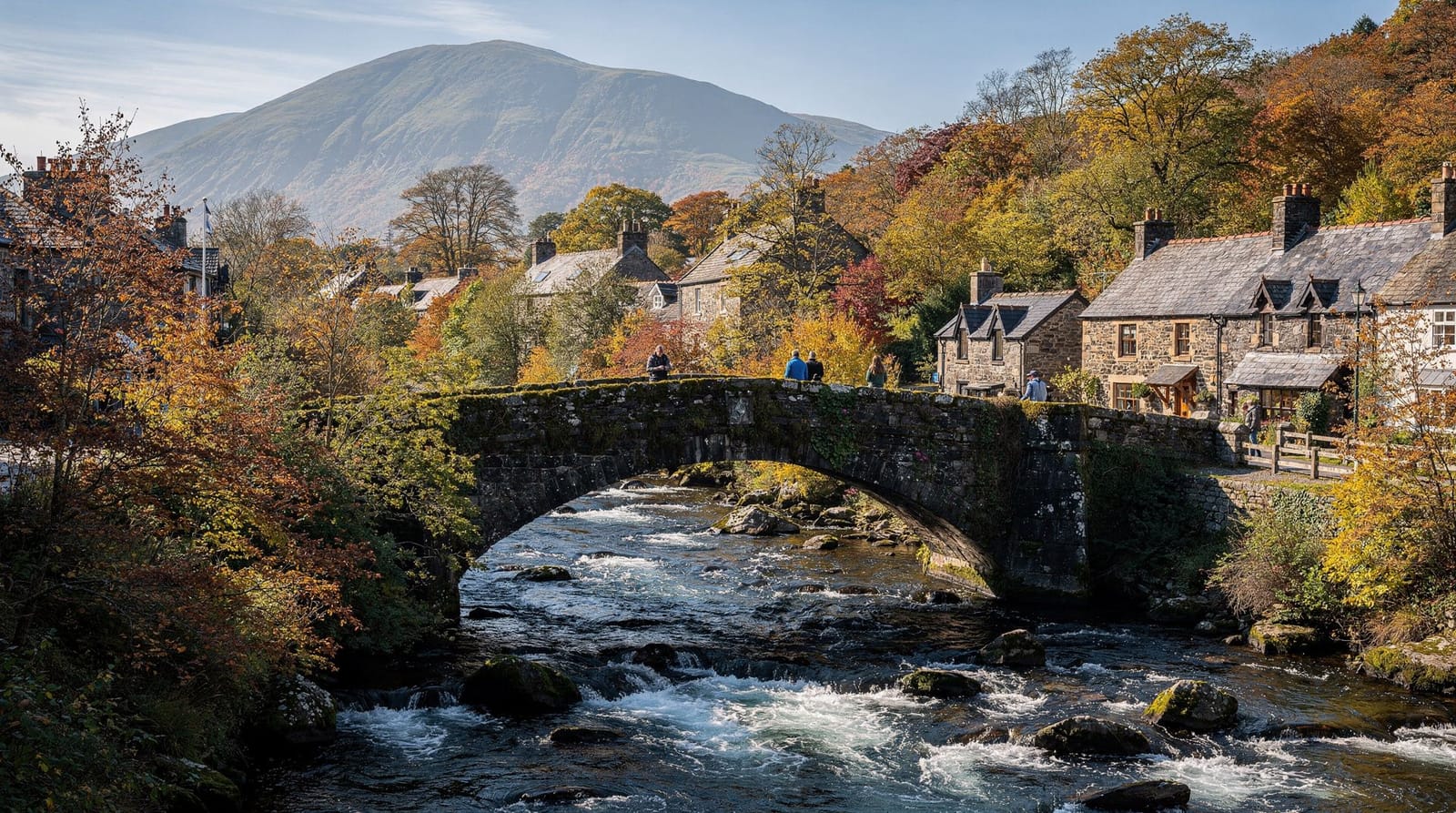
Llangollen sits in the Dee Valley (Dyffryn Dyfrdwy), where the River Dee, still a young, fast-flowing river here compared with the wide tidal estuary it becomes back at Chester, runs through a stone bridge dating to the 14th century (with later rebuilding). The town’s name comes from St Collen, a 7th-century hermit whose church still stands at its centre. Unlike the coastal resorts further north, Llangollen never built itself around Victorian seaside tourism — its draw has always been the canal, the valley, and later the railway and international festival that put it on the cultural map.
The single best free thing to do here is simply walk the town bridge, follow the Dee downstream a short way to see Horseshoe Falls (a curved weir built in 1808 by Thomas Telford to feed the Llangollen Canal, not a natural waterfall but an elegant piece of engineering worth the 2-mile round-trip walk from town), and then loop back via the canal towpath.
Pontcysyllte Aqueduct: the reason most people come
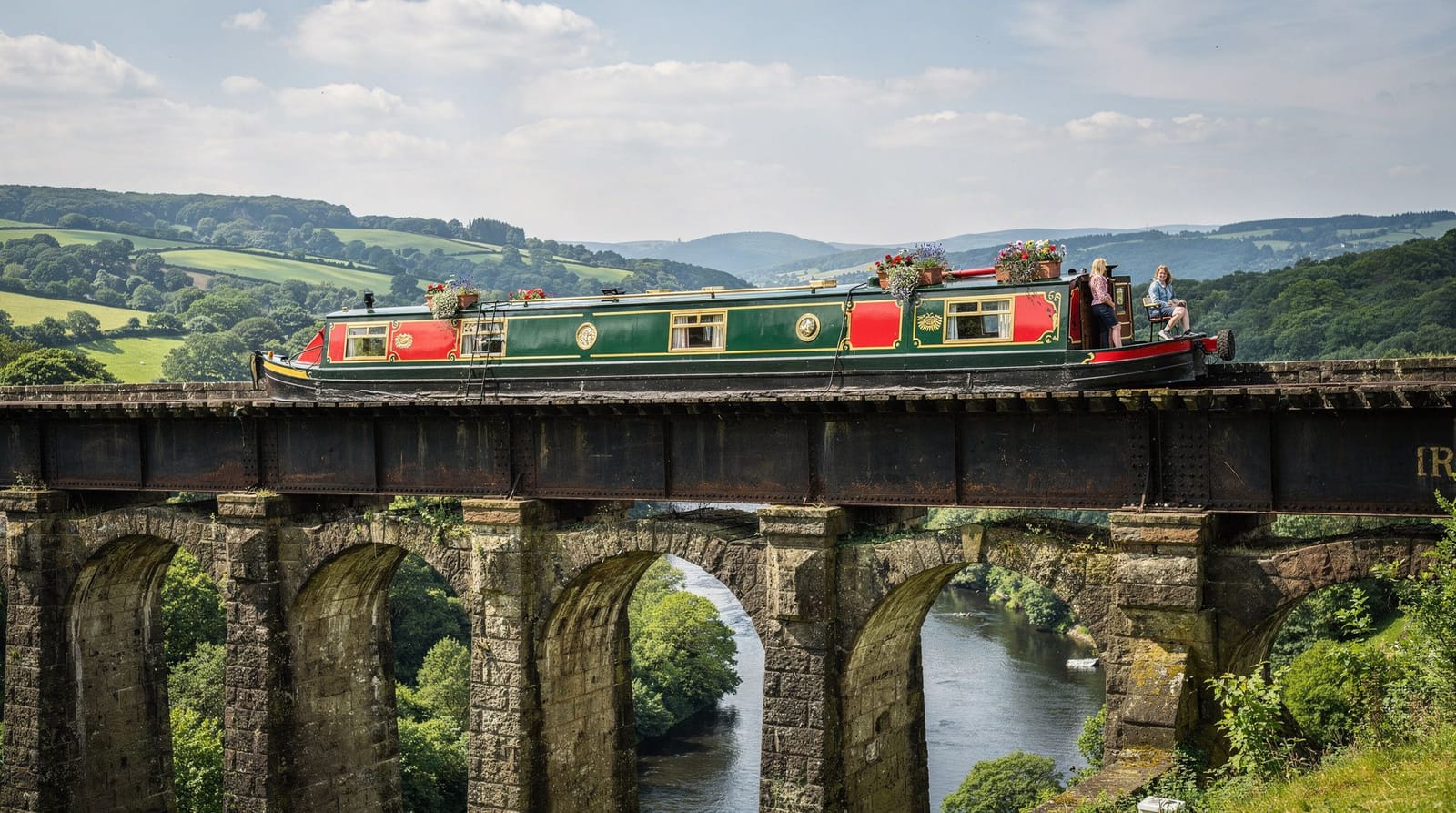
The Pontcysyllte Aqueduct, about 4 miles east of Llangollen at Trevor, carries the Llangollen Canal 126 feet above the River Dee on 18 stone piers and a cast-iron trough — at 307 metres it’s the longest and highest navigable aqueduct in Britain, engineered by Thomas Telford and William Jessop and completed in 1805.
UNESCO inscribed the aqueduct and 11 miles of surrounding canal as a World Heritage Site in 2009, and it remains one of the few places in the UK where you can walk across an open cast-iron trough with a narrowboat gliding past a few feet away and an 18-storey drop on one side (there’s a footpath with a railing on one side only — the towpath side is safe, the canal side is genuinely a sheer drop, so keep an eye on children here).
Walking across is free. For something more memorable than looking at it, paddling across is the better option:
Llangollen aqueduct kayak or canoe cruise from Trevorputs you on the water itself, crossing the aqueduct at water level rather than from the towpath above — a genuinely different perspective on a structure most visitors only see from above. A more structured, guided version is also available:
Guided Pontcysyllte Aqueduct canoe tourwhich suits first-time paddlers who want instruction rather than a self-guided rental. Both operate seasonally (roughly April to October) and are worth booking a few days ahead in summer.
Castell Dinas Bran: the hilltop ruin most visitors miss
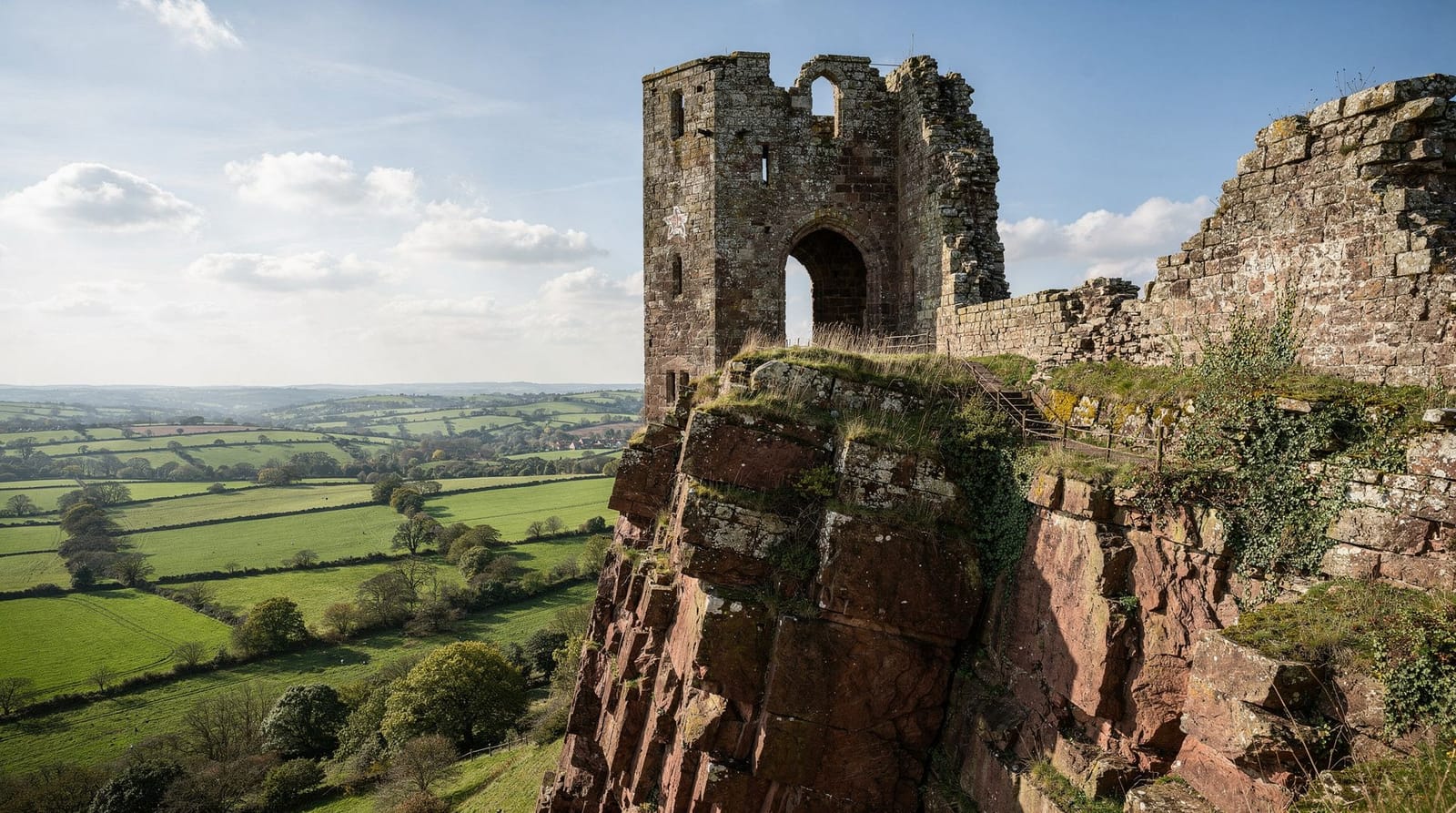
Above the town, on a steep conical hill, sit the ruins of Castell Dinas Bran, a 13th-century Welsh castle built by the princes of Powys Fadog and abandoned within a few decades of construction. There’s no entry fee and no visitor centre — just a genuinely steep 45-60 minute walk up from town (steeper than it looks from below; wear proper shoes, not sandals) rewarded with one of the best panoramic views in this part of Wales, taking in the whole Dee Valley and, on a clear day, the coast. It’s the kind of spot the coach tours skip entirely because there’s nothing to sell at the top, which is exactly why it’s worth the climb if you’re reasonably fit.
Llangollen Railway and the canal boats
The Llangollen Railway is a heritage standard-gauge steam line running roughly 10 miles from Llangollen station to Corwen, staffed largely by volunteers and using restored steam and diesel locomotives. A return ticket runs around £22-26 for adults depending on the service, with reduced-frequency running in winter (worth checking the timetable before travelling, as it doesn’t run daily outside peak season).
For a shorter and gentler experience, horse-drawn canal boat trips depart from the wharf in the town centre along a short, calm stretch of the Llangollen Canal — a 45-minute trip costs around £10-12 per adult and is a genuinely relaxed way to see the canal without any exertion, popular with families and older visitors.
Valle Crucis Abbey and Plas Newydd
A mile and a half north of the town centre, Valle Crucis Abbey is a genuinely evocative ruin of a Cistercian monastery founded in 1201, with substantial standing walls, a rose window and the roofless chapter house still intact enough to give a real sense of the building’s original scale. Entry is around £5-6 for adults, and it’s rarely crowded even in summer — one of the better-value historic stops in this guide.
In the town itself, Plas Newydd (not to be confused with the National Trust property of the same name on Anglesey) was the home of the “Ladies of Llangollen,” Eleanor Butler and Sarah Ponsonby, two Anglo-Irish women who eloped together in 1778 and lived here for the rest of their lives, turning the house into a celebrated destination for literary and aristocratic visitors of the era, including Wordsworth, Byron and the Duke of Wellington. The house, remodelled in a distinctive Gothic style with elaborately carved oak panelling collected from across Europe, is now a small museum (entry around £6-7) and one of the more unusual historical stories attached to any Welsh town of this size.
The International Musical Eisteddfod
Llangollen’s single biggest annual event is the International Musical Eisteddfod, a week-long festival of choirs, dancers and musicians from around the world that has run here since 1947, founded partly as a post-war gesture of cultural reconciliation. Competitions and evening concerts take place in a large purpose-built pavilion on the edge of town, drawing performers and audiences from dozens of countries each July. If you’re not specifically here for the festival, be aware that accommodation within a 20-mile radius books out months in advance for that week, and the town itself is considerably busier and louder than its usual quiet character — plan around it rather than being surprised by it.
Practical costs for a day in Llangollen
A realistic day budget per adult, on top of transport: free to walk the town, bridge and canal towpath; £10-12 for a horse-drawn canal boat trip; £22-26 for a Llangollen Railway return; £5-6 for Valle Crucis Abbey; £6-7 for Plas Newydd; £8-12 for a pub lunch. Doing everything in one day (railway, canal boat, both historic houses) would run £50-65 per person before food, so most visitors pick two or three of these rather than attempting all of them.
Getting to Llangollen from Chester
By car, it’s about 22 miles via the A483 and A5, typically 35-45 minutes depending on traffic through Wrexham. Parking in town (the main car park by the canal wharf, or Chapel Street) costs around £3-5 for the day.
By public transport, there’s no direct train to Llangollen itself — the nearest mainline station is Ruabon, about 20-25 minutes away by bus (the T3 TrawsCymru service connects Wrexham, Ruabon and Llangollen roughly hourly) or a 15-minute taxi. From Chester, that means a train to Wrexham General (around 25-30 minutes) followed by the bus, with total journey time around 1h15-1h30 door to door. It’s workable but slower and less predictable than driving, so build in buffer time if you’re relying on the bus connection.
Where to eat and where to stay if you linger
Llangollen’s food scene is modest but solid: Corn Mill, a restaurant built into a restored watermill directly over the River Dee, has a terrace practically hanging above the rapids and is the best-located lunch spot in town, though it gets busy on weekends and doesn’t take walk-ins during peak service. For something simpler, the Ponsonby Arms or Wharf Tearooms by the canal basin suit a quick coffee and cake between activities. Overnight options are limited compared with the coastal towns — a scattering of B&Bs and a couple of small hotels, plus camping and caravan sites in the surrounding valley for those touring the wider region rather than day-tripping from Chester.
Weather, accessibility and when to avoid
Like most of inland North Wales, Llangollen sits in a valley that traps cloud and rain more than the exposed coast, so a wet forecast for Llandudno doesn’t necessarily mean a wet day here, and vice versa — check a local forecast rather than assuming the coastal conditions apply. The town centre and canal towpath are flat and largely accessible, making this one of the easier North Wales stops for visitors with mobility considerations, though Castell Dinas Bran and the steeper sections of the Panorama Walk above town are not.
Winter visits are workable for the aqueduct, canal towpath and castle ruins (all free, year-round, weather permitting), but the Llangollen Railway reduces to a skeleton timetable outside the main season and the canal boat operators typically pause entirely from around November to March — if either is the reason for your visit, stick to April-October.
The honest take: when Llangollen isn’t worth the detour
If you’ve already built Snowdonia castles and the coast into your itinerary, Llangollen is an easy add-on rather than a must — it’s a smaller-scale, quieter day than Conwy or Caernarfon, and the aqueduct is the single genuine “must-see” here rather than a whole day of attractions. The International Musical Eisteddfod, held over a week in early July, brings genuine crowds and a real festival atmosphere but also fills every room in town months ahead — book well in advance if that’s your target week, or deliberately avoid it if you want the quieter, everyday version of Llangollen.
How Llangollen compares to Betws-y-Coed
Both are inland, riverside North Wales villages without a direct train service, but they suit slightly different visitors. Betws-y-Coed leans harder into hiking, forest walks and Snowdonia proper — it’s the better base if mountains and waterfalls are the priority. Llangollen leans into engineering heritage (the aqueduct, the canal, the railway) and has a genuinely more interesting historic backstory in the town itself (the Ladies of Llangollen, the abbey, the Eisteddfod), making it the better choice if history and canals interest you more than hill-walking. If you only have time for one, decide based on which of those two draws you more, rather than assuming they’re interchangeable “North Wales village” stops.
Accessibility notes
The canal towpath and much of the town centre are flat and reasonably accessible for wheelchairs and pushchairs, one of the easier North Wales stops in this respect. The path across Pontcysyllte Aqueduct is level but narrow in places with a single-sided railing, worth approaching cautiously with young children or anyone uneasy with heights. Castell Dinas Bran and the Panorama Walk above the town are genuinely steep and not accessible for wheelchairs or most pushchairs.
A gentle canal walk instead of a boat ticket
If the horse-drawn boat’s price doesn’t appeal, or the timetable doesn’t line up with your visit, the towpath itself is free and arguably the more flexible way to see the canal. Walking east from the wharf toward Trevor takes you gradually out of town and along the same route the boats and kayaks use to reach Pontcysyllte, with several benches and a couple of small waterside pubs along the way if you want to break the walk up. It’s a genuinely pleasant flat walk in either direction, and combining it with the free crossing of the aqueduct itself means you can see Llangollen’s two best-known water features without spending anything beyond a coffee stop.
Where Llangollen fits if you’re touring by car
For visitors driving rather than relying on the Wrexham-Ruabon bus link, Llangollen sits naturally on a loop with Wrexham (25 minutes), Beeston Castle back across the border in Cheshire (35-40 minutes), and the wider North Wales castle circuit if you’re prepared to add another hour or two of driving. It’s a sensible midway stop on a day that also takes in Wrexham or a North Wales castles road trip, rather than a destination that justifies its own dedicated round trip from Chester unless the Eisteddfod or a specific canal activity is the draw.
Combining Llangollen with the rest of North Wales
Llangollen sits close to Wrexham (25 minutes) and within reach of Beeston Castle back on the Cheshire side (35-40 minutes), making it a natural link in a loop rather than an out-and-back trip. The North Wales castles road trip and 2-day Welsh castles itinerary both route through this corner of Denbighshire. For the wider region, see the North Wales overview, Wrexham and Betws-y-Coed destination pages.
For related activities and background, the Pontcysyllte Aqueduct guide, heritage railways of North Wales, Welsh castles guide and Edward I’s castles in North Wales go into more depth than fits here. If you’re planning without a car, check getting from Chester to North Wales and best day trips by train from Chester before committing to the bus connection via Ruabon.
Frequently asked questions about Llangollen
Is there a direct train from Chester to Llangollen?
No — the nearest mainline station is Ruabon, reached by train from Chester via Wrexham General, then a bus or short taxi to Llangollen itself. Total journey time is roughly 1h15-1h30, slower than driving.
Is walking across Pontcysyllte Aqueduct safe for children?
The towpath side has a railing and is safe for careful children, but the canal side is an open drop with no barrier, so keep a close hold on young children rather than letting them walk ahead on that side.
Top experiences
Bookable activities with verified prices and instant confirmation on GetYourGuide.