Llangollen Canal boat trips — the Pontcysyllte Aqueduct and beyond
Llangollen: Guided Pontcysyllte Aqueduct Canoe Tour
What is the best way to see the Pontcysyllte Aqueduct by boat?
The horse-drawn boat trip from Llangollen Wharf is the classic way to cross the Pontcysyllte Aqueduct, Thomas Telford's 1805 UNESCO World Heritage structure carrying the canal 38 metres above the River Dee. Trips run around 45 minutes to 2 hours and cost roughly £10-18 per adult; self-drive kayak and canoe trips across the aqueduct are also available for a more active crossing.
A working canal that became a World Heritage Site
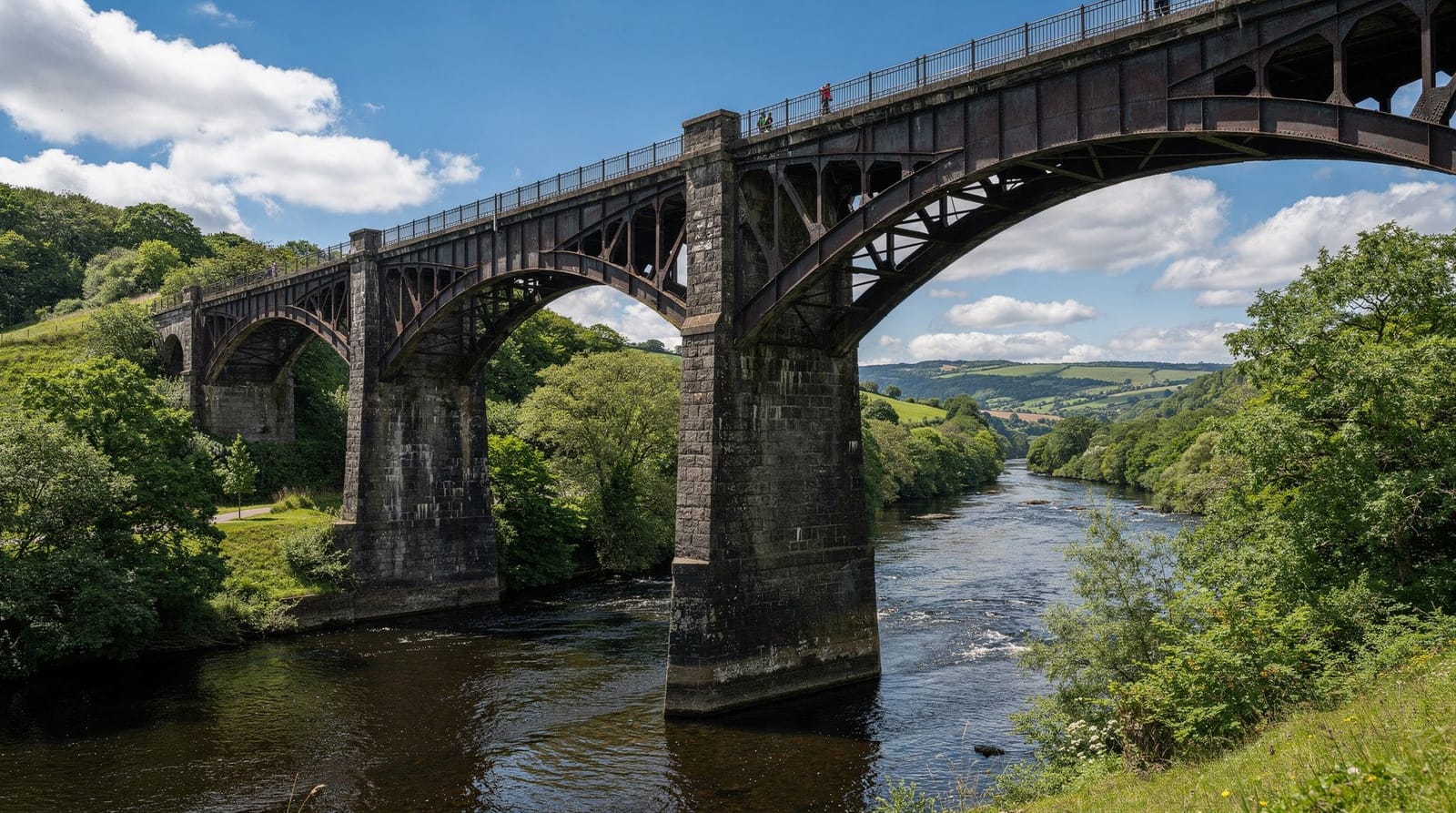
The Llangollen Canal was built in the early 1800s to carry slate, limestone and general freight through the Dee valley, and its centrepiece — the Pontcysyllte Aqueduct, engineered by Thomas Telford and William Jessop and completed in 1805 — is still doing exactly the job it was built for over two centuries later, just with pleasure boats instead of coal barges.
UNESCO added the aqueduct and 18km of surrounding canal to the World Heritage list in 2009, recognising it as a feat of Georgian civil engineering that hasn’t been surpassed for its type since. The wider canal network it belongs to once linked the industrial Midlands to the Welsh coast, and while freight traffic disappeared decades ago, the leisure boating economy that replaced it — hire companies, wharves, waterside pubs — now supports a meaningful part of the local Llangollen and Trevor economy in its own right.
At 38 metres above the River Dee, it remains the highest navigable aqueduct in the world, and crossing it by boat — watching the valley floor drop away on one side with nothing but a low rail between you and it — is one of the more quietly startling experiences available as a day trip from Chester. It sits within the wider Llangollen area, one of North Wales’ more understated bases.
| Where | Llangollen Wharf and Trevor Basin, Vale of Llangollen |
| Cost | Horse-drawn boat ~£18-20/adult; kayak/canoe tour ~£70-75/person |
| Time needed | 45 min-2 hours depending on trip type |
| Getting there | ~45-50 min drive from Chester (A483/A5); no direct rail |
| Best time | May-September for full operating hours and driest conditions |
The engineering behind the aqueduct
What makes Pontcysyllte remarkable isn’t just its height, but the construction method Telford and Jessop used to achieve it in 1805, decades before structural steel existed as a building material. The water-carrying trough is cast iron, not masonry — a radical choice at the time, since most canal engineers of the era assumed only stone or brick could hold a watertight channel at scale. The iron trough sits on stone piers, and the combination lets the whole structure be lighter and more slender than an equivalent masonry aqueduct would have needed to be, which is part of why it still looks startlingly delicate when you first see it from the valley floor rather than lumbering and industrial the way some Victorian infrastructure does.
The aqueduct carries a single canal channel roughly 3.4 metres wide with a towpath cantilevered out on one side — boats occupy almost the full width of the trough, which is why oncoming vessels can’t pass each other mid-span and why canal traffic across it is effectively one-way at any given moment, regulated informally by boaters checking the far end before committing to cross. Restoration work over the two centuries since construction has kept the ironwork sound, but the structure is still, fundamentally, the same one Telford’s crews riveted together, making it one of the oldest continuously functioning pieces of transport infrastructure in Britain still doing its original job.
Horse-drawn boat trips from Llangollen Wharf
The classic, low-effort way to experience the canal is a horse-drawn boat trip departing from Llangollen Wharf, in the town itself. A single horse pulls the boat along the towpath at a steady walking pace, exactly as canal boats were moved before engines, while a guide narrates the canal’s history and points out features of the Dee valley below.
Llangollen: Guided Pontcysyllte Aqueduct Canoe TourThe shorter trip (around 45 minutes) stays within the town stretch and doesn’t reach the aqueduct; the longer version (roughly 2 hours) continues out through the Vale of Llangollen and across the aqueduct itself before returning. If crossing the aqueduct is the point of your visit — and for most people it is — book the longer trip rather than the town-only version. Prices run roughly £10 for the short trip up to around £18-20 for the full aqueduct crossing, with family tickets available.
The pace is genuinely slow — a horse walks the towpath at perhaps 3-4km/h, so the journey out to the aqueduct takes considerably longer than the crossing itself, which passes in a couple of unhurried minutes once you’re actually on the span. Most of the trip’s length is spent gliding through the wooded Vale of Llangollen approach, with the guide narrating canal history, wildlife along the banks (herons and kingfishers are both realistic sightings depending on the season) and points of interest in the surrounding hills, before the aqueduct itself arrives almost as a punctuation mark at the trip’s climax rather than the whole experience.
Kayak and canoe crossings for a more active option
Llangollen: Pontcysyllte Aqueduct Kayak or Canoe CruiseFor visitors who’d rather paddle than be pulled, guided kayak and canoe trips depart from Trevor Basin, at the Wrexham-side end of the aqueduct, and cross the same 38-metre span under your own power. These run around 2-2.5 hours, cost roughly £70-75 per person, and are a genuinely different experience from the horse-drawn boat — closer to the water, slower to process the height, and a workout rather than a passive ride. Basic paddling ability is assumed, though guides brief beginners before setting off, and life jackets are provided.
Sitting or kneeling in an open kayak at trough level, with only the low iron parapet between your paddle stroke and the 38-metre drop, gives a materially different sense of the height than watching it from inside an enclosed horse-drawn boat — several visitors describe it as the more visceral of the two crossings, precisely because you’re more exposed to the exposure itself. Guides typically pause mid-span to let the group take in the view (and photos) before continuing across, and the return leg usually explores a short stretch of the Trevor Basin side of the canal rather than immediately turning back, giving the trip a proper loop shape rather than an out-and-back.
Self-drive narrowboat hire
If you want more than a single crossing, the Llangollen Canal supports multi-day self-drive narrowboat holidays, with hire bases at Trevor, Llangollen and further along the canal toward Whitchurch and the Shropshire Union network. Companies including Black Prince Holidays, Anglo Welsh and ABC Boat Hire operate on this stretch, typically offering short breaks (2-4 nights) as well as week-long hires.
Be realistic about the skill level required: canal boats are slow (walking pace, around 4mph) and forgiving in open water, but the Pontcysyllte Aqueduct crossing itself is narrow, has no room to pass oncoming boats mid-span, and demands confidence at the tiller. Most hire companies give novices a thorough handover and a practice run before letting them loose, and some restrict first-timers to a helmsman-assisted aqueduct crossing rather than a fully solo one. If in doubt, ask directly when booking.
A short break (2-3 nights) typically covers enough canal to reach the aqueduct and back with time to explore Llangollen town and perhaps push on toward the Horseshoe Falls at the canal’s western terminus, a scenic weir on the River Dee that marks where the canal draws its water supply. Longer week-long hires can combine the Llangollen Canal with the wider Shropshire Union network, giving experienced canal boaters a genuinely varied route through the England-Wales border country rather than a there-and-back trip on a single short stretch.
Families and accessibility
The horse-drawn boat trips are one of the gentler activities covered across this site for families with young children — the pace is slow, there’s a crew member always present, and the novelty of a horse-pulled boat tends to hold children’s attention better than a standard sightseeing cruise. That said, the open gunwales on the traditional boats mean young children need supervision throughout, and this is more pronounced on the aqueduct crossing itself, where the drop below is real and the towpath-side rail is lower than a modern safety barrier would be.
The kayak and canoe trips are a different proposition — they require a reasonable level of physical ability and comfort in open, unenclosed watercraft, and are better suited to teenagers and adults than young children. Life jackets are mandatory and provided, but this isn’t a passive activity the way the horse-drawn boat is.
Self-drive narrowboat holidays are broadly accessible to most fitness levels since the boat does the work, but the aqueduct crossing specifically demands steady nerves at the tiller, and hire companies are honest that this is the one section of the route that catches out overconfident first-timers.
Budgeting the day
A single horse-drawn boat trip across the aqueduct runs roughly £18-20 per adult, with family tickets reducing the per-person cost for groups. The kayak and canoe tours, at £70-75 per person, are a bigger outlay but include full equipment and a guide for what amounts to a genuine 2-2.5 hour outdoor activity rather than a short sightseeing trip — comparable in price to a half-day adventure activity elsewhere in North Wales, such as the caving and kayaking options around Betws-y-Coed and Llanberis. Multi-day narrowboat hire is priced per boat rather than per person, which makes it considerably better value for a group of four to six sharing a short break than for a solo traveller or couple.
Comparing the Llangollen Canal to other UK waterway trips
For visitors who’ve done canal boating elsewhere in Britain — the Norfolk Broads, the Kennet and Avon, or a Regent’s Canal trip in London — the Llangollen Canal’s distinguishing feature is unambiguous: nowhere else in the UK canal network offers anything close to the scale or drama of the Pontcysyllte crossing.
Most British canal boating is a genuinely relaxed, flat-water experience with modest scenery; the Llangollen Canal delivers that same gentle pace for most of its length but builds to a single, genuinely spectacular set-piece that few other UK waterways can match. This makes it a good choice for visitors who want canal boating’s characteristic slow pace without sacrificing a proper “wow” moment, and it’s part of why the aqueduct draws boaters from well beyond North Wales specifically to experience this one crossing.
A note on Horseshoe Falls and the canal’s water source
At the western end of the navigable canal, beyond Llangollen town, the Horseshoe Falls on the River Dee marks the point where the canal draws its water supply via a purpose-built Telford-designed weir, part of the same early 19th-century engineering programme that produced the aqueduct itself. It’s a quieter, less-visited stop than the aqueduct, reachable by towpath walk or cycle from Llangollen town rather than by boat trip, and worth the detour if you have time beyond the main boat activities and want to see the lesser-known engineering that keeps the whole canal system supplied with water. The walk from town takes around 45 minutes each way at a relaxed pace, following the towpath through wooded riverside scenery.
Llangollen has no direct rail connection — the nearest working station is on the heritage Llangollen Railway, which doesn’t connect to the national network. By car, it’s about 45-50 minutes from Chester via the A483 and A5, a straightforward if winding drive through the Welsh border country. Public transport requires at least one bus change and takes considerably longer, so most visitors either drive themselves or join a guided day tour from Chester that includes Llangollen, the aqueduct or the wider North Wales castles circuit.
If you’re driving, Trevor Basin (for the Wrexham-side kayak/canoe departures) and Llangollen Wharf (for the horse-drawn boats) are about 10 minutes apart by road, so it’s easy to combine a look at both ends of the aqueduct in a single day even if you only book one activity. This trip also slots neatly into our Chester North Wales 3-day itinerary as a change of pace from castles and hiking.
Is it worth the detour from Chester
Yes, with a caveat on timing: the round trip from Chester (drive there, activity, drive back) eats most of a day once you account for the aqueduct crossing itself and any time in Llangollen town, so this suits visitors with a full free day rather than a half-day gap. For the effort involved, the aqueduct crossing is a legitimately unusual sight — most people have never stood on a boat 38 metres above a valley floor — and it photographs and tells better as a story afterward than most standard sightseeing stops.
It’s also one of the few UNESCO World Heritage Sites within reach of Chester that most visitors have never heard of before arriving in the area, which gives it a slightly different character from the well-known headline sights like the North Wales castles — there’s a genuine sense of discovery to it that a first-time visitor doesn’t get from a landmark they already had strong expectations of.
Where it’s not worth it: if you’re short on time and have to choose between this and a North Wales castles day (Conwy Castle, Caernarfon Castle, covered together in our North Wales castles road trip), the castles arguably have broader appeal for a first-time visitor, while the aqueduct rewards those with a specific interest in engineering, canals or a more active outdoor day. Our wider welsh castles guide covers how to prioritise between the two.
When to go
May to September gives the longest operating hours for both the horse-drawn boats and the kayak/canoe tours, and the driest conditions for a day that involves being on open water. The Llangollen International Eisteddfod (a major music and culture festival) takes over the town for a week each July, which adds atmosphere but also crowds and higher demand for boat trips — book ahead if visiting during that period.
Outside the main season, the horse-drawn boats typically run a reduced weekend-only schedule or close entirely over winter, since the towpath and open boats aren’t well suited to cold, wet conditions, and the horses themselves need appropriate ground conditions underfoot. Self-drive narrowboat hire generally continues year-round for those who want it, though a winter canal holiday is a genuinely different, quieter, colder experience than the same trip in July.
What the aqueduct crossing actually feels like
Descriptions and photos rarely prepare first-time visitors for the specific sensation of crossing Pontcysyllte — it’s less a dramatic thrill-ride moment and more a slow, quiet unease that builds as the valley floor drops away on the open side, with only a low iron rail between the boat and the 38-metre gap. On the horse-drawn boat, enclosed and moving at walking pace, most people find the crossing passes more calmly than they expected once they’re actually on the span; on the kayak or canoe, sitting at trough level with your paddle inches from the drop, the sense of exposure is considerably more direct. Neither is objectively “scarier,” but knowing which kind of unease you’re choosing helps set expectations before booking.
Wildlife and scenery along the canal
Beyond the aqueduct itself, the approach through the Vale of Llangollen is genuinely scenic in its own right, and the canal’s slow pace makes it a good spot for casual wildlife spotting — herons are a near-certain sighting standing in the shallows, and kingfishers, while less reliable, do appear along quieter stretches, particularly in early morning or evening light outside the busiest midday period. The wooded banks and surrounding hills give the approach a different, gentler character from the aqueduct crossing’s more dramatic climax, and it’s worth treating the journey itself as part of the experience rather than simply a means of reaching the famous span.
Common mistakes to avoid
Practical tips
- Wear layers even on a warm day; the aqueduct and open canal stretches are more exposed to wind than Llangollen town itself.
- Book the longer, aqueduct-crossing horse-drawn trip specifically if that’s the point of your visit — don’t assume the shorter town loop reaches it.
- Allow extra driving time from Chester on summer weekends, when the A483/A5 approach roads see heavier holiday traffic than the base 45-50 minute estimate assumes.
- Secure loose belongings before the aqueduct crossing on the kayak/canoe trips — anything dropped goes 38 metres down into the Dee.
- The horse-drawn boat trips have limited capacity per sailing; in summer, arrive at the wharf 20-30 minutes before your preferred departure or book online in advance.
- Combine the visit with lunch in Llangollen town, which has a handful of solid cafés and pubs a short walk from the wharf, before the drive back to Chester.
- Pair this trip with the nearby Llangollen Railway (a preserved steam line) if you want a full day of heritage transport in the Dee valley rather than a single activity. The Pontcysyllte Aqueduct guide covers the landmark itself in more depth, including walking and cycling the towpath instead of taking a boat.
The Pontcysyllte Aqueduct earns its World Heritage status honestly — this isn’t a manufactured tourist experience but a real, still-functioning piece of canal infrastructure that happens to be spectacular to cross. Whether you take the horse-drawn boat, paddle it yourself, or hire a narrowboat for a few days, it’s one of the more distinctive day trips within reach of Chester.
Frequently asked questions about Llangollen Canal boat trips
How high is the Pontcysyllte Aqueduct and is it safe to cross by boat?
The aqueduct carries the canal 38 metres (126 feet) above the River Dee valley below, making it the highest navigable aqueduct in the world. It is entirely safe by boat — narrowboats and horse-drawn trip boats cross routinely — though the open side with no towpath railing on the canal-side channel does unsettle some visitors with a fear of heights.Can beginners hire a self-drive canal boat on the Llangollen Canal?
Yes, but the Llangollen Canal above Trevor Basin, including the aqueduct crossing itself, is technical enough that most hire companies restrict self-drive novices to the calmer stretches around Llangollen, Trevor and the Vale of Llangollen, or provide a helmsman for the aqueduct crossing. Check with the specific hire company (such as Black Prince or Anglo Welsh) about which sections novices can pilot solo.How long is a horse-drawn boat trip on the Llangollen Canal?
The standard trip from Llangollen Wharf runs about 45 minutes along the town stretch; a longer 2-hour version continues out to and across the Pontcysyllte Aqueduct. Both are gentle, low-speed trips pulled by a single horse along the towpath, in the same tradition as when the canal was a working freight route.Is the Llangollen Canal boat trip suitable for children?
Yes — the horse-drawn boats move at walking pace and are one of the calmer, more novel activities for families in this guide's coverage area, though very young children should be kept seated and supervised near the open gunwales, especially on the aqueduct crossing where there's a real drop below.How do you get to Llangollen from Chester without a car?
There is no direct rail line to Llangollen; the practical options are driving (around 45-50 minutes via the A483 and A5) or joining a guided day tour from Chester that includes Llangollen or the wider Vale of Llangollen. Public transport connections involve a bus change and take considerably longer than driving.What's the difference between the horse-drawn boat and the kayak crossing?
The horse-drawn boat is a passive, enclosed ride pulled along the towpath at walking pace, well suited to families and anyone who'd rather sit back. The kayak or canoe crossing is a paddled, open-air activity requiring basic fitness and comfort in a small craft, giving a more exposed, active sense of the aqueduct's height.
Top experiences
Bookable activities with verified prices and instant confirmation on GetYourGuide.