Chester's hidden gems beyond the walls and the Rows
Quick answer: the city walls and the Rows are the headline sights for good reason, but Chester’s better-kept secrets — the Roman amphitheatre, the underground remains beneath the Rows themselves, Grosvenor Park, and a scattering of quieter museums — are where an extra half-day of sightseeing actually pays off.
| Where | just outside Newgate, Grosvenor Street, Watergate Street |
| Cost | free (amphitheatre, museum, park); tour prices vary |
| Time needed | around 3 hours for a full hidden-gems loop |
| Best for | a second day, or first-timers wanting more than walls and Rows |
| Getting there | all walkable from the city centre |
Why Chester’s obvious sights overshadow the rest
It’s not hard to see why the walls and the Rows dominate every Chester itinerary — they’re free or cheap, immediately visible from the moment you arrive, and genuinely good value for the time they take. The knock-on effect is that a lot of visitors treat a Chester visit as complete after those two, when in reality the city rewards a slightly longer, slightly more deliberate look. None of what follows requires abandoning the classics; it’s about adding half a day around them rather than replacing them.
The largest Roman amphitheatre in Britain (and most people walk past it)
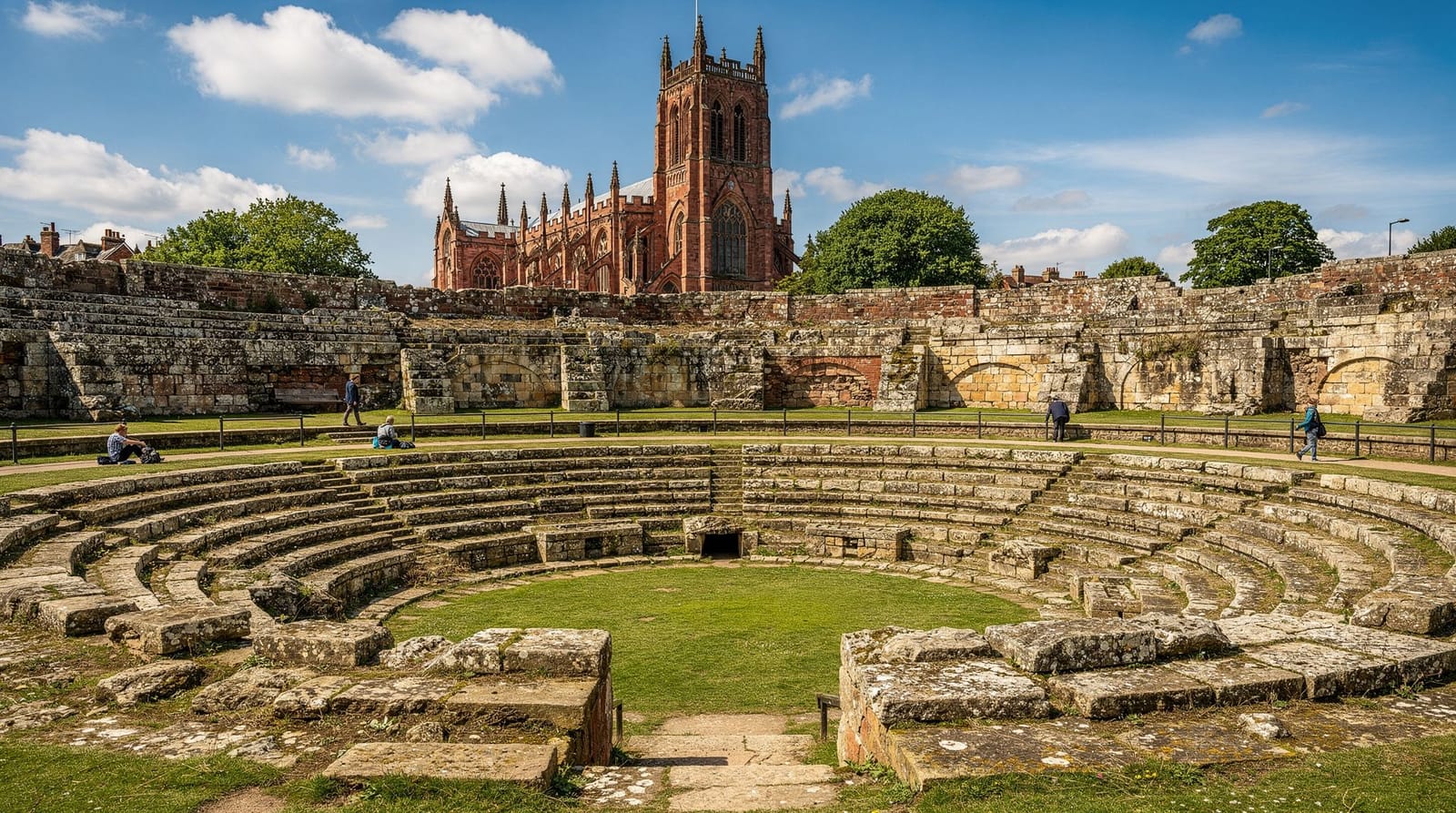
Just outside Newgate, a short walk from the cathedral, sits the excavated remains of Chester’s Roman amphitheatre — the largest such structure yet uncovered in Britain, built to seat several thousand spectators from the Roman fortress of Deva Victrix. It’s free to visit, unstaffed, and consequently ignored by a large share of visitors who stick to the walls and the Rows. There isn’t much reconstruction to look at — you’re seeing stone foundations rather than a rebuilt structure — but it’s a genuinely significant site for anyone interested in Chester’s Roman heritage, and it takes ten minutes to see properly.
What’s actually under the Rows
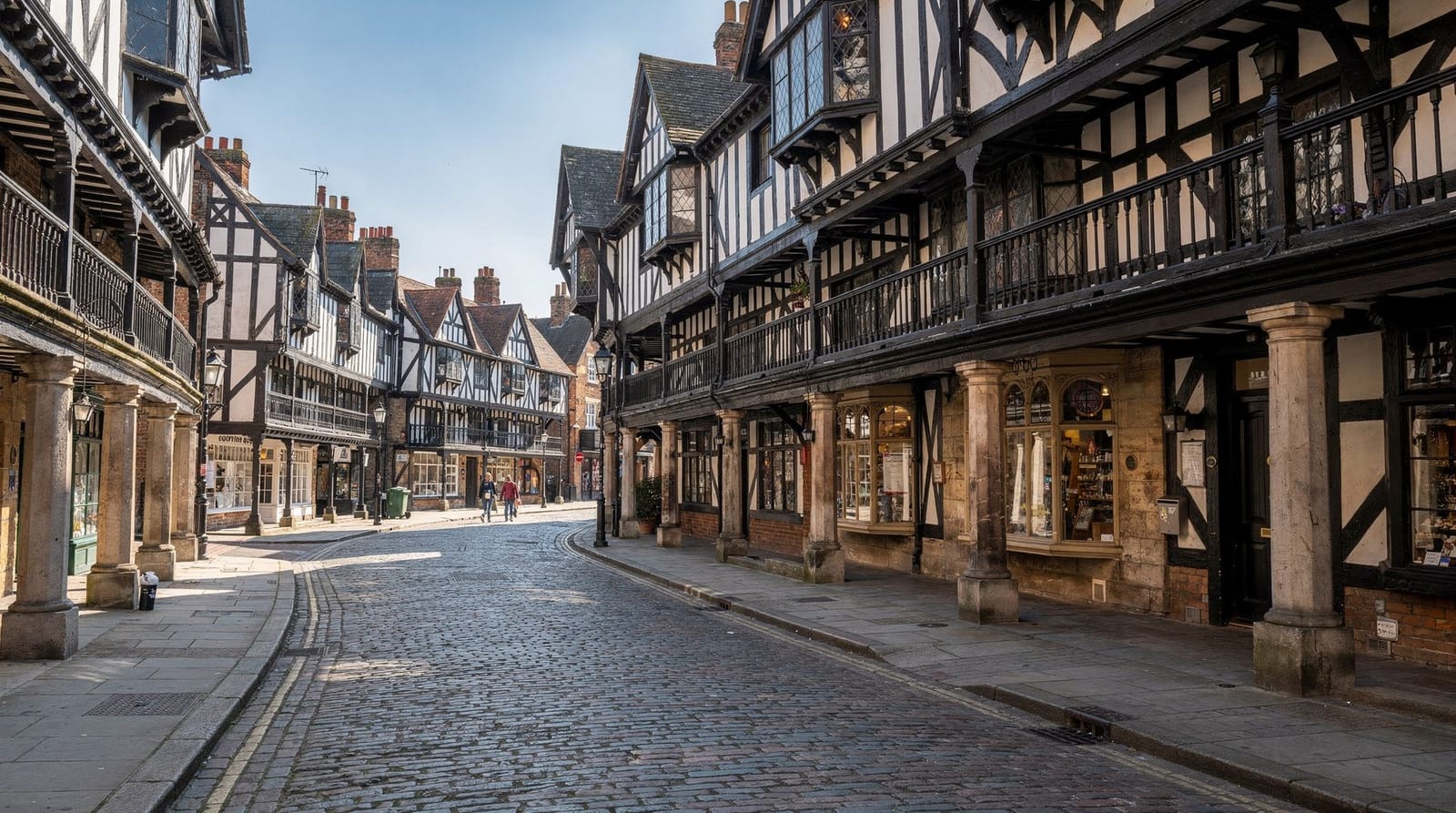
Most visitors walk through the Rows without realising some of the undercrofts beneath the shopfronts date back to the medieval period, built directly onto Roman-era street levels. A few shops and cafés still have visible cellar space open to browsing customers — ask if you’re curious, since it isn’t signposted well. This is one of those details a good guide will point out that you’d otherwise miss entirely; the two-hour Chester Heart walking tour covers this level of detail.
Grosvenor Park and the open-air theatre
South of the cathedral, Grosvenor Park runs along the River Dee and is worth the ten-minute walk from the centre — it’s genuinely one of the better Victorian public parks in the North West, landscaped in the 1860s, and hosts an open-air theatre season through the summer months (check current programme before assuming performances are running on your visit date). It’s a good spot to decompress after a busy morning of sightseeing, and unlike the centre, it’s rarely crowded even on a summer weekend.
The Grosvenor Museum, properly
The Grosvenor Museum on Grosvenor Street is free and holds one of the best collections of Roman tombstones in Britain, recovered from Chester’s city walls where they’d been reused as building material centuries after burial. It’s a smaller museum than its collection deserves credit for — most visitors give it 20 minutes when it merits closer to an hour, particularly the natural history and period room sections upstairs that a lot of people skip entirely.
The city walls’ quieter stretches
Everyone walks the section of the city walls near Eastgate and the cathedral. Fewer walk the stretch along the racecourse (the Roodee) on the south-west side, which gives a genuinely different view of the city — the river, the Welsh hills on a clear day, and the racecourse itself when it isn’t in use. It’s quieter, flatter, and a better spot for photos without other tourists in the frame.
Self-guided vs guided for hidden-gem hunting
If your interest runs to the slightly macabre, Chester leans into its history with a handful of ghost tour operators, and the dark tourism walking tour covers plague pits, execution sites and some of the darker Roman-era history alongside the usual architecture commentary — worth it if you want a different angle on the same streets rather than a rehash of the standard city tour. For a slower, self-directed pace, our self-guided Chester route links most of the sights above into a single loop you can do at your own speed.
Stanley Palace and the timber-framed side streets
Away from the main Rows, Watergate Street’s western end and the streets around Stanley Palace — a well-preserved 17th-century timber-framed townhouse — get a fraction of the footfall of Eastgate or Bridge Street, despite similarly striking architecture. It’s a good stretch to walk slowly rather than rush through on the way somewhere else; several of the buildings here are genuinely older and less altered than their more photographed counterparts closer to the cross.
The Water Tower and the walls’ northern stretch
At the north-west corner of the city walls, the medieval Water Tower — built in the 1320s to defend the harbour that once reached this point before the River Dee’s course shifted — is a genuinely underrated stop. It’s a reminder that Chester was a working port for much of its history, something easy to forget when the Dee today looks more like a leisure river than a maritime approach. The stretch of wall here is quieter than the Eastgate-to-cathedral section and gives a different, more industrial-history angle on the city.
St John’s Church and its ruined chapel
Just outside the walls near the amphitheatre, St John’s Church retains a ruined section from an earlier, larger medieval structure, visible in the churchyard alongside the still-active parish church. It’s an easy add-on to an amphitheatre visit — the two sit within a few minutes’ walk of each other — and gives a tangible sense of how much of medieval Chester was lost to later rebuilding, reformation-era changes, and simple decay, rather than surviving intact the way the Rows or the walls have.
Timing your hidden-gems day right
Most of the sites in this guide are free, unstaffed or lightly staffed, which means opening hours matter less than they would for a ticketed attraction — but a few, including sections of Grosvenor Park’s facilities and any special exhibitions at the Grosvenor Museum, do have set hours worth checking. A reasonable order for a hidden-gems half-day: amphitheatre first (quiet, unstaffed, no rush), then Grosvenor Museum, then a walk through Grosvenor Park, finishing at the Water Tower and the northern walls stretch as the light starts to turn gold in the early evening.
Photographing the quieter spots
The Water Tower stretch and the racecourse side of the walls both photograph better than most visitors expect, precisely because they’re rarely crowded — no need to wait for a gap in foot traffic the way you often do near Eastgate. Late afternoon light works particularly well along the Roodee side, catching the Welsh hills on a clear day, and the Water Tower itself is a genuinely photogenic structure that most day-trippers never reach because it sits at the far end of the circuit from where most walks start. If photography is part of the appeal of a hidden-gems day, our best views in Chester guide has more detail on timing and specific angles worth targeting.
A word on what to skip
Not everything marketed as a “hidden gem” earns the label. Some of the smaller gift-shop “museums” along the main tourist streets charge entry for a handful of static displays that add little beyond what a free plaque already tells you — if in doubt, check whether a site has real free-to-view content (like the amphitheatre or Grosvenor Museum) before paying for a lesser alternative nearby.
Pairing hidden gems with a guided tour
If you’d rather have context explained as you go rather than reading plaques and guessing at significance, the Dead Good ghost tour takes in several of the lesser-known corners covered here — including stretches near St John’s and the older, darker corners of the city’s history — as part of its route, giving a reasonable middle ground between a fully self-guided hidden-gems walk and a straightforward architecture-focused city tour. It runs in the evening, which also happens to be a good time to see the amphitheatre and Water Tower stretch of wall in softer light, away from daytime crowds.
A realistic half-day plan
If you’re adding this to an existing Chester visit rather than dedicating a full separate day, a workable half-day sequence runs: amphitheatre and St John’s ruins first (15-20 minutes combined, both free and unstaffed), then the Grosvenor Museum (45-60 minutes), a walk through Grosvenor Park (30 minutes, longer if the weather’s good enough to sit by the river), and finishing at the Water Tower and the quieter northern stretch of the walls as the afternoon light turns gold. That’s roughly three hours, comfortably fitting into a second day alongside a lighter morning or evening elsewhere in the city.
How the hidden gems compare on time and cost
| Sight | Cost | Time | Crowds |
|---|---|---|---|
| Roman amphitheatre | free | 10-15 min | low |
| Grosvenor Museum | free | 45-60 min | low |
| Grosvenor Park | free | 30 min+ | low |
| Water Tower / northern walls | free | 15-20 min | very low |
| Stanley Palace area | free (exterior) | 15-20 min | low |
Fitting hidden gems around a first Chester visit
None of this needs to replace the walls and the Rows — it works best layered around them. If you’re following a 1-day Chester itinerary, the amphitheatre and St John’s ruins slot naturally into a morning walk from the cathedral, since they’re a few minutes apart on foot. With a full 2-day Chester itinerary, day two morning is the natural slot for the Grosvenor Museum and Grosvenor Park loop described above, leaving the afternoon free for a day trip or a slower pace back in the centre.
Frequently asked questions about Chester’s hidden gems
Is the Chester amphitheatre worth visiting?
Yes, and it’s free. Don’t expect a rebuilt Colosseum-style structure — it’s excavated stone foundations — but as the largest known Roman amphitheatre in Britain, it’s a genuinely significant site that most visitors walk past entirely.
Is Grosvenor Museum free?
Yes, entry is free, and it holds one of Britain’s best collections of Roman tombstones, many recovered from the city walls where they were reused as building stone.
How long do Chester’s hidden gems take to see?
Budget half a day to see the amphitheatre, Grosvenor Museum, and Grosvenor Park together, on top of the standard walls-and-Rows sightseeing most visitors already plan for.
Are ghost tours in Chester worth it?
They’re a reasonable way to see the same streets from a different angle, but check what’s included first — some overlap heavily with standard walking tours and add little beyond a torch and a script.