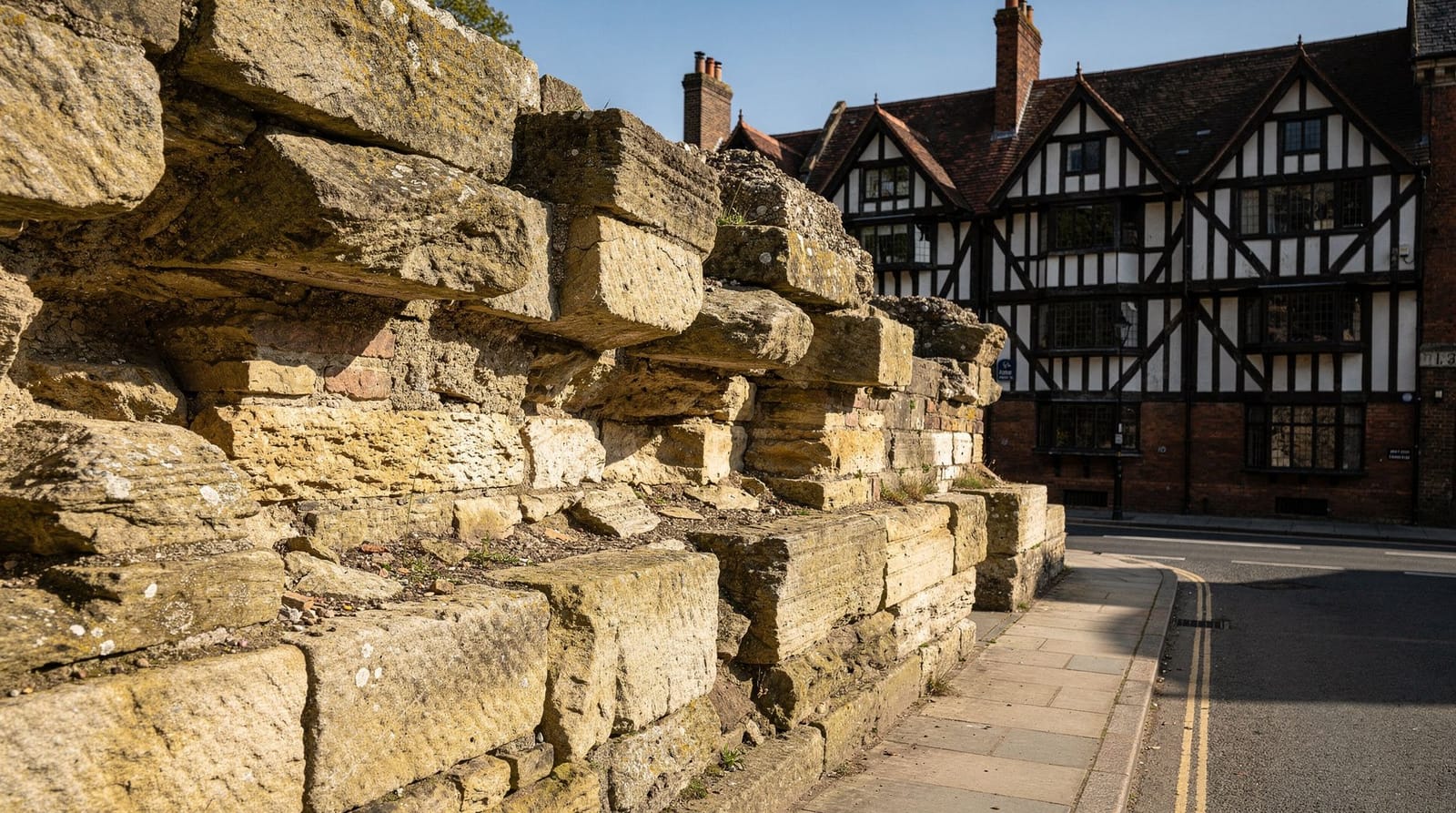
Beeston Castle — Cheshire's hilltop ruin with views to three counties
How far is Beeston Castle from Chester and what does it cost to visit?
Beeston Castle is about 11 miles (25-30 minutes) southeast of Chester by car, with no direct train connection, making it a driving-only day trip in practice. Adult admission through English Heritage runs around £8-9; confirm current prices before visiting since these are reviewed periodically.
Beeston Castle sits on a dramatic sandstone crag rising out of the flat Cheshire Plain, the closest significant castle to Chester and one with a far longer history than its medieval ruins suggest. This guide covers the site’s Bronze Age origins, what survives today, and how to plan a half-day visit from Chester.
| Where | ~11 miles southeast of Chester, Cheshire |
| Cost | Around £8-9 adult admission (English Heritage) |
| Time needed | 1.5-2.5 hours including the climb and walking trails |
| Getting there | Car recommended (~25-30 min via A51/A49); no direct train |
| Best time | Clear days for the panoramic views; early morning after rain for best visibility |
Cheshire’s own castle on the crag
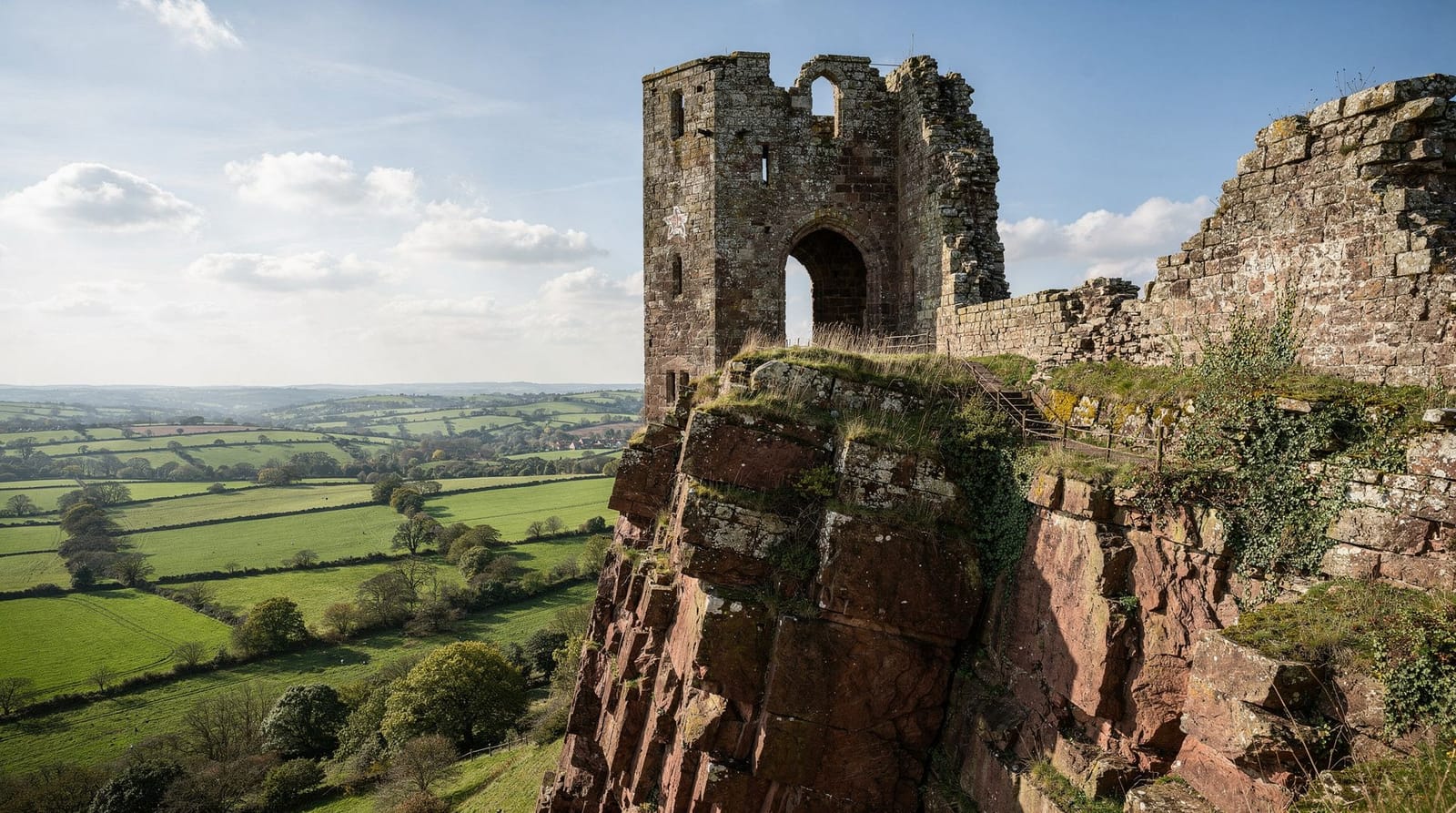
Beeston Castle stands on a steep, isolated sandstone crag rising abruptly out of the flat Cheshire Plain, visible for miles around and offering, on a clear day, one of the widest panoramic views from any castle in England — reportedly taking in parts of eight counties, stretching from the Welsh hills across the Cheshire Plain to the Peak District and, on the clearest days, as far as Liverpool Bay and the hills of Lancashire.
It’s the closest significant castle to Chester itself, roughly 11 miles southeast of the city, and offers a genuinely different castle experience from the Edward I fortresses of North Wales covered elsewhere on this site — English rather than a monument to Welsh conquest, older in its earliest origins, and defined above all by its extraordinary natural setting rather than by architectural sophistication.
A Bronze Age hillfort before it was ever a castle
The crag Beeston Castle occupies has a much longer history of fortification than the medieval castle whose ruins are visible today. Archaeological excavation has shown the hilltop was fortified as far back as the Bronze Age, roughly 3,000 years ago, and again during the Iron Age, when a substantial hillfort occupied the summit — one of many such Iron Age hillforts across Cheshire and the Welsh Marches, but distinguished by the crag’s exceptional natural defensibility and visibility.
This deep pre-medieval history is easy to overlook given how completely the visible medieval castle ruins dominate a visitor’s impression of the site, but it’s a genuine part of what makes Beeston significant archaeologically — a location valued for defensive and probably ceremonial purposes for millennia before Ranulf de Blondeville, the powerful Earl of Chester, built the stone castle whose remains stand today.
Ranulf de Blondeville’s castle
The medieval castle was built from around 1225 by Ranulf de Blondeville, the 6th Earl of Chester, one of the most powerful English nobles of his generation, who had recently returned from crusade in the Holy Land and is believed to have incorporated concentric defensive design ideas he’d encountered there — a direct architectural parallel to the influence later seen in Edward I’s own Welsh castle-building programme, covered in our Welsh castles guide, which drew on similar Crusader-era fortification knowledge roughly six decades later.
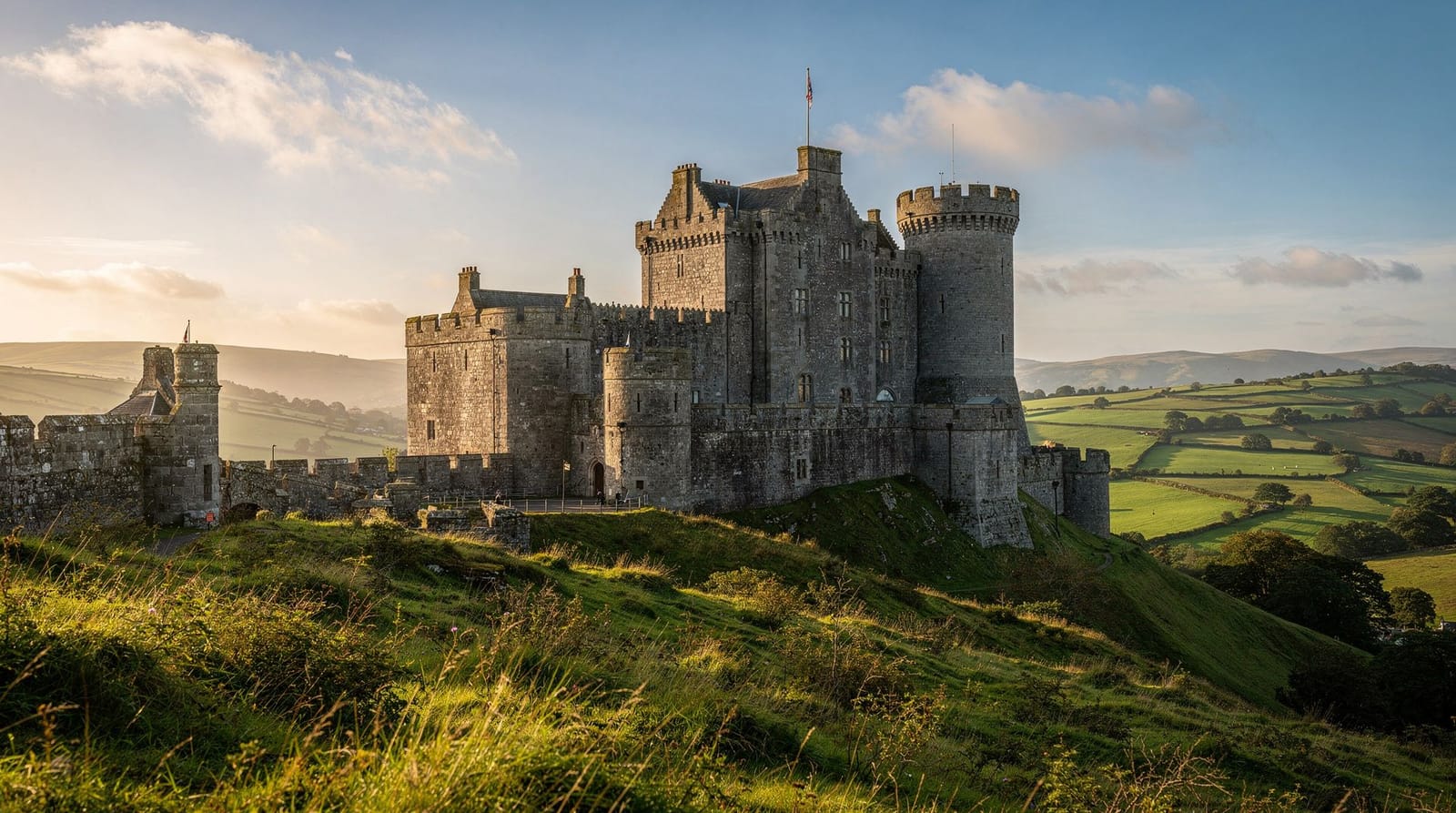
Beeston’s design uses the crag’s natural cliffs as its primary defence on most sides, with a substantial ditch cut through solid rock protecting the more vulnerable approach, and an inner ward built at the very summit of the crag, separated from a larger outer ward lower down the hillside by its own additional fortification — an early and locally significant example of the “castle within a castle” concentric principle that would later reach its fullest expression at Beaumaris in North Wales.
As Earl of Chester, Ranulf held authority over the same Anglo-Welsh frontier zone that shaped so much of the wider region’s medieval history, and Beeston’s construction reflects the same strategic logic of controlling and monitoring the border with Wales that motivated Chester’s own Norman-era fortifications and, later, Edward I’s chain of castles further west.
The well and the legend of hidden treasure
One of Beeston’s most talked-about features is its well, cut deep into the solid sandstone of the inner ward and reputed to be among the deepest castle wells in England, reportedly reaching close to 100 metres in some historical accounts, though its exact depth and current condition have varied across different surveys over the centuries.
The well has long attracted local legend claiming that Richard II, deposed in 1399 and briefly connected to Beeston during the turbulent final months of his reign, hid royal treasure at the bottom before his fall from power — a story with no solid documentary evidence behind it, but persistent enough in local tradition that periodic attempts have been made over the centuries to investigate the well’s depths for exactly this reason. No treasure has ever been confirmed found, and most historians treat the story as castle folklore rather than credible history, but it remains one of the most-repeated anecdotes associated with the site and adds a genuinely entertaining layer to a visit even without any basis in fact.
Archaeology and ongoing discoveries
Beeston has been the subject of periodic archaeological investigation since the early 20th century, with major excavation campaigns adding progressively more detail to understanding of the site’s Bronze Age and Iron Age phases alongside the better-documented medieval castle.
Finds from these excavations, including pottery, tools and evidence of the hillfort’s original defensive earthworks, are displayed in the site’s visitor centre, and English Heritage has continued more limited investigative work in recent years as conservation and consolidation projects on the standing masonry periodically expose new archaeological evidence. Because large parts of the crag’s summit and slopes have never been fully excavated, Beeston remains one of the more archaeologically “live” sites in Cheshire, with a genuine possibility of further discoveries relating to its pre-medieval history in years to come.
Civil War siege and slighting
Like so many English and Welsh castles, Beeston’s most dramatic recorded history comes from the English Civil War, when it changed hands more than once between Royalist and Parliamentarian forces during the 1640s, including a notable episode in which a small Royalist force scaled the crag’s supposedly unclimbable rock face at night to capture the castle by surprise from its Parliamentarian garrison — a genuinely audacious piece of military history that local guides and information panels recount in detail.
After the war, Parliament ordered the castle slighted (deliberately damaged to prevent future military use), which is why so little of the castle’s stonework survives intact today compared with the still largely complete curtain walls of the North Wales UNESCO castles.
Ranulf de Blondeville and the Earls of Chester
Ranulf de Blondeville’s career extended well beyond Beeston Castle alone. As 6th Earl of Chester, he held one of the most powerful semi-autonomous noble titles in medieval England, with authority over the Chester earldom that functioned in some respects more like an independent principality than an ordinary English lordship, reflecting the region’s status as a militarised frontier zone against Wales. Ranulf also held extensive lands and titles elsewhere in England and played a significant role in the politics of King John’s reign and the aftermath of Magna Carta, making him a genuinely major figure in early 13th-century English history rather than simply a regional lord who happened to build a memorable castle.
His decision to fortify Beeston reflects both his personal military experience — gained on crusade in the eastern Mediterranean, where he would have encountered sophisticated contemporary fortification techniques well ahead of what was then standard in England — and Chester’s specific strategic needs as the administrative and military centre of the Anglo-Welsh frontier, the same underlying logic that shaped Roman Deva Victrix a thousand years earlier and would later shape Edward I’s Welsh castle-building programme six decades after Beeston’s construction.
Beeston, in other words, sits squarely within a much longer continuity of fortification along this same frontier zone, covered in more depth in our Deva Victrix guide and Chester history guide.
Beeston among Cheshire’s other heritage sites
Beeston isn’t the only historic site in this part of Cheshire worth combining with a castle visit. The surrounding countryside includes several other heritage and natural attractions that pair naturally with a Beeston day trip, and the crag itself sits within reach of Cheshire’s sandstone ridge, a distinctive geological feature running through the county that includes several other viewpoints and walking routes beyond the castle grounds. For visitors extending a Cheshire day beyond Beeston alone, the wider Cheshire destination guide covers the county’s other attractions, from historic houses to outlet shopping, giving a fuller picture of what the region offers beyond Chester’s own city-centre sights.
What to see today
What survives at Beeston today is more fragmentary than the North Wales castles — sections of curtain wall, the gatehouse towers of the outer ward, and the deep rock-cut ditch protecting the inner ward’s approach — but the site’s real draw is less about complete standing architecture and more about the crag itself and the views it commands.
The walk up from the visitor entrance to the inner ward summit is genuinely steep in places, rewarding the effort with panoramic views that few other castle sites in England can match, and the site includes woodland walks around the base of the crag, a small visitor centre with archaeological finds from the site’s long history, and, in recent years, ongoing excavation work that has periodically added new detail to the understanding of the site’s Bronze Age and Iron Age phases.
Walking trails and visiting with family
Beyond the castle summit itself, Beeston’s grounds include woodland walking trails around the base of the crag, generally gentler than the steep summit climb and suitable for a wider range of fitness levels and for families with younger children who might struggle with the full ascent. The site’s varied terrain — dense woodland, open grassland and the dramatic exposed sandstone of the crag itself — gives it a genuinely different feel from the more purely architectural North Wales castles, closer in some ways to a countryside nature reserve with a historic ruin at its summit than a conventional heritage attraction.
Families visiting with a picnic often use the lower grounds for this purpose before or after tackling the steeper climb to the inner ward, and the visitor centre provides some facilities, though it’s worth bringing supplies given the site’s rural, standalone location away from any town centre.
Photography and the best time to visit
Beeston’s panoramic views are famously weather-dependent — on a clear day the visibility genuinely extends across multiple counties, while low cloud, mist or Cheshire’s frequent overcast conditions can reduce the view to little more than the immediate surrounding farmland. Checking a weather forecast for visibility rather than just rain is worth doing if the views are your primary reason for visiting, since a dry but hazy day can be just as disappointing for photography as a wet one. Early morning after overnight rain sometimes gives the clearest, haze-free long-distance visibility, while the golden hour before sunset lights up the sandstone crag itself attractively even on days when distant visibility is more limited.
Getting to Beeston Castle from Chester
Beeston has no railway station, and the nearest stations (Beeston Castle & Tarporley, on a limited local service, or Crewe for mainline connections) still require a taxi or infrequent local bus for the final leg, making a car the realistic way to visit for most Chester-based travellers. The drive from Chester takes around 25-30 minutes via the A51 and A49, through pleasant Cheshire countryside, and there’s a car park directly at the site.
Because it requires a car and sits in a different direction from the North Wales castles, Beeston is best treated as a standalone half-day trip from Chester rather than combined with Conwy, Caernarfon or the other Welsh sites in a single day — the geography simply doesn’t align for an efficient combined route. It pairs more naturally with other Cheshire countryside stops, including the wider Cheshire destination guide, or as a scenic stop on a drive toward Manchester or the Peak District.
Comparing Beeston to the North Wales castles
Visitors expecting Beeston to resemble the imposing, largely intact fortresses at Conwy or Caernarfon should recalibrate expectations — Beeston’s ruins are considerably more fragmentary, a direct result of its Civil War slighting, and its architectural sophistication doesn’t match the later, more theoretically refined Edward I castles built with the benefit of decades of additional castle-design experience.
What Beeston offers instead is a longer, deeper timeline of continuous fortification stretching back to the Bronze Age, a dramatic natural setting arguably unmatched by any of the North Wales castles, and genuine proximity to Chester that none of the Welsh sites can offer. For visitors with only a single day and a car, Beeston makes a compelling, low-effort half-day addition to a Chester stay that doesn’t require the longer journey times of a North Wales day trip.
Why Beeston is worth the detour even without the fame of Wales’s castles
It’s easy for Beeston to be overshadowed on a Chester itinerary by the more famous, more architecturally complete UNESCO castles of North Wales, and many visitors with limited time understandably prioritise those instead. But Beeston offers something none of the Welsh sites can: a continuous span of fortification stretching back roughly 3,000 years on a single dramatic natural feature, genuine proximity to Chester without the long North Wales journey times, and a hands-on, exploratory feel — steep paths, woodland, an atmospheric ruined summit — that’s quite different from the more curated, fully signposted visitor experience at the larger Cadw sites.
For visitors staying in Chester for several days who’ve already covered the city’s own Roman and medieval sites, Beeston is a strong candidate for a lower-key half-day that rewards genuine physical effort with one of the best views in England.
Beeston versus the North Wales castles at a glance
| Beeston Castle | North Wales UNESCO castles (Conwy/Caernarfon/Beaumaris) | |
|---|---|---|
| Distance from Chester | ~11 miles, ~25-30 min drive | 40-90 min by car or train |
| Completeness | Fragmentary, Civil War slighted | Largely complete (Conwy, Caernarfon) |
| History span | ~3,000 years, Bronze Age onward | Medieval, 13th century onward |
| Signature feature | Panoramic views over up to 8 counties | Architectural scale and preservation |
| Access | Car needed, no direct train | Direct train (Conwy) or train+bus |
Both are worth a visit on a longer Chester stay — they simply answer different questions. Beeston rewards visitors chasing views and a longer historical timeline; the North Wales castles reward those chasing architectural spectacle.
Combining Beeston with other Cheshire stops
Because Beeston requires a car and sits southeast of Chester, it pairs naturally with other Cheshire countryside attractions reached the same way rather than with a North Wales day. Tatton Park’s historic house and gardens, and the outlet shopping at Cheshire Oaks, both sit within a similar driving radius and make sensible companions for a fuller Cheshire day if a single castle visit doesn’t fill your schedule. The wider Cheshire destination guide lays out these options alongside Beeston in more depth.
What to expect if you’re not driving
Visitors without a car who still want to see Beeston have a genuinely limited set of options: a taxi from Chester (roughly 25-30 minutes each way, so budget the return trip into your costs), joining a organised tour that includes Beeston as a stop, or the infrequent local bus to Beeston Castle & Tarporley station followed by a further taxi or a longish walk. None of these are as straightforward as the North Wales castles’ train links, which is worth factoring in honestly before committing to a car-free Chester trip that includes Beeston as a priority.
Weather and safety on the summit climb
The steep path to the inner ward crosses exposed rock and packed earth that turns genuinely slippery after Cheshire’s frequent rain, so sturdy, grippy footwear matters more here than at the flatter North Wales sites like Beaumaris. There’s limited shelter at the summit if weather closes in suddenly, and the exposed crag can feel noticeably windier and colder than the surrounding countryside even on a mild day — worth knowing if you’re visiting with children or anyone less sure-footed on uneven terrain.
Tourist traps and practical notes
Beeston is a relatively low-key, less commercially developed attraction compared with the North Wales UNESCO castles, and pricing around the site is generally reasonable without the tourist-premium markups sometimes seen at busier locations. The steep walk to the inner ward is worth planning for with appropriate footwear — the paths can be slippery after rain, a frequent occurrence in Cheshire, and the climb is genuinely strenuous in parts, not suitable for visitors with significant mobility restrictions given the lack of any step-free alternative route to the summit.
What to bring
Given the steep, uneven terrain and Cheshire’s changeable weather, sturdy footwear with good grip is genuinely important rather than optional — the paths to the inner ward involve real elevation gain over rock and packed earth that can turn slick after rain. A layered jacket is worth carrying regardless of season, since the exposed summit is noticeably windier and cooler than the sheltered woodland lower down the site, and there’s limited shelter at the top if weather turns during your visit.
Planning your visit
Beeston Castle works well as a half-day trip from Chester for visitors with a car who want dramatic views and a genuinely different, much longer historical timeline than the North Wales castles offer, without the extended travel time those sites require. Combine it with other Cheshire attractions or a countryside drive rather than trying to fit it into a North Wales castle circuit on the same day.
For the fuller regional castle picture, including how Beeston compares architecturally and historically to Edward I’s Welsh fortresses, see our Welsh castles guide, and for the wider Cheshire day-trip options from Chester, our day trips from Chester guide covers Beeston alongside the region’s other options.
Frequently asked questions about Beeston Castle
Is Beeston Castle worth visiting compared with the North Wales castles?
Yes, for a different reason — Beeston's ruins are more fragmentary than Conwy or Caernarfon, but it offers roughly 3,000 years of continuous fortification on a single dramatic crag, panoramic views across up to eight counties, and genuine proximity to Chester without the longer North Wales journey time.Can you visit Beeston Castle without a car?
It's difficult. Beeston has no railway station, and the nearest stations (Beeston Castle & Tarporley, or Crewe) still need a taxi or infrequent local bus for the final leg. Most Chester-based visitors drive the roughly 25-30 minutes via the A51 and A49.